Gabapentin Capsule
Product Images NDC 69434-042

View Photos of Packaging, Regulatory Labels, and Product Appearance

Product Visual Gallery

This gallery contains 9 technical images submitted to the FDA as part of the official labeling for Gabapentin (NDC 69434-042). Unlike standard consumer photos, these assets often include clinical data figures, molecular chemical structures, and official manufacturer packaging layouts.

As provided by Zhejiang Yongtai Pharmaceutical Co., Ltd, these visuals offer a comprehensive scientific overview of the product's physical and chemical identity, aiding pharmacists and researchers in product verification and study.

FDA Label Image

100 mg (100mg 100s 07)
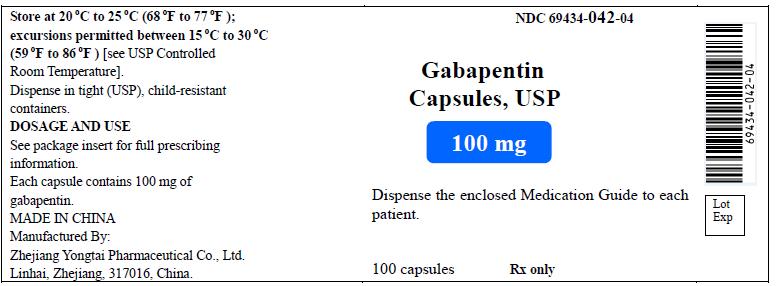
100 mg (100mg 100s 07)
Gabapentin Capsules, USP 100 mg oral capsules label from Zhejiang Yongtai Pharmaceutical Co., Ltd. The label includes storage instructions, dosage and use notes, manufacturer details, and indicates a package size of 100 capsules. It is marked Rx only and includes an NDC barcode and lot/expiration date area.*
FDA Label Image

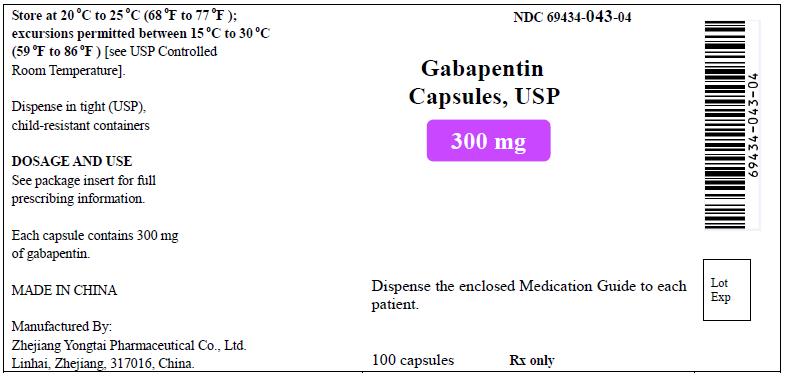
300 mg (300mg 100s 08)

300 mg (300mg 100s 08)
Label for Gabapentin Capsules, USP 300 mg by Zhejiang Yongtai Pharmaceutical Co., Ltd. The label indicates storage instructions, dosage form as capsules, a package count of 100 capsules, and notes that it is Rx only. The label also includes manufacturing details and a barcode.*
FDA Label Image

400 mg (400mg 100s 09)

400 mg (400mg 100s 09)
Gabapentin Capsules, USP 400 mg oral capsules label showing dosage strength and quantity of 100 capsules. Manufactured by Zhejiang Yongtai Pharmaceutical Co., Ltd in China. The label includes storage instructions, prescription status (Rx only), and directions to dispense the Medication Guide to each patient. Barcode and lot/expiration fields are also visible.*
FDA Label Image

Image Description (Gaba 01)

Image Description (Gaba 01)
A formula for calculating creatinine clearance (CLCr) displayed as text. The equation shows how to compute CLCr based on age, weight, and serum creatinine, with a multiplication factor for female patients.*
FDA Label Image

Chemical Structure (Gaba 02)

Chemical Structure (Gaba 02)
Chemical structure diagram of gabapentin showing a cyclohexane ring with amino and carboxymethyl substituents, representing the active ingredient gabapentin.*
FDA Label Image

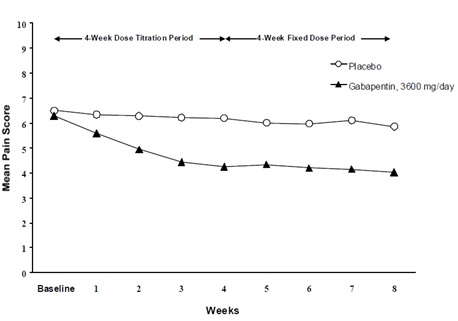
Figure 1 (Gaba 03)

Figure 1 (Gaba 03)
A line graph depicting the mean pain score over 8 weeks for two groups: placebo and Gabapentin at 3600 mg/day. The x-axis shows weeks with baseline and weeks 1 to 8; the y-axis shows mean pain score from 0 to 10. The graph indicates a 4-week dose titration period followed by a 4-week fixed dose period.*
FDA Label Image

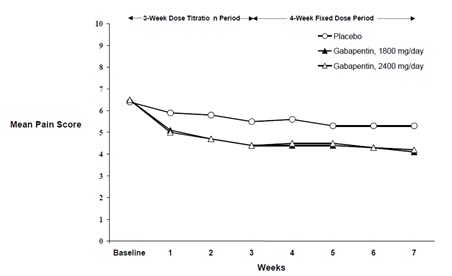
Figure 2 (Gaba 04)

Figure 2 (Gaba 04)
A line graph displaying mean pain scores over seven weeks comparing placebo, Gabapentin 1800 mg/day, and Gabapentin 2400 mg/day. The x-axis represents weeks, including baseline and study periods (3-week dose titration and 4-week fixed dose), while the y-axis shows the mean pain score from 0 to 10. Gabapentin groups show a decrease in pain scores compared to placebo over time.*
FDA Label Image

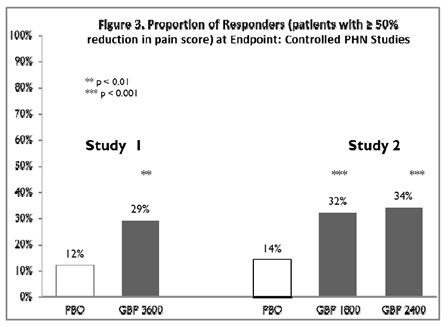
Figure 3 (Gaba 05)

Figure 3 (Gaba 05)
A bar chart titled 'Proportion of Responders (patients with ≥ 50% reduction in pain score) at Endpoint: Controlled PHN Studies' comparing placebo (PBO) against Gabapentin (GBP) at doses of 3600 mg in Study 1 and 1800 mg and 2400 mg in Study 2. The chart shows percentages of responders with statistical significance markers (p < 0.01, p < 0.001) indicated.*
FDA Label Image

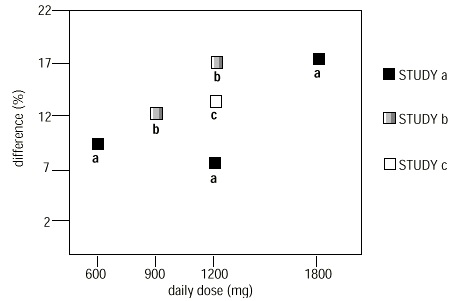
Figure 4 (Gaba 06)

Figure 4 (Gaba 06)
A scatter plot comparing percentage difference against daily dose (mg) for three studies labeled a, b, and c. Study a uses black squares, study b grey squares, and study c white squares, showing data points at daily doses 600, 900, 1200, and 1800 mg with differences ranging approximately from 7% to 18%.*

* About these descriptions: Image descriptions on this page are generated by automated AI analysis of the product label images from the manufacturer's FDA label submission (SPL). They are provided for reference only and may contain errors or omissions. Always rely on the printed label itself and the official FDA labeling, and consult a pharmacist or healthcare professional with any questions about this product.