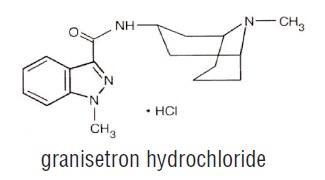
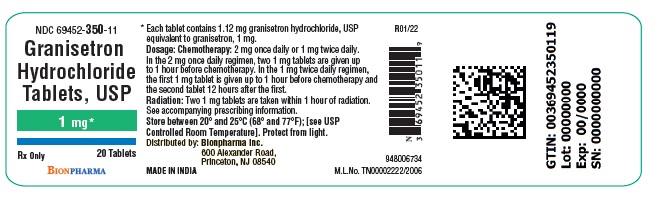
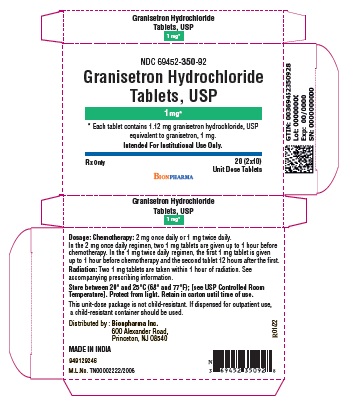
Granisetron hydrochloride tablets prevent nausea and vomiting associated with initial and repeat courses of emetogenic cancer therapy, as shown by 24 hour efficacy data from studies using both moderately- and highly-emetogenic chemotherapy.
Moderately Emetogenic Chemotherapy
The first trial compared granisetron hydrochloride tablets doses of 0.25 mg to 2 mg twice a day, in 930 cancer patients receiving, principally, cyclophosphamide, carboplatin, and cisplatin (20 mg/m2 to 50 mg/m2). Efficacy was based on complete response (i.e., no vomiting, no moderate or severe nausea, no rescue medication), no vomiting, and no nausea. Table 2 summarizes the results of this study.
Table 2 Prevention of Nausea and Vomiting 24 Hours Post-Chemotherapy1 | Percentages of Patients Granisetron Hydrochloride Tablet Dose |
| Efficacy Measures | 0.25 mg twice a day (n=229) % | 0.5 mg twice a day (n=235) % | 1 mg twice a day (n=233) % | 2 mg twice a day (n=233) % |
| Complete Response2 | 61 | 70* | 81*† | 72* |
| No Vomiting | 66 | 77* | 88* | 79* |
| No Nausea | 48 | 57 | 63* | 54 |
1Chemotherapy included oral and injectable cyclophosphamide, carboplatin, cisplatin (20 mg/m2 to 50 mg/m2), dacarbazine, doxorubicin, epirubicin.
2 No vomiting, no moderate or severe nausea, no rescue medication.
*Statistically significant (P<0.01) vs. 0.25 mg twice a day.
†Statistically significant (P<0.01) vs. 0.5 mg twice a day.
Results from a second double-blind, randomized trial evaluating granisetron hydrochloride tablets 2 mg once a day and granisetron hydrochloride tablets 1 mg twice a day were compared to prochlorperazine 10 mg twice a day derived from a historical control. At 24 hours, there was no statistically significant difference in efficacy between the two granisetron hydrochloride tablet regimens. Both regimens were statistically superior to the prochlorperazine control regimen (see Table 3).
Table 3 Prevention of Nausea and Vomiting 24 Hours Post-Chemotherapy1 | Percentages of Patients |
| Efficacy Measures | Granisetron Hydrochloride Tablets 1 mg twice a day (n = 354) % | Granisetron Hydrochloride
Tablets 2 mg once a day (n = 343) % | Prochlorperazine2 10 mg twice daily (n=111) % |
| Complete Response3 | 69* | 64* | 41 |
| No Vomiting | 82* | 77* | 48 |
| No Nausea | 51* | 53* | 35 |
| Total Control4 | 51* | 50* | 33 |
1 Moderately emetogenic chemotherapeutic agents included cisplatin (20 mg/m2 to 50 mg/m2), oral and intravenous cyclophosphamide, carboplatin, dacarbazine,
doxorubicin.
2 Historical control from a previous double-blind granisetron hydrochloride trial.
3 No vomiting, no moderate or severe nausea, no rescue medication.
4 No vomiting, no nausea, no rescue medication.
*Statistically significant (P<0.05) vs. prochlorperazine historical control.
Results from a granisetron hydrochloride tablets 2 mg daily alone treatment arm in a third double-blind, randomized trial, were compared to prochlorperazine (PCPZ), 10 mg twice a day, derived from a historical control. The 24 hour results for granisetron hydrochloride tablets 2 mg daily were statistically superior to PCPZ for all efficacy parameters: complete response (58%), no vomiting (79%), no nausea (51%), total control (49%). The PCPZ rates are shown in Table 3.
Cisplatin-Based Chemotherapy
The first double-blind trial compared granisetron hydrochloride tablets 1 mg twice a day, relative to placebo (historical control), in 119 cancer patients receiving high-dose cisplatin (mean dose 80 mg/m2). At 24 hours, granisetron hydrochloride tablets 1 mg twice a day was significantly (P<0.001) superior to placebo (historical control) in all efficacy parameters: complete response (52%), no vomiting (56%) and no nausea (45%). The placebo rates were 7%, 14%, and 7%, respectively, for the three efficacy parameters.
Results from a granisetron hydrochloride tablets 2 mg once a day alone treatment arm in a second double-blind, randomized trial, were compared to both granisetron hydrochloride tablets 1 mg twice a day and placebo historical controls. The 24 hour results for granisetron hydrochloride tablets 2 mg once a day were: complete response (44%), no vomiting (58%), no nausea (46%), total control (40%). The efficacy of granisetron hydrochloride tablets 2 mg once a day was comparable to granisetron hydrochloride tablets 1 mg twice a day and statistically superior to placebo. The placebo rates were 7%, 14%, 7%, and 7%, respectively, for the four parameters.
No controlled study comparing granisetron injection with the oral formulation to prevent chemotherapy-induced nausea and vomiting has been performed.
Over 3700 patients have received granisetron hydrochloride tablets in clinical trials with emetogenic cancer therapies consisting primarily of cyclophosphamide or cisplatin regimens. In patients receiving granisetron hydrochloride tablets 1 mg twice a day for 1, 7 or 14 days, or 2 mg daily for 1 day, adverse experiences reported in more than 5% of the patients with comparator and placebo incidences are listed inTable 4.
Table 4 Principal Adverse Events in Clinical Trials | Percent of Patients With Event |
| Granisetron Hydrochloride1
Tablets
1 mg twice a day
(n=978) | Granisetron Hydrochloride1
Tablets
2 mg once a day
(n=1450) | Comparator2
(n=599) | Placebo
(n=185) |
| Headache | 21% | 20% | 13% | 12% |
| Constipation | 18% | 14% | 16% | 8% |
| Asthenia | 14% | 18% | 10% | 4% |
| Diarrhea | 8% | 9% | 10% | 4% |
| Abdominal pain | 6% | 4% | 6% | 3% |
| Dyspepsia | 4% | 6% | 5% | 4% |
1 Adverse events were recorded for 7 days when granisetron hydrochloride tablets were given on a single day and for up to 28 days when granisetron hydrochloride tablets were administered for 7 or 14 days.
2 Metoclopramide/dexamethasone; phenothiazines/dexamethasone; dexamethasone alone; prochlorperazine.
Other adverse events reported in clinical trials were:
Gastrointestinal: In single-day dosing studies in which adverse events were collected for 7 days, nausea (20%) and vomiting (12%) were recorded as adverse events after the 24 hour efficacy assessment period.
Hepatic: In comparative trials, elevation of AST and ALT (>2 times the upper limit of normal) following the administration of granisetron hydrochloride tablets occurred in 5% and 6% of patients, respectively. These frequencies were not significantly different from those seen with comparators (AST: 2%; ALT: 9%).
Cardiovascular: Hypertension (1%); hypotension, angina pectoris, atrial fibrillation, and syncope have been observed rarely.
Central Nervous System: Dizziness (5%), insomnia (5%), anxiety (2%), somnolence (1%). One case compatible with, but not diagnostic of, extrapyramidal symptoms has been reported in a patient treated with granisetron hydrochloride tablets.
Hypersensitivity: Rare cases of hypersensitivity reactions, sometimes severe (e.g., anaphylaxis, shortness of breath, hypotension, urticaria) have been reported.
Other: Fever (5%). Events often associated with chemotherapy also have been reported: leukopenia (9%), decreased appetite (6%), anemia (4%), alopecia (3%), thrombocytopenia (2%).
Over 5000 patients have received injectable granisetron hydrochloride in clinical trials.
Table 5 gives the comparative frequencies of the five commonly reported adverse events (≥3%) in patients receiving granisetron hydrochloride injection, 40 mcg/kg, in single-day chemotherapy trials. These patients received chemotherapy, primarily cisplatin, and intravenous fluids during the 24 hour period following granisetron hydrochloride injection administration.
Table 5 Principal Adverse Events in Clinical Trials - Single-Day Chemotherapy | Percent of Patients with Event |
| Granisetron Hydrochloride Injection1
40 mcg/kg
(n=1268) | Comparator2
(n=422) |
| Headache | 14% | 6% |
| Asthenia | 5% | 6% |
| Somnolence | 4% | 15% |
| Diarrhea | 4% | 6% |
| Constipation | 3% | 3% |
1 Adverse events were generally recorded over 7 days post-granisetron hydrochloride injection administration.
2 Metoclopramide/dexamethasone and phenothiazines/dexamethasone.
In the absence of a placebo group, there is uncertainty as to how many of these events should be attributed to granisetron hydrochloride, except for headache, which was clearly more frequent than in comparison groups.