Other
For Oral Use
Rx only
Absorption:Cetirizine was rapidly absorbed with a time to maximum concentration (T max) of approximately 1 hour following oral administration of tablets or solution in adults. Comparable bioavailability was found between the tablet and solution dosage forms. When healthy volunteers were administered multiple doses of cetirizine (10 mg tablets once daily for 10 days), a mean peak plasma concentration (C max) of 311 ng/mL was observed. No accumulation was observed. Cetirizine pharmacokinetics were linear for oral doses ranging from 5 to 60 mg. Food had no effect on the extent of cetirizine exposure (AUC) but T maxwas delayed by 1.7 hours and C maxwas decreased by 23% in the presence of food.
Distribution: The mean plasma protein binding of cetirizine is 93%, independent of concentration in the range of 25–1000 ng/mL, which includes the therapeutic plasma levels observed.
Metabolism:A mass balance study in 6 healthy male volunteers indicated that 70% of the administered radioactivity was recovered in the urine and 10% in the feces. Approximately 50% of the radioactivity was identified in the urine as unchanged drug. Most of the rapid increase in peak plasma radioactivity was associated with parent drug, suggesting a low degree of first-pass metabolism. Cetirizine is metabolized to a limited extent by oxidative O-dealkylation to a metabolite with negligible antihistaminic activity. The enzyme or enzymes responsible for this metabolism have not been identified.
Elimination:The mean elimination half-life in 146 healthy volunteers across multiple pharmacokinetic studies was 8.3 hours and the apparent total body clearance for cetirizine was approximately 53 mL/min.
Interaction Studies
Pharmacokinetic interaction studies with cetirizine in adults were conducted with pseudoephedrine, antipyrine, ketoconazole, erythromycin and azithromycin. No interactions were observed. In a multiple dose study of theophylline (400 mg once daily for 3 days) and cetirizine (20 mg once daily for 3 days), a 16% decrease in the clearance of cetirizine was observed. The disposition of theophylline was not altered by concomitant cetirizine administration.
Special Populations
Pediatric Patients:In pediatric patients aged 2 to 5 years who received 5 mg of cetirizine, the mean C maxwas 660 ng/mL. Based on cross-study comparisons, the weight normalized, apparent total body clearance was 81–111% greater and the elimination half life was 33 to 41% shorter in the pediatric population than in adults. In pediatric patients aged 6 to 23 months who received a single dose of 0.25 mg/kg cetirizine oral solution (mean dose 2.3 mg), the mean C maxwas 390 ng/mL. Based on cross-study comparisons, the weight-normalized, apparent total body clearance was 304% greater and the elimination half-life was 63% shorter in this pediatric population compared to adults. The average AUC (0-t)in children 6 months to <2 years of age receiving the maximum dose of cetirizine solution (2.5 mg twice a day) is expected to be two-fold higher than that observed in adults receiving a dose of 10 mg cetirizine tablets once a day.
Effect of Gender:The effect of gender on cetirizine pharmacokinetics has not been adequately studied.
Effect of Race:No race-related differences in the kinetics of cetirizine have been observed.
Perennial Allergic Rhinitis:Cetirizine hydrochloride oral solution is indicated for the relief of symptoms associated with perennial allergic rhinitis due to allergens such as dust mites, animal dander and molds in children 6 to 23 months of age. Symptoms treated effectively include sneezing, rhinorrhea, postnasal discharge, nasal pruritus, ocular pruritus, and tearing.
Chronic Urticaria:Cetirizine hydrochloride oral solution is indicated for the treatment of the uncomplicated skin manifestations of chronic idiopathic urticaria in children 6 months to 5 years of age. It significantly reduces the occurrence, severity, and duration of hives and significantly reduces pruritus.
Risk of New Onset Pruritus After Discontinuation of Cetirizine:Cases of pruritus after discontinuation of cetirizine have been reported in the postmarketing setting in patients where pruritus was not present before initiation of cetirizine. Pruritus occurred within a few days of discontinuing cetirizine among patients who used cetirizine long-term (e.g., few months to years). Reported cases of pruritus were infrequent, but some were serious with patients experiencing widespread severe pruritus. If pruritus occurs after discontinuation of cetirizine, symptoms may improve with restarting or tapering cetirizine.
Activities Requiring Mental Alertness:In clinical trials, the occurrence of somnolence has been reported in some patients taking cetirizine hydrochloride; due caution should therefore be exercised when driving a car or operating potentially dangerous machinery. Concurrent use of cetirizine hydrochloride with alcohol or other CNS depressants should be avoided because additional reductions in alertness and additional impairment of CNS performance may occur.
Post-Marketing Experience
In the post-marketing period, the following additional rare, but potentially severe adverse events have been reported: aggressive reaction, anaphylaxis, cholestasis, convulsions, glomerulonephritis, hallucinations, hemolytic anemia, hepatitis, orofacial dyskinesia, severe hypotension, stillbirth, suicidal ideation, suicide, thrombocytopenia, acute generalized exanthematous pustulosis (AGEP), and new onset pruritus within a few days after discontinuation of cetirizine, usually after long-term use (e.g., months to years) of cetirizine.
Children 2 to 5 Years for Chronic Urticaria:The recommended initial dose of Cetirizine Hydrochloride Oral Solution, USP 1 mg/mL in children aged 2 to 5 years is 2.5 mg (½ teaspoonful) once daily. The dosage in this age group can be increased to a maximum dose of 5 mg per day given as 1 teaspoonful once a day, or one ½ teaspoonful given every 12 hours.
Children 6 months to <2 Years for Perennial Allergic Rhinitis and Chronic Urticaria:The recommended dose of Cetirizine Hydrochloride Oral Solution, USP 1 mg/mL in children 6 months to 23 months of age is 2.5 mg (½ teaspoonful) once daily. The dose in children 12 to 23 months of age can be increased to a maximum dose of 5 mg per day, given as ½ teaspoonful (2.5 mg) every 12 hours.
Rx only
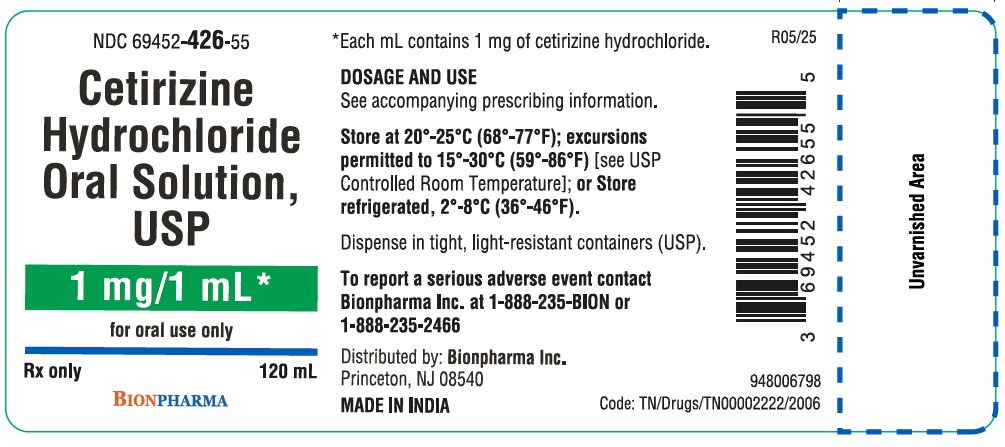
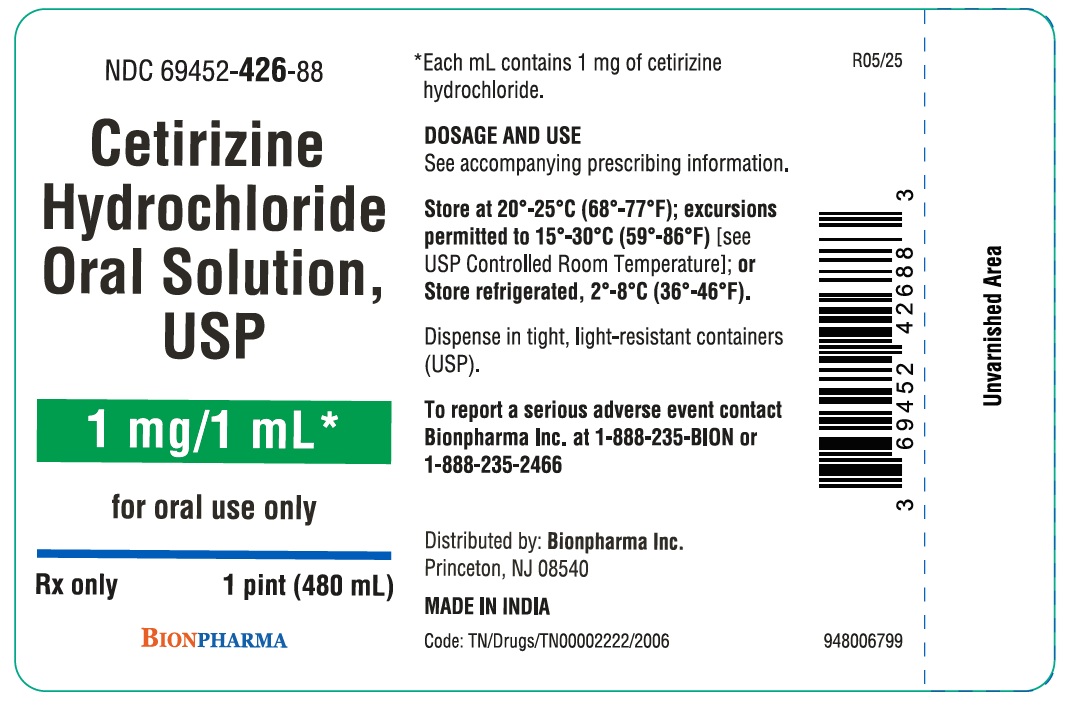
To report a serious adverse event contact Bionpharma Inc. at 1-888-235-BION or 1-888-235-2466
Distributed by:
Bionpharma Inc.
Princeton, NJ 08540
MADE IN INDIA
Revised: 05/2025
948026847