Description
Each capsule contains:
300 mg of gabapentin, USP.
DESCRIPTION
The active ingredient in gabapentin capsules, USP is gabapentin which has the chemical name
1-(aminoethyl) cyclohexaneacetic acid.
The following Structured Product Label (SPL) was submitted to the FDA by Alivio Medical Products, Llc for the product Gabapentin (NDC 69512-102). This document serves as the official prescribing information, containing essential scientific data and clinical materials required for healthcare providers and patients.
This specific version of the label includes detailed information regarding description, dosage & administration, storage and handling, precautions, summary of safety and effectiveness, other, indications & usage, dosage forms & strengths, and other regulatory disclosures. Use the navigation below to review specific sections of the FDA submission.
Each capsule contains:
300 mg of gabapentin, USP.
DESCRIPTION
The active ingredient in gabapentin capsules, USP is gabapentin which has the chemical name
1-(aminoethyl) cyclohexaneacetic acid.
Dosage and Use:
See package insert
for full prescribing information
DOSAGE AND ADMINISTRATION
Gabapentin capsules, USP are given orally with or without food. Gabapentin capsules, USP should be
swallowed whole with plenty of water.
Store at 20 to 25 C (68 to 77 F); excursions
permitted to 15 to 30 C (59 to 86 F)) [See
USP Controlled Room Temperature].
Dispense in tight (USP), child-resistant containers.
Pharmacist: Please dispense
with medication guide
provided separately
Highlights of Prescribing Information
These highlights do not include all the information needed to use gabapentin capsules safely and
effectively. See full prescribing information for gabapentin capsules.
GABAPENTIN capsules, USP for oral use
Initial U.S. Approval: 1993
FULL PRESCRIBING INFORMATION: CONTENTS
INDICATIONS AND USAGE
Gabapentin capsules, USP, are indicated for:
-management of postherpeticneuralgia in adults
-Adjunctive therapy in the treatment of partial onset seizures, with and without secondary
generalization, in adults and pediatric patients 3 years and older with epilepsy
DOSAGE FORMS AND STRENGTHS
Capsules:
CONTRAINDICATIONS
Gabapentin capsules, USP are contraindicated in patients who have demonstrated hypersensitivity to
the drug or its ingredients.
WARNINGS AND PRECAUTIONS
Drug Reaction with Eosinophilia and Systemic Symptoms (DRESS) Multiorgan Hypersensitivity
Drug Reaction with with Eosinophilia and Systemic Symptoms
ADVERSE REACTIONS
The following severe adverse reactions are discussed in greater detail in other sections: Drug Reaction
with Eosiniphilia and Systemic Syndrome (DRESS) Multiorgan
DRUG INTERACTIONS
Other Antiepileptic Drugs Gabapentin is not appreciably metabolized nor does it interfere
with the metabolism of commonly co-administered antiepileptic drugs
USE IN SPECIFIC POPULATIONS
Pregnanacy - Pregnancy Category C: There are no adequate and well-controlled studies in pregnant women.
DRUG ABUSE AND DEPENDENCE
Controlled Substance - Gabapentin is not a scheduled drug.
OVERDOSAGE
A lethal dose of gabapentin was not identified in mice and rats receiving single oral doses as high
as 8000 mg / kg.
CLINICAL PHARMACOLOGY
Mechanism of Action - The precise mechanisms by which gabapentin produces its analgesic
and antiepileptic actions are unknown.
NONCLINICAL TOXICOLOGY
Carcinogenesis, Mutagenesis, Impairment of Fertility - Gabapentin was adminstered orally to
mice and rats in 2-year carcinogenicity studies.
CLINICAL STUDIES
Postherpetic Neuralgia Gabapentin was evaluated for the management of postherpetic neuralgia
(PHN) in two randomized, double-blind, placebo-controlled multicenter studies.
HOW SUPPLIED/STORAGE AND HANDLING
Gabapentin capsules, USP
PATIENT COUNSELING INFORMATION
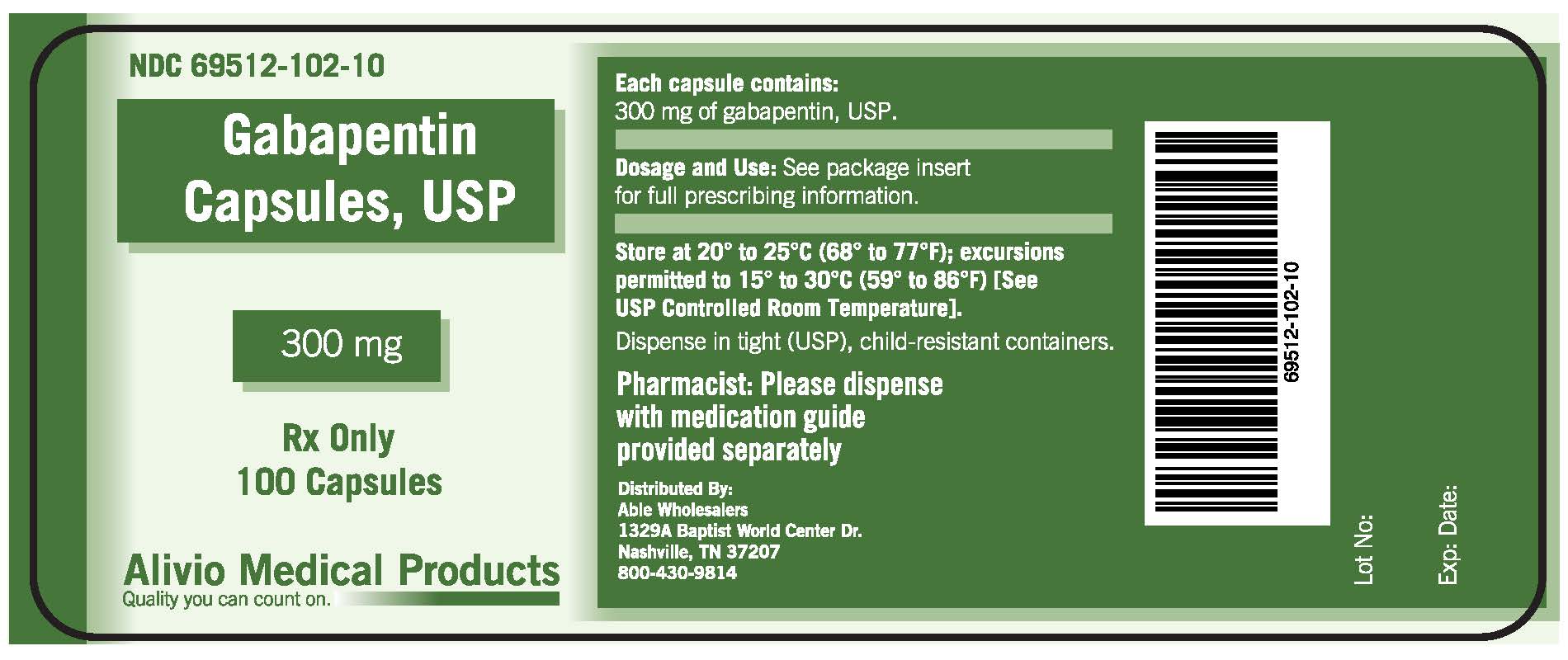
Copy Of Label (Gaba Label)
* Please review the disclaimer below.
