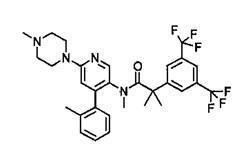
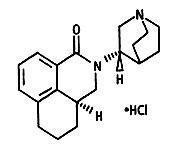
After single dose administration of AKYNZEO in healthy subjects, the peak plasma concentrations for netupitant and palonosetron were reached in about 5 hours.
Table 4: PK Parameters (mean and CV%) After Single Dose Administration of AKYNZEO in Healthy Subjects | Netupitant | Palonosetron |
Cmax (ng/ml) | 434 (56) | 1.53 (25) |
Tmax1 (h) | 5 (2-12) | 5 (1-12) |
AUC (ng*h/mL) | 14401 (51) | 56.7 (33) |
T1/2 (h) | 96 (61) | 44 (34) |
1 median (min-max)
When administered under fed condition, the systemic exposure to netupitant and palonosetron was similar to those obtained under fasting condition.
In cancer patients who received a single dose of AKYNZEO 1 hour prior to chemotherapy (docetaxel, etoposide, or cyclophosphamide), the Cmax and AUC of netupitant and its metabolites were similar to those in healthy subjects. The mean Cmax and AUC of palonosetron in cancer patients were similar to those in healthy subjects.
No significant changes in pharmacokinetics of netupitant and palonosetron were observed when 450 mg oral netupitant and 0.75 mg oral palonosetron were co-administered.
Netupitant
Absorption
Upon oral administration of a single dose of netupitant, netupitant started to be measurable in plasma between 15 minutes and 3 hours after dosing. Plasma concentrations reached Cmax in approximately 5 hours. There was a greater than dose-proportional increase in the systemic exposure with the dose increase from 10 mg to 300 mg and a dose-proportional increase in systemic exposure with a dose increase from 300 mg to 450 mg.
Distribution
In cancer patients netupitant disposition was characterized by a large apparent volume of distribution (Vz/F: 1982 ± 906 L) (mean ± SD). Human plasma protein binding of netupitant is greater than 99.5% at drug concentrations ranging from 10-1300 ng/mL and protein binding of its major metabolites (M1, M2 and M3) is greater than 97% at drug concentrations ranging from 100 to 2000 ng/mL.
Metabolism
Once absorbed, netupitant is extensively metabolized to form three major metabolites: desmethyl derivative, M1; N-oxide derivative, M2; and OH-methyl derivative, M3. Metabolism is mediated primarily by CYP3A4 and to a lesser extent by CYP2C9 and CYP2D6. Metabolites M1, M2 and M3 were shown to bind to the substance P/neurokinin 1 (NK1) receptor.
Mean Cmax was approximately 11%, 47% and 16% of netupitant for metabolites M1, M2 and M3, respectively. Mean AUC for metabolites M1, M2 and M3 was 29%, 14% and 33% of netupitant, respectively. The median tmax for metabolite M2 was 5 hours and was about 17-32 hours for metabolites M1 and M3.
Elimination
Netupitant is eliminated from the body in a multi-exponential fashion, with an apparent elimination half-life in cancer patients of 80 ± 29 hours (mean ± SD) and with an estimated systemic clearance of 20.3 ± 9.2 L/h (mean ± SD) after a single oral dose of AKYNZEO.
After a single oral administration of [14C]-netupitant, approximately half the administered radioactivity was recovered from urine and feces within 120 hours of dosing. The total of 3.95% and 70.7% of the radioactive dose was recovered in the urine and feces collected over 336 hours, respectively, and the mean fraction of an oral dose of netupitant excreted unchanged in urine is less than 1% suggesting renal clearance is not a significant elimination route for the netupitant-related entities. About 86.5% and 4.7% of administered radioactivity was estimated to be excreted via the feces and urine in 30 days post-dose
Palonosetron
Absorption
Following oral administration, palonosetron is well absorbed with its absolute bioavailability reaching 97%. After single oral doses using buffered solution mean maximum palonosetron concentrations (Cmax) and area under the concentration-time curve (AUC0-∞) were dose proportional over the dose range of 3.0 to 80 µg/kg in healthy subjects.
Distribution
Palonosetron has a volume of distribution of approximately 8.3 ± 2.5 L/kg. Approximately 62% of palonosetron is bound to plasma proteins.
Metabolism
Palonosetron is eliminated by multiple routes with approximately 50% metabolized to form two primary metabolites: N-oxide-palonosetron and 6-S-hydroxy-palonosetron. These metabolites each have less than 1% of the 5-HT3 receptor antagonist activity of palonosetron. In vitro metabolism studies have suggested that CYP2D6 and to a lesser extent CYP3A4 and CYP1A2 are involved in the metabolism of palonosetron. However, clinical pharmacokinetic parameters are not significantly different between poor and extensive metabolizers of CYP2D6 substrates.
Elimination
Following administration of a single oral 0.75 mg dose of [14C]-palonosetron to six healthy subjects, 85% to 93% of the total radioactivity was excreted in urine, and 5% to 8% was eliminated in feces. The amount of unchanged palonosetron excreted in the urine represented approximately 40% of the administered dose. In cancer patients, t½ was 48 ± 19 hours. After a single-dose of approximately 0.75 mg intravenous palonosetron, the total body clearance of palonosetron in healthy subjects was 160 ± 35 mL/h/kg (mean ± SD) and renal clearance was 66.5 ± 18.2 mL/h/kg.
Specific Populations
Gender
In a pooled analysis, the Cmax for netupitant was 35% higher in females than in males while the AUC was similar between males and females. In female subjects, the mean AUC for palonosetron was 35% higher and the mean Cmax was 26% higher than in male subjects.
Geriatrics
In cancer patients receiving AKYNZEO, population PK analysis indicated that age (within the range of 29 to 75 years old) did not influence the pharmacokinetics of netupitant or palonosetron. In healthy elderly subjects (>65 years old) the mean AUC0-∞ and Cmax was 25% and 36% higher, respectively, for netupitant, and 37% and 10% higher, respectively, for palonosetron compared to those in healthy younger adults (22-45 years old).
Hepatic Impairment
The effects of hepatic impairment on the PK of netupitant and palonosetron were studied following administration of a single oral dose of AKYNZEO to patients with mild (Child-Pugh score 5 to 6), moderate (Child-Pugh score 7 to 9), or severe (Child-Pugh score >9) hepatic impairment.
In patients with mild or moderate hepatic impairment, the mean AUC0-∞ of netupitant was 67% and 86% higher, respectively, than in healthy subjects and the mean Cmax for netupitant was about 40% and 41% higher, respectively, than in healthy subjects.
In patients with mild or moderate hepatic impairment, the mean AUC0-∞ of palonosetron was 33% and 62% higher, respectively, than in healthy subjects and the mean Cmax for palonosetron was about 14% higher and unchanged, respectively, than in healthy subjects.
The pharmacokinetics of netupitant and palonosetron was available from only two patients with severe hepatic impairment. As such the data are too limited to draw a conclusion.
Renal Impairment
In a population PK analysis, mild and moderate renal impairment did not significantly affect the pharmacokinetics of netupitant in cancer patients. Netupitant has not been studied in patients with severe renal impairment.
Mild to moderate renal impairment does not significantly affect palonosetron pharmacokinetic parameters. In a study with intravenous palonosetron, total systemic exposure to palonosetron increased by approximately 28% in patients with severe renal impairment relative to healthy subjects.
The pharmacokinetics of either palonosetron or netupitant has not been studied in subjects with end-stage renal disease.
Drug Interactions:In vitro studies have shown that netupitant and its metabolite M1 are inhibitors of CYP3A4. An in vivo study has confirmed that netupitant is a moderate inhibitor of CYP3A4.
Based on the in vitro studies, netupitant and its metabolites’ are unlikely to have in vivo drug-drug interaction via inhibition of CYP1A2, CYP2B6, CYP2C8, CYP2C9, CYP2C19, and CYP2D6 at the clinical dose of 300 mg.
Netupitant and its metabolites, M1, M2 and M3, are not inducers of CYP1A2, CYP2B6, CYP2C9, CYP2C19 and CYP3A4.
Based on in vitro studies, netupitant is an inhibitor of P-gp and BCRP transporters. In addition, netupitant is not a substrate for P-gp, metabolite M2 is a substrate for P-gp. In vitro studies indicate that netupitant and its three major metabolites are unlikely to have in vivo drug-drug interactions with human efflux transporters BSEP, MRP2, and human uptake transporters OATP1B1, OATP1B3, OAT1, OAT3, OCT1, and OCT2 at the clinical dose of 300 mg.
In vitro studies, palonosetron does not inhibit CYP1A2, CYP2A6, CYP2B6, CYP2C9, CYP2D6, CYP2E1 and CYP3A4/5 or induce CYP1A2, CYP2D6 or CYP3A4/5. CYP2C19 was not investigated.
Dexamethasone
Co-administration of a single dose of netupitant (300 mg) with a dexamethasone regimen (20 mg on Day 1, followed by 8 mg twice daily from Day 2 to Day 4) significantly increased exposure to dexamethasone. When netupitant was co-administered on Day 1, the mean AUC of dexamethasone was increased by 1.7-fold on Day 1 and up to 2.4-fold on Day 2 and Day 4. [see Drug Interactions (7.1)]
The duration of CYP3A4 inhibition by single dose AKYNZEO (300 mg netupitant/0.5 mg palonosetron) was assessed using dexamethasone as a CYP3A4 probe substrate. Co-administration of a single dose of AKYNZEO on Day 1 with a dexamethasone regimen (12 mg on Day 1 followed by 8 mg on Days 2, 3, 4, 6, 8 and 10) increased mean AUC of dexamethasone by 1.6-fold on Day 1, 2.4-fold on Day 4, 1.5-fold on Day 6, and 1.2-fold on Day 8 [see Drug Interactions (7.1)].
Chemotherapeutic Agents (docetaxel, etoposide, cyclophosphamide)
Systemic exposure to intravenously administered chemotherapeutic agents that are metabolized by CYP3A4 was higher when AKYNZEO was co-administered than when palonosetron alone was co-administered in cancer patients. [see Drug Interactions (7.1)]
With co-administration of AKYNZEO the mean Cmax and AUC of docetaxel were 49% and 35% higher, respectively, and mean Cmax and AUC of etoposide were increased by 10% and 28%, respectively, compared to when co-administered with palonosetron alone.
Mean Cmax and AUC for cyclophosphamide after co-administration with AKYNZEO was 27% and 20% higher compared to when co-administered with palonosetron alone.
The mean AUC of palonosetron was about 65% higher when AKYNZEO was co-administered with docetaxel than with etoposide or cyclophosphamide, while the mean AUC of netupitant was similar among groups that received docetaxel, etoposide, or cyclophosphamide.
Midazolam
When co-administered with netupitant 300 mg the mean Cmax and AUC of midazolam after single dose oral administration of 7.5 mg midazolam was 36% and 126% higher, respectively. [see Drug Interactions (7.1)]
Erythromycin
When 500 mg erythromycin was co-administered with netupitant 300 mg, the systemic exposure of erythromycin was highly variable and the mean Cmax and AUC of erythromycin were increased by 92% and 56%, respectively.
Oral Contraceptives
Single dose AKYNZEO, when given with a single oral dose of 60 μg ethinyl estradiol and 300 μg levonorgestrel, increased the AUC of levonorgestrel by 46%. AKYNZEO had no significant effect on the AUC of ethinyl estradiol. [see Drug Interactions (7.1)]
Digoxin
Co-administration of netupitant 450 mg did not significantly affect the systemic exposure and urinary excretion of digoxin, a substrate of P-glycoprotein, at steady-state. Concurrent administration of AKYNZEO with digoxin is not expected to affect the systemic exposure to digoxin.
Effects of other drugs on AKYNZEO
Rifampicin
Single dose AKYNZEO was administered with rifampicin, a strong CYP3A4 inducer, following once daily administration of 600 mg rifampicin for 17 days. Pharmacokinetics of netupitant and palonosetron were compared to that after administration of AKYNZEO alone. Co-administration of rifampicin decreased the mean Cmax and AUC0-∞ of netupitant by 62% and 82%, respectively, compared to those after AKYNZEO alone. Co-administration of rifampicin decreased the mean Cmax and AUC for palonosetron by 15% and 19%, respectively. [see Drug Interactions (7.1)]
Ketoconazole
Single dose AKYNZEO was administered with ketoconazole, a strong CYP3A4 inhibitor, following once daily administration of 400 mg ketoconazole for 12 days. Pharmacokinetics of netupitant and palonosetron were compared to that after administration of AKYNZEO alone. Co-administration with ketoconazole increased mean Cmax and AUC of netupitant by 25% and 140%, respectively, compared to those after administration of AKYNZEO alone. The mean AUC and Cmax of palonosetron were 10% and 15% higher, respectively, when co-administered with ketoconazole. [see Drug Interactions (7.1)]