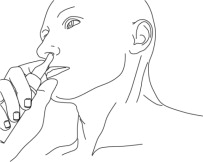
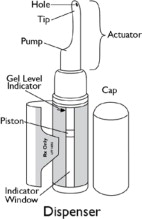
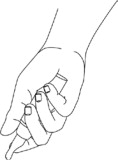
When using Natesto for the first time, patients should be instructed to prime the pump by inverting the pump, depressing the pump 10 times, and discarding any small amount of product dispensed directly into a sink and then washing the gel away thoroughly with warm water. The tip should be wiped with a clean, dry tissue. If the patient gets Natesto gel on their hands, it is recommended that they wash their hands with warm water and soap. This priming should be done only prior to the first use of each dispenser.
To administer the dose, patients should be instructed to perform the following steps:
- Blow the nose.
- Remove the cap from the dispenser.
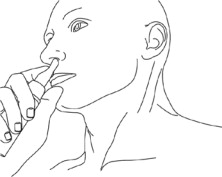
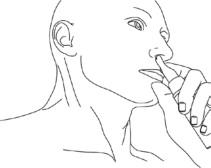
- Place the right index finger on the pump of the actuator and while in front of a mirror, slowly advance the tip of the actuator into the left nostril upwards until their finger on the pump reaches the base of the nose.
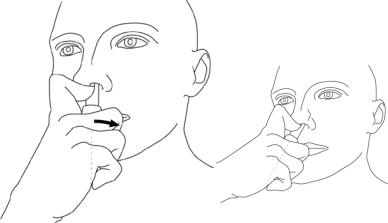
- Tilt the actuator so that the opening on the tip of the actuator is in contact with the lateral wall of the nostril to ensure that the gel is applied to the nasal wall.
- Slowly depress the pump until it stops.
- Remove the actuator from the nose while wiping the tip along the inside of the lateral nostril wall to fully transfer the gel.
- Using your left index finger, repeat the steps outlined in bullets 3 through 6 for the right nostril.
- Use a clean, dry tissue to wipe the tip of the actuator.
- Replace the cap on the dispenser.
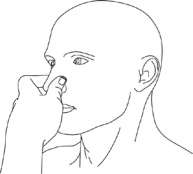
- Press on the nostrils at a point just below the bridge of the nose and lightly massage.
- Refrain from blowing the nose or sniffing for 1 hour after administration.
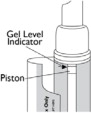
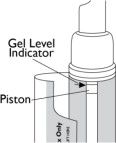
The dispenser should be replaced when the top of the piston inside the dispenser reaches the arrow at the top of the inside label. The inside label may be found by unwrapping the outer flap from around the container.
90-Day Clinical Study
Among the 78 patients who received Natesto three times daily in the 90-day clinical study, the most common adverse reactions were: prostate specific antigen (PSA) increased, headache, rhinorrhea, epistaxis, nasal discomfort, nasopharyngitis, upper respiratory tract infection (URI), sinusitis, bronchitis and nasal scab. PSA increased was considered an adverse reaction by meeting one of two pre-specified criteria: (1) increase from baseline serum PSA greater than 1.4 ug/L, or (2) serum PSA greater than 4.0 ug/L.
Table 1 shows adverse reactions reported by ≥3% of patients treated with 11 mg three times daily in the 90-day clinical study.
Table 1: Adverse Reactions Reported by ≥3% of Patients Treated with Natesto (11 mg of testosterone) Three Times Daily in the 90-Day Clinical Study
| Adverse Reactions | Natesto
(11 mg of Testosterone) Three Times Daily
(N=78)
n (%) |
| PSA increased
| 4 (5.1)
|
| Headache
| 3 (3.8)
|
| Rhinorrhea
| 3 (3.8)
|
| Epistaxis
| 3 (3.8)
|
| Nasal discomfort
| 3 (3.8)
|
| Nasopharyngitis
| 3 (3.8)
|
| Bronchitis
| 3 (3.8)
|
| Upper respiratory tract infection
| 3 (3.8)
|
| Sinusitis
| 3 (3.8)
|
| Nasal scab
| 3 (3.8)
|
Adverse reactions reported by >2% but <3% of patients in the 90-day clinical study include: blood pressure increased, dysgeusia, nasal dryness, nasal congestion, and cough.
Extension Periods
Among the 78 patients who received Natesto three times daily in the 90-day clinical study, a total of 69 patients received Natesto three times daily in the first 90-day extension period.
Among these 69 patients, the most common adverse reactions were: nasopharyngitis, PSA increased, parosmia, nasal discomfort, rhinorrhea and nasal scab.
Table 2 shows adverse reactions reported by ≥3% of patients who received Natesto three times daily in both the 90-day clinical study and in the 90-day extension period.
Table 2: Adverse Reactions Reported by ≥3% of Patients in Both the 90-Day Clinical Study and in the 90-Day Extension Period
| Adverse Reactions | Natesto 11 mg TID
(N=69)
n (%) |
| Nasopharyngitis
| 6 (8.7)
|
| Rhinorrhea
| 5 (7.2)
|
| PSA increased
| 4 (5.8)
|
| Parosmia
| 4 (5.8)
|
| Nasal discomfort
| 4 (5.8)
|
| Nasal Scab
| 4 (5.8)
|
| Upper respiratory tract infection
| 3 (4.3)
|
| Bronchitis
| 3 (4.3)
|
| Procedural pain
| 3 (4.3)
|
| Pain in extremity
| 3 (4.3)
|
| Headache
| 3 (4.3)
|
| Epistaxis
| 3 (4.3)
|
A total of 18 patients received Natesto three times daily in all three treatment periods, including the 90-day clinical study, the first 90-day extension period, and the second 180-day extension period. Among these 18 patients, the following adverse reactions were reported in more than one patient each: nasopharyngitis, parosmia, PSA increased, nasal discomfort, nasal scab and hypertension. The following adverse reactions were reported in one patient each: nausea, nasal excoriation, thyroid stimulating hormone increased, decreased appetite, myalgia, anosmia, testicular atrophy, epistaxis, nasal septum disorder, nasal discomfort, and rhinorrhea.
In patients who received Natesto three times daily, mean serum PSA concentrations increased by 0.2 ng/mL, 0.1 ng/mL, and 0.2 ng/mL after 90, 180 and 360 days, respectively.
Discontinuations due to Adverse Reactions
Among all subjects (n=306) who received Natesto at any dose in the 90-day clinical study and its 90- and 180-day extension periods, a total of 6 subjects withdrew from treatment for the following adverse reactions, reported by 1 subject each: nasal discomfort, headache, dysgeusia, PSA increased, allergic reaction (hives, swollen lips and tongue), and 1 patient with myalgia, arthralgia, fever, chills and petechiae.
Increased Hematocrit
Among all subjects (n=306) who received Natesto at any dose in the 90-day clinical study and its 90- and 180-day extension periods, a total of 4 subjects had a hematocrit level > 55%. These 4 patients had baseline hematocrits of 48% and 51%. In no case did hematocrit exceed 58%.
Nasal Adverse Reactions
Among all subjects (n=306) who received Natesto at any dose in the 90-day clinical study and its 90- and 180-day extension periods, the following nasal adverse reactions were reported: nasopharyngitis (8.2%), rhinorrhea (7.8%), epistaxis (6.5%), nasal discomfort (5.9%), parosmia (5.2%), nasal scab (5.2%), upper respiratory infection (4.2%), nasal dryness (4.2%), and nasal congestion (3.9%).
Abuse-Related Adverse Reactions
Serious adverse reactions have been reported in individuals who abuse anabolic androgenic steroids and include cardiac arrest, myocardial infarction, hypertrophic cardiomyopathy, congestive heart failure, cerebrovascular accident, hepatotoxicity, and serious psychiatric manifestations, including major depression, mania, paranoia, psychosis, delusions, hallucinations, hostility and aggression.
The following adverse reactions have also been reported in men: transient ischemic attacks, convulsions, hypomania, irritability, dyslipidemias, testicular atrophy, subfertility, and infertility.
The following additional adverse reactions have been reported in women: hirsutism, virilization, deepening of voice, clitoral enlargement, breast atrophy, male-pattern baldness, and menstrual irregularities.
The following adverse reactions have been reported in male and female adolescents: premature closure of bony epiphyses with termination of growth, and precocious puberty.
Because these reactions are reported voluntarily from a population of uncertain size and may include abuse of other agents, it is not always possible to reliably estimate their frequency or establish a causal relationship to drug exposure.
Behaviors Associated with Addiction
Continued abuse of testosterone and other anabolic steroids, leading to addiction is characterized by the following behaviors:
- Taking greater dosages than prescribed
- Continued drug use despite medical and social problems due to drug use
- Spending significant time to obtain the drug when supplies of the drug are interrupted
- Giving a higher priority to drug use than other obligations
- Having difficulty in discontinuing the drug despite desires and attempts to do so
- Experiencing withdrawal symptoms upon abrupt discontinuation of use
Physical dependence is characterized by withdrawal symptoms after abrupt drug discontinuation or a significant dose reduction of a drug. Individuals taking supratherapeutic doses of testosterone may experience withdrawal symptoms lasting for weeks or months which include depressed mood, major depression, fatigue, craving, restlessness, irritability, anorexia, insomnia, decreased libido and hypogonadotropic hypogonadism.
Drug dependence in individuals using approved doses of testosterone for approved indications has not been documented.
Absorption
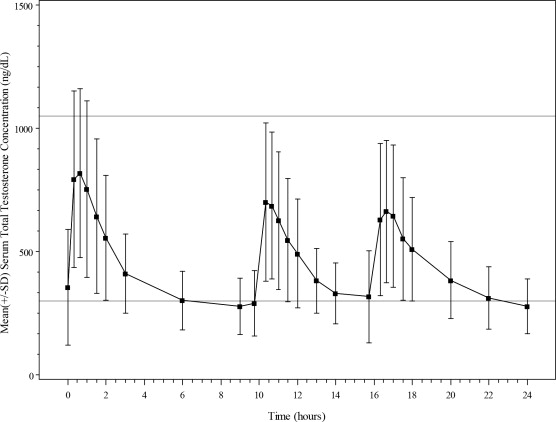
Natesto delivers physiologic amounts of testosterone, producing circulating concentrations that approximate normal testosterone concentrations (i.e., 300 to 1,050 ng/dL) seen in healthy men. The maximum concentration for Natesto is achieved within approximately 40 minutes of administration and has a half-life ranging from 10 to 100 minutes.
Figure 1 summarizes the pharmacokinetic profiles of total testosterone in patients completing 90 days of Natesto treatment administered as 33 mg of testosterone daily (11 mg three times daily).
Figure 1: Mean Serum Total Testosterone Concentrations on Day 90 Following Natesto Administered As 11 mg of Testosterone Three Times Daily (N=69)
The average daily testosterone concentration produced by Natesto administered as 11 mg of testosterone three times daily on Day 90 was 421 (± 116) ng/dL.
Distribution
Circulating testosterone is primarily bound in the serum to sex hormone-binding globulin (SHBG) and albumin. Approximately 40% of testosterone in plasma is bound to SHBG, 2% remains unbound (free), and the rest is loosely bound to albumin and other proteins.
Metabolism
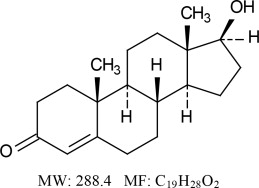
Testosterone is metabolized to various 17-keto steroids through 2 different pathways. The major active metabolites of testosterone are estradiol and dihydrotestosterone (DHT).
DHT concentrations increased in parallel with testosterone concentrations during Natesto treatment. After 90 days of treatment, the mean DHT/testosterone ratio was 0.09 which was within the normal range.
Excretion
About 90% of a dose of testosterone given intramuscularly is excreted in the urine as glucuronic and sulfuric acid conjugates of testosterone and its metabolites; about 6% of a dose is excreted in the feces, mostly in the unconjugated form. Inactivation of testosterone occurs primarily in the liver.
Drug Interactions
Use in patients with allergic rhinitis and oxymetazoline: The effects of allergic rhinitis and the use of oxymetazoline on the absorption of testosterone were investigated in a 3-way cross-over clinical study. Eighteen males with seasonal allergic rhinitis received 3 doses of 11 mg of testosterone intranasally (testosterone dose of 33 mg/day) while they were in the asymptomatic, symptomatic, and symptomatic but treated (with oxymetazoline) states using an environmental challenge chamber model.
Serum total testosterone concentrations were decreased by 21 to 24% in males with symptomatic allergic rhinitis. A 2.6% decrease in mean AUC(0-24) and 3.6% decrease in mean Cmax of total testosterone was observed in males with symptomatic seasonal rhinitis when treated with oxymetazoline 30 minutes prior to Natesto compared to when left untreated. Oxymetazoline does not impact the absorption of testosterone when concomitantly administered with Natesto [see Clinical Pharmacology (12.3)]. Drug interaction potential with nasally administered drugs other than oxymetazoline has not been studied.
Carcinogenicity
Testosterone has been tested by subcutaneous injection and implantation in mice and rats. In mice, the implant induced cervical-uterine tumors, which metastasized in some cases. There is suggestive evidence that injection of testosterone into some strains of female mice increases their susceptibility to hepatoma. Testosterone is also known to increase the number of tumors and decrease the degree of differentiation of chemically induced carcinomas of the liver in rats.
Mutagenesis
Testosterone was negative in the in vitro Ames and in the in vivo mouse micronucleus assays.
Impairment of Fertility
The administration of exogenous testosterone has been reported to suppress spermatogenesis in the rat, dog and non-human primates, which was reversible on cessation of the treatment.
Use in Men With Known or Suspected Prostate or Breast Cancer
Men with known or suspected prostate or breast cancer should not use Natesto [see Contraindications (4) and Warnings and Precaution (5.3)].
Nasal Adverse Reactions
Nasal adverse reactions, including nasopharyngitis, rhinorrhea, epistaxis, nasal discomfort and nasal scabbing, were reported in clinical trials of Natesto. Advise patients to report any nasal symptoms or signs to their health care professional.
Potential Adverse Reactions With Androgens
Patients should be informed that treatment with androgens may lead to adverse reactions which include: