1 Indications And Usage
FAYUVI is indicated for the treatment of neurologic manifestations of mucopolysaccharidosis type IIIA (MPS IIIA, Sanfilippo syndrome type A) in pediatric patients with preserved neurodevelopmental function.
The following Structured Product Label (SPL) was submitted to the FDA by Ultragenyx Pharmaceutical Inc. for the product Fayuvi (NDC 69794-322). This document serves as the official prescribing information, containing essential scientific data and clinical materials required for healthcare providers and patients.
This specific version of the label includes detailed information regarding 1 indications and usage, 2.1 dose, 2.2 preparation, 2.3 administration, 3 dosage forms and strengths, 4 contraindications, 5.1 hepatotoxicity, 5.2 thrombocytopenia, and other regulatory disclosures. Use the navigation below to review specific sections of the FDA submission.
FAYUVI is indicated for the treatment of neurologic manifestations of mucopolysaccharidosis type IIIA (MPS IIIA, Sanfilippo syndrome type A) in pediatric patients with preserved neurodevelopmental function.
For single-dose intravenous infusion only.
The recommended dose of FAYUVI is 3.0 × 10¹³ vector genomes per kilogram (vg/kg) body weight, administered as a single intravenous infusion.
| Patient weight range (kg) | Dose volume Dose volume is calculated using the upper limit of the patient weight range, rounded up to the nearest 2 mL. (mL) | Number of vials |
|---|---|---|
| 2.5 to 3.0 | 10 | 5 |
| 3.1 to 4.0 | 12 | 6 |
| 4.1 to 5.0 | 16 | 8 |
| 5.1 to 6.0 | 18 | 9 |
| 6.1 to 7.0 | 22 | 11 |
| 7.1 to 8.0 | 24 | 12 |
| 8.1 to 9.0 | 28 | 14 |
| 9.1 to 10.0 | 30 | 15 |
| 10.1 to 12.0 | 36 | 18 |
| 12.1 to 14.0 | 42 | 21 |
| 14.1 to 16.0 | 48 | 24 |
| 16.1 to 18.0 | 54 | 27 |
| 18.1 to 20.0 | 60 | 30 |
| 20.1 to 22.0 | 66 | 33 |
| 22.1 to 24.0 | 72 | 36 |
| 24.1 to 26.0 | 78 | 39 |
| 26.1 to 28.0 | 84 | 42 |
| 28.1 to 30.0 | 90 | 45 |
| 30.1 to 32.0 | 96 | 48 |
| 32.1 to 34.0 | 102 | 51 |
| 34.1 to 36.0 | 108 | 54 |
| 36.1 to 38.0 | 114 | 57 |
| 38.1 to 40.0 | 120 | 60 |
| 40.1 to 42.0 | 126 | 63 |
| 42.1 to 46.0 | 138 | 69 |
| 46.1 to 50.0 | 150 | 75 |
| 50.1to 54.0 | 162 | 81 |
| 54.1 to 58.0 | 174 | 87 |
| 58.1 to 62.0 | 186 | 93 |
| 62.1 to 66.0 | 198 | 99 |
| 66.1 to 70.0 Patients weighing > 70 kg will be dosed at the 70 kg weight. | 210 | 105 |
Prior to FAYUVI Infusion:
| Corticosteroid (prednisone or prednisolone) Dosage | |
|---|---|
| Starting dose | 1.0 mg/kg/day for 8 weeks |
| Tapering | Taper slowly for a minimum of 4 weeks. Refer to Management of Corticosteroid Regimen. |
Management of Corticosteroid Regimen
Required Equipment and Materials
General Precautions
Thaw and Inspect
Extraction into Syringes
Addition of In-line Filter and Priming the Infusion System
Monitoring Post-Infusion
Conduct the following tests after FAYUVI administration [see Warnings and Precautions (5.1, 5.2)]:
FAYUVI is supplied as a clear to translucent, colorless, sterile suspension for intravenous infusion at a concentration of 1.0 × 10¹³ vector genomes/mL (vg/mL) solution. Each vial of FAYUVI contains 2 mL of extractable volume.
FAYUVI is provided in a kit containing 5 to 105 single-dose vials, with each kit constituting a dosage unit based on the patient's body weight [see How Supplied/Storage and Handling (16.1)].
None.
Elevated liver enzymes (ALT, AST, and GGT) were observed in clinical studies of FAYUVI [see Adverse Reactions (6.1)].
Prior to FAYUVI infusion, assess liver function by clinical examination and laboratory testing (ALT, AST, GGT and total bilirubin) and evaluate liver-related medical history. Administer corticosteroids to all patients before and after FAYUVI infusion. If abnormalities are observed, adjust the corticosteroid treatment regimen, including increasing the dose and/or prolonging the corticosteroid taper period [see Dosage and Administration (2.1)].
Closely monitor ALT, AST, GGT and total bilirubin levels after FAYUVI administration until 2 weeks after the corticosteroid taper is complete and as clinically indicated. Continue to monitor liver function in all patients who develop elevated liver enzymes until levels return to baseline [see Dosage and Administration (2.3)].
Decreased platelet counts were observed in clinical studies of FAYUVI [see Adverse Reactions (6.1)].
Prior to FAYUVI infusion, assess platelet counts. Monitor platelet counts weekly for the first 4 weeks, then monthly for 6 months following infusion. Continue monitoring as clinically indicated [see Dosage and Administration (2.3)].
Thrombotic microangiopathy (TMA) has been reported in association with AAV gene therapies. While there have been no cases of TMA associated with FAYUVI in clinical studies, laboratory and clinical monitoring for TMA following FAYUVI infusion is recommended.
Monitor platelet counts closely within the first 4 weeks following FAYUVI infusion [see Warnings and Precautions (5.2)]. Signs and symptoms of TMA may include, but are not limited to, thrombocytopenia, hemolytic anemia, easy bruising, hypertension, seizures, decreased urine output and renal dysfunction. If TMA is suspected, immediately consult a pediatric hematologist and/or nephrologist for further evaluation and management as clinically indicated.
Infusion reactions, including hypersensitivity reactions and anaphylaxis, may occur with infusion of FAYUVI. Symptoms may include but are not limited to hypotension, pyrexia, palpitation, nausea, vomiting, chills, or headache.
Closely monitor patients for clinical signs and symptoms of infusion reactions, including hypersensitivity reactions, and monitor vital signs during and after completion of FAYUVI infusion as clinically indicated. In the event of an infusion reaction during administration, pause the infusion and provide supportive care according to clinical practice. If the infusion is paused and continued administration is appropriate, restart at a slower rate after the infusion reaction has resolved [see Dosage and Administration (2.3)].
Malignancy may occur following treatment with FAYUVI due to potential integration of AAV vector DNA into the genome.
In the event of a malignancy, contact Ultragenyx Pharmaceutical Inc. at 1-888-756-8657.
Because clinical trials are conducted under widely varying conditions, adverse reaction rates observed in the clinical trials of a drug cannot be directly compared to rates in the clinical trials of another drug and may not reflect the rates observed in practice.
The safety of FAYUVI was evaluated in 33 pediatric patients with MPS IIIA who received a single intravenous infusion of FAYUVI in 3 clinical studies: 2 open-label, single-arm studies (Study 1 and Study 3) and 1 long-term follow-up study (Study 2) which enrolled patients who participated in one of the prior studies [see Clinical Studies (14)]. Twenty-seven patients received the recommended dose of 3.0 × 10¹³ vg/kg. The mean age at the time of treatment was 38.5 months (range: 3.0 months to 9.2 years) and the mean weight was 17.1 kg (range: 3.9 to 31.2 kg). Patients treated with the recommended dose were 96% White and 4% of multiple race; 11% were Hispanic or Latino. The median duration of follow-up following FAYUVI infusion was 4.1 years (range: 7.0 months to 7.8 years).
Adverse reactions in patients who received the recommended dose of 3.0 × 10¹³ vg/kg of FAYUVI (N=27) in clinical studies are listed in Table 3.
| Adverse Reactions | Number of Patients (%) N=27 |
|---|---|
| Liver enzyme increased Includes aspartate aminotransferase (AST) increased, alanine aminotransferase (ALT) increased, and gamma-glutamyl transferase (GGT) increased. | 23 (85%) |
| Vomiting All adverse reactions were of Grade 1 or Grade 2 severity. | 18 (67%) |
| Abnormal behavior Includes abnormal behavior, affect lability, aggression, agitation, irritability, nervousness, anxiety, attention deficit hyperactivity disorder, behavior disorder, insomnia, mental status changes, and related behavioral terms. | 15 (56%) |
| Diarrhea | 13 (48%) |
| Pyrexia | 11 (41%) |
| White cell count decreased Includes white blood cell count decreased, leukopenia, lymphocyte count decreased, lymphopenia, and neutropenia. | 8 (30%) |
| Cushingoid features | 8 (30%) |
| Decreased appetite | 6 (22%) |
| Platelet count decreased Includes platelet count decreased and thrombocytopenia. | 5 (19%) |
| Anemia | 5 (19%) |
| Constipation | 4 (15%) |
| Nausea | 3 (11%) |
| Amylase increased | 3 (11%) |
| Alkaline phosphatase increased | 3 (11%) |
| Seizure Includes seizure, epilepsy, status epilepticus, partial seizures | 3 (11%) |
| Hepatomegaly | 3 (11%) |
| Muscle spasticity | 2 (7%) |
| Hypokalemia | 2 (7%) |
| Gait disturbance | 2 (7%) |
| Adrenal insufficiency | 2 (7%) |
Hepatotoxicity
In clinical trials, 85% (23/27) of patients receiving the recommended dose of FAYUVI experienced adverse reactions associated with liver enzyme elevations (AST, ALT, and/or GGT). Most liver enzyme elevations were less than Grade 3 in severity, and none were associated with elevations of total bilirubin. A single Grade 3 ALT elevation in one patient occurred in the setting of gastroenteritis 62 days following FAYUVI infusion and resolved spontaneously within 8 days. The time to first onset was most frequently within the first 14 days and ranged from 2 days to 30.3 months following FAYUVI infusion. All liver enzyme elevations resolved within 6 days to 40.6 months of onset, except in 2 patients where slight elevations persisted.
Neutropenia
In clinical trials, 22% (6/27) of patients receiving the recommended dose of FAYUVI experienced neutropenia. One patient experienced Grade 3 neutropenia, and the remaining events were of Grade 1 or 2 severity.
Vaccinations
Prior to FAYUVI administration, consider the patient's vaccination status. Vaccines should be avoided 30 days prior to treatment with FAYUVI (and use of corticosteroids) and while on corticosteroid therapy [see Dosage and Administration (2.1)].
Risk Summary
There are no data on the use of FAYUVI in pregnant women. No animal reproductive and developmental toxicity studies have been conducted to assess whether FAYUVI can cause fetal harm when administered to a pregnant woman. Women who are pregnant or desire to become pregnant should not be treated with FAYUVI.
The estimated background risk of major birth defects and miscarriage for the indicated population is unknown. In the U.S. general population, the estimated background risk of major birth defects and miscarriage in clinically recognized pregnancies is 2 to 4% and 15 to 20%, respectively.
Risk Summary
There are no data regarding the presence of FAYUVI in human milk, the effects on the breastfed infant, or the effects on milk production. The development and health benefits of breastfeeding should be considered along with the mother's clinical need for FAYUVI and any potential adverse effects on the breastfed infant from FAYUVI or from the underlying maternal condition.
Pregnancy Testing
A negative serum pregnancy test must be confirmed before administration of FAYUVI in females of childbearing potential.
Contraception
There are insufficient exposure data to provide a recommendation on duration of contraception following treatment with FAYUVI.
Infertility
There are no data on the effects of FAYUVI on fertility. No fertility studies with FAYUVI have been conducted in animals or humans.
The safety and efficacy of FAYUVI have been established in pediatric patients with MPS IIIA. The use of FAYUVI in pediatric patients is supported by three open-label, single-arm studies (Studies 1, 2, and 3) which enrolled 33 pediatric patients with a mean age of 41.5 months (range: 3.0 months to 9.2 years) at treatment [see Adverse Reactions (6.1), Clinical Studies (14)].
FAYUVI has not been studied in patients 65 years of age and older.
FAYUVI™ (rebisufligene etisparvovec-hopf) is a gene therapy product. It is a non-replicating, recombinant adeno-associated serotype 9 (AAV9) based vector containing the cDNA of the R169Q variant of the human SGSH gene under the control of the murine small nuclear RNA promoter U1a. FAYUVI is produced in human embryonic kidney cells by recombinant DNA technology.
FAYUVI is a sterile, preservative-free, clear to translucent, colorless suspension for intravenous infusion. Each vial of FAYUVI contains an extractable volume of 2 mL of rebisufligene etisparvovec-hopf at a concentration of 1.0 × 10¹³ vector genomes/mL solution ([vg]/mL) and the following excipients: 0.001% poloxamer 188, 20 mM Tris base, 200 mM sodium chloride, 1 mM magnesium chloride hexahydrate, and hydrochloric acid (used to adjust the pH as required). The pH of FAYUVI is 8.0. The osmolality is 386 to 435 mOsm/kg.
FAYUVI is an adeno-associated virus serotype 9 (AAV9)-based gene therapy designed to deliver a functional copy of the human N-sulfoglucosamine sulfohydrolase (SGSH) gene to cells. Intravenous infusion of FAYUVI results in production of the lysosomal enzyme sulfamidase in target tissues with subsequent breakdown of heparan sulfate (HS) in lysosomes.
In Study 1, the mean (standard deviation [SD]) baseline cerebrospinal fluid heparan sulfate (CSF HS) concentration in the modified intention-to-treat (mITT) population (N=17) was 335.3 (156.9) nmol/L. The mean percent change from baseline (SD) in CSF HS concentration in the mITT population was −58.5% (13.84) at Month 1 post-FAYUVI infusion, −73.6% (11.12) at Month 6, −66.7% (13.46) at Month 12, and −57.1% (22.48) at Month 24 (n=16).
CSF HS exposure represents the time-normalized area under the curve (AUC) of the percent change from baseline in CSF HS concentration. In Study 1, the mean (SD) change from baseline in CSF HS exposure was −29.25% (6.92) at Month 1, -60.17 (9.43) at Month 6, -65.02 (9.42) at Month 12, and -63.78% (11.56) at Month 24 in the mITT population (N=17).
At Month 24, 93.8% of patients (15 of 16) in the mITT population maintained a reduction in CSF HS exposure of at least 50%.
Vector Distribution and Vector Shedding
Nonclinical Data
Biodistribution of vector genome DNA was evaluated following a single intravenous administration in healthy C57BL/6 mice at dose levels of 5.0 × 10¹³ vg/kg and 2.0 × 10¹⁴ vg/kg. At 26 weeks post administration of 5.0 × 10¹³ vg/kg to adult mice, vector genome DNA was detected in all major organs analyzed, with the highest quantities detected in the liver followed by lower levels in the heart, uterus with cervix, kidney, lung, brain, lymph node, spleen, and gonads. At 90 days post administration of 2.0 × 10¹⁴ vg/kg to adolescent and neonatal mice, vector genome DNA was detected in all major organs analyzed, with the highest quantities detected in the liver and heart followed by lower levels in the lung and kidney. Human SGSH mRNA transcripts were measured in the liver and brain, with highest expression in the liver.
Clinical Data
Biodistribution of vector genome DNA in plasma and vector shedding in stool, urine, and saliva were assessed at multiple time points in 22 patients following a single intravenous administration of FAYUVI at a dose of 3.0 × 10¹³ vg/kg in Study 1. In general, peak levels of vector genome DNA occurred within a median duration of 3 days for plasma, urine, saliva and stool after infusion. Peak vector genome DNA concentrations were highest in plasma followed by stool, saliva, and urine. After reaching the maximum in a matrix, the vector genome DNA concentration declined steadily. Clearance of vector DNA was defined as measurement of at least 2 consecutive results below the lower limit of quantification (LLOQ; 5000 vg/mL for urine, saliva, plasma and 4000 vg/mL for stool samples). Based on this definition, vector genome DNA was cleared from urine, saliva, and stool within median values of 15, 30, and 84 days post-infusion, respectively. All patients achieved clearance of vector DNA in saliva, while 96% and 82% of the patients cleared the vector DNA in urine and stool, respectively, based on available data.
Pharmacokinetics in Specific/Special Populations
No dedicated pharmacokinetic studies using rebisufligene etisparvovec have been conducted in special populations.
The observed incidence of anti-AAV9 and anti-SGSH antibodies is highly dependent on the sensitivity and specificity of the assay. Differences in assay methods preclude meaningful comparisons of the incidence of anti-AAV9 and anti-SGSH antibodies in the studies described below with the incidence of anti-AAV9 and anti-SGSH antibodies in other studies.
Anti-AAV9 antibody titers and anti-SGSH antibody titers were assessed by investigational total binding antibody enzyme-linked immunosorbent assays (ELISA) in clinical trials.
Anti-AAV9 antibodies
Baseline anti-AAV9 total antibody titers were < 1:100. The safety and efficacy of FAYUVI in patients with anti-AAV9 antibodies ≥ 1:100 have not been evaluated [see Clinical Studies (14)].
All patients seroconverted to anti-AAV9 antibody positive following administration of FAYUVI. At the dose of 3.0 × 10¹³ vg/kg in Study 1 (N=22), individual anti-AAV9 antibody titers peaked at a mean (SD) of 15.50 (19.36) months after administration, with mean (SD) values of 2,376,590.9 (3,097,657.4) and remained stable at Month 24 onwards. Similar seroconversion rates were observed in Study 3.
Anti-SGSH antibodies
All patients had an increase in anti-SGSH antibodies in serum following administration of FAYUVI. At the dose of 3.0 × 10¹³ vg/kg in Study 1 (N=22), individual serum anti-SGSH antibody titers peaked at a mean (SD) of 13.88 (12.02) months after administration, with mean (SD) values of 182,552.7 (659,299.6). Individual serum anti-SGSH antibody titers varied over time.
In Study 1, among patients with available CSF samples, anti-SGSH antibodies were also detected in CSF; anti-SGSH antibody titers were generally lower in CSF than in serum. At the dose of 3.0 × 10¹³ vg/kg, at Month 24, mean (SD) anti-SGSH titers in the CSF was 670.7 (1850.7) (N=15) and the mean (SD) anti-SGSH titers in serum was 162,947.3 (662,526.3) (N=22). The clinical significance of CSF anti-SGSH antibodies is not clear.
In Study 3, CSF samples for anti-SGSH antibody evaluation were not collected. Anti-SGSH antibody titers in serum were below the assay limit (1:40) at Screening for all evaluated patients. All patients developed detectable anti-SGSH antibodies by Month 12 (range: Day 14 to Month 12).
No animal studies have been performed to evaluate the effects of FAYUVI on carcinogenesis, mutagenesis, or impairment of fertility.
Animal toxicology studies were conducted in healthy C57BL/6 mice at dose levels up to 2.0 x10¹⁴ vg/kg. No adverse FAYUVI-related toxicological findings were observed.
The efficacy of FAYUVI was evaluated in a multi-center, open-label, single-arm, single dose, dose-escalation study (Study 1; NCT02716246) and a long-term follow-up study (Study 2; NCT04360265) in pediatric patients with mucopolysaccharidosis type IIIA (MPS IIIA; Sanfilippo syndrome type A).
The primary efficacy population includes the modified intention-to-treat (mITT) population, which included 17 patients from Study 1 who received the recommended dose of 3.0 × 10¹³ vg/kg and were ≤ 2 years of age at treatment, or > 2 years of age with a Cognitive Developmental Quotient (DQ) of ≥ 60 (indicating mild or moderate neurodevelopmental impairment) at treatment calculated by the Bayley Scales of Infant and Toddler Development - Third Edition (Bayley-III) or the Mullen Scales of Early Learning. Baseline anti-AAV9 total antibody titers were < 1:100 at the time of enrollment. All patients received a prophylactic regimen of corticosteroids prior to FAYUVI. Patients were observed for 24 months in Study 1 with subsequent enrollment in Study 2. Across studies, the median duration of follow-up was 4.2 years (range: 2.9 to 7.8 years), with 14 of 17 patients reaching the age of 5 years (60 months).
Population characteristics are as follows: mean age at treatment 21.8 months (range: 3.0 to 32.9 months), mean weight at baseline 13.1 kg (range: 3.9 to 17.5 kg); 65% male; 100% White; and 12% Hispanic or Latino. Mean Bayley-III Cognitive raw score was 47.6 (range: 3 to 69) at baseline (n=14).
Efficacy was assessed based on the difference in mean change in Bayley-III Cognitive Scale raw score between 24 to 60 months of age (chronological age) between treated and natural history patients. The Bayley-III Cognitive subtest assesses sensorimotor development, exploration and manipulation, object relatedness, concept formation, memory, and other aspects of cognitive processing. Each item is scored 0 or 1, and scores range from 0 to 91 with higher scores indicating higher skill level. FAYUVI-treated patients from the mITT population (N=17) were compared to untreated patients with MPS IIIA from an external, natural history control (N=27).
Population characteristics for the natural history control population were as follows: mean age at enrollment 38.3 months (range: 12 to 58 months); 78% male; and 48% White and not Hispanic or Latino, with race and ethnicity not reported in 52%. Mean Bayley-III Cognitive raw score was 55.1 (range: 24 to 76) at baseline.
There was a statistically significant 23.5-point difference in the mean change in Bayley-III Cognitive raw score from 24 to 60 months of age favoring FAYUVI-treated patients in the mITT population (see Table 4) reflecting gain or maintenance of developmental skills in the treated population versus loss of developmental skills in the untreated natural history population.
| FAYUVI (N=17) | Natural History (N=27) | Difference | |
|---|---|---|---|
| CI=confidence interval; mITT=modified intention-to-treat; SE=standard error | |||
| Mean (SE) | 16.0 (2.4) | -7.6 (2.1) | 23.5 (3.2) |
| 95% CI | (11.2, 20.7) | (-11.8, -3.3) | (17.2, 29.9) |
| p-value p-value is based on a non-linear mixed effects model with response variable Bayley-III Cognitive raw score and with chronological age (months) as a covariate. | - | - | < 0.0001 |
FAYUVI™ is supplied as a clear to translucent, colorless, sterile suspension for intravenous infusion. FAYUVI contains 1.0 x 10¹³ vector genomes per mL.
FAYUVI is shipped frozen at ≤ -60°C (−76°F) in 8 mL glass vials (with 2 mL extractable volume).
FAYUVI is provided as a kit to meet the dosing requirements for each patient. Each kit contains a specified number of FAYUVI vials (NDC 69794-300-01), with a minimum of 5 vials and a maximum of 105 vials. The total number of vials in each kit corresponds to the dosing requirement for the individual patient based on the patient's weight [see Dosage and Administration (2.1)].
Kit sizes and National Drug Codes (NDC) are provided in Table 5.
| Patient weight range (kg) | Dose volume (mL) | Number of vials | NDC Number |
|---|---|---|---|
| 2.5 to 3.0 | 10 | 5 | 69794-301-05 |
| 3.1 to 4.0 | 12 | 6 | 69794-302-06 |
| 4.1 to 5.0 | 16 | 8 | 69794-303-08 |
| 5.1 to 6.0 | 18 | 9 | 69794-346-09 |
| 6.1 to 7.0 | 22 | 11 | 69794-305-11 |
| 7.1 to 8.0 | 24 | 12 | 69794-306-12 |
| 8.1 to 9.0 | 28 | 14 | 69794-307-14 |
| 9.1 to 10.0 | 30 | 15 | 69794-308-15 |
| 10.1 to 12.0 | 36 | 18 | 69794-309-18 |
| 12.1 to 14.0 | 42 | 21 | 69794-310-21 |
| 14.1 to 16.0 | 48 | 24 | 69794-311-24 |
| 16.1 to 18.0 | 54 | 27 | 69794-312-27 |
| 18.1 to 20.0 | 60 | 30 | 69794-313-30 |
| 20.1 to 22.0 | 66 | 33 | 69794-314-33 |
| 22.1 to 24.0 | 72 | 36 | 69794-315-36 |
| 24.1 to 26.0 | 78 | 39 | 69794-316-39 |
| 26.1 to 28.0 | 84 | 42 | 69794-317-42 |
| 28.1 to 30.0 | 90 | 45 | 69794-318-45 |
| 30.1 to 32.0 | 96 | 48 | 69794-319-48 |
| 32.1 to 34.0 | 102 | 51 | 69794-320-51 |
| 34.1 to 36.0 | 108 | 54 | 69794-321-54 |
| 36.1 to 38.0 | 114 | 57 | 69794-322-57 |
| 38.1 to 40.0 | 120 | 60 | 69794-323-60 |
| 40.1 to 42.0 | 126 | 63 | 69794-324-63 |
| 42.1 to 46.0 | 138 | 69 | 69794-325-69 |
| 46.1 to 50.0 | 150 | 75 | 69794-326-75 |
| 50.1 to 54.0 | 162 | 81 | 69794-327-81 |
| 54.1 to 58.0 | 174 | 87 | 69794-328-87 |
| 58.1 to 62.0 | 186 | 93 | 69794-329-93 |
| 62.1 to 66.0 | 198 | 99 | 69794-330-99 |
| 66.1 to 70.0 | 210 | 105 | 69794-331-05 |
Discuss the following with patients and/or caregivers:
Hepatotoxicity
FAYUVI can increase certain liver enzymes. Inform patients and/or caregivers that patients will receive an oral corticosteroid medication before and after infusion with FAYUVI, and patients will undergo regular blood tests to monitor liver function. Advise patients and/or caregivers to contact their healthcare provider immediately if the patient's skin and/or whites of the eyes appear yellowish or if the patient misses a dose of corticosteroid or vomits it up [see Warnings and Precautions (5.1)].
Advise patients and/or caregivers not to use any medications, herbal products, or supplements without first confirming with a healthcare professional that they are not hepatotoxic. If use of a hepatotoxic agent appears unavoidable, instruct patients or caregivers that they or their healthcare professional contact you to discuss potential alternatives.
Thrombocytopenia
FAYUVI can decrease blood platelet count and increase the risk of bruising or bleeding. Inform caregivers that thrombocytopenia has been reported to generally occur within the first 2 weeks after FAYUVI infusion. Advise patients and/or caregivers to seek medical attention if the patient experiences unexpected bruising or bleeding [see Warnings and Precautions (5.2)].
Thrombotic Microangiopathy
Decreased blood platelet and red blood cell counts, acute kidney injury, and increased risk of bruising or bleeding may be indicative of TMA and have been reported in association with AAV gene therapies. Advise patients and/or caregivers to seek immediate medical attention if the patient experiences unexpected bruising or bleeding, seizures, or decreased urine output [see Warnings and Precautions (5.3)].
Hypersensitivity and Infusion Reactions
Infusion reactions, including hypersensitivity reactions and anaphylaxis, may occur during and after infusion with FAYUVI. Educate patients or caregivers on possible symptoms of infusion reactions, including hypersensitivity reactions, and advise them to immediately inform medical staff if they experience such a reaction [see Dosage and Administration (2.3), Warnings and Precautions (5.4)].
Risk of Malignancy
Malignancy may occur after AAV therapies such as FAYUVI. Advise patients and/or caregivers to contact their healthcare provider and Ultragenyx Pharmaceutical Inc. (1-888-756-8657) if the patient who received FAYUVI develops a malignancy [see Warnings and Precautions (5.5)].
Vaccinations
Advise patients and/or caregivers to consult with their healthcare provider to determine if adjustments to the patient's vaccination schedule are necessary prior to treatment with FAYUVI. Vaccines should be avoided 30 days prior to treatment with FAYUVI (and use of corticosteroids) and while on corticosteroid therapy [see Drug Interactions (7)].
Vector Shedding
Temporary vector shedding of FAYUVI occurs primarily through bodily fluids and waste. Advise patients and/or caregivers on the proper handling of patient bodily fluids and waste; recommended procedures include sealing disposable diapers in disposable trash bags and then discarding into regular trash. Inform caregivers and family members regarding proper hand hygiene when coming into direct contact with patient bodily fluids and waste. These precautions should be followed for three months after FAYUVI infusion.
Manufactured by:
Ultragenyx Pharmaceutical Inc.
Novato, CA 94949
U.S. License No. 2040
© 2026 Ultragenyx Pharmaceutical Inc.
NDC 69794-301-05
rebisufligene etisparvovec-hopf
FAYUVI
Patient Weight:
2.5 to 3.0 kg
Kit Contents:
5 x 2 mL vials
10081401
CAHM2529
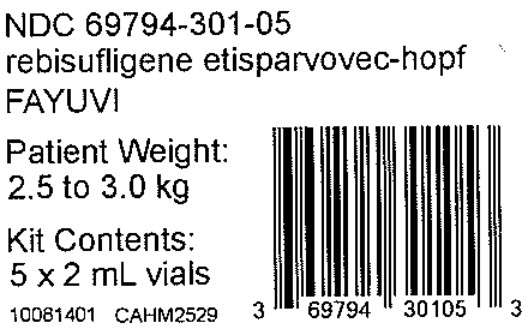
Principal Display Panel (Kit Carton Label)
rebisufligene etisparvovec-hopf
FAYUVI™
Rx only
Single-dose vials
1 × 10¹³ vector genomes/mL
Suspension for intravenous infusion
Store frozen at ≤ -60˚C (-76˚F). DO NOT SHAKE.
Store in the original carton protected from light
until ready to use.
Do not refreeze.
See prescribing information for dosage and
administration instructions.
No Preservative
No U.S. standard of potency.
Discard unused portion.
Manufactured by:
Ultragenyx Pharmaceutical Inc.
Novato, CA 94949
U.S. License No. 2040
ultragenyx
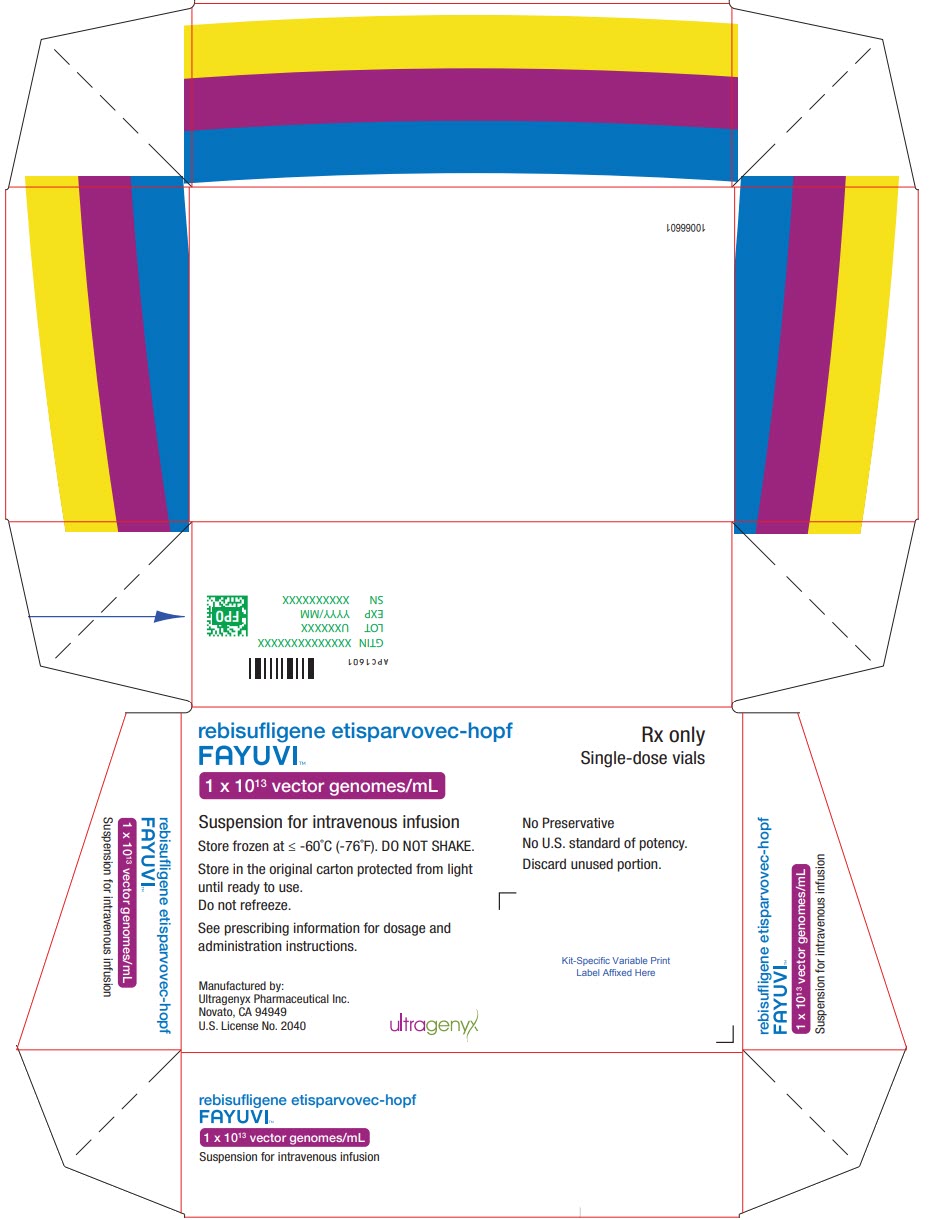
Principal Display Panel (Kit Carton)
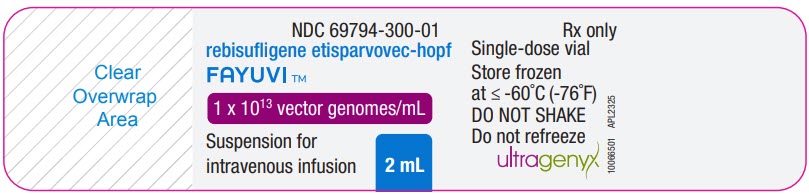
NDC 69794-300-01
rebisufligene etisparvovec-hopf
FAYUVI™
1 x 10¹³ vector genomes/mL
Suspension for
intravenous infusion
2 mL
Rx only
Single-dose vial
Store frozen
at ≤ -60˚C (-76˚F)
DO NOT SHAKE
Do not refreeze
ultragenyx
10066501
APL2325
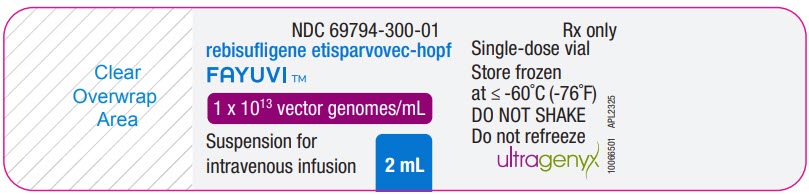
Principal Display Panel (2 mL Vial Label)
NDC 69794-302-06
rebisufligene etisparvovec-hopf
FAYUVI
Patient Weight:
3.1 to 4.0 kg
Kit Contents:
6 x 2 mL vials
10081401
CAHM2531
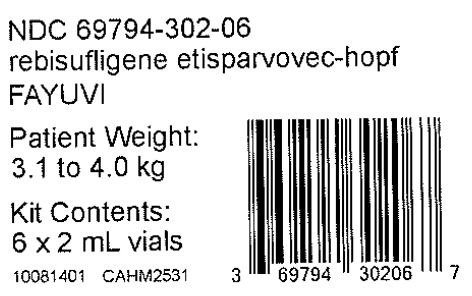
Principal Display Panel (Kit Carton Label)
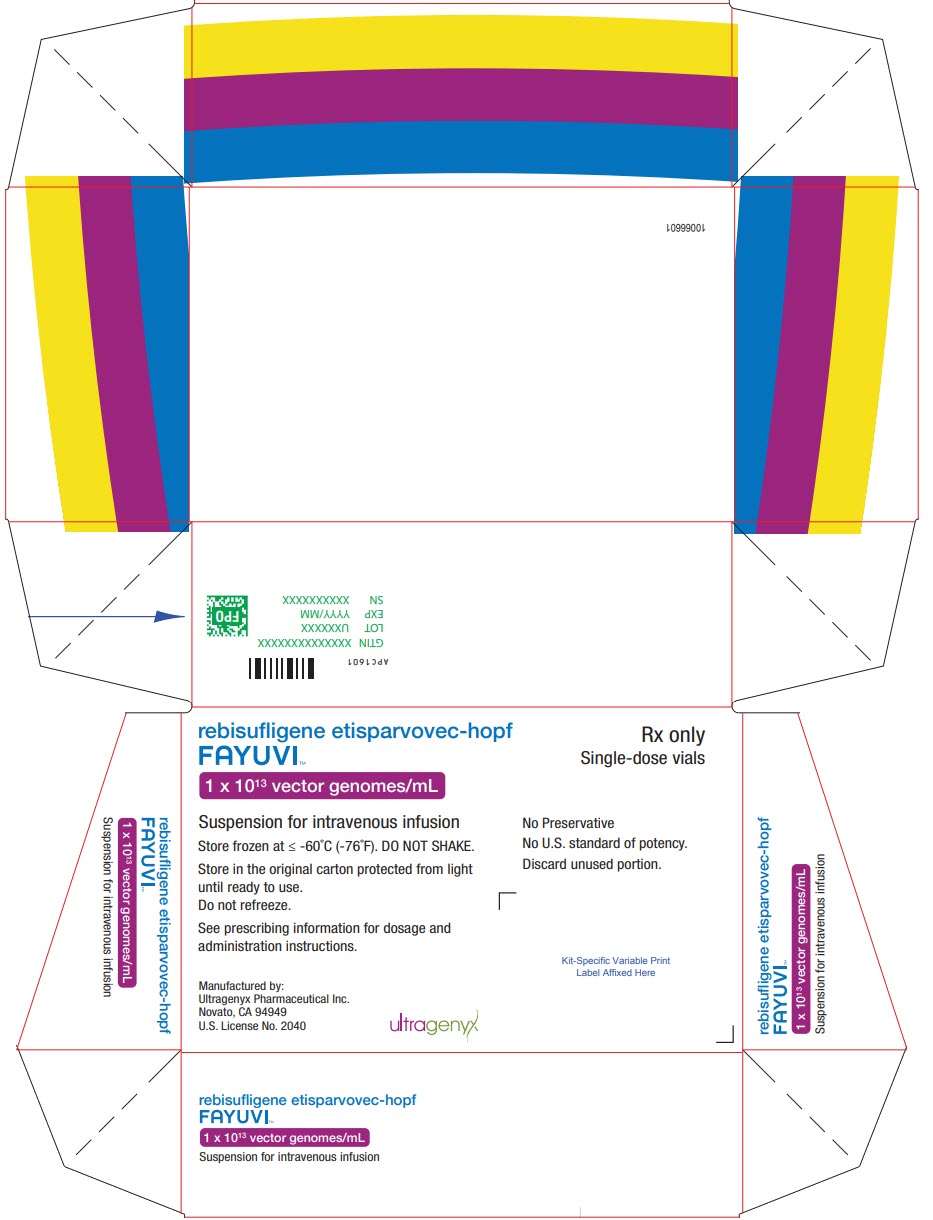
rebisufligene etisparvovec-hopf
FAYUVI™
Rx only
Single-dose vials
1 x 10¹³ vector genomes/mL
Suspension for intravenous infusion
Store frozen at ≤ -60˚C (-76˚F). DO NOT SHAKE.
Store in the original carton protected from light
until ready to use.
Do not refreeze.
See prescribing information for dosage and
administration instructions.
No Preservative
No U.S. standard of potency.
Discard unused portion.
Manufactured by:
Ultragenyx Pharmaceutical Inc.
Novato, CA 94949
U.S. License No. 2040
ultragenyx
Principal Display Panel (Kit Carton)
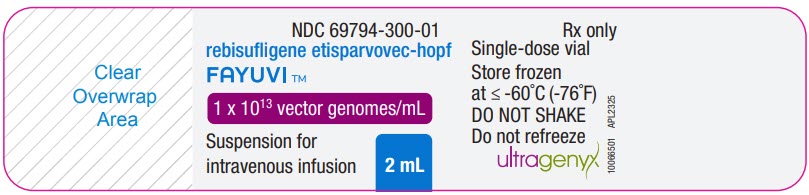
NDC 69794-300-01
rebisufligene etisparvovec-hopf
FAYUVI™
1 x 10¹³ vector genomes/mL
Suspension for
intravenous infusion
2 mL
Rx only
Single-dose vial
Store frozen
at ≤ -60˚C (-76˚F)
DO NOT SHAKE
Do not refreeze
ultragenyx
10066501
APL2325
Principal Display Panel (2 mL Vial Label)
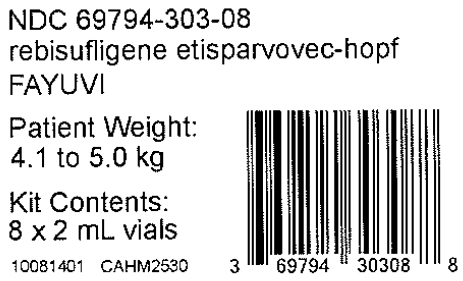
NDC 69794-303-08
rebisufligene etisparvovec-hopf
FAYUVI
Patient Weight:
4.1 to 5.0 kg
Kit Contents:
8 x 2 mL vials
10081401
CAHM2530
Principal Display Panel (Kit Carton Label)
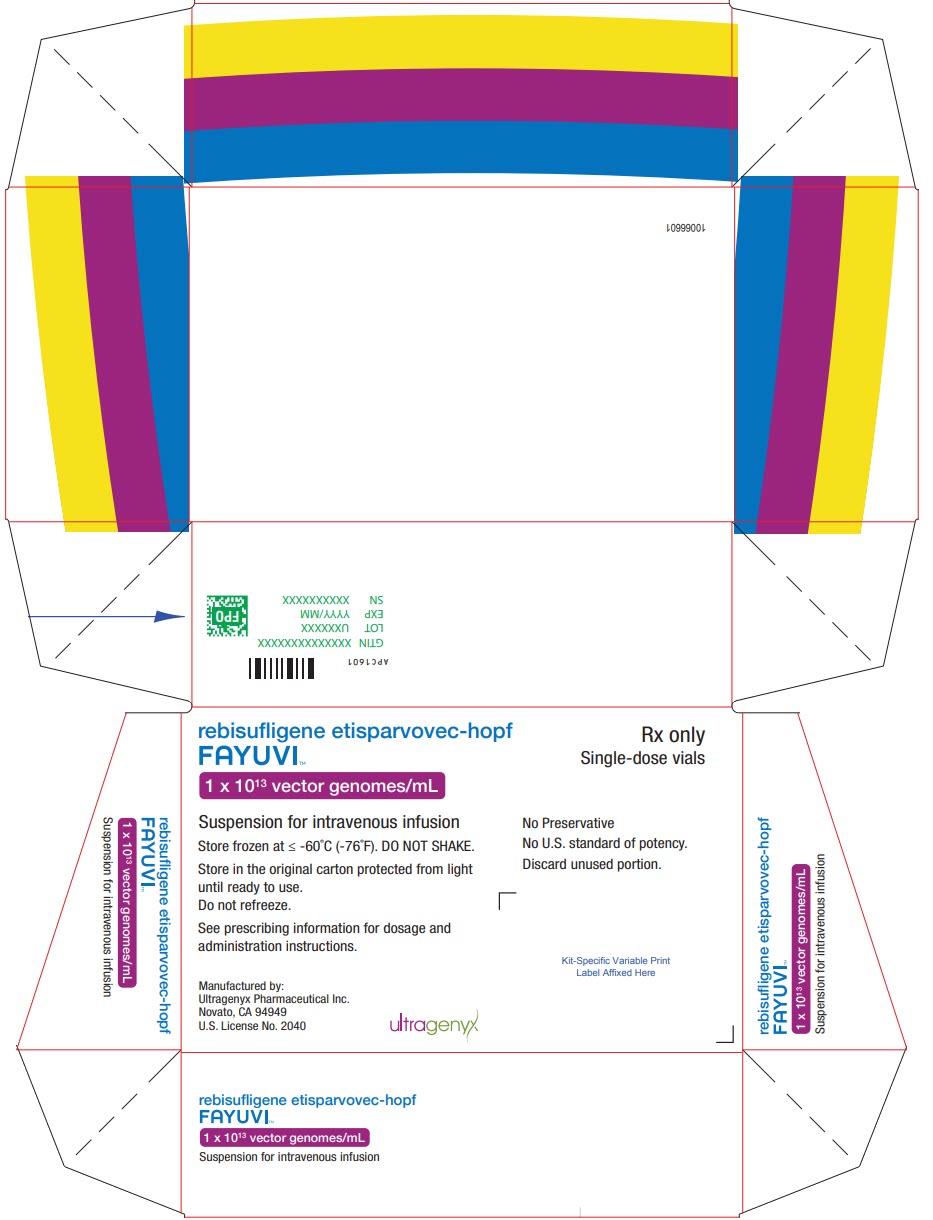
rebisufligene etisparvovec-hopf
FAYUVI™
Rx only
Single-dose vials
1 x 10¹³ vector genomes/mL
Suspension for intravenous infusion
Store frozen at ≤ -60˚C (-76˚F). DO NOT SHAKE.
Store in the original carton protected from light
until ready to use.
Do not refreeze.
See prescribing information for dosage and
administration instructions.
No Preservative
No U.S. standard of potency.
Discard unused portion.
Manufactured by:
Ultragenyx Pharmaceutical Inc.
Novato, CA 94949
U.S. License No. 2040
ultragenyx
Principal Display Panel (Kit Carton)
NDC 69794-300-01
rebisufligene etisparvovec-hopf
FAYUVI™
1 x 10¹³ vector genomes/mL
Suspension for
intravenous infusion
2 mL
Rx only
Single-dose vial
Store frozen
at ≤ -60˚C (-76˚F)
DO NOT SHAKE
Do not refreeze
ultragenyx
10066501
APL2325
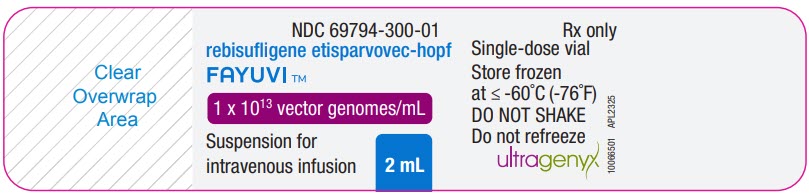
Principal Display Panel (2 mL Vial Label)
NDC 69794-346-09
rebisufligene etisparvovec-hopf
FAYUVI
Patient Weight:
5.1 to 6.0 kg
Kit Contents:
9 x 2 mL vials
10081401
CAHM2533
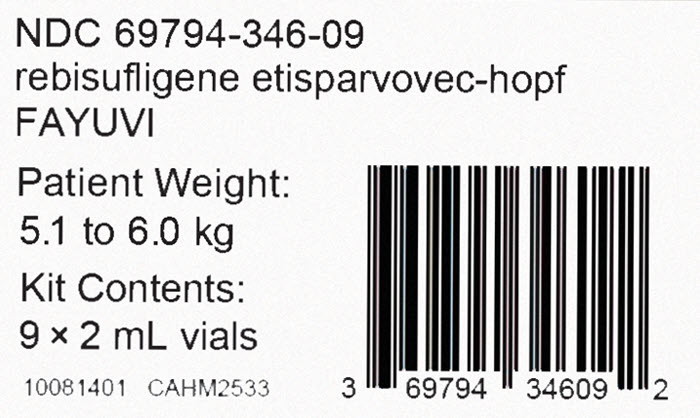
Principal Display Panel (Kit Carton Label)
rebisufligene etisparvovec-hopf
FAYUVI™
Rx only
Single-dose vials
1 x 10¹³ vector genomes/mL
Suspension for intravenous infusion
Store frozen at ≤ -60˚C (-76˚F). DO NOT SHAKE.
Store in the original carton protected from light
until ready to use.
Do not refreeze.
See prescribing information for dosage and
administration instructions.
No Preservative
No U.S. standard of potency.
Discard unused portion.
Manufactured by:
Ultragenyx Pharmaceutical Inc.
Novato, CA 94949
U.S. License No. 2040
ultragenyx
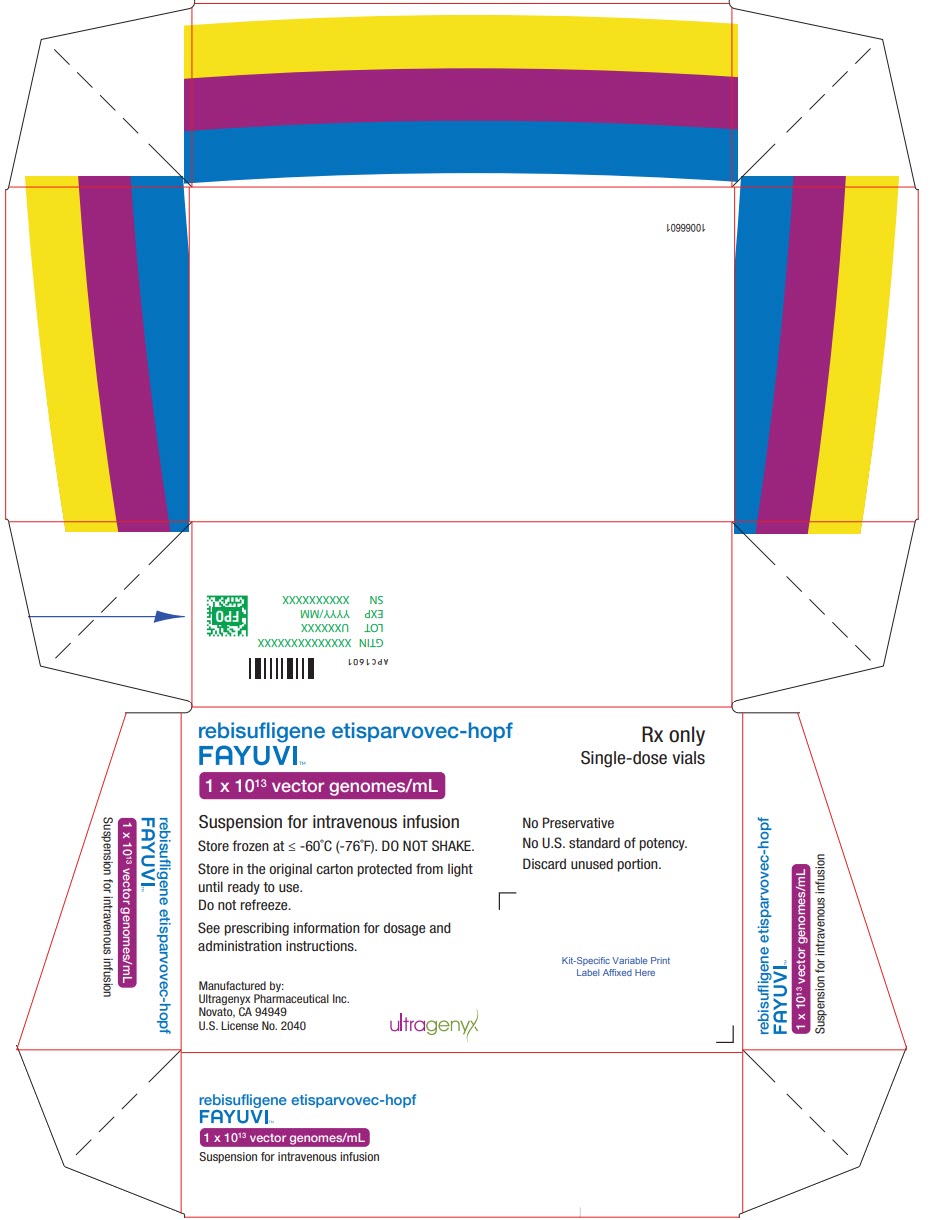
Principal Display Panel (Kit Carton)
NDC 69794-300-01
rebisufligene etisparvovec-hopf
FAYUVI™
1 x 10¹³ vector genomes/mL
Suspension for
intravenous infusion
2 mL
Rx only
Single-dose vial
Store frozen
at ≤ -60˚C (-76˚F)
DO NOT SHAKE
Do not refreeze
ultragenyx
10066501
APL2325
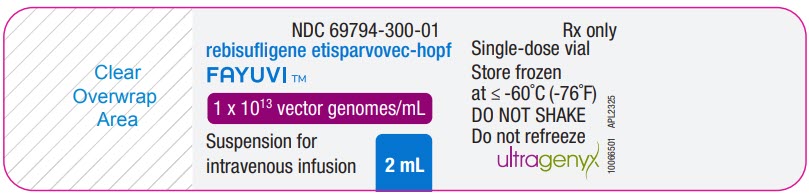
Principal Display Panel (2 mL Vial Label)
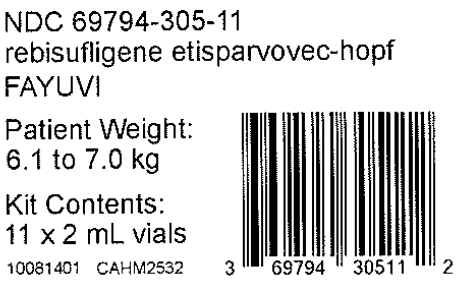
NDC 69794-305-11
rebisufligene etisparvovec-hopf
FAYUVI
Patient Weight:
6.1 to 7.0 kg
Kit Contents:
11 x 2 mL vials
10081401
CAHM2532
Principal Display Panel (Kit Carton Label)
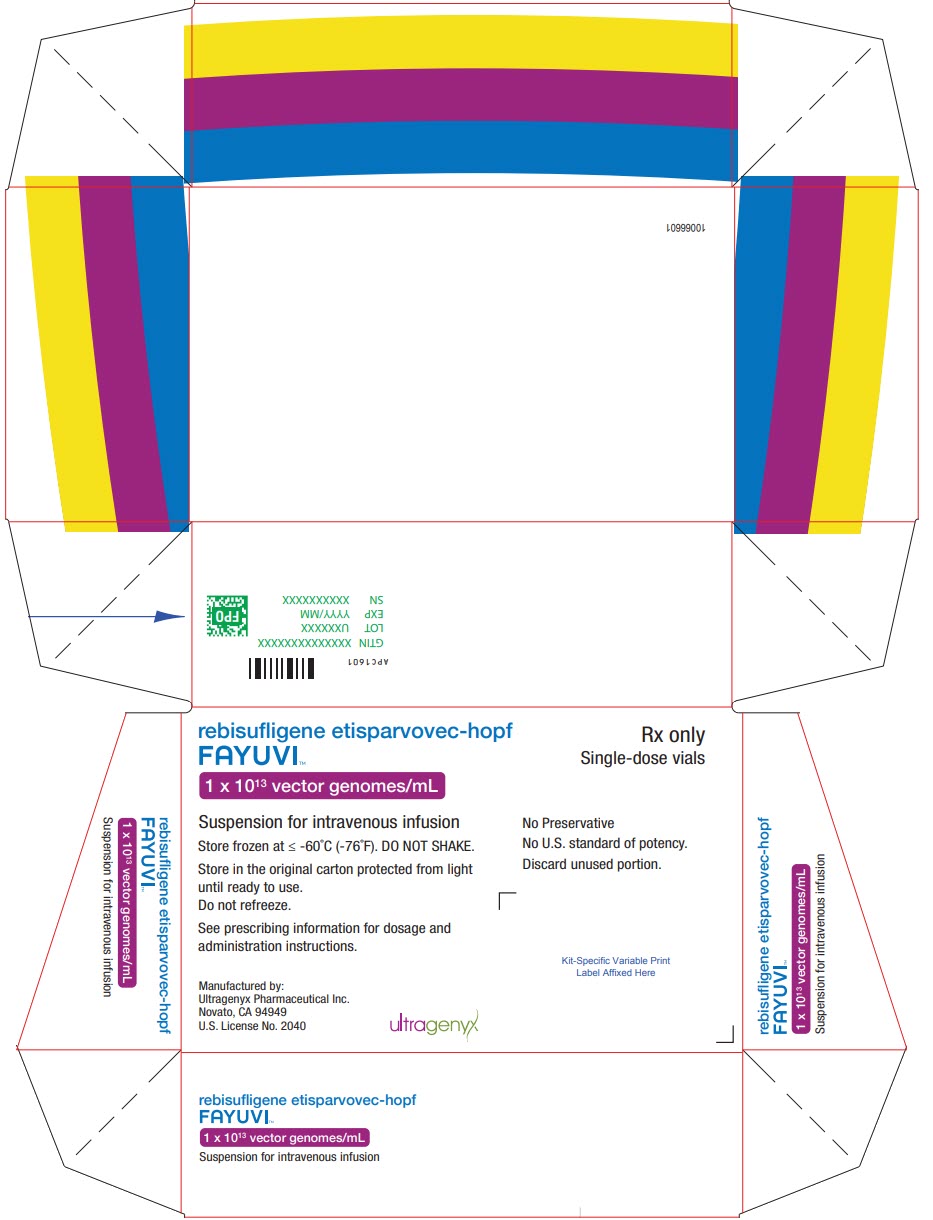
rebisufligene etisparvovec-hopf
FAYUVI™
Rx only
Single-dose vials
1 x 10¹³ vector genomes/mL
Suspension for intravenous infusion
Store frozen at ≤ -60˚C (-76˚F). DO NOT SHAKE.
Store in the original carton protected from light
until ready to use.
Do not refreeze.
See prescribing information for dosage and
administration instructions.
No Preservative
No U.S. standard of potency.
Discard unused portion.
Manufactured by:
Ultragenyx Pharmaceutical Inc.
Novato, CA 94949
U.S. License No. 2040
ultragenyx
Principal Display Panel (Kit Carton)
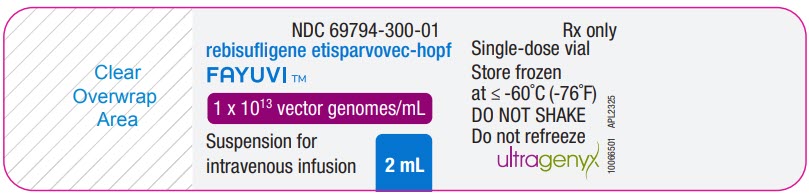
NDC 69794-300-01
rebisufligene etisparvovec-hopf
FAYUVI™
1 x 10¹³ vector genomes/mL
Suspension for
intravenous infusion
2 mL
Rx only
Single-dose vial
Store frozen
at ≤ -60˚C (-76˚F)
DO NOT SHAKE
Do not refreeze
ultragenyx
10066501
APL2325
Principal Display Panel (2 mL Vial Label)
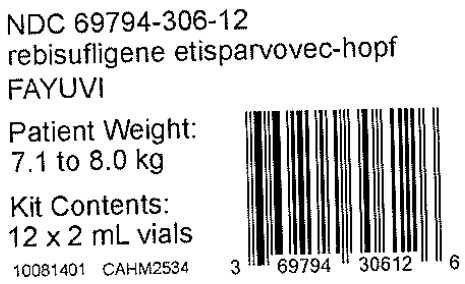
NDC 69794-306-12
rebisufligene etisparvovec-hopf
FAYUVI
Patient Weight:
7.1 to 8.0 kg
Kit Contents:
12 x 2 mL vials
10081401
CAHM2534
Principal Display Panel (Kit Carton Label)
rebisufligene etisparvovec-hopf
FAYUVI™
Rx only
Single-dose vials
1 x 10¹³ vector genomes/mL
Suspension for intravenous infusion
Store frozen at ≤ -60˚C (-76˚F). DO NOT SHAKE.
Store in the original carton protected from light
until ready to use.
Do not refreeze.
See prescribing information for dosage and
administration instructions.
No Preservative
No U.S. standard of potency.
Discard unused portion.
Manufactured by:
Ultragenyx Pharmaceutical Inc.
Novato, CA 94949
U.S. License No. 2040
ultragenyx
Principal Display Panel (Kit Carton)
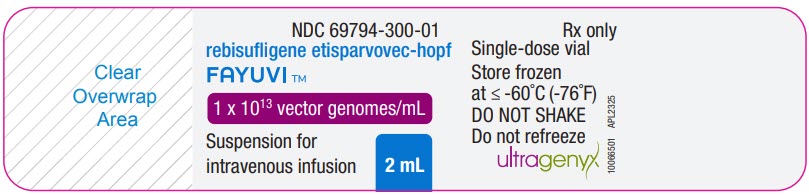
NDC 69794-300-01
rebisufligene etisparvovec-hopf
FAYUVI™
1 x 10¹³ vector genomes/mL
Suspension for
intravenous infusion
2 mL
Rx only
Single-dose vial
Store frozen
at ≤ -60˚C (-76˚F)
DO NOT SHAKE
Do not refreeze
ultragenyx
10066501
APL2325
Principal Display Panel (2 mL Vial Label)
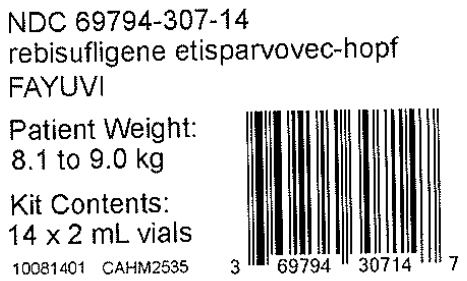
NDC 69794-307-14
rebisufligene etisparvovec-hopf
FAYUVI
Patient Weight:
8.1 to 9.0 kg
Kit Contents:
14 x 2 mL vials
10081401
CAHM2535
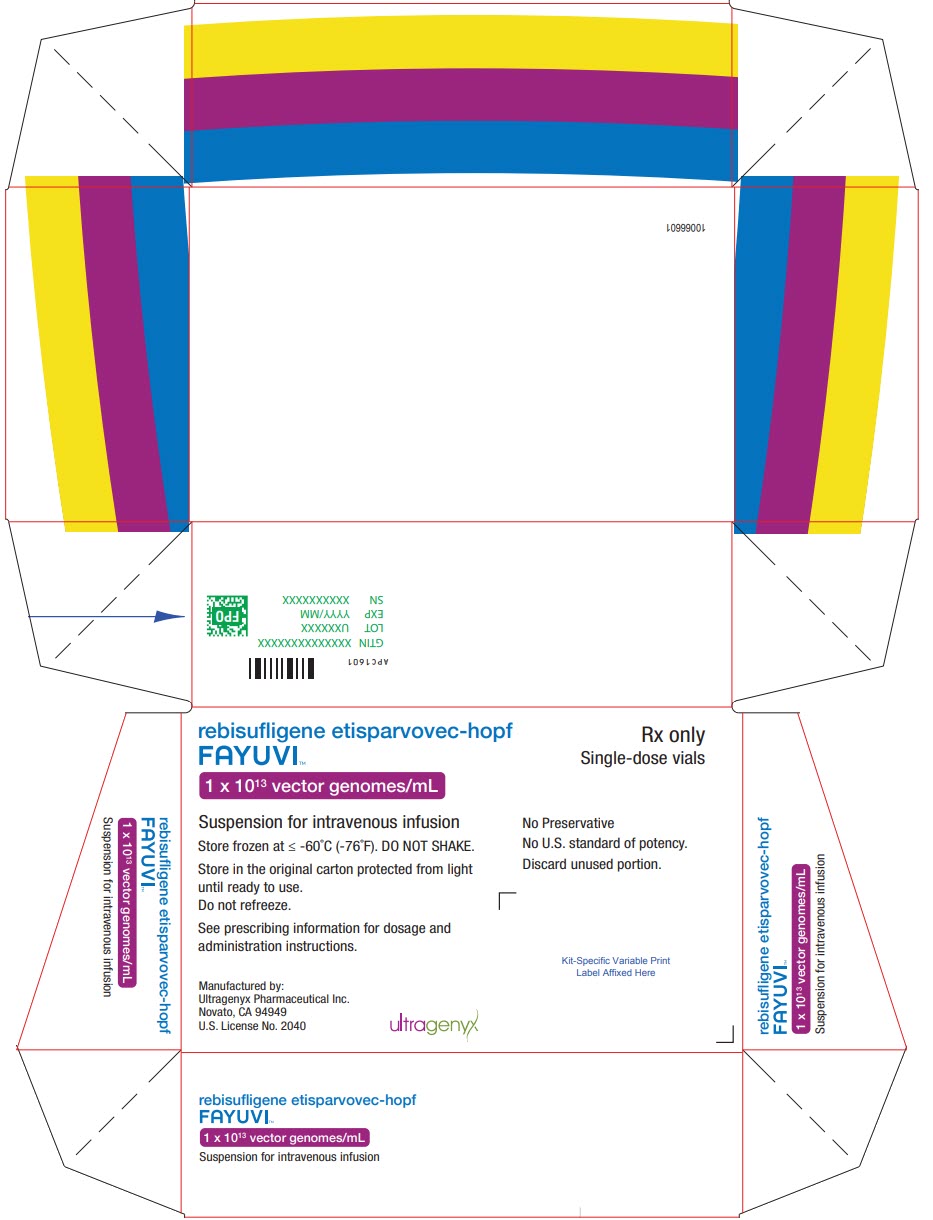
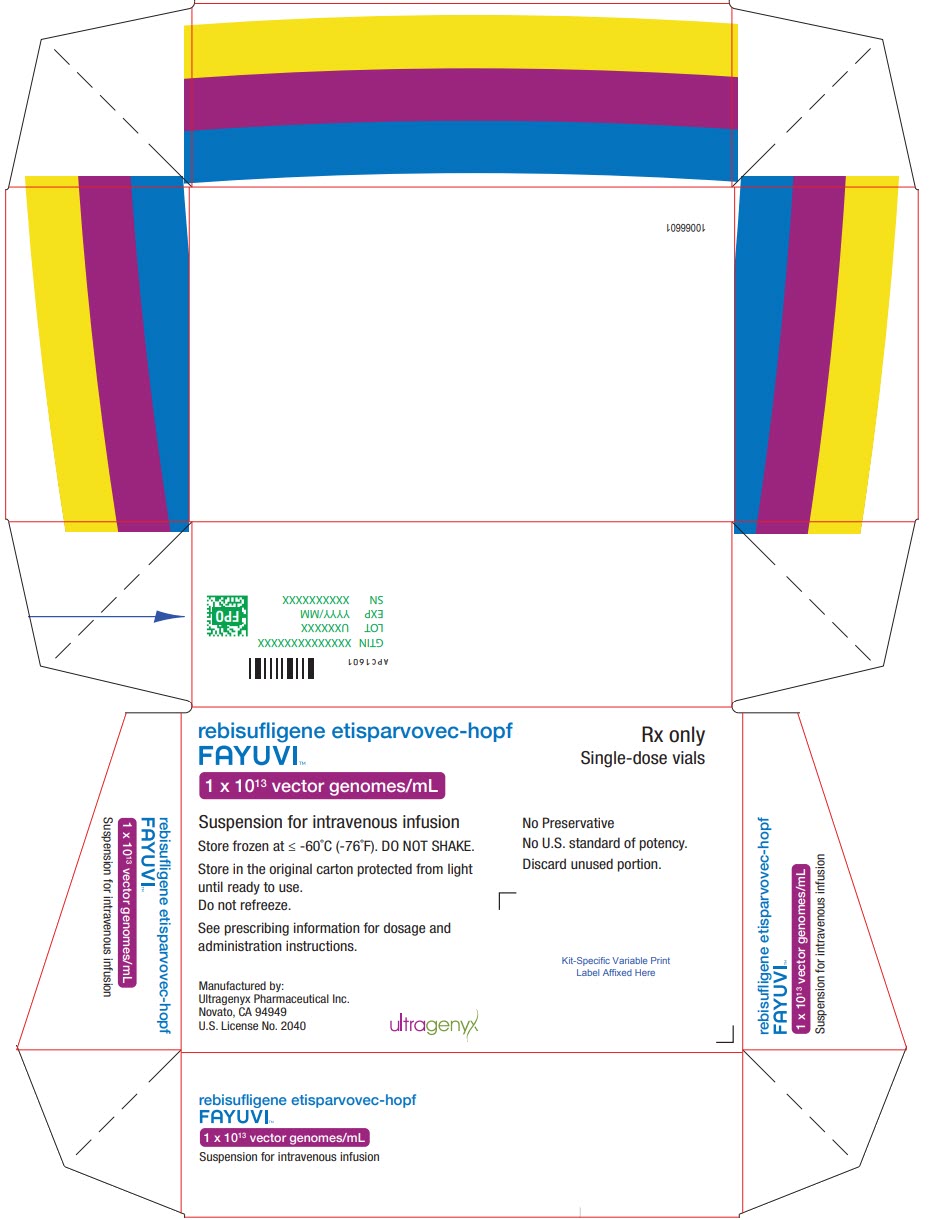
Principal Display Panel (Kit Carton Label)
rebisufligene etisparvovec-hopf
FAYUVI™
Rx only
Single-dose vials
1 x 10¹³ vector genomes/mL
Suspension for intravenous infusion
Store frozen at ≤ -60˚C (-76˚F). DO NOT SHAKE.
Store in the original carton protected from light
until ready to use.
Do not refreeze.
See prescribing information for dosage and
administration instructions.
No Preservative
No U.S. standard of potency.
Discard unused portion.
Manufactured by:
Ultragenyx Pharmaceutical Inc.
Novato, CA 94949
U.S. License No. 2040
ultragenyx
Principal Display Panel (Kit Carton)
NDC 69794-300-01
rebisufligene etisparvovec-hopf
FAYUVI™
1 x 10¹³ vector genomes/mL
Suspension for
intravenous infusion
2 mL
Rx only
Single-dose vial
Store frozen
at ≤ -60˚C (-76˚F)
DO NOT SHAKE
Do not refreeze
ultragenyx
10066501
APL2325
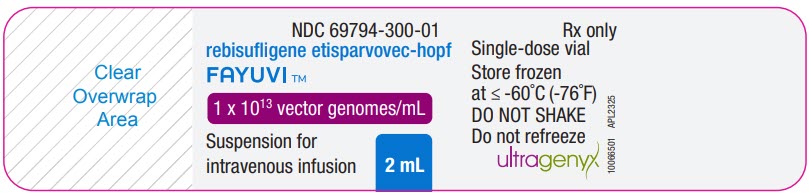
Principal Display Panel (2 mL Vial Label)
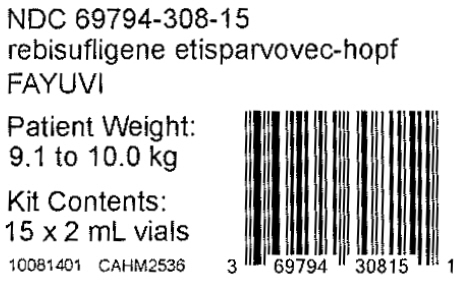
NDC 69794-308-15
rebisufligene etisparvovec-hopf
FAYUVI
Patient Weight:
9.1 to 10.0 kg
Kit Contents:
15 x 2 mL vials
10081401
CAHM2536
Principal Display Panel (Kit Carton Label)
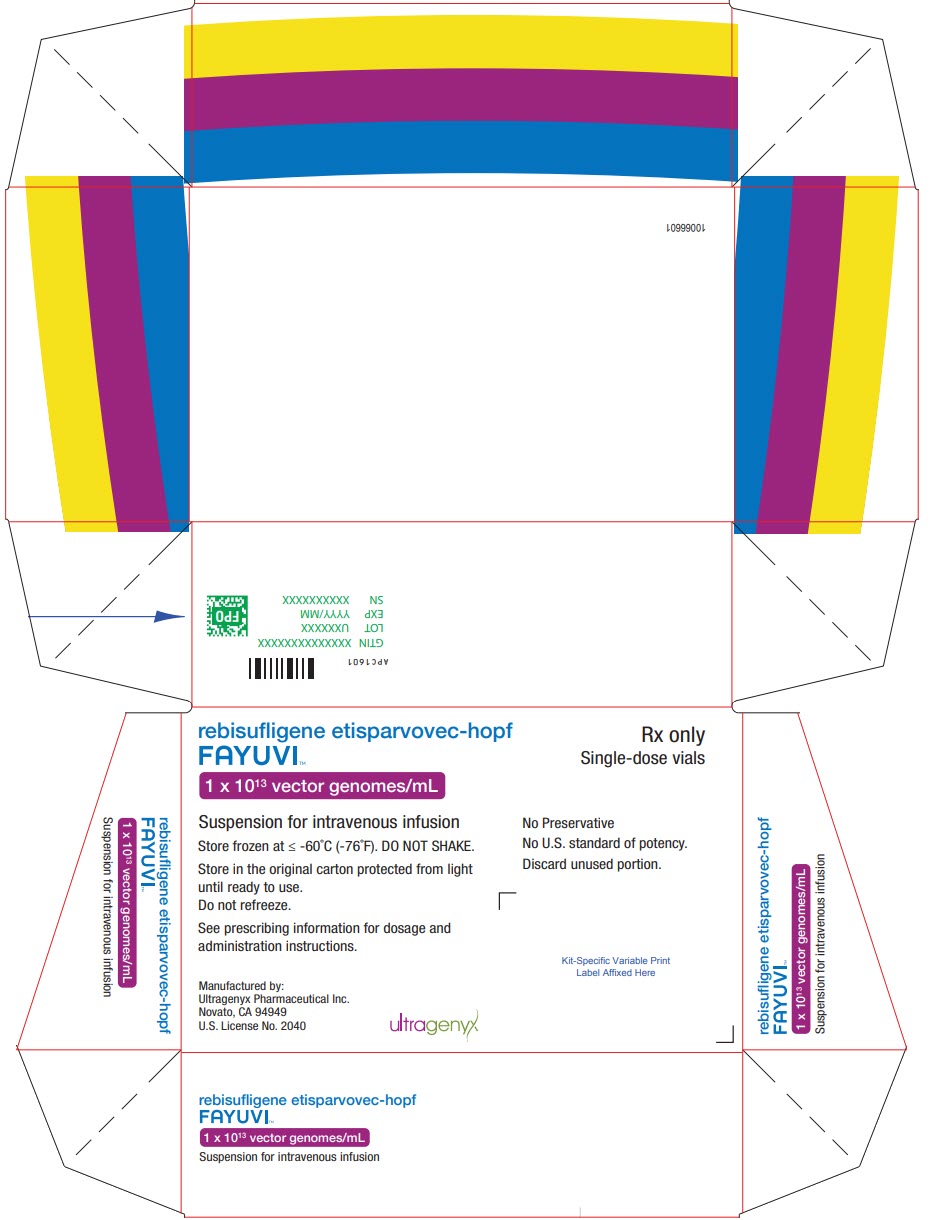
rebisufligene etisparvovec-hopf
FAYUVI™
Rx only
Single-dose vials
1 x 10¹³ vector genomes/mL
Suspension for intravenous infusion
Store frozen at ≤ -60˚C (-76˚F). DO NOT SHAKE.
Store in the original carton protected from light
until ready to use.
Do not refreeze.
See prescribing information for dosage and
administration instructions.
No Preservative
No U.S. standard of potency.
Discard unused portion.
Manufactured by:
Ultragenyx Pharmaceutical Inc.
Novato, CA 94949
U.S. License No. 2040
ultragenyx
Principal Display Panel (Kit Carton)
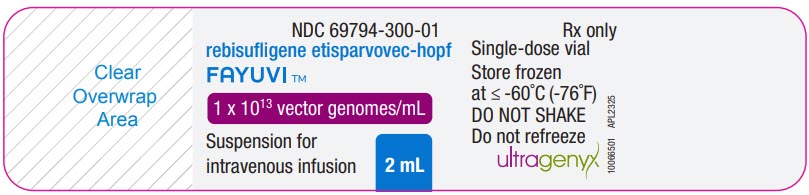
NDC 69794-300-01
rebisufligene etisparvovec-hopf
FAYUVI™
1 x 10¹³ vector genomes/mL
Suspension for
intravenous infusion
2 mL
Rx only
Single-dose vial
Store frozen
at ≤ -60˚C (-76˚F)
DO NOT SHAKE
Do not refreeze
ultragenyx
10066501
APL2325
Principal Display Panel (2 mL Vial Label)
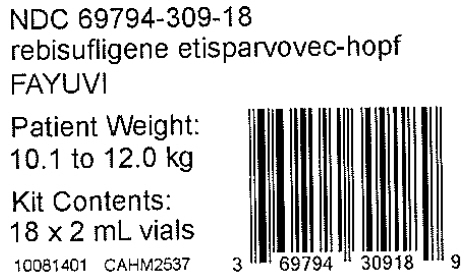
NDC 69794-309-18
rebisufligene etisparvovec-hopf
FAYUVI
Patient Weight:
10.1 to 12.0 kg
Kit Contents:
18 x 2 mL vials
10081401
CAHM2537
Principal Display Panel (Kit Carton Label)
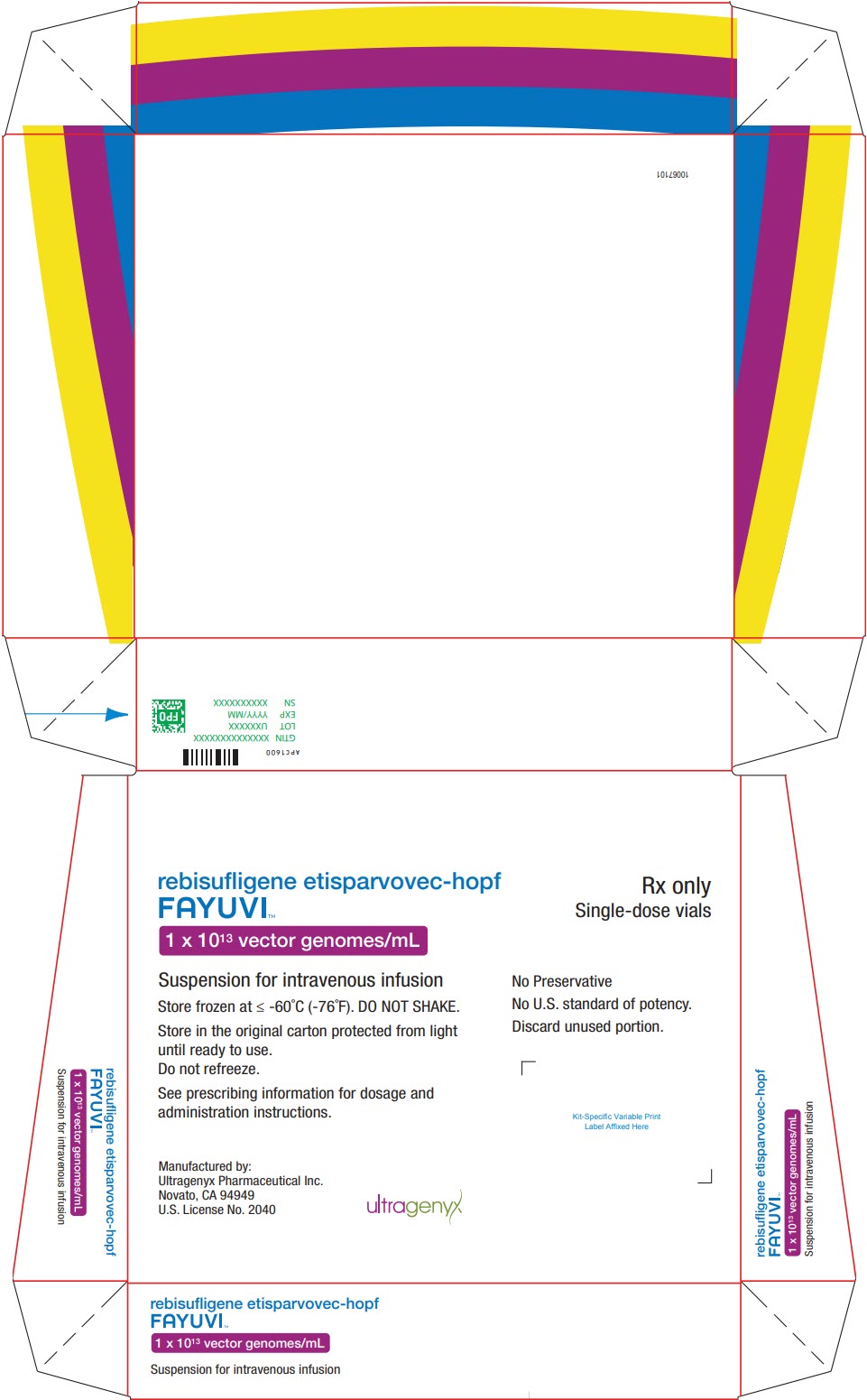
rebisufligene etisparvovec-hopf
FAYUVI™
Rx only
Single-dose vials
1 x 10¹³ vector genomes/mL
Suspension for intravenous infusion
Store frozen at ≤ -60˚C (-76˚F). DO NOT SHAKE.
Store in the original carton protected from light
until ready to use.
Do not refreeze.
See prescribing information for dosage and
administration instructions.
No Preservative
No U.S. standard of potency.
Discard unused portion.
Manufactured by:
Ultragenyx Pharmaceutical Inc.
Novato, CA 94949
U.S. License No. 2040
ultragenyx
Principal Display Panel (Kit Carton)
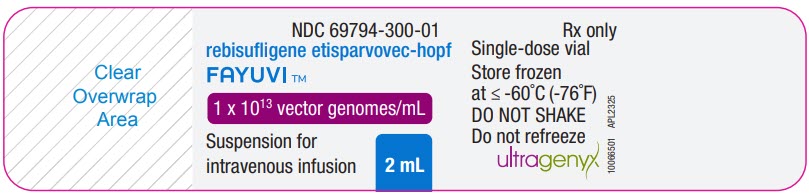
NDC 69794-300-01
rebisufligene etisparvovec-hopf
FAYUVI™
1 x 10¹³ vector genomes/mL
Suspension for
intravenous infusion
2 mL
Rx only
Single-dose vial
Store frozen
at ≤ -60˚C (-76˚F)
DO NOT SHAKE
Do not refreeze
ultragenyx
10066501
APL2325
Principal Display Panel (2 mL Vial Label)
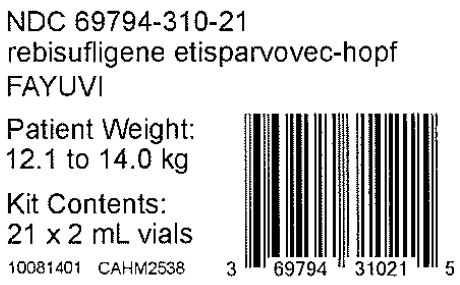
NDC 69794-310-21
rebisufligene etisparvovec-hopf
FAYUVI
Patient Weight:
12.1 to 14.0 kg
Kit Contents:
21 x 2 mL vials
10081401
CAHM2538
Principal Display Panel (Kit Carton Label)
rebisufligene etisparvovec-hopf
FAYUVI™
Rx only
Single-dose vials
1 x 10¹³ vector genomes/mL
Suspension for intravenous infusion
Store frozen at ≤ -60˚C (-76˚F). DO NOT SHAKE.
Store in the original carton protected from light
until ready to use.
Do not refreeze.
See prescribing information for dosage and
administration instructions.
No Preservative
No U.S. standard of potency.
Discard unused portion.
Manufactured by:
Ultragenyx Pharmaceutical Inc.
Novato, CA 94949
U.S. License No. 2040
ultragenyx
Principal Display Panel (Kit Carton)
NDC 69794-300-01
rebisufligene etisparvovec-hopf
FAYUVI™
1 x 10¹³ vector genomes/mL
Suspension for
intravenous infusion
2 mL
Rx only
Single-dose vial
Store frozen
at ≤ -60˚C (-76˚F)
DO NOT SHAKE
Do not refreeze
ultragenyx
10066501
APL2325
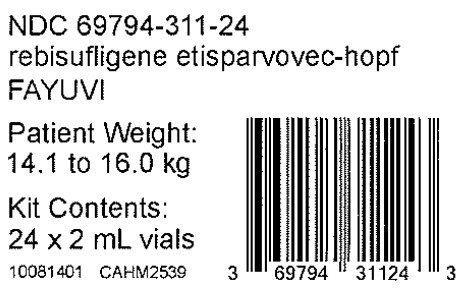
Principal Display Panel (2 mL Vial Label)
NDC 69794-311-24
rebisufligene etisparvovec-hopf
FAYUVI
Patient Weight:
14.1 to 16.0 kg
Kit Contents:
24 x 2 mL vials
10081401
CAHM2539
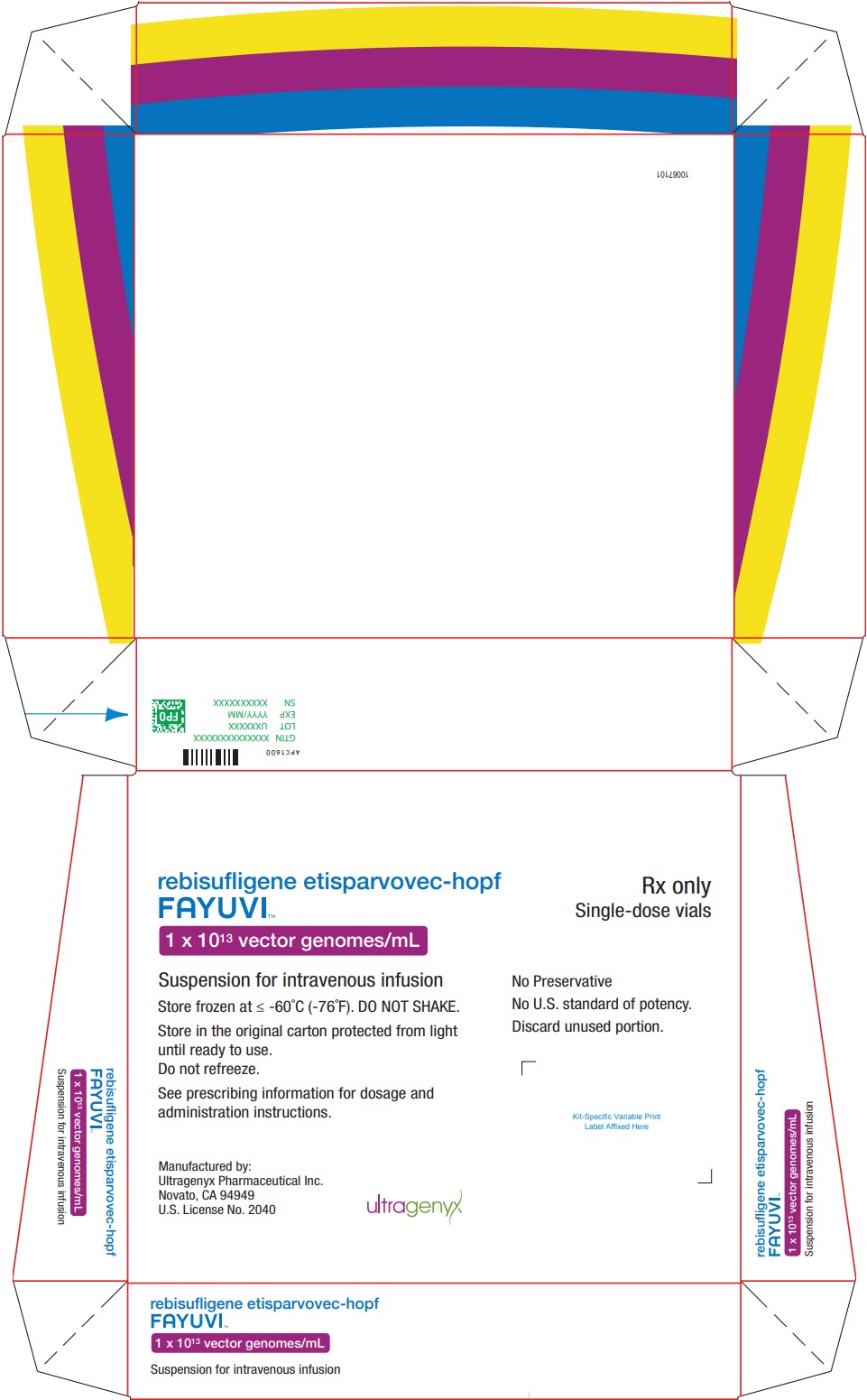
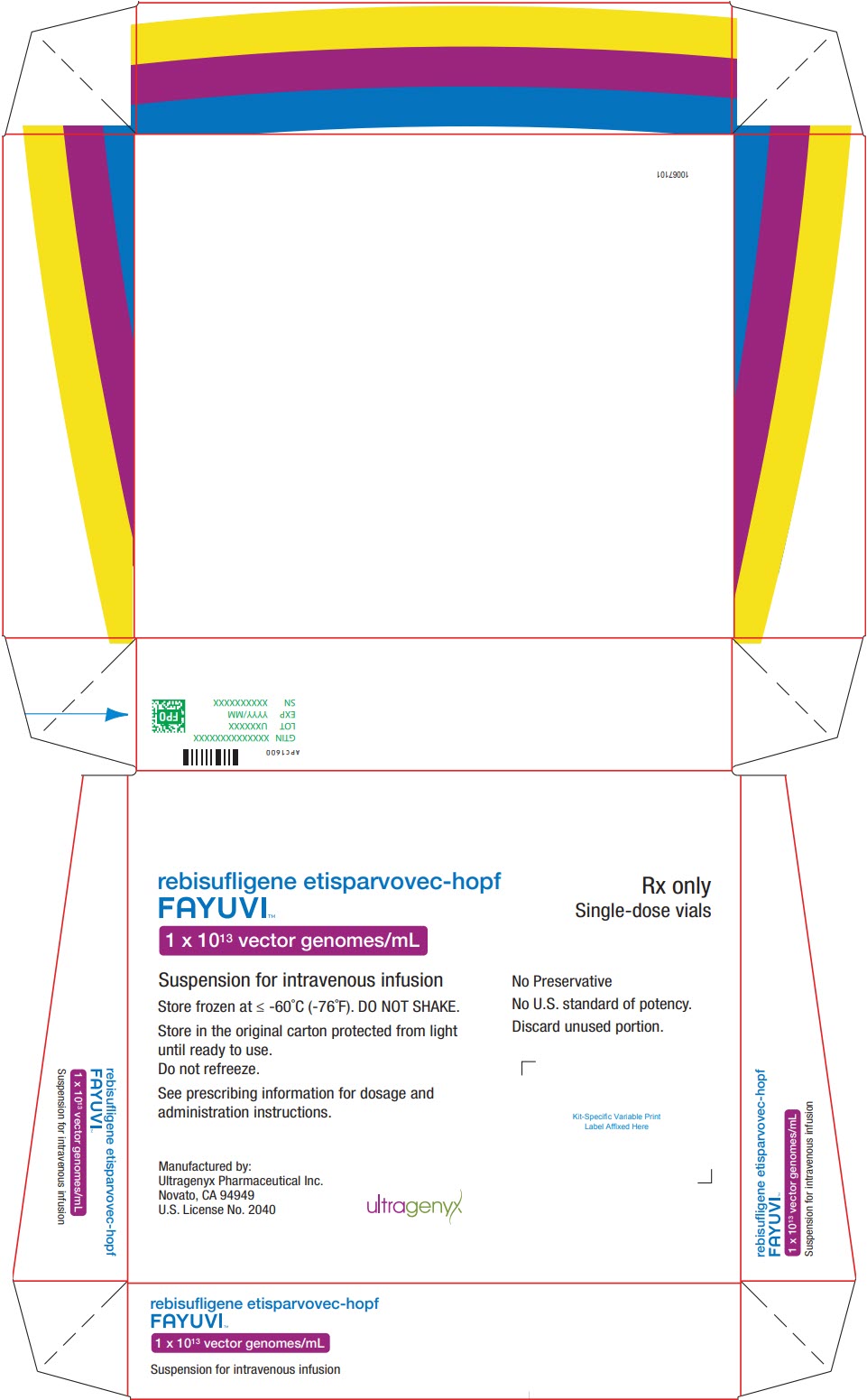
Principal Display Panel (Kit Carton Label)
rebisufligene etisparvovec-hopf
FAYUVI™
Rx only
Single-dose vials
1 x 10¹³ vector genomes/mL
Suspension for intravenous infusion
Store frozen at ≤ -60˚C (-76˚F). DO NOT SHAKE.
Store in the original carton protected from light
until ready to use.
Do not refreeze.
See prescribing information for dosage and
administration instructions.
No Preservative
No U.S. standard of potency.
Discard unused portion.
Manufactured by:
Ultragenyx Pharmaceutical Inc.
Novato, CA 94949
U.S. License No. 2040
ultragenyx
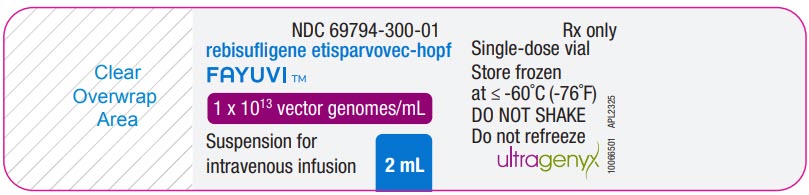
Principal Display Panel (Kit Carton)
NDC 69794-300-01
rebisufligene etisparvovec-hopf
FAYUVI™
1 x 10¹³ vector genomes/mL
Suspension for
intravenous infusion
2 mL
Rx only
Single-dose vial
Store frozen
at ≤ -60˚C (-76˚F)
DO NOT SHAKE
Do not refreeze
ultragenyx
10066501
APL2325
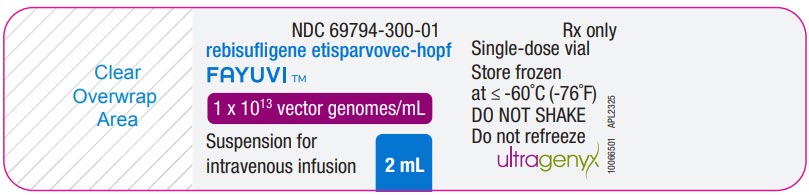
Principal Display Panel (2 mL Vial Label)
NDC 69794-312-27
rebisufligene etisparvovec-hopf
FAYUVI
Patient Weight:
16.1 to 18.0 kg
Kit Contents:
27 x 2 mL vials
10081401
CAHM2540
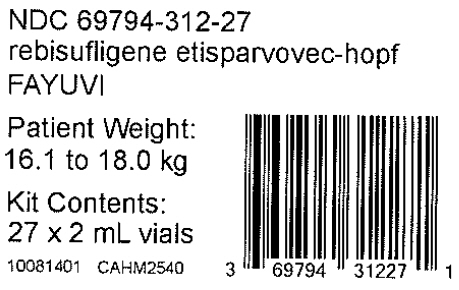
Principal Display Panel (Kit Carton Label)
rebisufligene etisparvovec-hopf
FAYUVI™
Rx only
Single-dose vials
1 x 10¹³ vector genomes/mL
Suspension for intravenous infusion
Store frozen at ≤ -60˚C (-76˚F). DO NOT SHAKE.
Store in the original carton protected from light
until ready to use.
Do not refreeze.
See prescribing information for dosage and
administration instructions.
No Preservative
No U.S. standard of potency.
Discard unused portion.
Manufactured by:
Ultragenyx Pharmaceutical Inc.
Novato, CA 94949
U.S. License No. 2040
ultragenyx
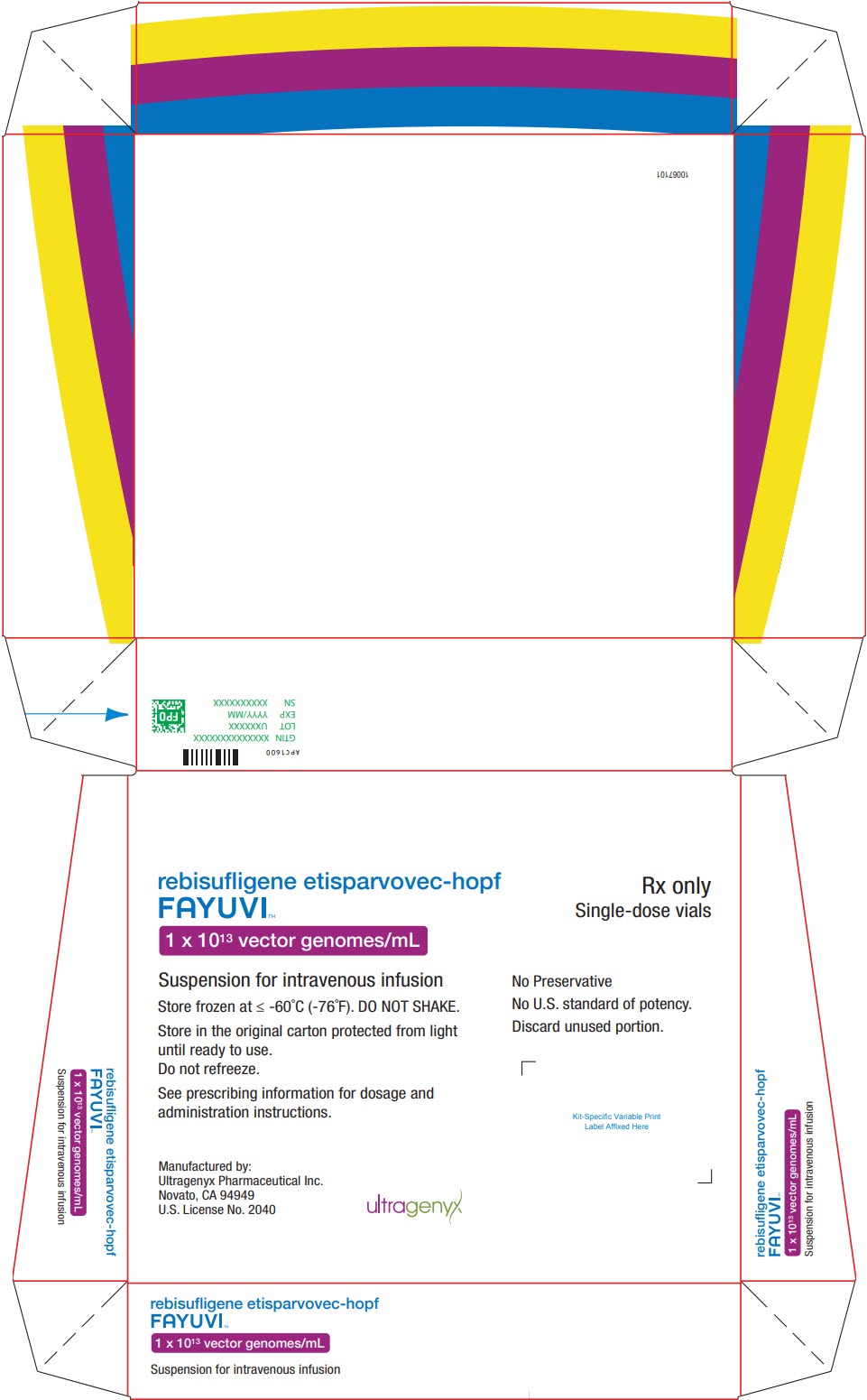
Principal Display Panel (Kit Carton)
NDC 69794-300-01
rebisufligene etisparvovec-hopf
FAYUVI™
1 x 10¹³ vector genomes/mL
Suspension for
intravenous infusion
2 mL
Rx only
Single-dose vial
Store frozen
at ≤ -60˚C (-76˚F)
DO NOT SHAKE
Do not refreeze
ultragenyx
10066501
APL2325
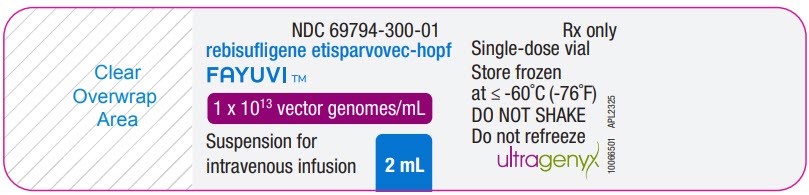
Principal Display Panel (2 mL Vial Label)
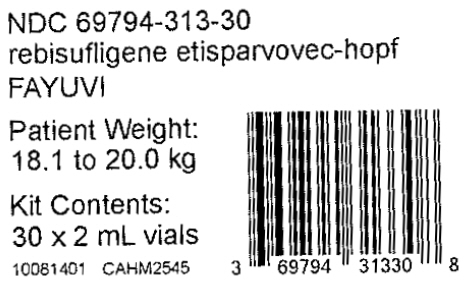
NDC 69794-313-30
rebisufligene etisparvovec-hopf
FAYUVI
Patient Weight:
18.1 to 20.0 kg
Kit Contents:
30 x 2 mL vials
10081401
CAHM2545
Principal Display Panel (Kit Carton Label)
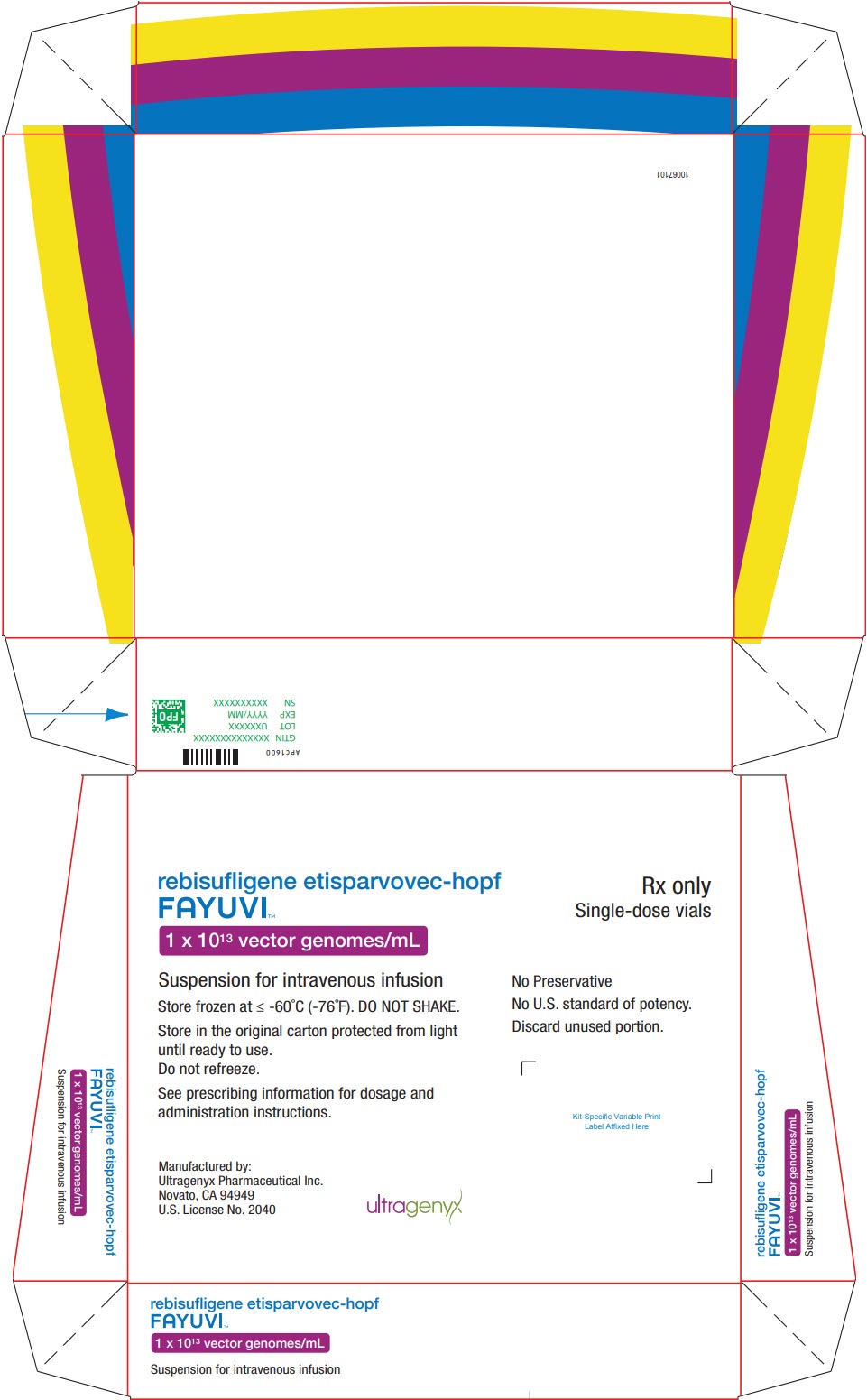
rebisufligene etisparvovec-hopf
FAYUVI™
Rx only
Single-dose vials
1 x 10¹³ vector genomes/mL
Suspension for intravenous infusion
Store frozen at ≤ -60˚C (-76˚F). DO NOT SHAKE.
Store in the original carton protected from light
until ready to use.
Do not refreeze.
See prescribing information for dosage and
administration instructions.
No Preservative
No U.S. standard of potency.
Discard unused portion.
Manufactured by:
Ultragenyx Pharmaceutical Inc.
Novato, CA 94949
U.S. License No. 2040
ultragenyx
Principal Display Panel (Kit Carton)
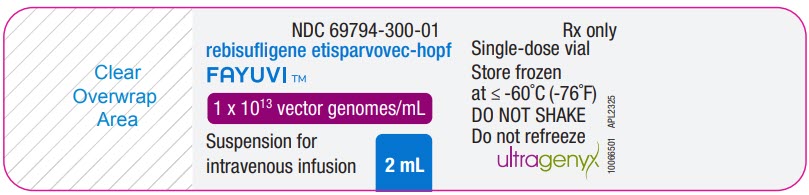
NDC 69794-300-01
rebisufligene etisparvovec-hopf
FAYUVI™
1 x 10¹³ vector genomes/mL
Suspension for
intravenous infusion
2 mL
Rx only
Single-dose vial
Store frozen
at ≤ -60˚C (-76˚F)
DO NOT SHAKE
Do not refreeze
ultragenyx
10066501
APL2325
Principal Display Panel (2 mL Vial Label)
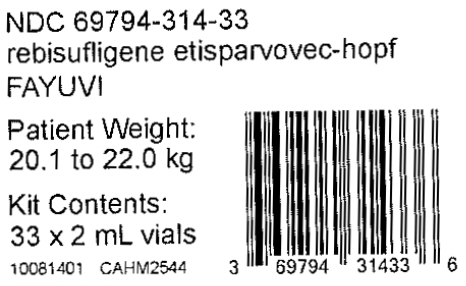
NDC 69794-314-33
rebisufligene etisparvovec-hopf
FAYUVI
Patient Weight:
20.1 to 22.0 kg
Kit Contents:
33 x 2 mL vials
10081401
CAHM2544
Principal Display Panel (Kit Carton Label)
rebisufligene etisparvovec-hopf
FAYUVI™
Rx only
Single-dose vials
1 x 10¹³ vector genomes/mL
Suspension for intravenous infusion
Store frozen at ≤ -60˚C (-76˚F). DO NOT SHAKE.
Store in the original carton protected from light
until ready to use.
Do not refreeze.
See prescribing information for dosage and
administration instructions.
No Preservative
No U.S. standard of potency.
Discard unused portion.
Manufactured by:
Ultragenyx Pharmaceutical Inc.
Novato, CA 94949
U.S. License No. 2040
ultragenyx
Principal Display Panel (Kit Carton)
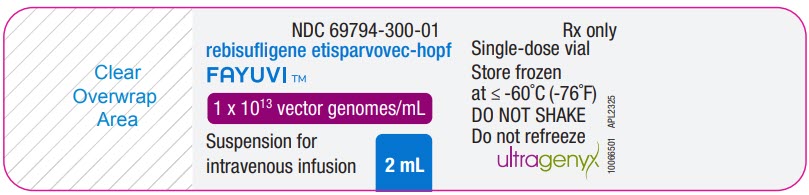
NDC 69794-300-01
rebisufligene etisparvovec-hopf
FAYUVI™
1 x 10¹³ vector genomes/mL
Suspension for
intravenous infusion
2 mL
Rx only
Single-dose vial
Store frozen
at ≤ -60˚C (-76˚F)
DO NOT SHAKE
Do not refreeze
ultragenyx
10066501
APL2325
Principal Display Panel (2 mL Vial Label)
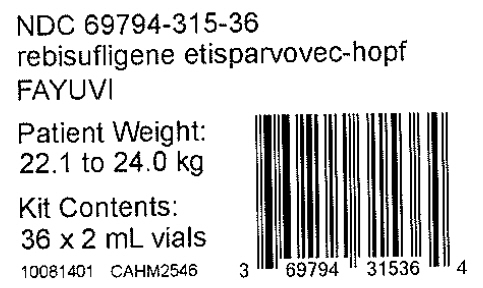
NDC 69794-315-36
rebisufligene etisparvovec-hopf
FAYUVI
Patient Weight:
22.1 to 24.0 kg
Kit Contents:
36 x 2 mL vials
10081401
CAHM2546
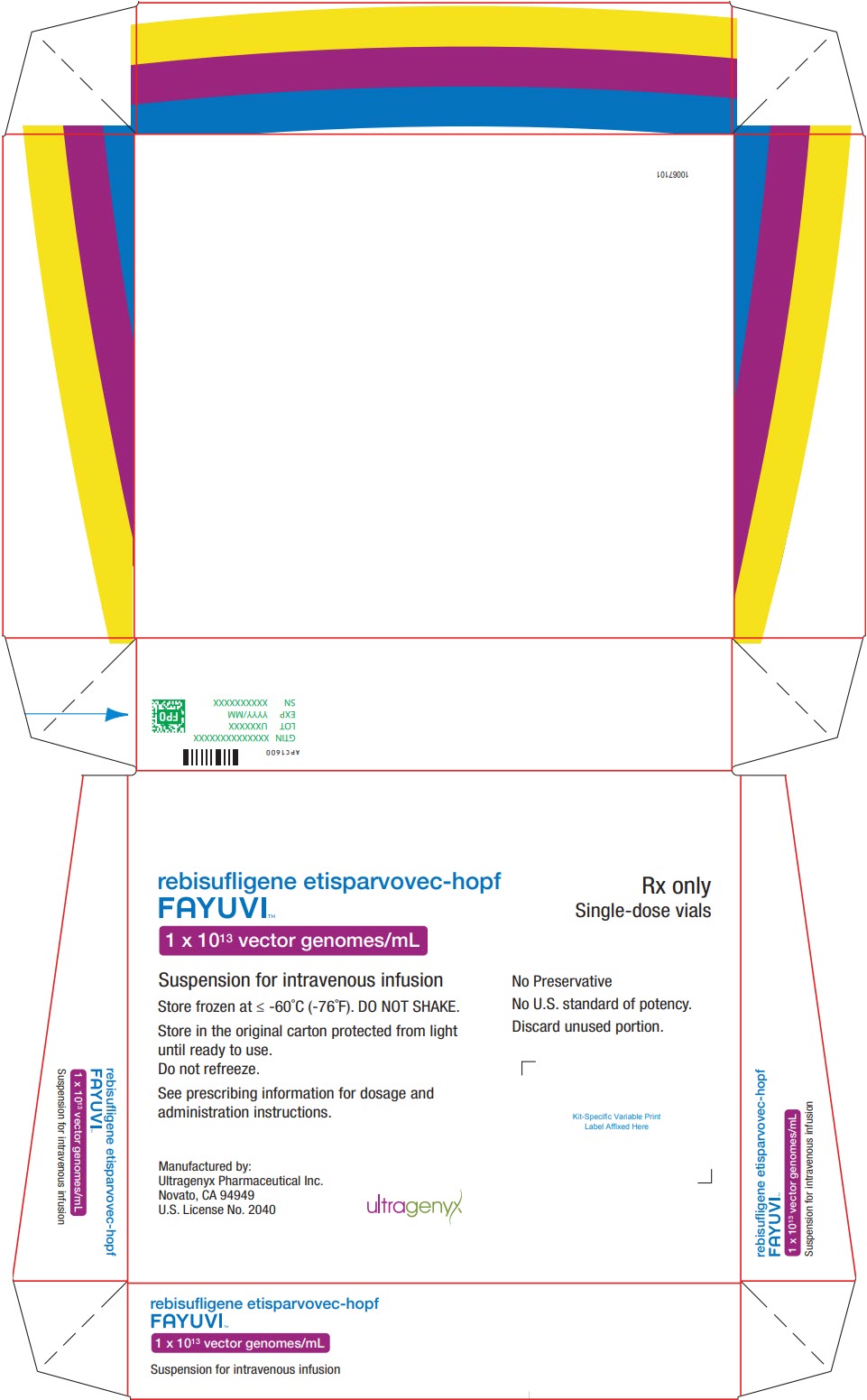
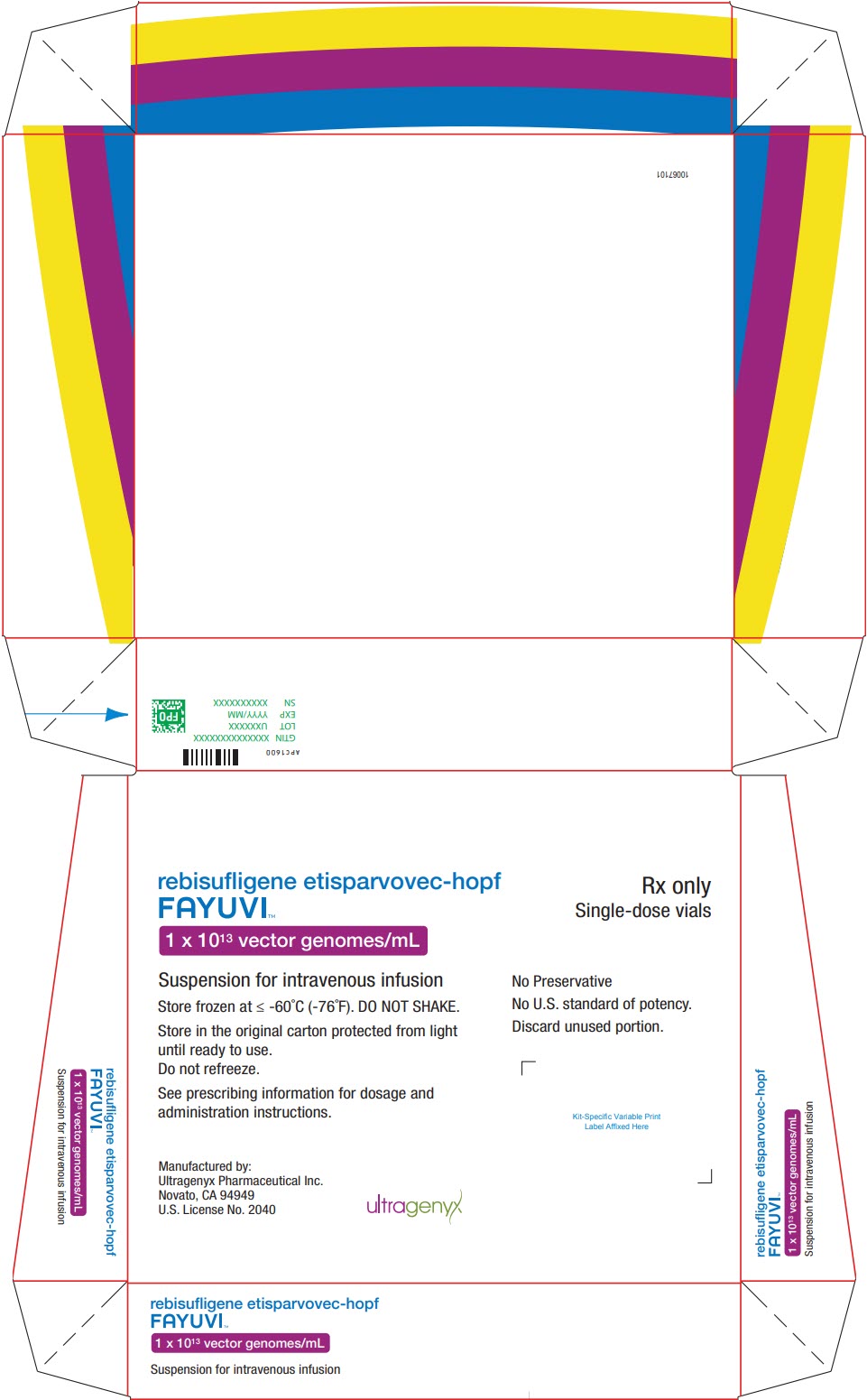
Principal Display Panel (Kit Carton Label)
rebisufligene etisparvovec-hopf
FAYUVI™
Rx only
Single-dose vials
1 x 10¹³ vector genomes/mL
Suspension for intravenous infusion
Store frozen at ≤ -60˚C (-76˚F). DO NOT SHAKE.
Store in the original carton protected from light
until ready to use.
Do not refreeze.
See prescribing information for dosage and
administration instructions.
No Preservative
No U.S. standard of potency.
Discard unused portion.
Manufactured by:
Ultragenyx Pharmaceutical Inc.
Novato, CA 94949
U.S. License No. 2040
ultragenyx
Principal Display Panel (Kit Carton)
NDC 69794-300-01
rebisufligene etisparvovec-hopf
FAYUVI™
1 x 10¹³ vector genomes/mL
Suspension for
intravenous infusion
2 mL
Rx only
Single-dose vial
Store frozen
at ≤ -60˚C (-76˚F)
DO NOT SHAKE
Do not refreeze
ultragenyx
10066501
APL2325
Principal Display Panel (2 mL Vial Label)
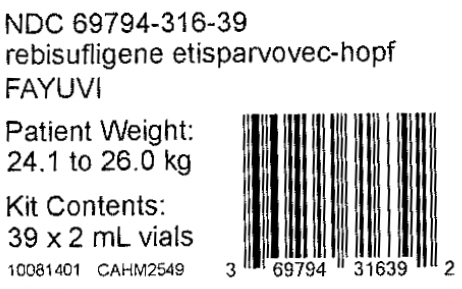
NDC 69794-316-39
rebisufligene etisparvovec-hopf
FAYUVI
Patient Weight:
24.1 to 26.0 kg
Kit Contents:
39 x 2 mL vials
10081401
CAHM2549
Principal Display Panel (Kit Carton Label)
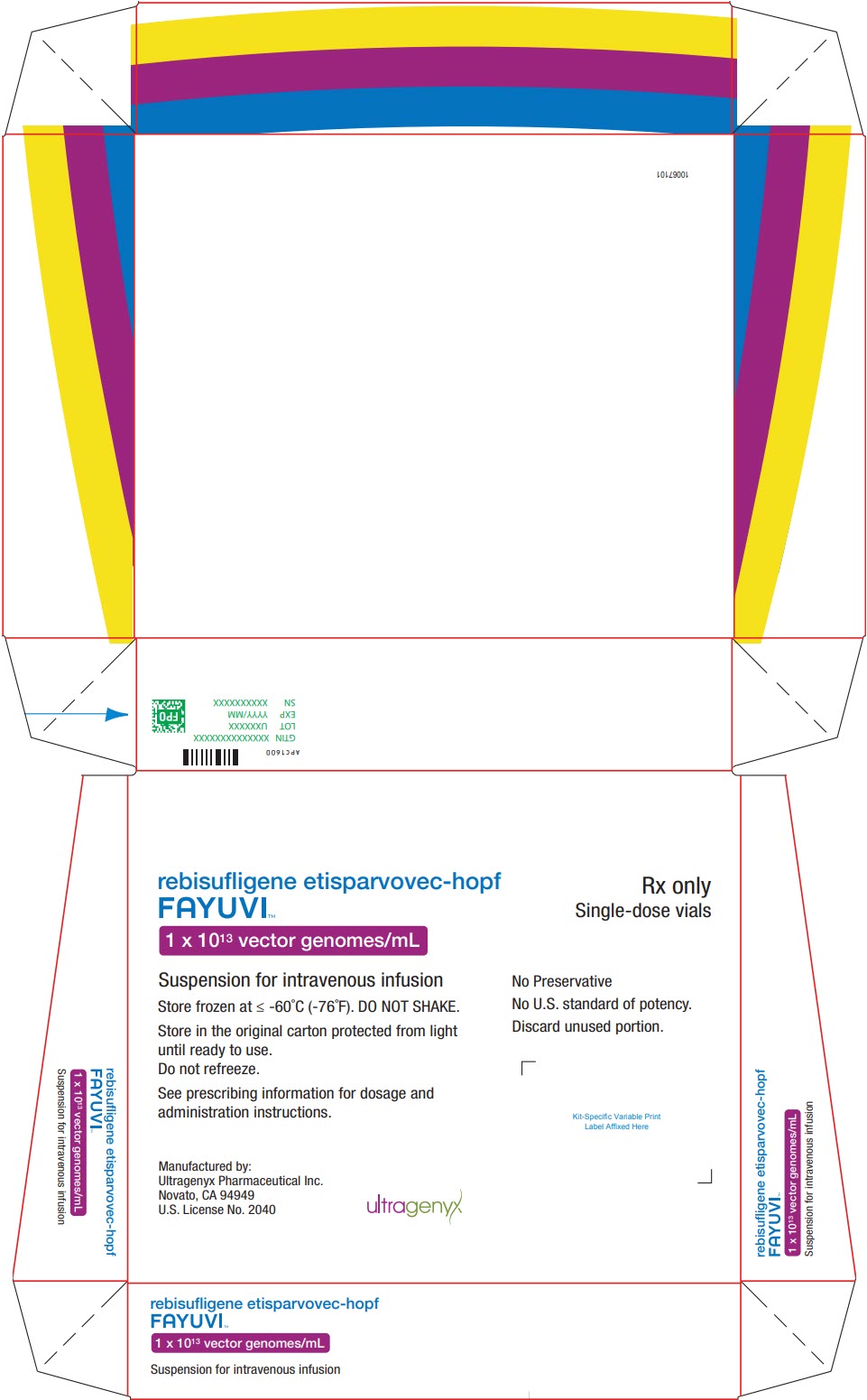
rebisufligene etisparvovec-hopf
FAYUVI™
Rx only
Single-dose vials
1 x 10¹³ vector genomes/mL
Suspension for intravenous infusion
Store frozen at ≤ -60˚C (-76˚F). DO NOT SHAKE.
Store in the original carton protected from light
until ready to use.
Do not refreeze.
See prescribing information for dosage and
administration instructions.
No Preservative
No U.S. standard of potency.
Discard unused portion.
Manufactured by:
Ultragenyx Pharmaceutical Inc.
Novato, CA 94949
U.S. License No. 2040
ultragenyx
Principal Display Panel (Kit Carton)
NDC 69794-300-01
rebisufligene etisparvovec-hopf
FAYUVI™
1 x 10¹³ vector genomes/mL
Suspension for
intravenous infusion
2 mL
Rx only
Single-dose vial
Store frozen
at ≤ -60˚C (-76˚F)
DO NOT SHAKE
Do not refreeze
ultragenyx
10066501
APL2325
Principal Display Panel (2 mL Vial Label)
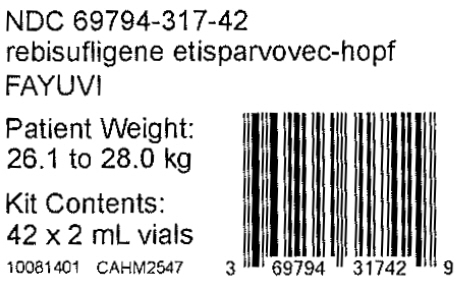
NDC 69794-317-42
rebisufligene etisparvovec-hopf
FAYUVI
Patient Weight:
26.1 to 28.0 kg
Kit Contents:
42 x 2 mL vials
10081401
CAHM2547
Principal Display Panel (Kit Carton Label)
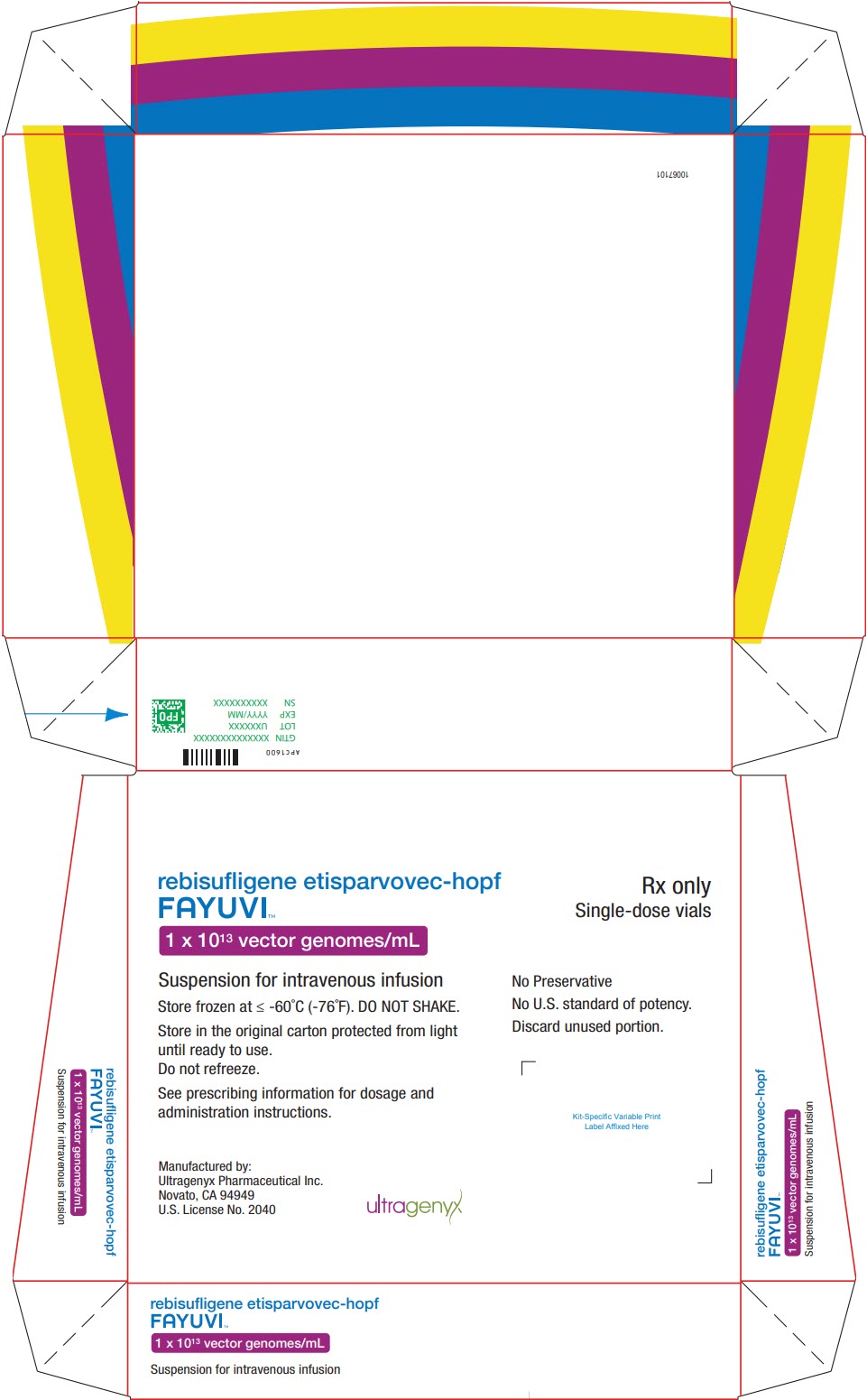
rebisufligene etisparvovec-hopf
FAYUVI™
Rx only
Single-dose vials
1 x 10¹³ vector genomes/mL
Suspension for intravenous infusion
Store frozen at ≤ -60˚C (-76˚F). DO NOT SHAKE.
Store in the original carton protected from light
until ready to use.
Do not refreeze.
See prescribing information for dosage and
administration instructions.
No Preservative
No U.S. standard of potency.
Discard unused portion.
Manufactured by:
Ultragenyx Pharmaceutical Inc.
Novato, CA 94949
U.S. License No. 2040
ultragenyx
Principal Display Panel (Kit Carton)
NDC 69794-300-01
rebisufligene etisparvovec-hopf
FAYUVI™
1 x 10¹³ vector genomes/mL
Suspension for
intravenous infusion
2 mL
Rx only
Single-dose vial
Store frozen
at ≤ -60˚C (-76˚F)
DO NOT SHAKE
Do not refreeze
ultragenyx
10066501
APL2325
Principal Display Panel (2 mL Vial Label)
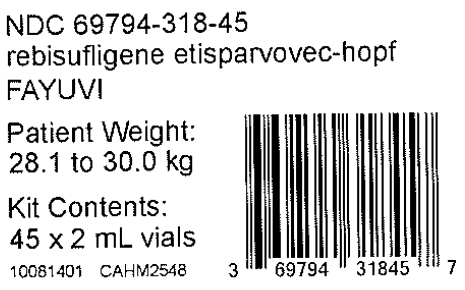
NDC 69794-318-45
rebisufligene etisparvovec-hopf
FAYUVI
Patient Weight:
28.1 to 30.0 kg
Kit Contents:
45 x 2 mL vials
10081401
CAHM2548
Principal Display Panel (Kit Carton Label)
rebisufligene etisparvovec-hopf
FAYUVI™
Rx only
Single-dose vials
1 x 10¹³ vector genomes/mL
Suspension for intravenous infusion
Store frozen at ≤ -60˚C (-76˚F). DO NOT SHAKE.
Store in the original carton protected from light
until ready to use.
Do not refreeze.
See prescribing information for dosage and
administration instructions.
No Preservative
No U.S. standard of potency.
Discard unused portion.
Manufactured by:
Ultragenyx Pharmaceutical Inc.
Novato, CA 94949
U.S. License No. 2040
ultragenyx
Principal Display Panel (Kit Carton)
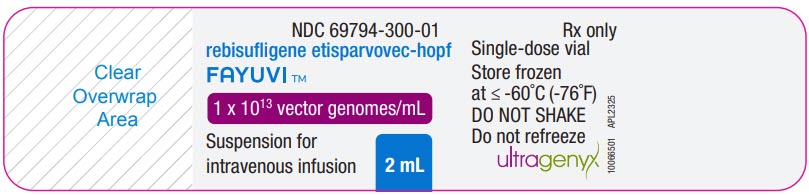
NDC 69794-300-01
rebisufligene etisparvovec-hopf
FAYUVI™
1 x 10¹³ vector genomes/mL
Suspension for
intravenous infusion
2 mL
Rx only
Single-dose vial
Store frozen
at ≤ -60˚C (-76˚F)
DO NOT SHAKE
Do not refreeze
ultragenyx
10066501
APL2325
Principal Display Panel (2 mL Vial Label)
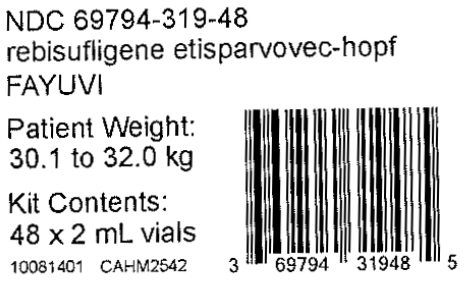
NDC 69794-319-48
rebisufligene etisparvovec-hopf
FAYUVI
Patient Weight:
30.1 to 32.0 kg
Kit Contents:
48 x 2 mL vials
10081401
CAHM2542
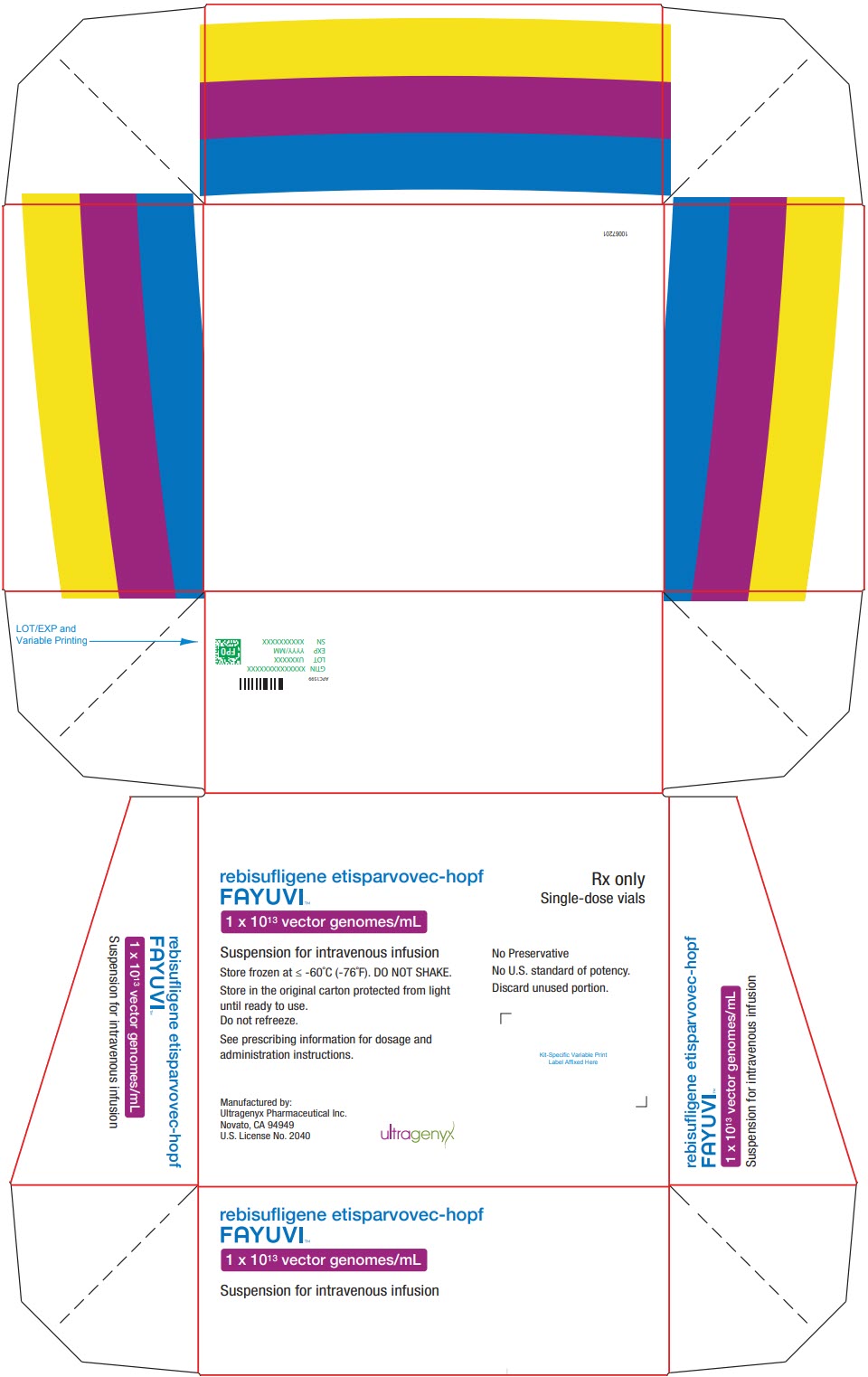
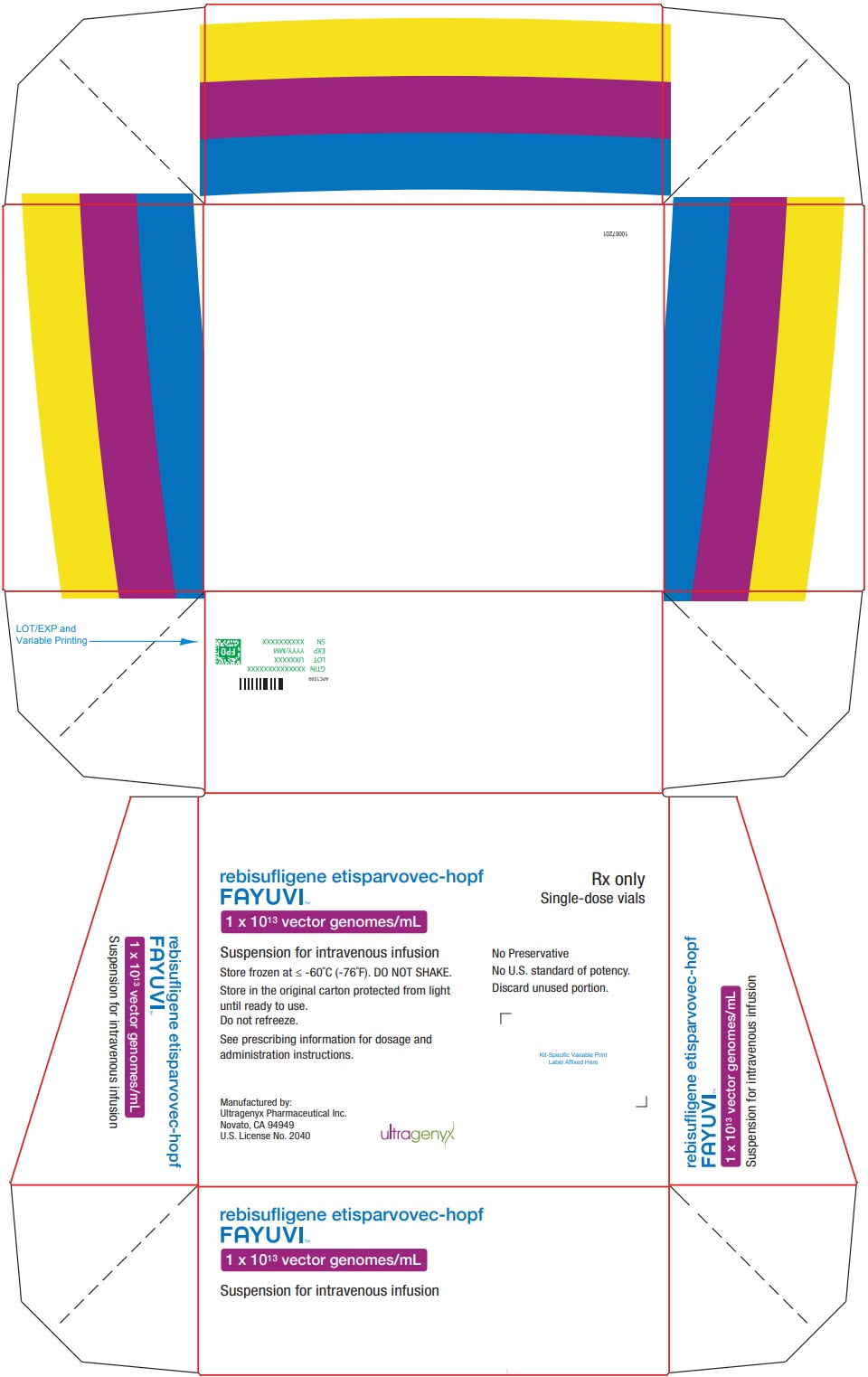
Principal Display Panel (Kit Carton Label)
rebisufligene etisparvovec-hopf
FAYUVI™
Rx only
Single-dose vials
1 x 10¹³ vector genomes/mL
Suspension for intravenous infusion
Store frozen at ≤ -60˚C (-76˚F). DO NOT SHAKE.
Store in the original carton protected from light
until ready to use.
Do not refreeze.
See prescribing information for dosage and
administration instructions.
No Preservative
No U.S. standard of potency.
Discard unused portion.
Manufactured by:
Ultragenyx Pharmaceutical Inc.
Novato, CA 94949
U.S. License No. 2040
ultragenyx
Principal Display Panel (Kit Carton)
NDC 69794-300-01
rebisufligene etisparvovec-hopf
FAYUVI™
1 x 10¹³ vector genomes/mL
Suspension for
intravenous infusion
2 mL
Rx only
Single-dose vial
Store frozen
at ≤ -60˚C (-76˚F)
DO NOT SHAKE
Do not refreeze
ultragenyx
10066501
APL2325
Principal Display Panel (2 mL Vial Label)
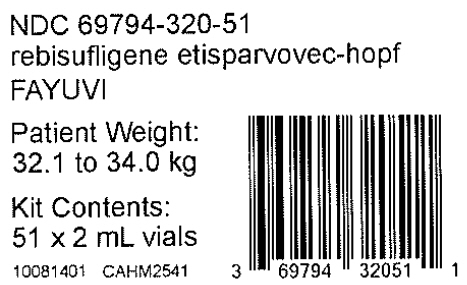
NDC 69794-320-51
rebisufligene etisparvovec-hopf
FAYUVI
Patient Weight:
32.1 to 34.0 kg
Kit Contents:
51 x 2 mL vials
10081401
CAHM2541
Principal Display Panel (Kit Carton Label)
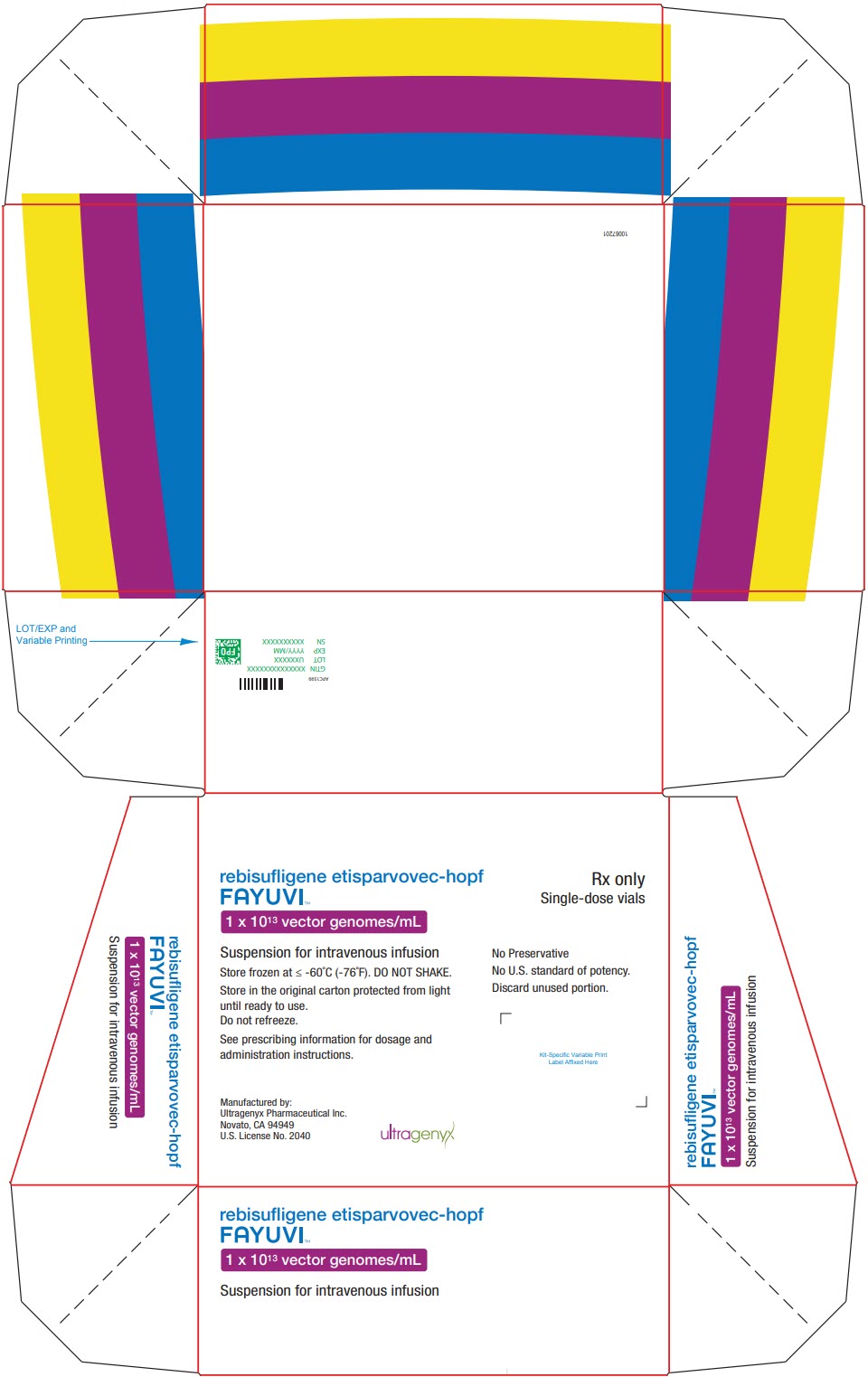
rebisufligene etisparvovec-hopf
FAYUVI™
Rx only
Single-dose vials
1 x 10¹³ vector genomes/mL
Suspension for intravenous infusion
Store frozen at ≤ -60˚C (-76˚F). DO NOT SHAKE.
Store in the original carton protected from light
until ready to use.
Do not refreeze.
See prescribing information for dosage and
administration instructions.
No Preservative
No U.S. standard of potency.
Discard unused portion.
Manufactured by:
Ultragenyx Pharmaceutical Inc.
Novato, CA 94949
U.S. License No. 2040
ultragenyx
Principal Display Panel (Kit Carton)
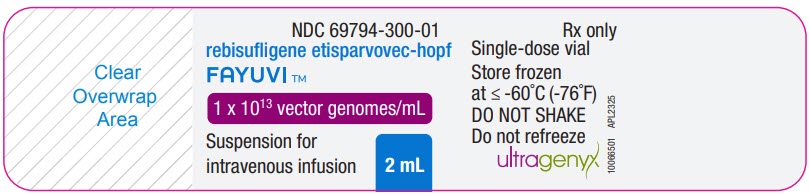
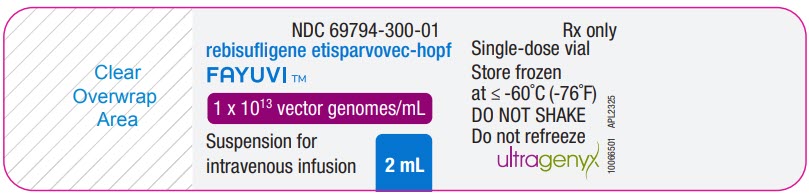
NDC 69794-300-01
rebisufligene etisparvovec-hopf
FAYUVI™
1 x 10¹³ vector genomes/mL
Suspension for
intravenous infusion
2 mL
Rx only
Single-dose vial
Store frozen
at ≤ -60˚C (-76˚F)
DO NOT SHAKE
Do not refreeze
ultragenyx
10066501
APL2325
Principal Display Panel (2 mL Vial Label)
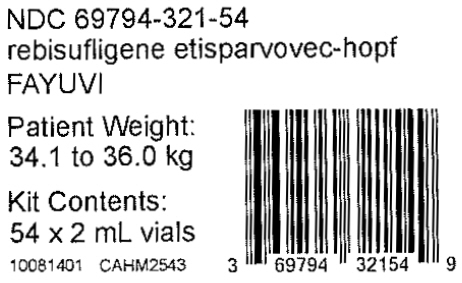
NDC 69794-321-54
rebisufligene etisparvovec-hopf
FAYUVI
Patient Weight:
34.1 to 36.0 kg
Kit Contents:
54 x 2 mL vials
10081401
CAHM2543
Principal Display Panel (Kit Carton Label)
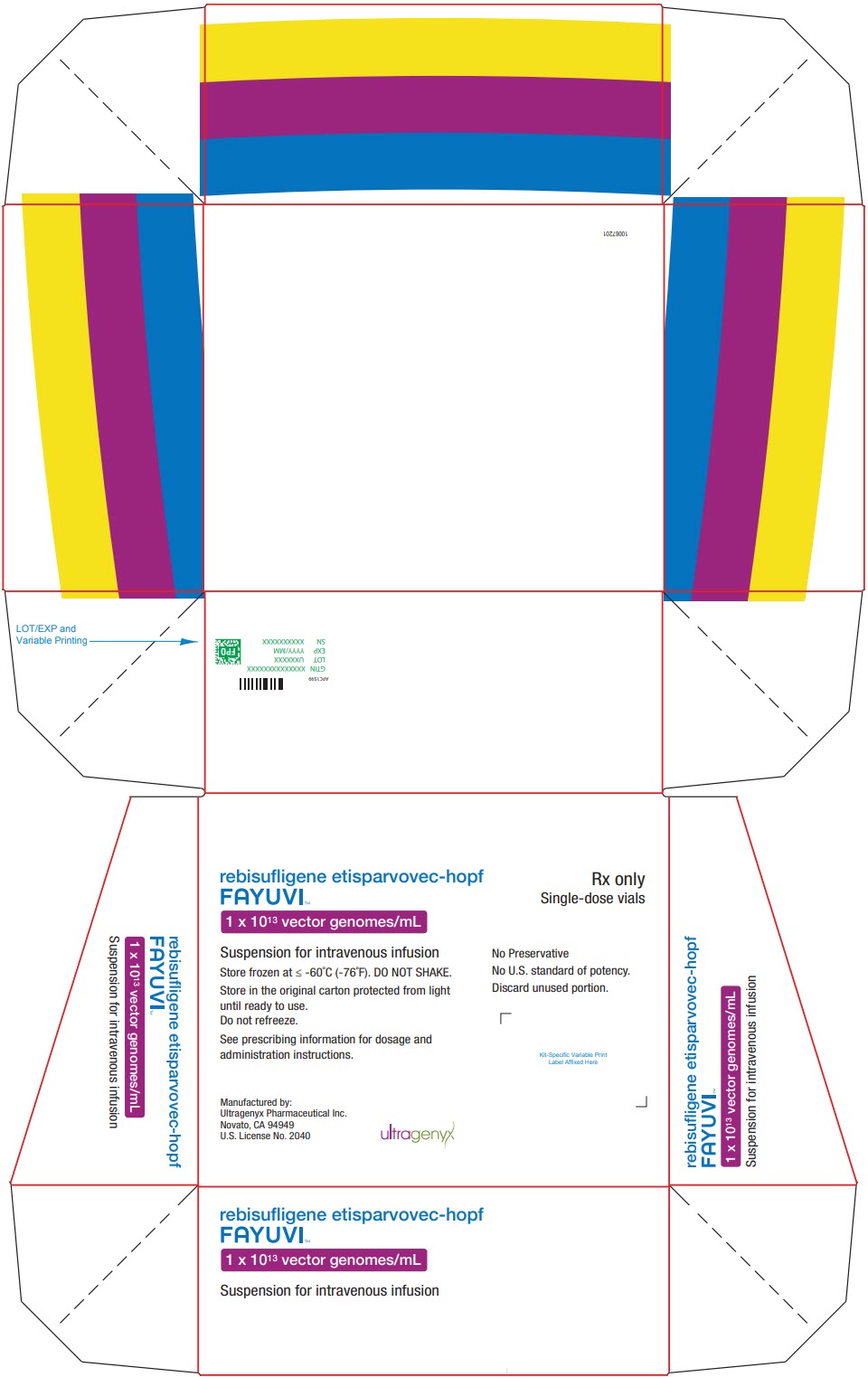
rebisufligene etisparvovec-hopf
FAYUVI™
Rx only
Single-dose vials
1 x 10¹³ vector genomes/mL
Suspension for intravenous infusion
Store frozen at ≤ -60˚C (-76˚F). DO NOT SHAKE.
Store in the original carton protected from light
until ready to use.
Do not refreeze.
See prescribing information for dosage and
administration instructions.
No Preservative
No U.S. standard of potency.
Discard unused portion.
Manufactured by:
Ultragenyx Pharmaceutical Inc.
Novato, CA 94949
U.S. License No. 2040
ultragenyx
Principal Display Panel (Kit Carton)
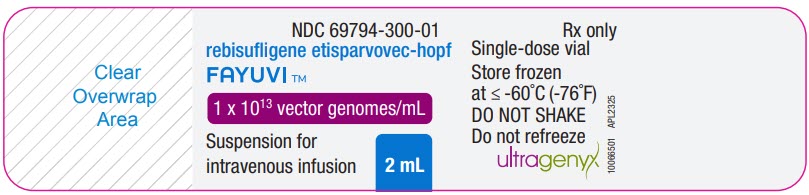
NDC 69794-300-01
rebisufligene etisparvovec-hopf
FAYUVI™
1 x 10¹³ vector genomes/mL
Suspension for
intravenous infusion
2 mL
Rx only
Single-dose vial
Store frozen
at ≤ -60˚C (-76˚F)
DO NOT SHAKE
Do not refreeze
ultragenyx
10066501
APL2325
Principal Display Panel (2 mL Vial Label)
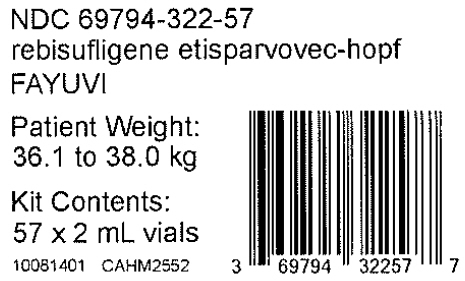
NDC 69794-322-57
rebisufligene etisparvovec-hopf
FAYUVI
Patient Weight:
36.1 to 38.0 kg
Kit Contents:
57 x 2 mL vials
10081401
CAHM2552
Principal Display Panel (Kit Carton Label)
rebisufligene etisparvovec-hopf
FAYUVI™
Rx only
Single-dose vials
1 x 10¹³ vector genomes/mL
Suspension for intravenous infusion
Store frozen at ≤ -60˚C (-76˚F). DO NOT SHAKE.
Store in the original carton protected from light
until ready to use.
Do not refreeze.
See prescribing information for dosage and
administration instructions.
No Preservative
No U.S. standard of potency.
Discard unused portion.
Manufactured by:
Ultragenyx Pharmaceutical Inc.
Novato, CA 94949
U.S. License No. 2040
ultragenyx
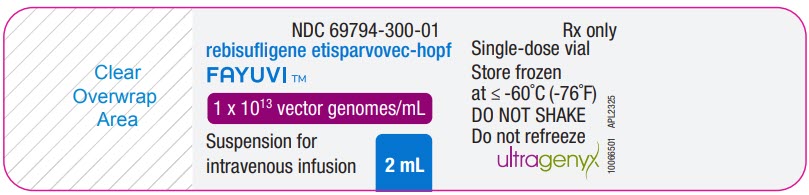
Principal Display Panel (Kit Carton)
NDC 69794-300-01
rebisufligene etisparvovec-hopf
FAYUVI™
1 x 10¹³ vector genomes/mL
Suspension for
intravenous infusion
2 mL
Rx only
Single-dose vial
Store frozen
at ≤ -60˚C (-76˚F)
DO NOT SHAKE
Do not refreeze
ultragenyx
10066501
APL2325
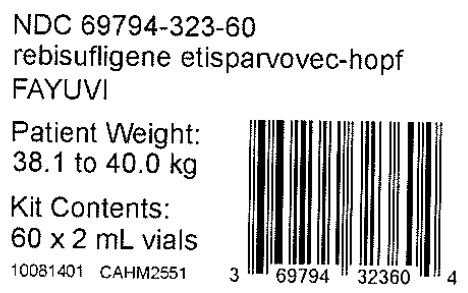
Principal Display Panel (2 mL Vial Label)
NDC 69794-323-60
rebisufligene etisparvovec-hopf
FAYUVI
Patient Weight:
38.1 to 40.0 kg
Kit Contents:
60 x 2 mL vials
10081401
CAHM2551
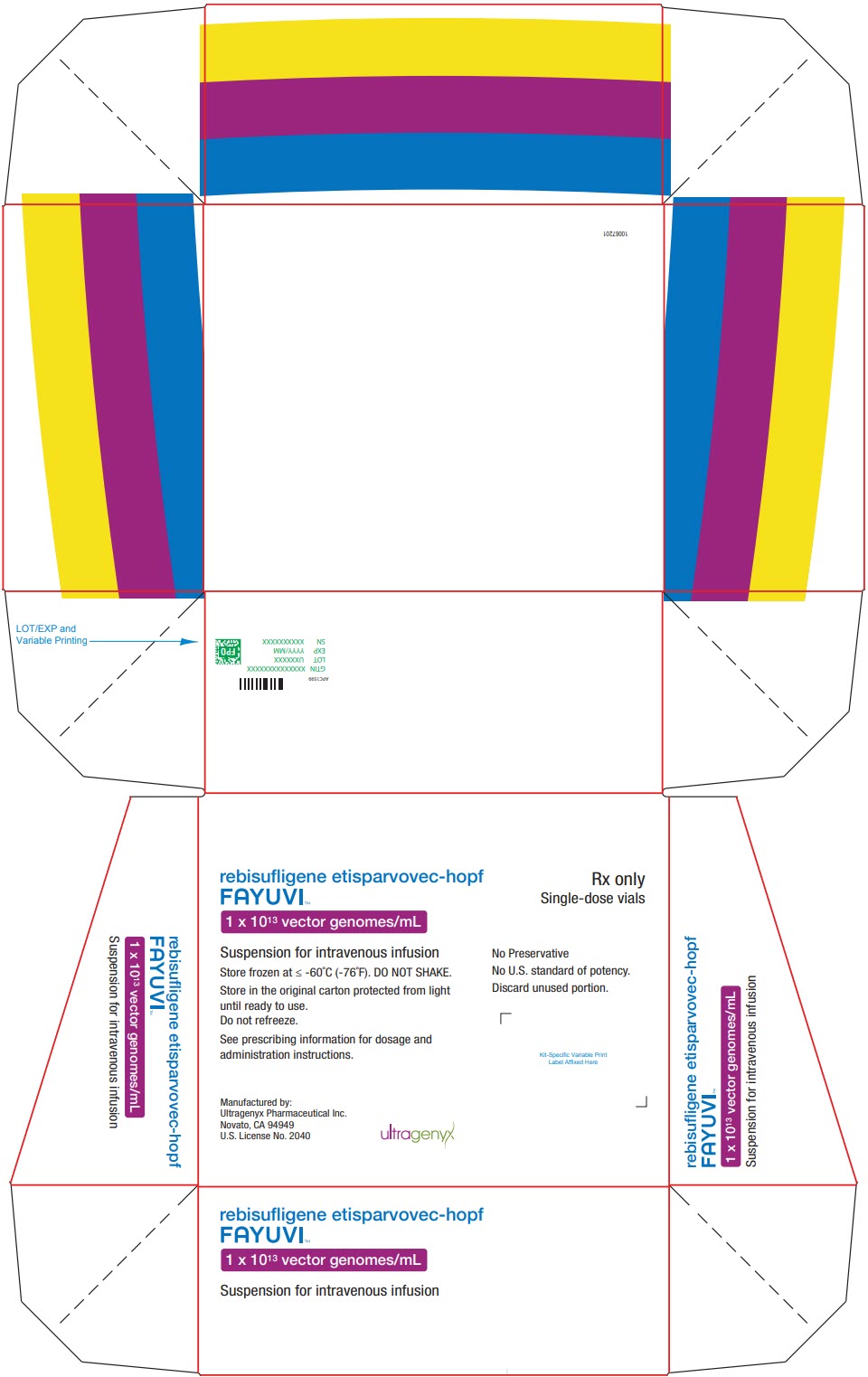
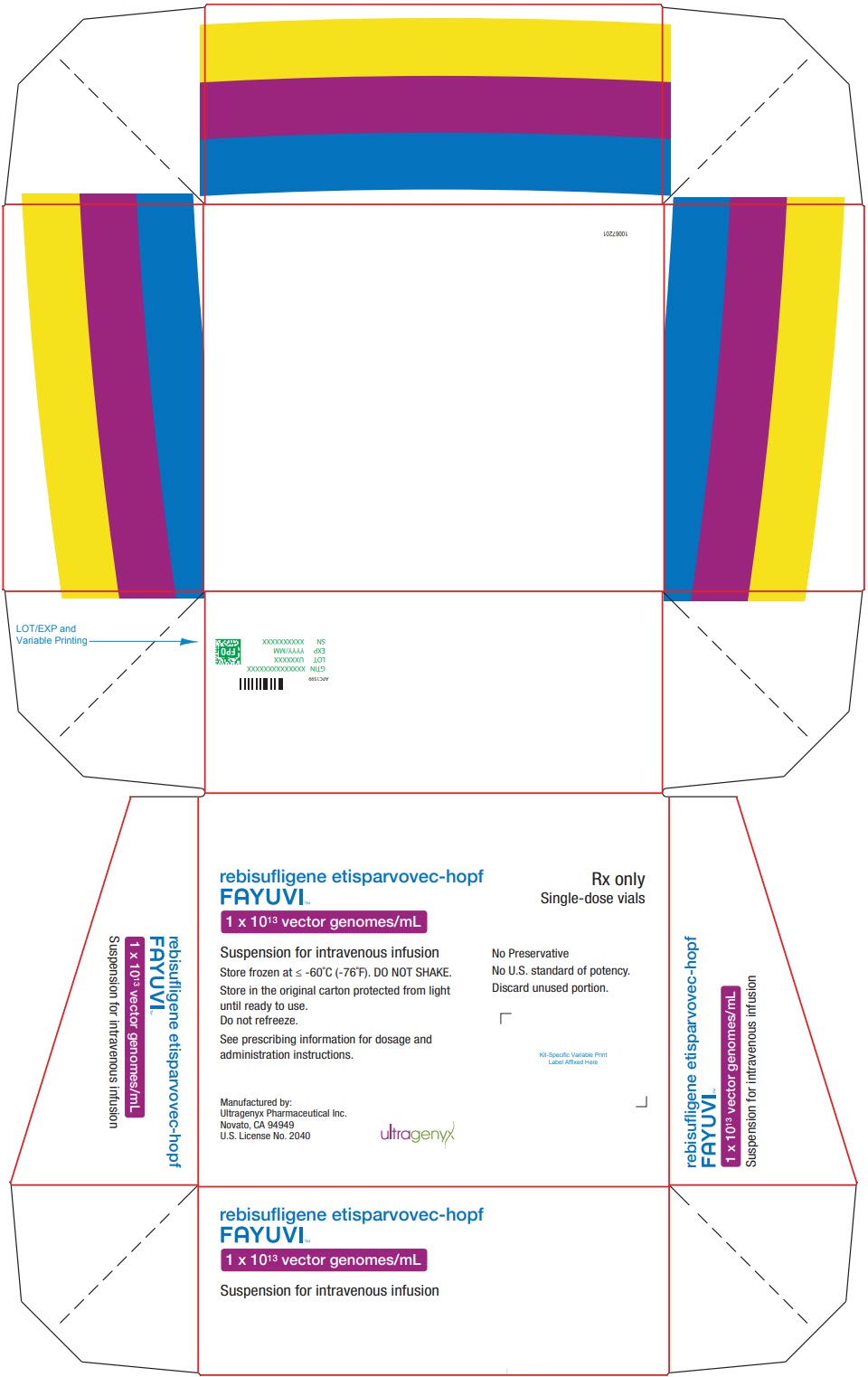
Principal Display Panel (Kit Carton Label)
rebisufligene etisparvovec-hopf
FAYUVI™
Rx only
Single-dose vials
1 x 10¹³ vector genomes/mL
Suspension for intravenous infusion
Store frozen at ≤ -60˚C (-76˚F). DO NOT SHAKE.
Store in the original carton protected from light
until ready to use.
Do not refreeze.
See prescribing information for dosage and
administration instructions.
No Preservative
No U.S. standard of potency.
Discard unused portion.
Manufactured by:
Ultragenyx Pharmaceutical Inc.
Novato, CA 94949
U.S. License No. 2040
ultragenyx
Principal Display Panel (Kit Carton)
NDC 69794-300-01
rebisufligene etisparvovec-hopf
FAYUVI™
1 x 10¹³ vector genomes/mL
Suspension for
intravenous infusion
2 mL
Rx only
Single-dose vial
Store frozen
at ≤ -60˚C (-76˚F)
DO NOT SHAKE
Do not refreeze
ultragenyx
10066501
APL2325
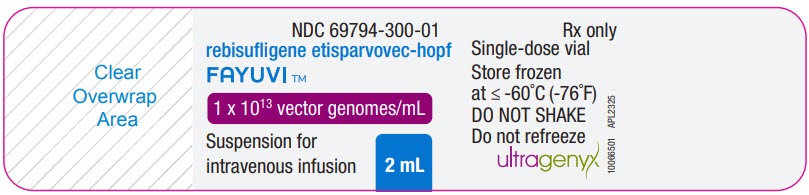
Principal Display Panel (2 mL Vial Label)
NDC 69794-324-63
rebisufligene etisparvovec-hopf
FAYUVI
Patient Weight:
40.1 to 42.0 kg
Kit Contents:
63 x 2 mL vials
10081401
CAHM2553
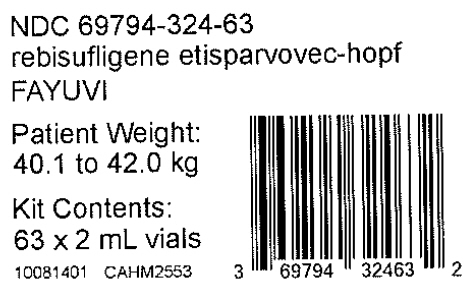
Principal Display Panel (Kit Carton Label)
rebisufligene etisparvovec-hopf
FAYUVI™
Rx only
Single-dose vials
1 x 10¹³ vector genomes/mL
Suspension for intravenous infusion
Store frozen at ≤ -60˚C (-76˚F). DO NOT SHAKE.
Store in the original carton protected from light
until ready to use.
Do not refreeze.
See prescribing information for dosage and
administration instructions.
No Preservative
No U.S. standard of potency.
Discard unused portion.
Manufactured by:
Ultragenyx Pharmaceutical Inc.
Novato, CA 94949
U.S. License No. 2040
ultragenyx
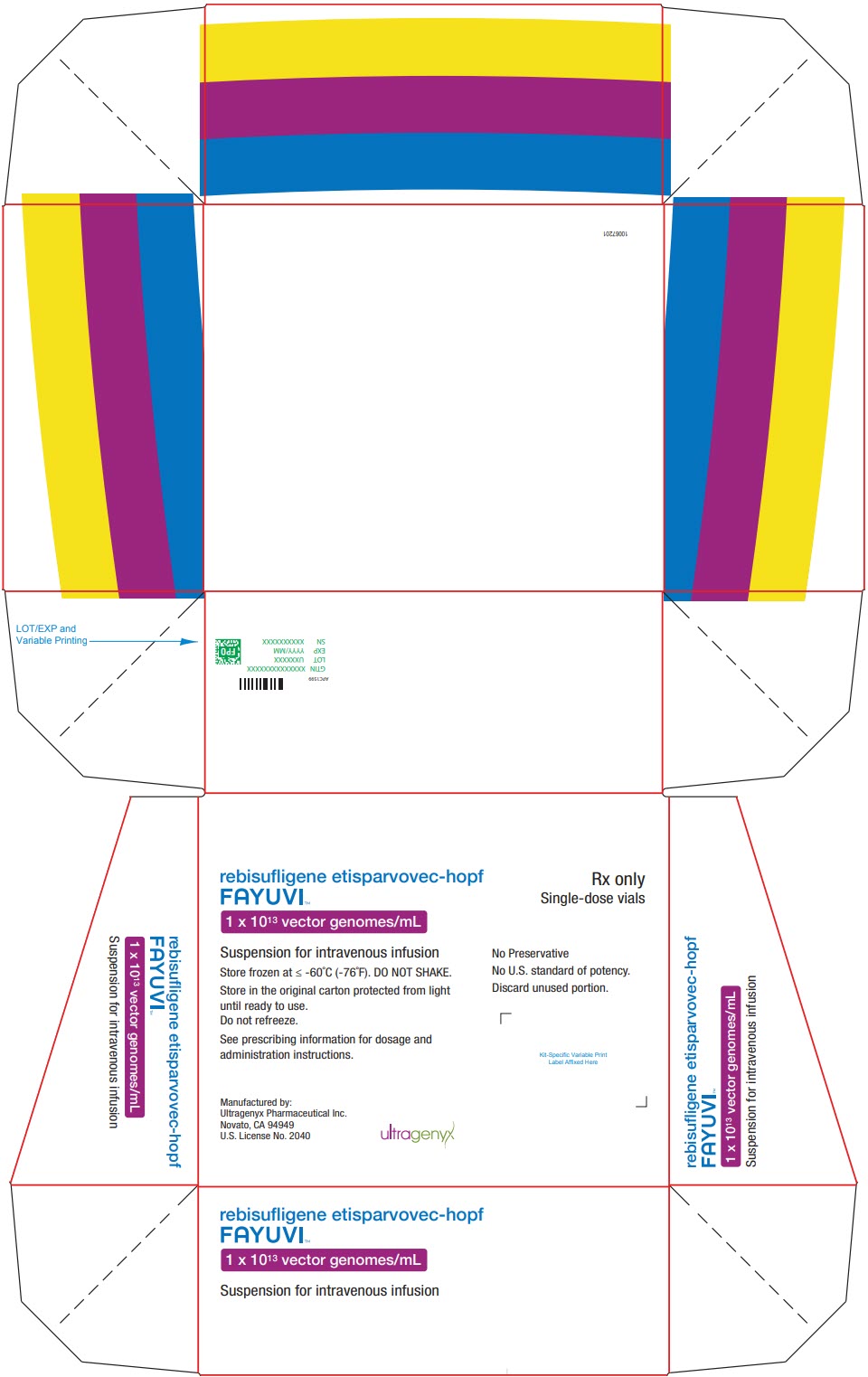
Principal Display Panel (Kit Carton)
NDC 69794-300-01
rebisufligene etisparvovec-hopf
FAYUVI™
1 x 10¹³ vector genomes/mL
Suspension for
intravenous infusion
2 mL
Rx only
Single-dose vial
Store frozen
at ≤ -60˚C (-76˚F)
DO NOT SHAKE
Do not refreeze
ultragenyx
10066501
APL2325
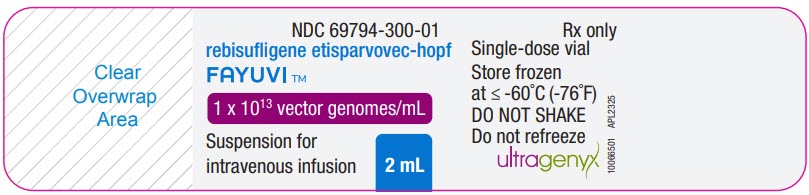
Principal Display Panel (2 mL Vial Label)
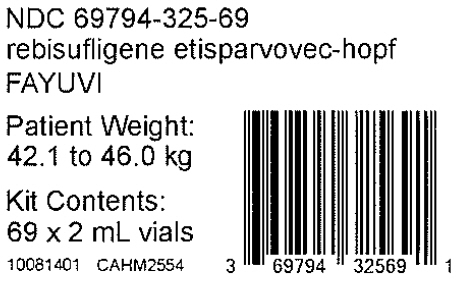
NDC 69794-325-69
rebisufligene etisparvovec-hopf
FAYUVI
Patient Weight:
42.1 to 46.0 kg
Kit Contents:
69 x 2 mL vials
10081401
CAHM2554
Principal Display Panel (Kit Carton Label)
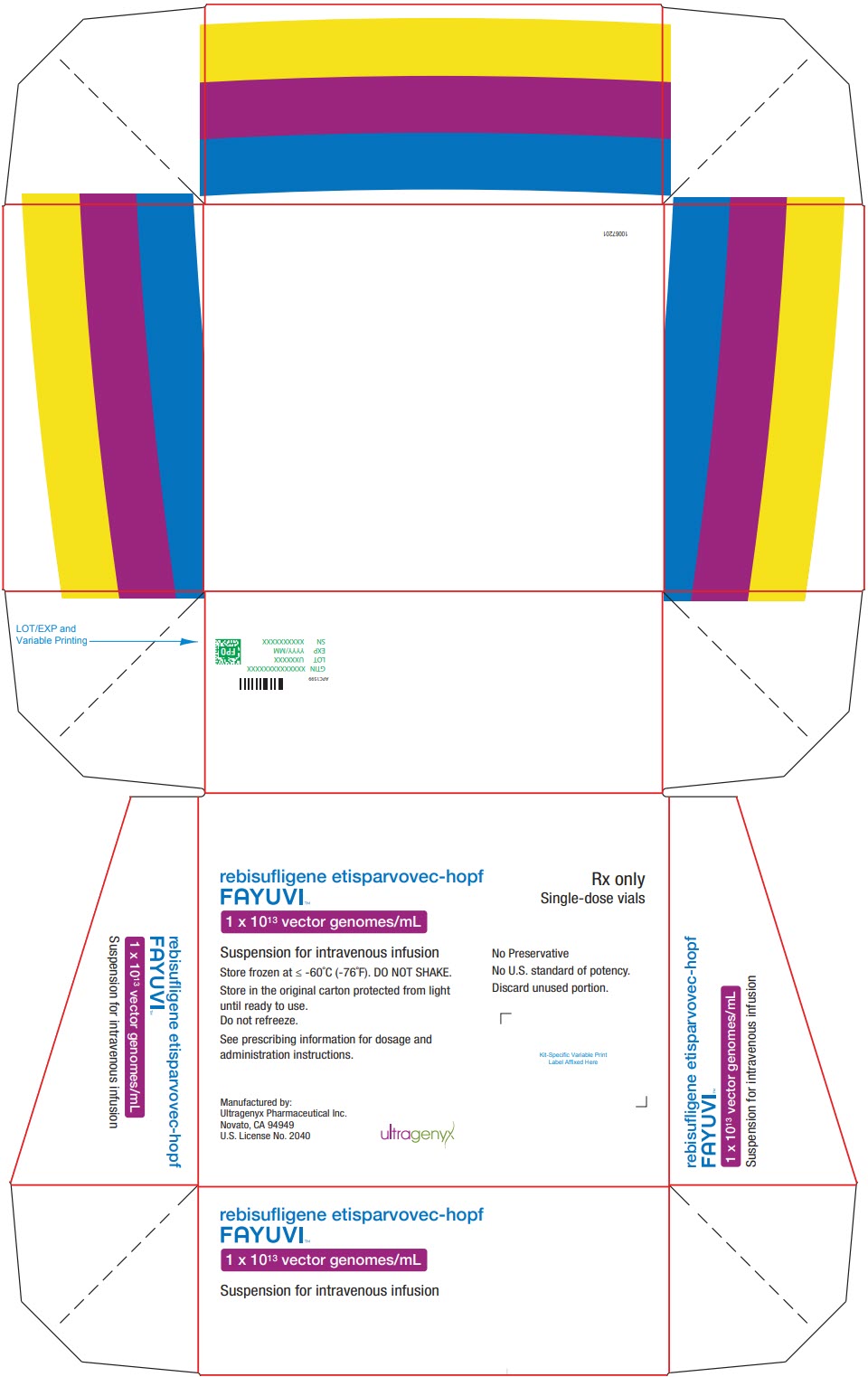
rebisufligene etisparvovec-hopf
FAYUVI™
Rx only
Single-dose vials
1 x 10¹³ vector genomes/mL
Suspension for intravenous infusion
Store frozen at ≤ -60˚C (-76˚F). DO NOT SHAKE.
Store in the original carton protected from light
until ready to use.
Do not refreeze.
See prescribing information for dosage and
administration instructions.
No Preservative
No U.S. standard of potency.
Discard unused portion.
Manufactured by:
Ultragenyx Pharmaceutical Inc.
Novato, CA 94949
U.S. License No. 2040
ultragenyx
Principal Display Panel (Kit Carton)
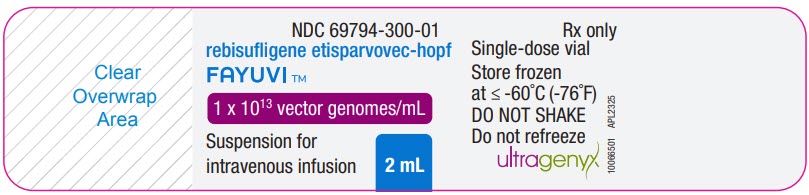
NDC 69794-300-01
rebisufligene etisparvovec-hopf
FAYUVI™
1 x 10¹³ vector genomes/mL
Suspension for
intravenous infusion
2 mL
Rx only
Single-dose vial
Store frozen
at ≤ -60˚C (-76˚F)
DO NOT SHAKE
Do not refreeze
ultragenyx
10066501
APL2325
Principal Display Panel (2 mL Vial Label)
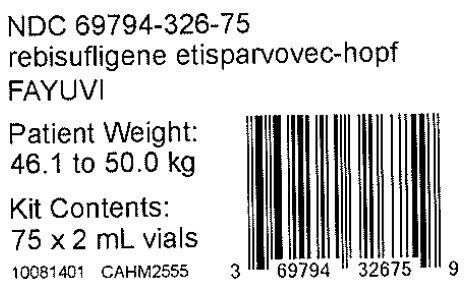
NDC 69794-326-75
rebisufligene etisparvovec-hopf
FAYUVI
Patient Weight:
46.1 to 50.0 kg
Kit Contents:
75 x 2 mL vials
10081401
CAHM2555
Principal Display Panel (Kit Carton Label)
rebisufligene etisparvovec-hopf
FAYUVI™
Rx only
Single-dose vials
1 x 10¹³ vector genomes/mL
Suspension for intravenous infusion
Store frozen at ≤ -60˚C (-76˚F). DO NOT SHAKE.
Store in the original carton protected from light
until ready to use.
Do not refreeze.
See prescribing information for dosage and
administration instructions.
No Preservative
No U.S. standard of potency.
Discard unused portion.
Manufactured by:
Ultragenyx Pharmaceutical Inc.
Novato, CA 94949
U.S. License No. 2040
ultragenyx
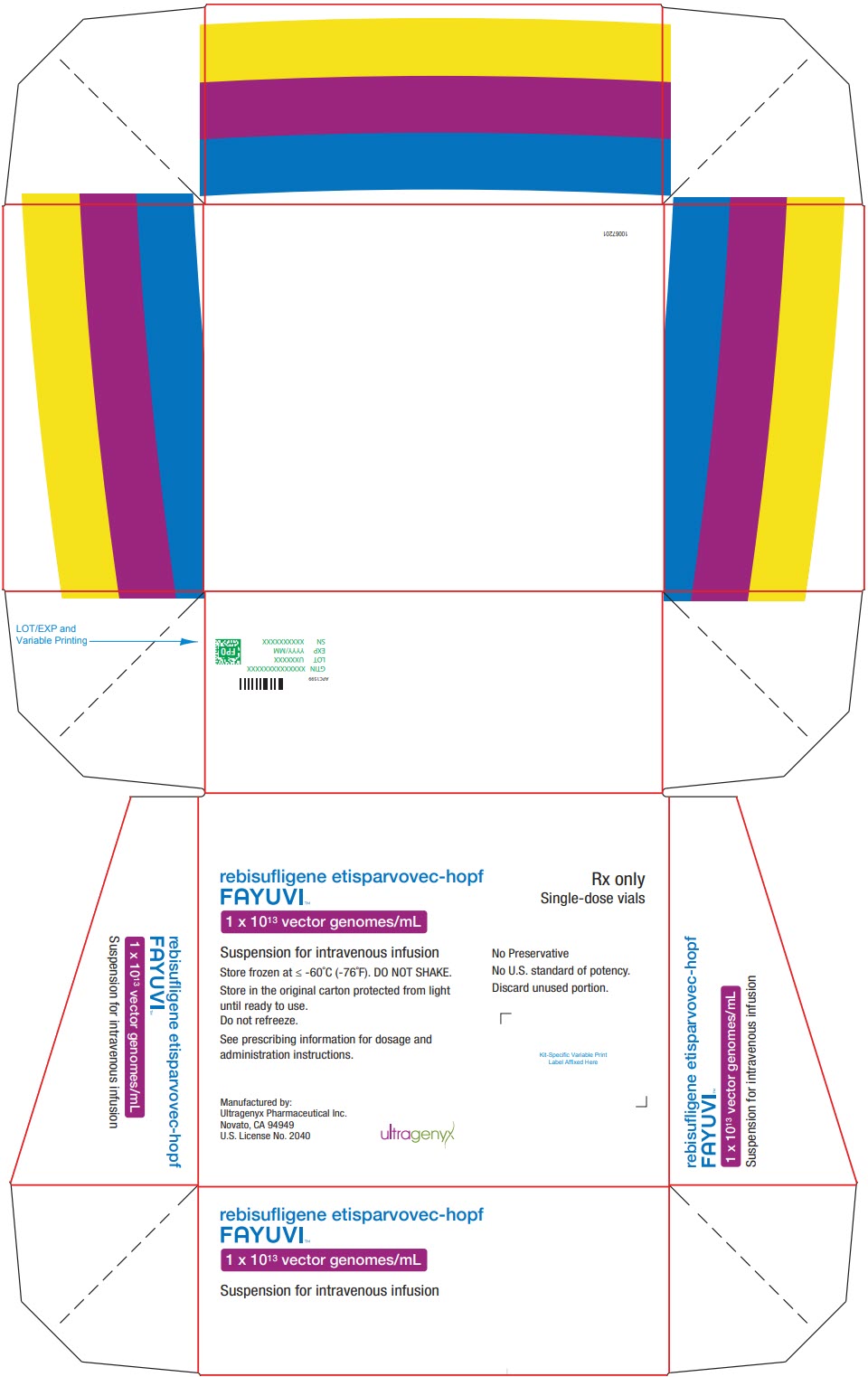
Principal Display Panel (Kit Carton)
NDC 69794-300-01
rebisufligene etisparvovec-hopf
FAYUVI™
1 x 10¹³ vector genomes/mL
Suspension for
intravenous infusion
2 mL
Rx only
Single-dose vial
Store frozen
at ≤ -60˚C (-76˚F)
DO NOT SHAKE
Do not refreeze
ultragenyx
10066501
APL2325
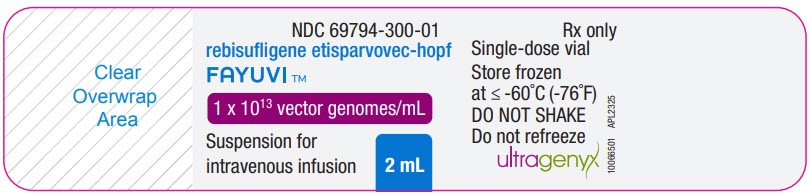
Principal Display Panel (2 mL Vial Label)
NDC 69794-327-81
rebisufligene etisparvovec-hopf
FAYUVI
Patient Weight:
50.1 to 54.0 kg
Kit Contents:
81 x 2 mL vials
10081401
CAHM2556
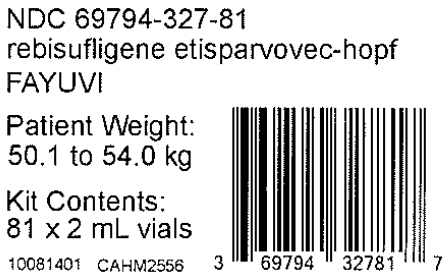
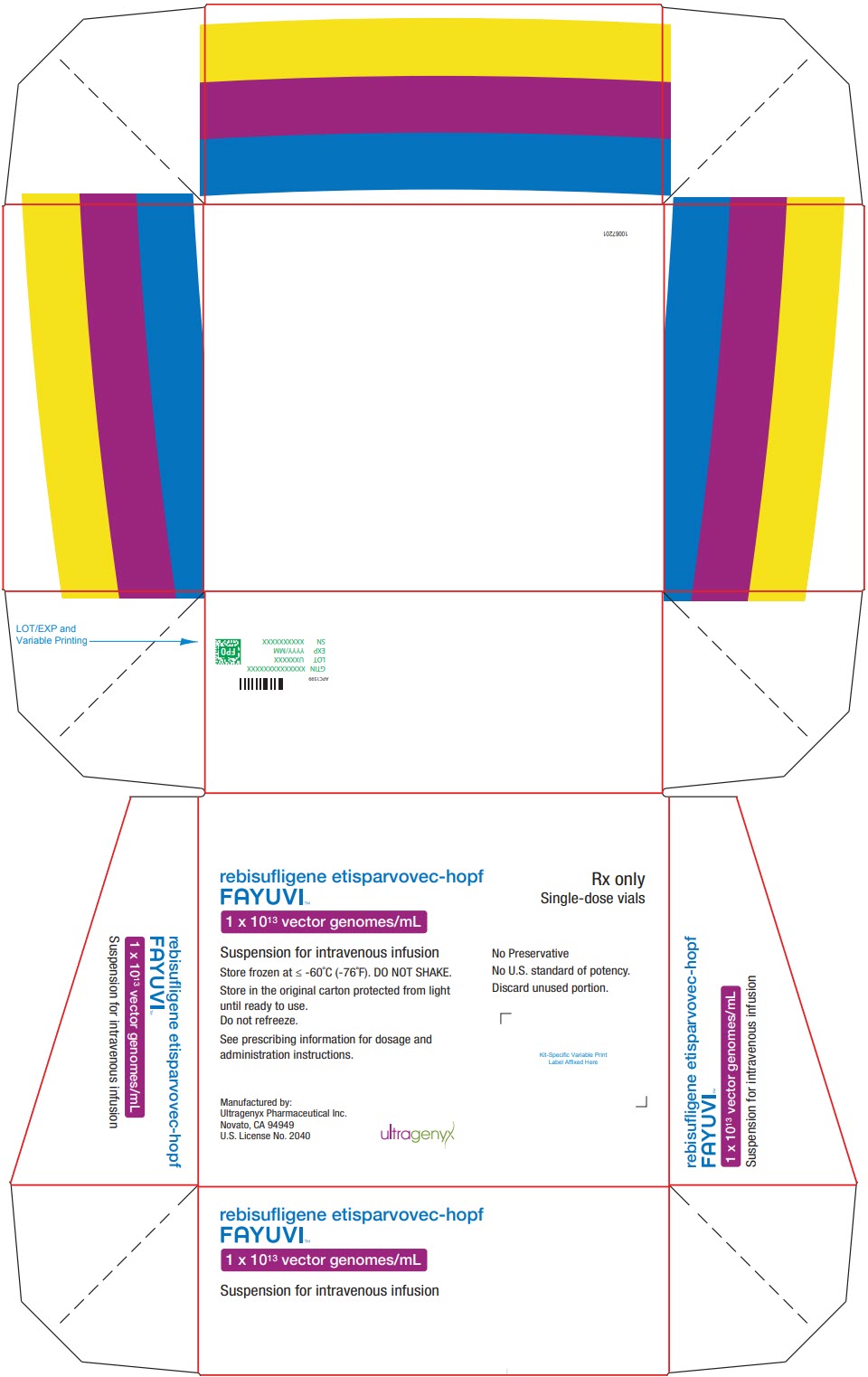
Principal Display Panel (Kit Carton Label)
rebisufligene etisparvovec-hopf
FAYUVI™
Rx only
Single-dose vials
1 x 10¹³ vector genomes/mL
Suspension for intravenous infusion
Store frozen at ≤ -60˚C (-76˚F). DO NOT SHAKE.
Store in the original carton protected from light
until ready to use.
Do not refreeze.
See prescribing information for dosage and
administration instructions.
No Preservative
No U.S. standard of potency.
Discard unused portion.
Manufactured by:
Ultragenyx Pharmaceutical Inc.
Novato, CA 94949
U.S. License No. 2040
ultragenyx
Principal Display Panel (Kit Carton)
NDC 69794-300-01
rebisufligene etisparvovec-hopf
FAYUVI™
1 x 10¹³ vector genomes/mL
Suspension for
intravenous infusion
2 mL
Rx only
Single-dose vial
Store frozen
at ≤ -60˚C (-76˚F)
DO NOT SHAKE
Do not refreeze
ultragenyx
10066501
APL2325
Principal Display Panel (2 mL Vial Label)
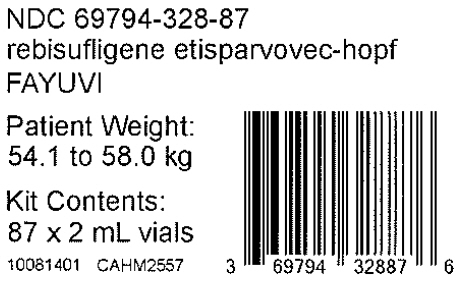
NDC 69794-328-87
rebisufligene etisparvovec-hopf
FAYUVI
Patient Weight:
54.1 to 58.0 kg
Kit Contents:
87 x 2 mL vials
10081401
CAHM2557
Principal Display Panel (Kit Carton Label)
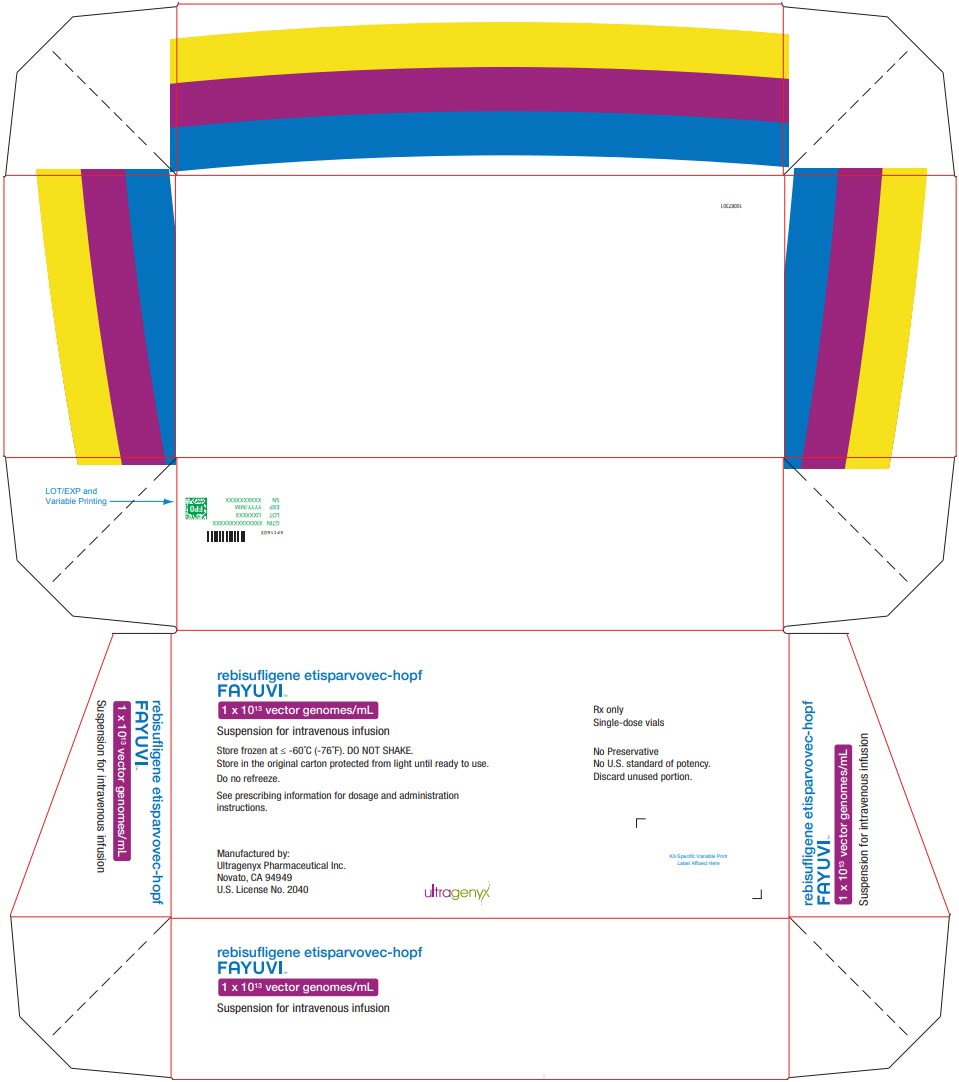
rebisufligene etisparvovec-hopf
FAYUVI™
Rx only
Single-dose vials
1 x 10¹³ vector genomes/mL
Suspension for intravenous infusion
Store frozen at ≤ -60˚C (-76˚F). DO NOT SHAKE.
Store in the original carton protected from light
until ready to use.
Do no refreeze.
See prescribing information for dosage and
administration instructions.
No Preservative
No U.S. standard of potency.
Discard unused portion.
Manufactured by:
Ultragenyx Pharmaceutical Inc.
Novato, CA 94949
U.S. License No. 2040
ultragenyx
Principal Display Panel (Kit Carton)
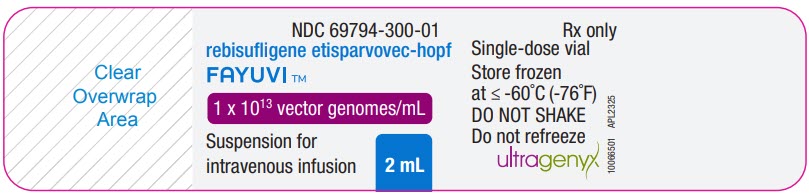
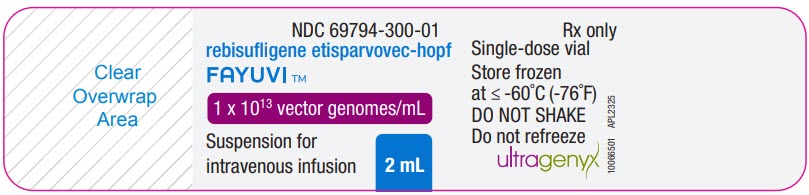
NDC 69794-300-01
rebisufligene etisparvovec-hopf
FAYUVI™
1 x 10¹³ vector genomes/mL
Suspension for
intravenous infusion
2 mL
Rx only
Single-dose vial
Store frozen
at ≤ -60˚C (-76˚F)
DO NOT SHAKE
Do not refreeze
ultragenyx
10066501
APL2325
Principal Display Panel (2 mL Vial Label)
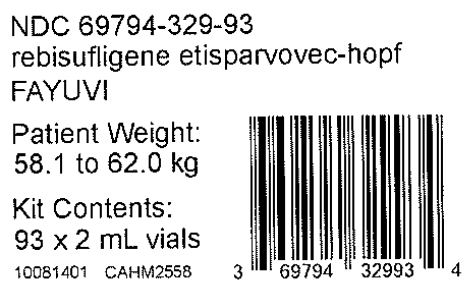
NDC 69794-329-93
rebisufligene etisparvovec-hopf
FAYUVI
Patient Weight:
58.1 to 62.0 kg
Kit Contents:
93 x 2 mL vials
10081401
CAHM2558
Principal Display Panel (Kit Carton Label)
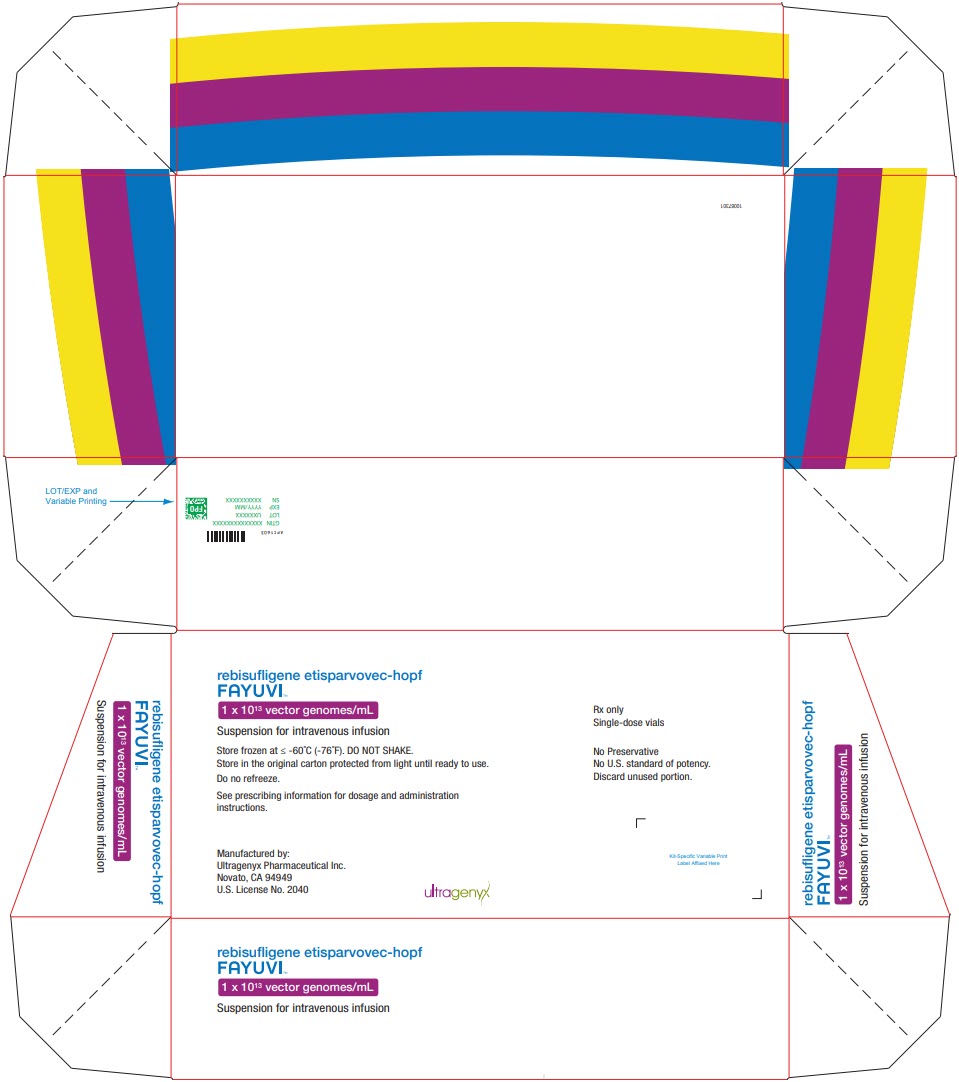
rebisufligene etisparvovec-hopf
FAYUVI™
Rx only
Single-dose vials
1 x 10¹³ vector genomes/mL
Suspension for intravenous infusion
Store frozen at ≤ -60˚C (-76˚F). DO NOT SHAKE.
Store in the original carton protected from light
until ready to use.
Do no refreeze.
See prescribing information for dosage and
administration instructions.
No Preservative
No U.S. standard of potency.
Discard unused portion.
Manufactured by:
Ultragenyx Pharmaceutical Inc.
Novato, CA 94949
U.S. License No. 2040
ultragenyx
Principal Display Panel (Kit Carton)
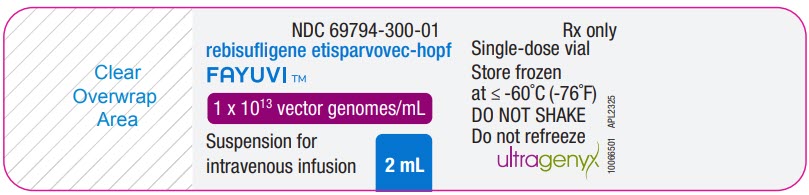
NDC 69794-300-01
rebisufligene etisparvovec-hopf
FAYUVI™
1 x 10¹³ vector genomes/mL
Suspension for
intravenous infusion
2 mL
Rx only
Single-dose vial
Store frozen
at ≤ -60˚C (-76˚F)
DO NOT SHAKE
Do not refreeze
ultragenyx
10066501
APL2325
Principal Display Panel (2 mL Vial Label)
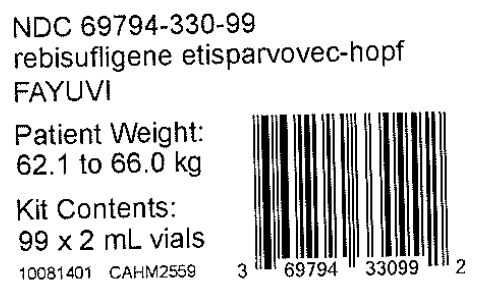
NDC 69794-330-99
rebisufligene etisparvovec-hopf
FAYUVI
Patient Weight:
62.1 to 66.0 kg
Kit Contents:
99 x 2 mL vials
10081401
CAHM2559
Principal Display Panel (Kit Carton Label)
rebisufligene etisparvovec-hopf
FAYUVI™
Rx only
Single-dose vials
1 x 10¹³ vector genomes/mL
Suspension for intravenous infusion
Store frozen at ≤ -60˚C (-76˚F). DO NOT SHAKE.
Store in the original carton protected from light
until ready to use.
Do no refreeze.
See prescribing information for dosage and
administration instructions.
No Preservative
No U.S. standard of potency.
Discard unused portion.
Manufactured by:
Ultragenyx Pharmaceutical Inc.
Novato, CA 94949
U.S. License No. 2040
ultragenyx
Principal Display Panel (Kit Carton)
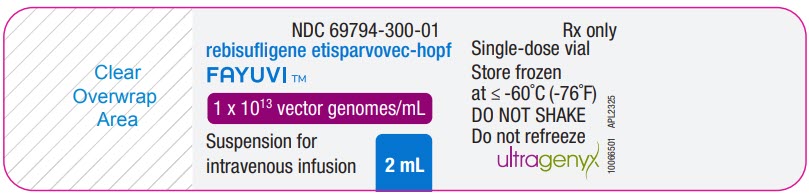
NDC 69794-300-01
rebisufligene etisparvovec-hopf
FAYUVI™
1 x 10¹³ vector genomes/mL
Suspension for
intravenous infusion
2 mL
Rx only
Single-dose vial
Store frozen
at ≤ -60˚C (-76˚F)
DO NOT SHAKE
Do not refreeze
ultragenyx
10066501
APL2325
Principal Display Panel (2 mL Vial Label)
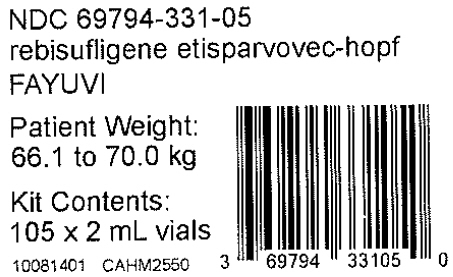
NDC 69794-331-05
rebisufligene etisparvovec-hopf
FAYUVI
Patient Weight:
66.1 to 70.0 kg
Kit Contents:
105 x 2 mL vials
10081401
CAHM2550
Principal Display Panel (Kit Carton Label)
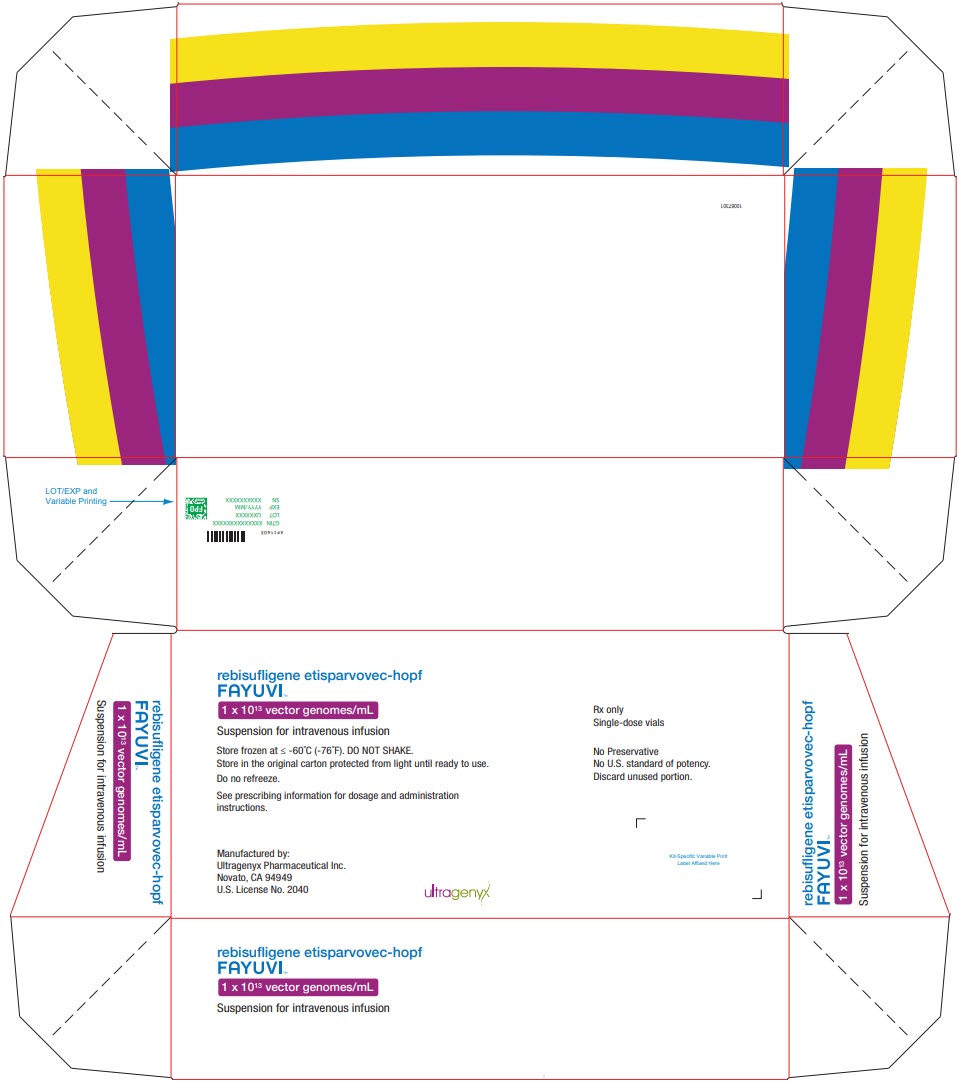
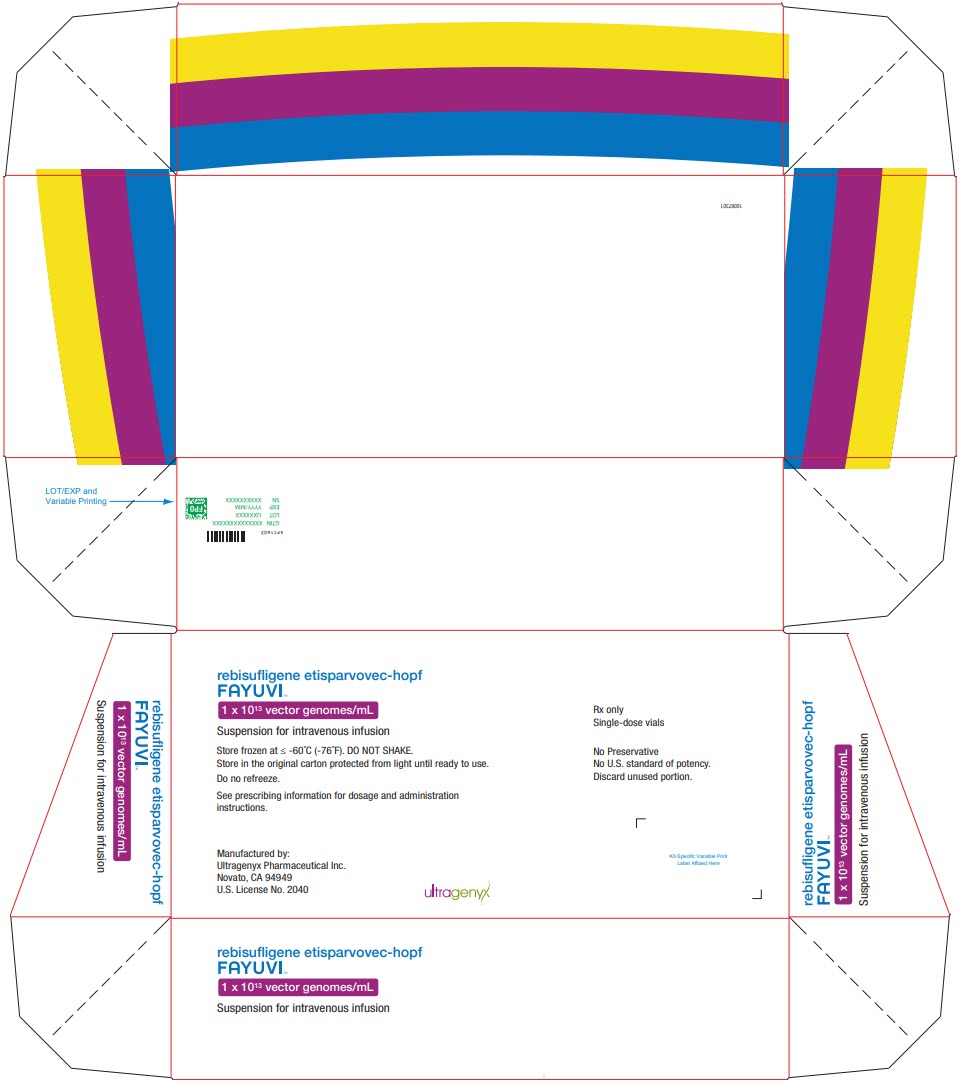
rebisufligene etisparvovec-hopf
FAYUVI™
Rx only
Single-dose vials
1 x 10¹³ vector genomes/mL
Suspension for intravenous infusion
Store frozen at ≤ -60˚C (-76˚F). DO NOT SHAKE.
Store in the original carton protected from light
until ready to use.
Do no refreeze.
See prescribing information for dosage and
administration instructions.
No Preservative
No U.S. standard of potency.
Discard unused portion.
Manufactured by:
Ultragenyx Pharmaceutical Inc.
Novato, CA 94949
U.S. License No. 2040
ultragenyx
Principal Display Panel (Kit Carton)
NDC 69794-300-01
rebisufligene etisparvovec-hopf
FAYUVI™
1 x 10¹³ vector genomes/mL
Suspension for
intravenous infusion
2 mL
Rx only
Single-dose vial
Store frozen
at ≤ -60˚C (-76˚F)
DO NOT SHAKE
Do not refreeze
ultragenyx
10066501
APL2325
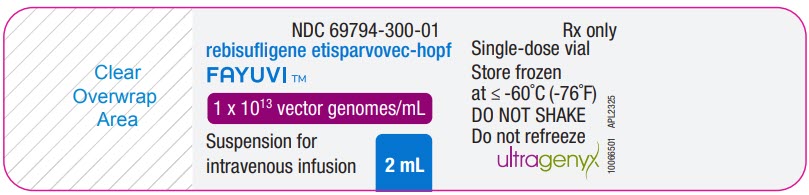
Principal Display Panel (2 mL Vial Label)
* Please review the disclaimer below.
