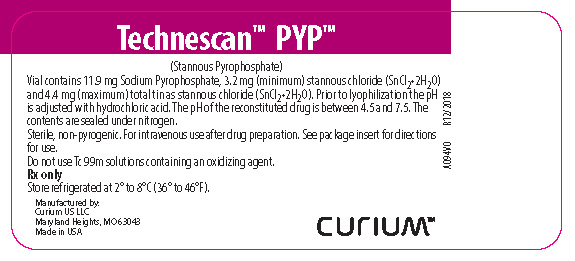
The recommended adult dose of Technescan PYP is one-third (0.33) to the entire vial contents, followed by 555 to 740 megabecquerels (15 to 20 millicuries) of sodium pertechnetate Tc 99m. Cardiac imaging should be done 10 minutes following the administration of sodium pertechnetate Tc 99m (in vivo method) or Tc 99m labeled red blood cells (modified in vivo/in vitro method) utilizing a scintillation camera interfaced to an electrocardiographic gating device.
In Vivo Method: Technescan PYP is reconstituted with sterile, non-pyrogenic normal saline containing no preservatives. The patient dose is administered intravenously 15 to 30 minutes prior to the intravenous administration of 555 to 740 megabecquerels (15 to 20 millicuries) of sodium pertechnetate Tc 99m. Technescan PYP should be injected by direct venipuncture. Heparinized catheter systems should be avoided.
Modified In Vivo/In Vitro Method Using Acid-Citrate-Dextrose (ACD): Technescan PYP is reconstituted with sterile, non-pyrogenic normal saline containing no preservatives, and the patient dose is administered intravenously. An intravenous line containing a 3-way stopcock is inserted in a large peripheral vein and kept patent with a continuous drip of sterile, non-pyrogenic normal saline containing no preservatives. Thirty minutes after Technescan PYP injection, the infusion line and stopcock are cleared by withdrawing and discarding approximately 5 milliliters of whole blood. Immediately following, approximately 5 milliliters of whole blood are withdrawn into a syringe containing 1 milliliter preservative-free acid-citrate-dextrose (ACD) and 555 to 740 megabecquerels (15 to 20 millicuries) of sodium pertechnetate Tc 99m. The stopcock is then turned, residual blood is flushed from the intravenous line, and the normal saline flow is readjusted. The syringe is gently rotated to mix and allowed to incubate at room temperature for 10 minutes prior to injection via the 3-way stopcock.
Modified In Vivo/In Vitro Method Using Heparin: Technescan PYP is reconstituted with sterile, non-pyrogenic normal saline containing no preservatives, and the patient dose is administered intravenously. An infusion set fitted with a 3-way stopcock is placed in a large peripheral vein, and the intravenous line is heparinized with a saline solution containing 5 to 10 units preservative-free heparin per milliliter. Thirty minutes after Technescan PYP injection, 3 milliliters of blood are withdrawn into a syringe containing 555 to 740 megabecquerels (15 to 20 millicuries) of sodium pertechnetate Tc 99m. Anticoagulation of the blood is provided by residual heparin in the intravenous line. The syringe is gently rotated to mix and allowed to incubate at room temperature for 10 minutes prior to injection via the 3-way stopcock.
Parenteral drug products should be visually inspected for particulate matter and discoloration prior to administration whenever solution and container permit. Do not use if contents are turbid.
The estimated absorbed radiation doses to an average patient (70 kg) from administration of 740 megabecquerels (20 millicuries) of sodium pertechnetate Tc 99m, 30 minutes after the intravenous administration of Technescan PYP are shown in Table 5.
Table 5. Absorbed Radiation Doses2 (Blood Pool Imaging)**Assumes non-resting state, with 75% of the sodium pertechnetate Tc 99m labeling red blood cells and the other 25% remaining as pertechnetate.
|
**Assumes no initial uptake in spleen.
|
| 2Data supplied by Oak Ridge Associated Universities, Radiopharmaceutical Internal Dose Information Center, 1986.
|
Tissue
| Sodium Pertechnetate Tc 99m
30 min. Post Technescan PYP Administration
|
| mGy/740 MBq
| rads/20 mCi
|
| Bladder Wall
| 6.8
| 0.68
|
| Ovaries
| 4.6
| 0.46
|
| Testes
| 2.6
| 0.26
|
| Red Marrow
| 3.8
| 0.38
|
| Spleen**
| 3.0
| 0.30
|
| Blood
| 10.2
| 1.02
|
| Total Body
| 3.0
| 0.30
|
- A Technescan PYP reaction vial is removed from the refrigerator and approximately five (5) minutes are allowed for the contents to come to room temperature.
- Reconstitute the reaction vial with 3 milliliters of sterile, non-pyrogenic normal saline containing no preservatives.
- Shake the reaction vial sufficiently to bring the lyophilized material into solution. Allow to stand for five (5) minutes at room temperature.
- The reaction vial should be visually inspected. The resulting solution should be clear and free of particulate matter. If not, the reaction vial should not be used.
-
Store reconstituted reaction vial at 20° to 25°C (68° to 77°F) when not in use and discard after six (6) hours from time of preparation.