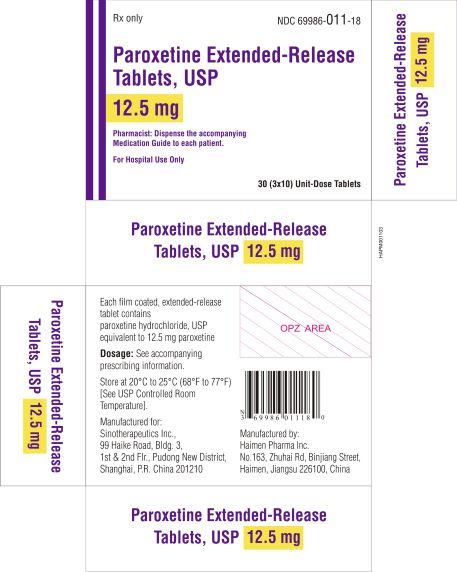
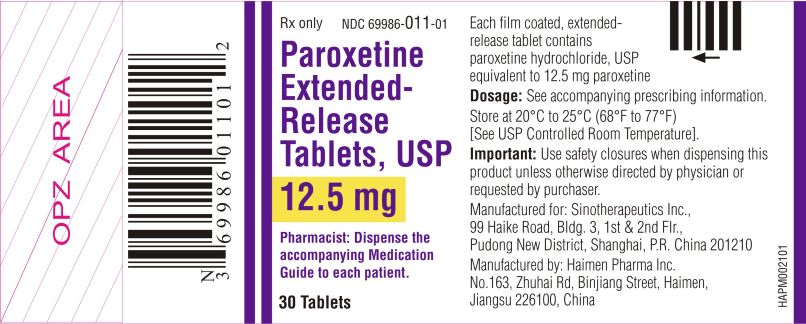
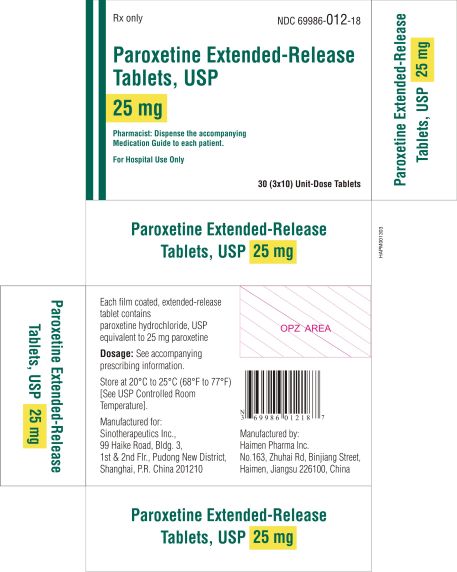
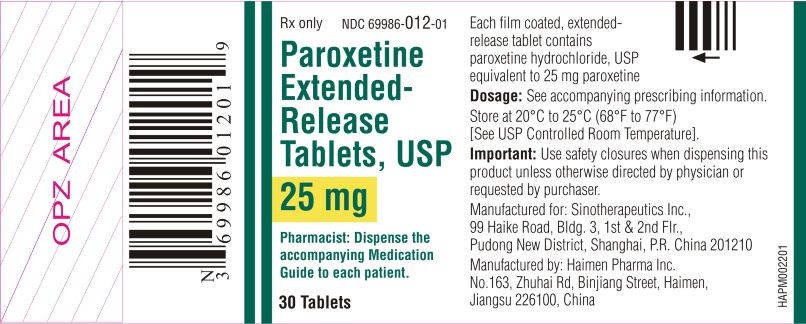
Paroxetine extended-release tablets are indicated in adults for the treatment of:
• Major depressive disorder (MDD)
• Panic disorder (PD)
• Social anxiety disorder (SAD)
• Premenstrual dysphoric disorder (PMDD)
The following adverse reactions are included in more detail in other sections of the prescribing information:
• Hypersensitivity reactions to paroxetine [see Contraindications (4)]
• Suicidal Thoughts and Behaviors [see Warnings and Precautions (5.1)]
• Serotonin Syndrome [see Warnings and Precautions (5.2)]
• Embryofetal and Neonatal Toxicity [see Warnings and Precautions (5.4)]
• Increased Risk of Bleeding [see Warnings and Precautions (5.5)]
• Activation of Mania/Hypomania [see Warnings and Precautions (5.6)]
• Discontinuation Syndrome [see Warnings and Precautions (5.7)]
• Seizures [see Warnings and Precautions (5.8)]
• Angle-closure Glaucoma [see Warnings and Precautions (5.9)]
• Hyponatremia [see Warnings and Precautions (5.10)]
• Bone Fracture [see Warnings and Precautions (5.12)]
Other Adverse Reactions Observed During the Premarketing Evaluation of Paroxetine Extended-Release Tablets
Adverse reactions from studies in MDD (not including Study 3 in elderly patients), PD, and SAD that occurred between 1% and 5% of patients treated with paroxetine extended-release tablets and at a rate greater than in placebo-treated patients include:, allergic reaction, tachycardia, vasodilatation, hypertension, migraine, vomiting, weight loss, weight gain, hypertonia, paresthesia, agitation, confusion, myoclonus, concentration impaired, depression, rhinitis, cough increased, bronchitis, photosensitivity, eczema, taste perversion, UTI, menstrual disorder, urinary frequency, urination impaired, and vaginitis.
Adverse Reactions in Patients with PMDD
Table 4 displays adverse reactions that occurred (incidence of 5% or more and greater than placebo within at least 1 of the studies) in patients treated with paroxetine extended-release tablets in Studies 8, 9, 10, and 11.
Table 4. Adverse Reactions (5% of Patients Treated with Paroxetine Extended-Release Tablets and Greater than Placebo) in Pooled Studies PMDD (Studies 8, 9, 11), and in Study 10a,b,c
Body System/Adverse Reaction | % Reporting Adverse Reaction |
Continuous Dosing Studies 8, 9, and 10 | Luteal Phase Dosing Study 11 |
Paroxetine extended-release tablets (n = 681) % | Placebo (n = 349) % | Paroxetine extended-release tablets (n = 246) % | Placebo (n = 120) % |
Body as a Whole Asthenia Headache Infection | 17 6 15 12 6 4 | 15 4 NA NA NA NA |
Digestive System Nausea Diarrhea Constipation | 17 7 6 2 5 1 | 18 2 6 0 2 <1 |
Nervous System Libido Decreased Somnolence Insomnia Dizziness Tremor | 12 5 9 2 8 2 7 3 4 <1 | 9 6 3 <1 7 3 6 3 5 0 |
Skin and Appendages Sweating | 7 <1 | 6 <1 |
Urogenital System Female Genital Disordersc | 8 1 | 2 0 |
NA= the adverse reaction information is not available in this population.
a<1% means greater than zero and less than 1%.
bThe luteal phase and continuous dosing PMDD trials were not designed for making direct comparisons between the 2 dosing regimens.
cMostly anorgasmia or difficulty achieving orgasm.
Dose Dependent Adverse Reactions
Comparison of the incidence of adverse reactions (placebo vs. 12.5 mg paroxetine extended-release tablets vs. 25 mg paroxetine extended-release tablets) from studies 8, 9, 10 showed the following adverse reactions to be dose-related: Nausea, somnolence, sweating, dry mouth, dizziness, decreased appetite, tremor, impaired concentration, yawn, paresthesia, hyperkinesia, and vaginitis.
Male and Female Sexual Dysfunction
Although changes in sexual desire, sexual performance, and sexual satisfaction often occur as manifestations of a psychiatric disorder, they may also be a consequence of SSRI treatment. However, reliable estimates of the incidence and severity of untoward experiences involving sexual desire, performance, and satisfaction are difficult to obtain, in part because patients and healthcare providers may be reluctant to discuss them. Accordingly, estimates of the incidence of untoward sexual experience and performance cited in labeling may underestimate their actual incidence.
The percentage of patients reporting symptoms of sexual dysfunction in the Studies 1 and 2 (nonelderly patients with MDD), 4, 5, 6, 7, 8, 9, 10, and 11 are presented in Table 5:
Table 5. Adverse Reactions Related To Sexual Dysfunction In Patients Treated With Paroxetine Extended-Release Tablets in Pooled 10 to 12 Week Studies of MDD, PD, SAD, and PMDD
| Studies 1 and 2 % | Studies 4, 5, and 6 % | Study 7 % | Studies 8, 9, and 11 (Continuous Dosing) % | Study 10 (Luteal Phase Dosing) % |
| Paroxetine extended-release tablets | Placebo | Paroxetine extended-release tablets | Placebo | Paroxetine extended-release tablets | Placebo | Paroxetine extended-release tablets | Placebo | Paroxetine extended-release tablets | Placebo |
n (males) | 78 | 78 | 162 | 194 | 88 | 97 | NA | NA | NA | NA |
Decreased Libido | 10 | 5 | 9 | 6 | 13 | 1 | NA | NA | NA | NA |
Abnormal ejaculation | 26 | 1 | 27 | 3 | 15 | 1 | NA | NA | NA | NA |
Impotence | 5 | 3 | 10 | 1% | 9 | 0 | NA | NA | NA | NA |
n (females) | 134 | 133 | 282 | 251 | 98 | 87 | 681 | 349 | 246 | 120 |
Decreased Libido | 4 | 2 | 8 | 2 | 4 | 1 | 12 | 5 | 9 | 6 |
Orgasmic Disturbance | 10 | <1 | 7 | 1 | 3 | 0 | 8 | 1 | 2 | 0 |
NA = the adverse reaction listed did not occur in this group of patients.
Paroxetine treatment has been associated with several cases of priapism. In those cases with a known outcome, patients recovered without sequelae.
Less Common Adverse Reactions
The following adverse reactions occurred during the clinical studies of paroxetine extended-release tablets and are not included elsewhere in the labeling.
Reactions are categorized by body system and listed in order of decreasing frequency according to the following definitions: Frequent adverse reactions are those occurring on 1 or more occasions in at least 1/100 patients; infrequent adverse reactions are those occurring in 1/100 to 1/1,000 patients; rare reactions are those occurring in fewer than 1/1,000 patients.
Cardiovascular System: Infrequent was postural hypotension.
Hemic and Lymphatic System: Rare was thrombocytopenia.
Metabolic and Nutritional Disorders: Infrequent were generalized edema and hypercholesteremia.
Nervous System: Infrequent were convulsion, akathisia, and manic reaction.
Psychiatric: Infrequent were hallucinations.
Skin and Appendages: Frequent was rash; infrequent was urticaria; rare was angioedema and erythema multiforme.
Urogenital System: Infrequent was urinary retention; rare was urinary incontinence.