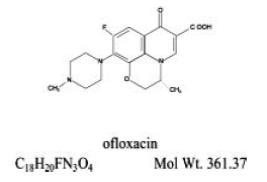
Ofloxacin has in vitro activity against a broad range of gram-positive and gram-negative aerobic and anaerobic bacteria. Ofloxacin is bactericidal at concentrations equal to or slightly greater than inhibitory concentrations. Ofloxacin is thought to exert a bactericidal effect on susceptible bacterial cells by inhibiting DNA gyrase, an essential bacterial enzyme which is a critical catalyst in the duplication, transcription, and repair of bacterial DNA.
Cross-resistance has been observed between ofloxacin and other fluoroquinolones. There is generally no cross-resistance between ofloxacin and other classes of antibacterial agents such as beta-lactams or aminoglycosides.
Ofloxacin has been shown to be active against most strains of the following organisms both in vitro and clinically, in conjunctival and/or corneal ulcer infections (see Indications and Usage).
_________________________________________________________________________
AEROBES, GRAM-POSITIVE: AEROBES, GRAM-NEGATIVE:
Staphylococcus aureus Enterobacter cloacae
Staphylococcus epidermidis Haemophilus influenzae
Streptococcus pneumoniae Proteus mirabilis
ANAEROBIC SPECIES: Pseudomonas aeruginosa
Propionibacterium acnes Serratia marcescens*
__________________________________________________________________________
*Efficacy for this organism was studied in fewer than 10 infections
The safety and effectiveness of ofloxacin ophthalmic solution in treating ophthalmologic infections due to the following organisms have not been established in adequate and well-controlled clinical trials. Ofloxacin ophthalmic solution has been shown to be active in vitro against most strains of these organisms but the clinical significance in ophthalmologic infections is unknown.
__________________________________________________________________________
AEROBES, GRAM-POSITIVE:
Enterococcus faecalis Staphylococcus hominus
Listeria monocytogenes Staphylococcus simulans
Staphylococcus capitis Streptococcus pyogenes
AEROBES, GRAM-NEGATIVE:
Acinetobacter calcoaceticus var. Klebsiella pneumoniae
anitratus
Acinetobacter calcoaceticus var. lwoffii Moraxella (Branhamella) catarrhalis
Citrobacter diversus Moraxella lacunata
Citrobacter freundii Morganella morganii
Enterobacter aerogenes Neisseria gonorrhoeae
Enterobacter agglomerans Pseudomonas acidovorans
Escherichia coli Pseudomonas fluorescens
Haemophilus parainfluenzae Shigellasonnei
Klebsiella oxytoca
OTHER:
Chlamydia trachomatis
__________________________________________________________________________
Clinical Studies
Conjunctivitis
In a randomized, double-masked, multicenter clinical trial, ofloxacin ophthalmic solution was superior to its vehicle after 2 days of treatment in patients with conjunctivitis and positive conjunctival cultures. Clinical outcomes for the trial demonstrated a clinical improvement rate of 86% (54/63) for the ofloxacin treated group versus 72% (48/67) for the placebo treated group after 2 days of therapy. Microbiological outcomes for the same clinical trial demonstrated an eradication rate for causative pathogens of 65% (41/63) for the ofloxacin treated group versus 25% (17/67) for the vehicle treated group after 2 days of therapy. Please note that microbiologic eradication does not always correlate with clinical outcome in anti-infective trials.
Corneal Ulcers
In a randomized, double-masked, multi-center clinical trial of 140 subjects with positive cultures, ofloxacin ophthalmic solution treated subjects had an overall clinical success rate (complete re-epithelialisation and no progression of the infiltrate for two consecutive visits) of 82% (61/74) compared to 80% (53/66) for the fortified antibiotic group, consisting of 1.5% tobramycin and 10% cefazolin solutions. The median time to clinical success was 11 days for the ofloxacin treated group and 10 days for the fortified treatment group.