Bortezomib Injection, Powder, Lyophilized, For Solution
Product Images NDC 70069-836
View Photos of Packaging, Regulatory Labels, and Product Appearance
Product Visual Gallery
This gallery contains 13 technical images submitted to the FDA as part of the official labeling for Bortezomib (NDC 70069-836). Unlike standard consumer photos, these assets often include clinical data figures, molecular chemical structures, and official manufacturer packaging layouts.
As provided by Somerset Therapeutics Llc, these visuals offer a comprehensive scientific overview of the product's physical and chemical identity, aiding pharmacists and researchers in product verification and study.
Product Images & Figures Index
Bortetraylabel (Bortetraylabel)
This text is a set of instructions for preparing and administering Bortezomib for Injection, including details on dilution concentrations, volumes, and routes of administration such as subcutaneous and intravenous. The instructions also mention applying stickers on vials and syringes and refer to the full instructions in the Package Insert.*
Bortevialtray (Bortetvialray)
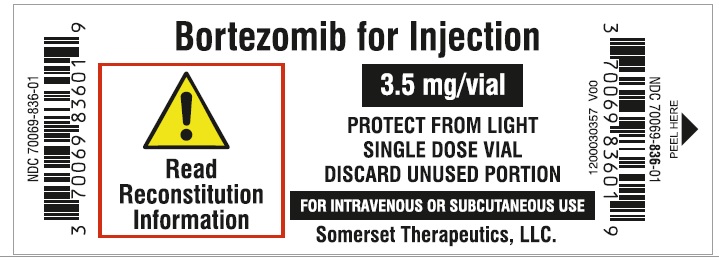
Borteviallabel (Borteviallabel)
This is a drug product containing 3.5 mg bortezomib and 35 mg mannitol in a lyophilized vial. The usual dose should be checked in the accompanying package insert. It is recommended to store this medication at 25°C (77°F) with excursions permitted between 15°C to 30°C (59°F to 86°F). This single-dose vial should be discarded if unused. The product is manufactured for Somerset Therapeutics, LLC in Somerset, NJ 08873, and made in India. It is identified as a Cytotoxic Agent and should be protected from light as indicated in the Package Insert.*
Figure (Bortezomib 01)
Figure (Bortezomib 02)
This text provides a formula for calculating the total volume of Bortezomib for Injection to be administered based on the dose in mg/m^2 and the patient's body surface area in m^2. The concentration of the Bortezomib for Injection solution is given as 2.5 mg/mL. This formula is likely used in a medical setting for accurate dosing of the medication.*
Chemical Structure (Bortezomib 03)
Figure 1 (Bortezomib 04)
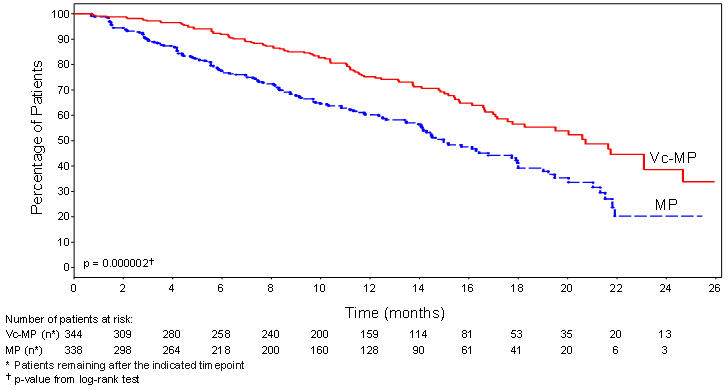
Figure 2 (Bortezomib 05)
The text appears to show data related to the percentage of patients at risk over different time points. It includes the number of patients at risk for two different treatments, indicated as VeMP and WP, at various time intervals measured in months. The information also suggests the patients remaining after the specified time points and mentions a p-value calculation using the logrank test.*
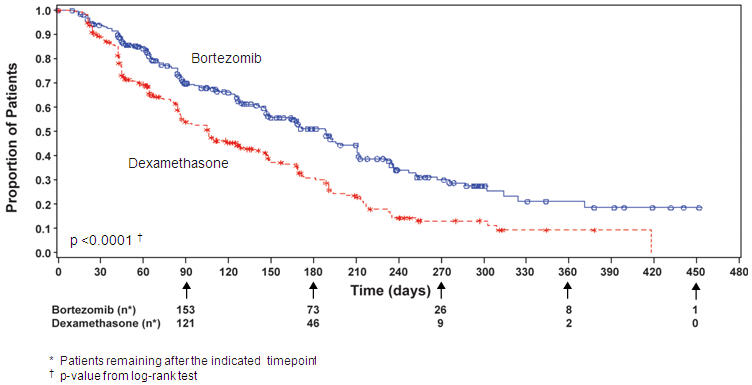
Figure 3 (Bortezomib 06)
This text provides data on the use of Bortezomib in patients and mentions the proportion of patients. The data includes the number of patients at different time points, with reference to p-values from a log-rank test. The text also mentions Doxamethasone and the number of patients remaining after a specific time point. This data seems to be part of a study or analysis involving Bortezomib and patient outcomes over time.*
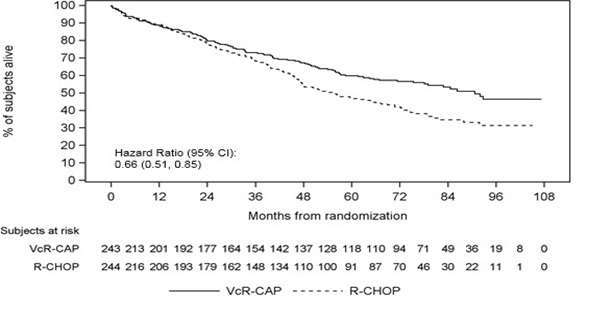
Figure 4 (Bortezomib 07)
Bortezomib-08 (Bortezomib 08)
This information appears to be related to a medical study or clinical trial involving two treatment groups, one labeled as VCR-CAP and the other as R-CHOP. The data is presented in a table showing values over time in months for each treatment group. The aim seems to be assessing the performance or effectiveness of these treatments based on the given values.*
Bortezomib-09 (Bortezomib 09)
The text contains data on Hazara Ratio with 95% confidence intervals (0.51, 0.85) and % of subjects alive over specific time points in months from randomization. It also includes the number of subjects at risk in two treatment groups: VGR-CAP and R-CHOP. The details can be used for survival analysis and comparison between the two treatment regimens.*
* These product label images have been analyzed using experimental machine learning. Please verify findings with the primary label text.