Induction of a Manic Episode in Patients with Bipolar Disorder
CNS stimulants may induce a manic or mixed episode in patients. Prior to initiating COTEMPLA XR-ODT treatment, screen patients for risk factors for developing a manic episode (e.g. comorbid or history of depressive symptoms or a family history of suicide, bipolar disorder, or depression).
New Psychotic or Manic Symptoms
CNS stimulants, at the recommended dosage, may cause psychotic or manic symptoms (e.g., hallucinations, delusional thinking or mania) in patients without a prior history of psychotic illness or mania. In a pooled analysis of multiple short-term, placebo-controlled studies of CNS stimulants, psychotic or manic symptoms occurred in approximately 0.1% of CNS stimulant-treated patients, compared to 0% of placebo-treated patients. If such symptoms occur, consider discontinuing COTEMPLA XR-ODT.
Adverse Reactions in Studies with Other Methylphenidate Products in Children, Adolescents, and Adults with ADHD
Commonly reported (≥2% of the methylphenidate group and at least twice the rate of the placebo group) adverse reactions from placebo-controlled trials of methylphenidate products include: appetite decreased, weight decreased, nausea, abdominal pain, dyspepsia, dry mouth, vomiting, insomnia, anxiety, nervousness, restlessness, affect lability, agitation, irritability, dizziness, vertigo, tremor, blurred vision, blood pressure increased, heart rate increased, tachycardia, palpitations, hyperhidrosis, and pyrexia.
Adverse Reactions in Studies with COTEMPLA XR-ODT in Children with ADHD
There is limited experience with COTEMPLA XR-ODT in controlled trials. Based on this limited experience, the adverse reaction profile of COTEMPLA XR-ODT appears similar to other methylphenidate extended release-products.
Physical Dependence
COTEMPLA XR-ODT may produce physical dependence. Physical dependence is a state that develops as a result of physiological adaptation in response to repeated drug use, manifested by withdrawal signs and symptoms after abrupt discontinuation or a significant dose reduction of a drug.
Withdrawal signs and symptoms after abrupt discontinuation or dose reduction following prolonged use of CNS stimulants including COTEMPLA XR-ODT include dysphoric mood; depression; fatigue; vivid, unpleasant dreams; insomnia or hypersomnia; increased appetite; and psychomotor retardation or agitation.
Tolerance
COTEMPLA XR-ODT may produce tolerance. Tolerance is a physiological state characterized by a reduced response to a drug after repeated administration (i.e., a higher dose of a drug is required to produce the same effect that was once obtained at a lower dose).
Clinical Effects of Overdose
Overdose of CNS stimulants is characterized by the following sympathomimetic effects:
- Cardiovascular effects including tachyarrhythmias, and hypertension or hypotension. Vasospasm, myocardial infarction, or aortic dissection may precipitate sudden cardiac death. Takotsubo cardiomyopathy may develop.
- CNS effects including psychomotor agitation, confusion, and hallucinations. Serotonin syndrome, seizures, cerebral vascular accidents, and coma may occur.
- Life-threatening hyperthermia (temperatures greater than 104⁰F) and rhabdomyolysis may develop.
Overdose Management
Consider the possibility of multiple drug ingestion. The pharmacokinetic profile of COTEMPLA XR-ODT should be considered when treating patients with overdose. Because methylphenidate has a large volume of distribution and is rapidly metabolized, dialysis is not useful. Consider contacting the Poison Help line (1-800-222-1222) or a medical toxicologist for additional overdose management recommendations.
Absorption
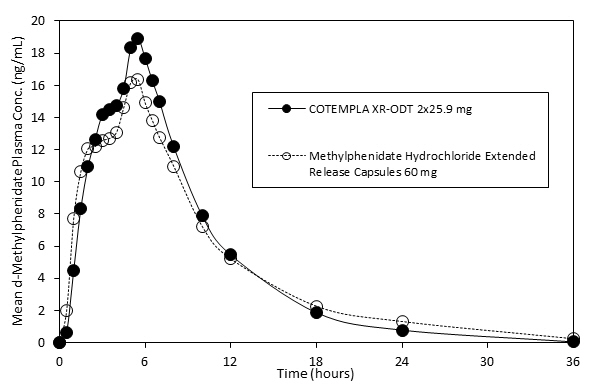
Following a single dose of 51.8 mg (2×25.9 mg daily) COTEMPLA XR-ODT in healthy adult subjects under fasted conditions, plasma methylphenidate (MPH) reached maximal concentration (C
max) at a median time of 5 hours after dosing. Compared to an extended release capsule formulation of methylphenidate, methylphenidate mean C
max and exposure (AUC
inf) was about 26% and 6% higher, respectively, after COTEMPLA XR-ODT administration (Figure 2).
Figure 2: Mean
d-Methylphenidate Plasma Concentration-Time Profiles After Administration of COTEMPLA XR-ODT or Methylphenidate Hydrochloride Extended-Release Capsule in Healthy Volunteers Under Fasted Conditions
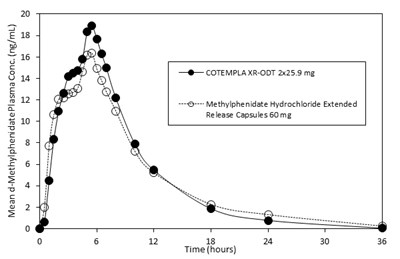
Figure 2 (Cotempla Xr Odt 2)
Abuse, Misuse, and Addiction
Educate patients and their families about the risks of abuse, misuse, and addiction of COTEMPLA XR-ODT, which can lead to overdose and death, and proper disposal of any unused drug [see Warnings and Precautions (5.1), Drug Abuse and Dependence (9.2), Overdosage (10)]. Advise patients to store COTEMPLA XR-ODT in a safe place, preferably locked, and instruct patients to not give COTEMPLA XR-ODT to anyone else.
Instructions for Taking COTEMPLA XR-ODT
Instruct patients and their caregivers on the following when supplied in blister form::
- The tablet should remain in the blister pack until the patient is ready to take it.
- The tablet should be taken immediately after opening the blister pack. It should not be stored for future use.
- The patient or caregiver should use dry hands when opening the blister pack.
- The patient or caregiver should remove the tablet by peeling back the foil on the blister pack. The tablet should not be pushed through the foil.
- As soon as the blister is opened, the tablet should be removed and placed on the patient's tongue.
- The whole tablet should be placed on the tongue and allowed to disintegrate without chewing or crushing.
- The tablet will disintegrate in saliva and can be swallowed. No liquid is needed to take the tablet.
Instruct patients and their caregivers on the following when supplied in bottle form:
- The tablet should remain in the bottle until the patient is ready to take it.
- The tablet should be taken immediately after removing it from the bottle. It should not be stored for future use.
- The patient or caregiver should use dry hands when removing from the bottle.
- As soon as the tablet is removed from the bottle, the tablet should be placed on the patient’s tongue.
- The whole tablet should be placed on the tongue and allowed to disintegrate without chewing or crushing.
- The tablet will disintegrate in saliva and can be swallowed. No liquid is needed to take the tablet.
Risks to Patients with Serious Cardiac Disease
Advise patients that there are potential risks to patients with serious cardiac disease, including sudden death with COTEMPLA XR-ODT use. Instruct patients to contact a healthcare provider immediately if they develop symptoms such as exertional chest pain, unexplained syncope, or other symptoms suggestive of cardiac disease
[see
Warnings and Precautions (5.2)]
.
Increased Blood Pressure and Heart Rate
Advise patients and their caregivers that COTEMPLA XR-ODT can elevate blood pressure and heart rate
[see
Warnings and Precautions (5.3)]
.
Psychiatric Adverse Reactions
Advise patients and their caregivers that COTEMPLA XR-ODT, at recommended doses, can cause psychotic or manic symptoms, even in patients without a prior history or psychotic symptoms or mania
[see
Warnings and Precautions (5.4)]
.
Long-Term Suppression of Growth in Pediatric Patients
Advise patients, families, and caregivers that COTEMPLA XR-ODT can cause slowing of growth and weight loss
[see
Warnings and Precautions (5.7)]
.
Increased Intraocular Pressure (IOP) and Glaucoma
Advise patients that IOP and glaucoma may occur during treatment with COTEMPLA XR-ODT
[see Warnings and Precautions (5.9)].
Motor and Verbal Tics, and Worsening of Tourette’s Syndrome
Advise patients that motor and verbal tics and worsening of Tourette’s Syndrome may occur during treatment with COTEMPLA XR-ODT. Instruct patients to notify their healthcare provider if emergence of new tics or worsening of tics or Tourette’s syndrome occurs
[see Warnings and Precautions (10)].
Alcohol Effect
Advise patients to avoid alcohol while taking COTEMPLA XR-ODT. Consumption of alcohol while taking COTEMPLA XR-ODT may result in a more rapid release of the dose of methylphenidate
[see Clinical Pharmacology (12.3)].
Pregnancy Registry
Advise patients that there is a pregnancy exposure registry that monitors pregnancy outcomes in females exposed to COTEMPLA XR-ODT during pregnancy
[see Use in Specific Populations (8.1)].
Manufactured for Neos Therapeutics Brands, LLC. Denver, CO 80237. Made in USA.
For more information, call 1-888-319-1789
COTEMPLA XR-ODT is a registered trademark of Neos Therapeutics, Inc.
Copyright
© 2014, Neos Therapeutics, Inc.