Tofacitinib Tablet, Film Coated, Extended Release
Product Images NDC 70377-057

View Photos of Packaging, Regulatory Labels, and Product Appearance

Product Visual Gallery

This gallery contains 8 technical images submitted to the FDA as part of the official labeling for Tofacitinib (NDC 70377-057). Unlike standard consumer photos, these assets often include clinical data figures, molecular chemical structures, and official manufacturer packaging layouts.

As provided by Biocon Pharma Inc, these visuals offer a comprehensive scientific overview of the product's physical and chemical identity, aiding pharmacists and researchers in product verification and study.

FDA Label Image

Chemical Structure (Chemical Structure)
Chemical Structure (Chemical Structure)
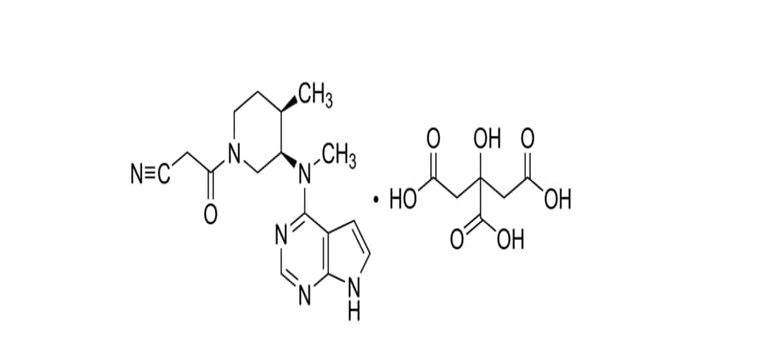
Chemical structure of Tofacitinib with a bisulfate moiety, illustrating the molecular composition and bonding of the active pharmaceutical ingredient in Tofacitinib XR tablets.*
FDA Label Image

Figure-1 (Figure 1)

Figure-1 (Figure 1)
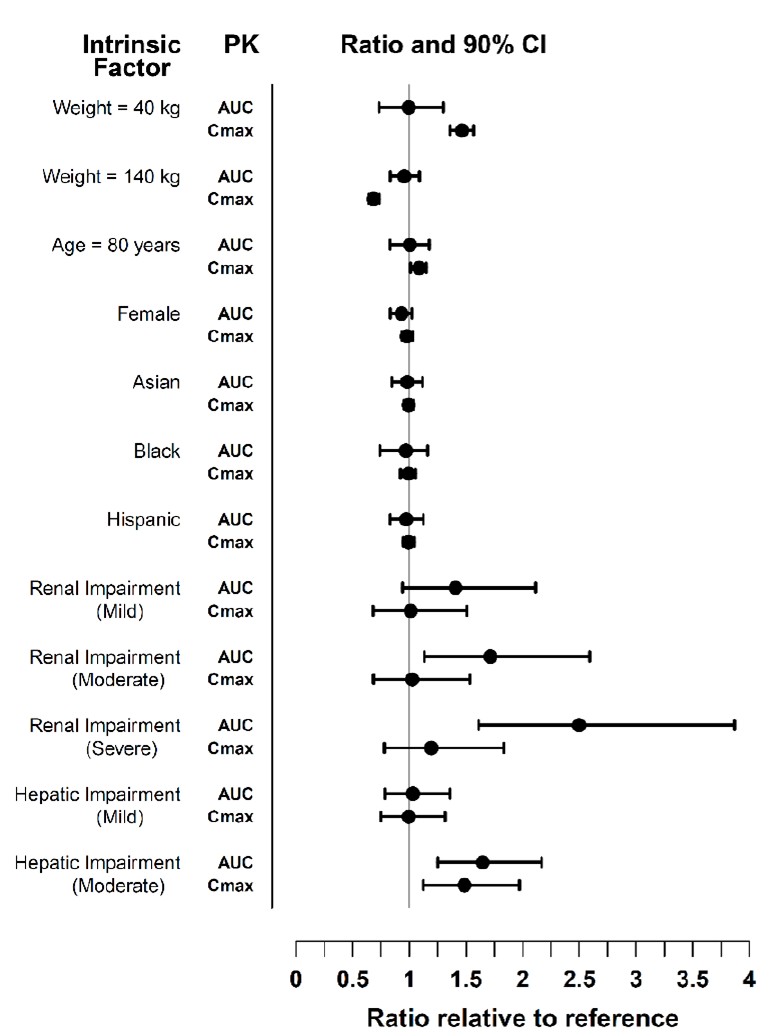
A forest plot illustrating the pharmacokinetic ratios (AUC and Cmax) and 90% confidence intervals for various intrinsic factors including weight, age, sex, race, and degrees of renal and hepatic impairment. The x-axis shows the ratio relative to reference values ranging from 0 to 4. The plot compares these ratios for Tofacitinib XR based on these intrinsic factors.*
FDA Label Image

Figure-2 (Figure 2)

Figure-2 (Figure 2)
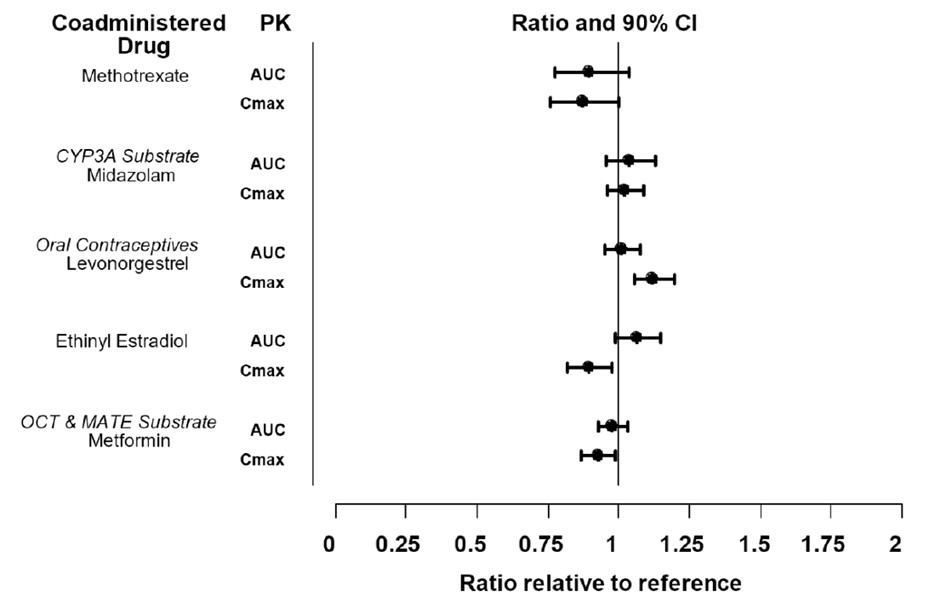
A forest plot chart illustrating the pharmacokinetic (PK) ratios and 90% confidence intervals (CI) for the drugs methotrexate, midazolam, levonorgestrel, ethinyl estradiol, and metformin when coadministered with Tofacitinib XR. The chart compares area under the curve (AUC) and maximum concentration (Cmax) ratios relative to reference values, with the x-axis showing the ratio scale from 0 to 2.*
FDA Label Image

Figure-3 (Figure 3)

Figure-3 (Figure 3)
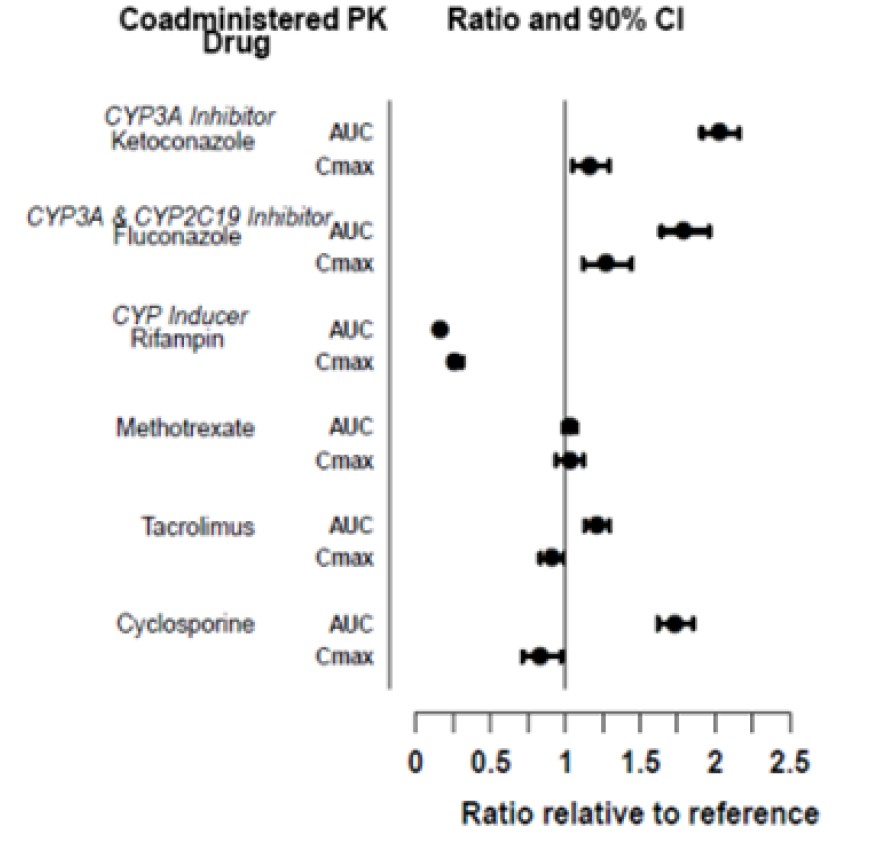
A pharmacokinetic (PK) interaction forest plot showing the ratio and 90% confidence interval (CI) of drug interactions for various coadministered drugs with Tofacitinib XR. The drugs include CYP3A inhibitor Ketoconazole, CYP3A & CYP2C19 inhibitor Fluconazole, CYP inducer Rifampin, Methotrexate, Tacrolimus, and Cyclosporine, each with data represented for AUC and Cmax ratios relative to reference (1.0). Ratio values range from 0 to 2.5 on the x-axis.*
FDA Label Image

Figure-4 (Figure 4)

Figure-4 (Figure 4)
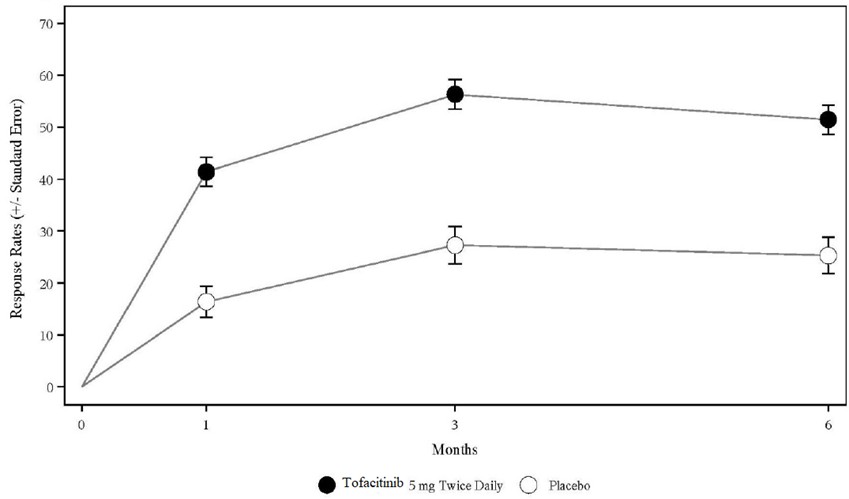
A line graph depicting response rates (with standard error bars) over a 6-month period for Tofacitinib 5 mg Twice Daily versus Placebo. The x-axis shows time in months (0, 1, 3, 6), while the y-axis shows response rates. Tofacitinib is represented by a solid black circle line, and Placebo by an open circle line.*
FDA Label Image

Figure-5 (Figure 5)

Figure-5 (Figure 5)
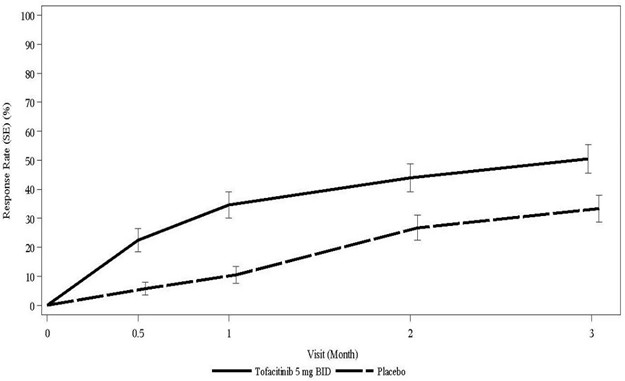
A line graph comparing response rates (%) over a 3-month period for Tofacitinib 5 mg BID versus placebo. The x-axis represents time in months (visits at 0, 0.5, 1, 2, and 3 months) and the y-axis shows response rate percentages with standard error bars. Tofacitinib data is shown with a solid line, placebo with a dashed line.*
FDA Label Image

Figure-6 (Figure 6)

Figure-6 (Figure 6)
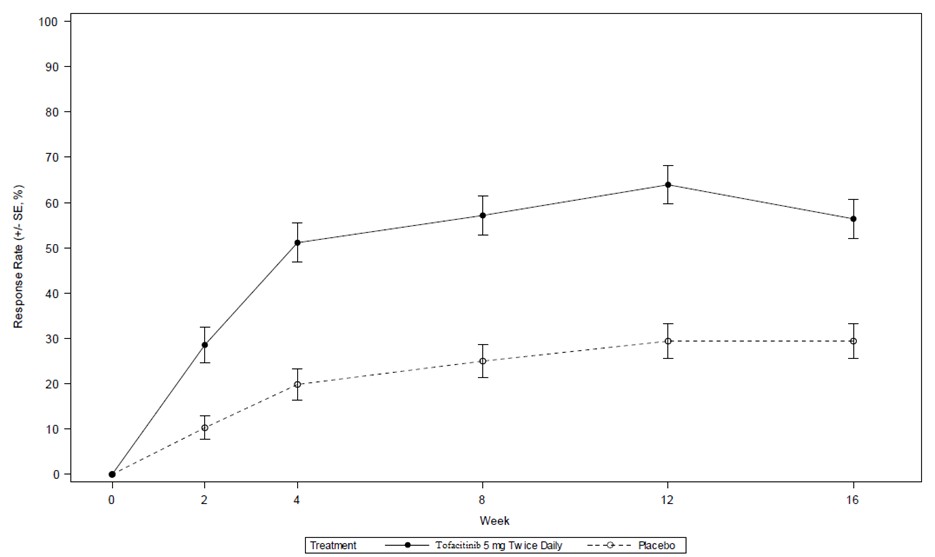
A line graph depicting response rate in percent (+/- SE) over 16 weeks comparing Tofacitinib 5 mg twice daily (solid line with filled circles) to placebo (dashed line with open circles). The response rate increases over time, with Tofacitinib showing a higher response rate than placebo at each measured interval.*
FDA Label Image

Principal Display Panel (11 mg Tablet Bottle Label)

Principal Display Panel (11 mg Tablet Bottle Label)
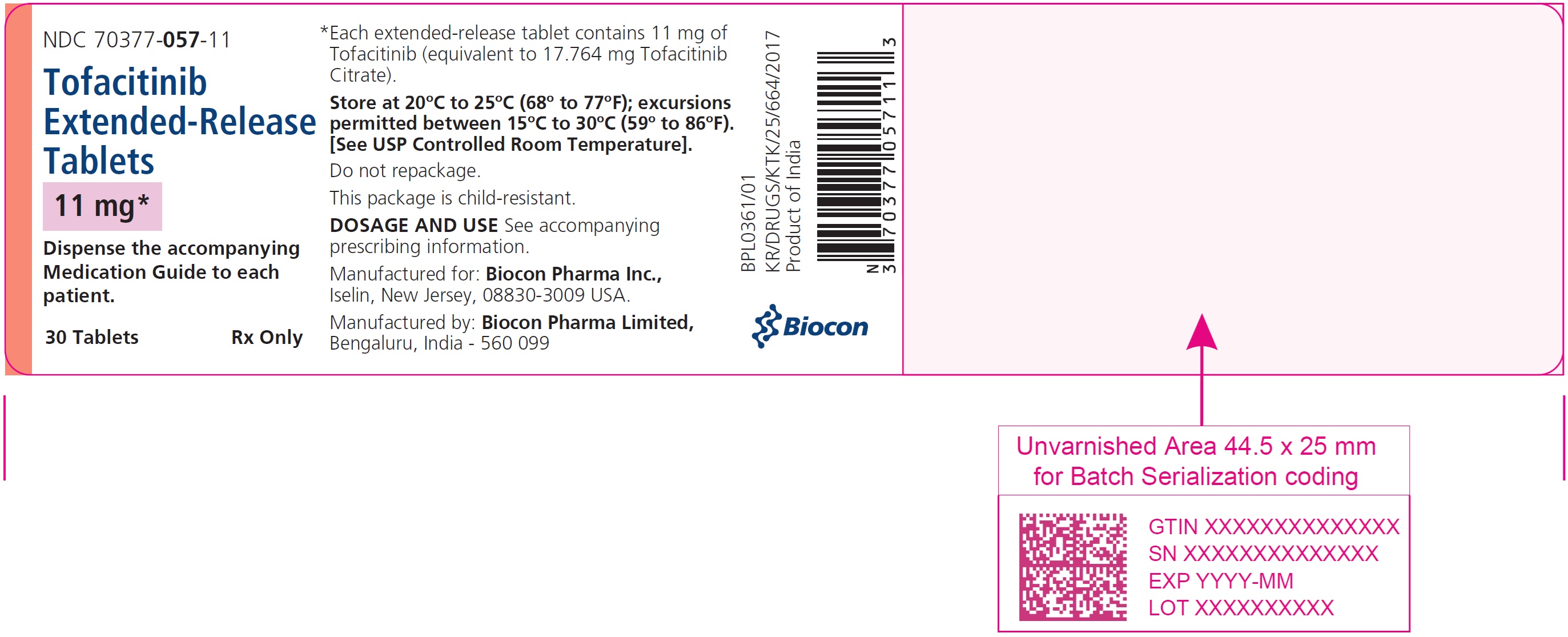
Label for Tofacitinib Extended-Release Tablets, 11 mg strength, containing 30 tablets. The label includes storage instructions, the NDC number 70377-057-11, and states the product is manufactured for Biocon Pharma Inc. It highlights the tablet is an extended-release formulation and includes a barcode and Biocon logo.*

* About these descriptions: Image descriptions on this page are generated by automated AI analysis of the product label images from the manufacturer's FDA label submission (SPL). They are provided for reference only and may contain errors or omissions. Always rely on the printed label itself and the official FDA labeling, and consult a pharmacist or healthcare professional with any questions about this product.