Clopidogrel Bisulfate
Product Images NDC 70400-101

View Photos of Packaging, Regulatory Labels, and Product Appearance

Product Visual Gallery

This gallery contains 10 technical images submitted to the FDA as part of the official labeling for Clopidogrel Bisulfate (NDC 70400-101). Unlike standard consumer photos, these assets often include clinical data figures, molecular chemical structures, and official manufacturer packaging layouts.

As provided by Sterisyn Inc., these visuals offer a comprehensive scientific overview of the product's physical and chemical identity, aiding pharmacists and researchers in product verification and study.

FDA Label Image

Label (Clopidogrel Tablets 30 Final)

FDA Label Image

Figure1 (Clopidogrel Fig)

Figure1 (Clopidogrel Fig)
This is a figure that shows how the exposure to the active metabolite of Clopidogrel changes when it is taken alone or in combination with different proton pump inhibitors (PPIs), namely Deslansoprazole, Lansoprszole, Pantoprazole and Omeprazole. The figure presents the effect of each PPI on the active metabolite's AUC, represented by the mean and 90% confidence interval. It also shows the change in relation to the active metabolite of Clopidogrel alone.*
FDA Label Image

Figure3 (Clopidogrel Fig2)

Figure3 (Clopidogrel Fig2)
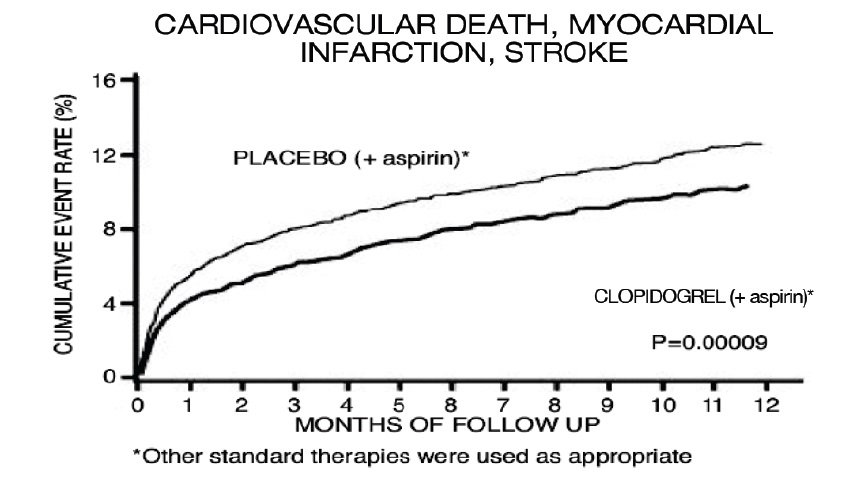
This appears to be a visual representation of a clinical trial comparing the effectiveness of clopidogrel and aspirin versus a placebo plus aspirin in preventing cardiovascular death, myocardial infarction, and stroke. The cumulative event rate is shown over the course of 12 months of follow-up. Standard therapies were also used as appropriate.*
FDA Label Image

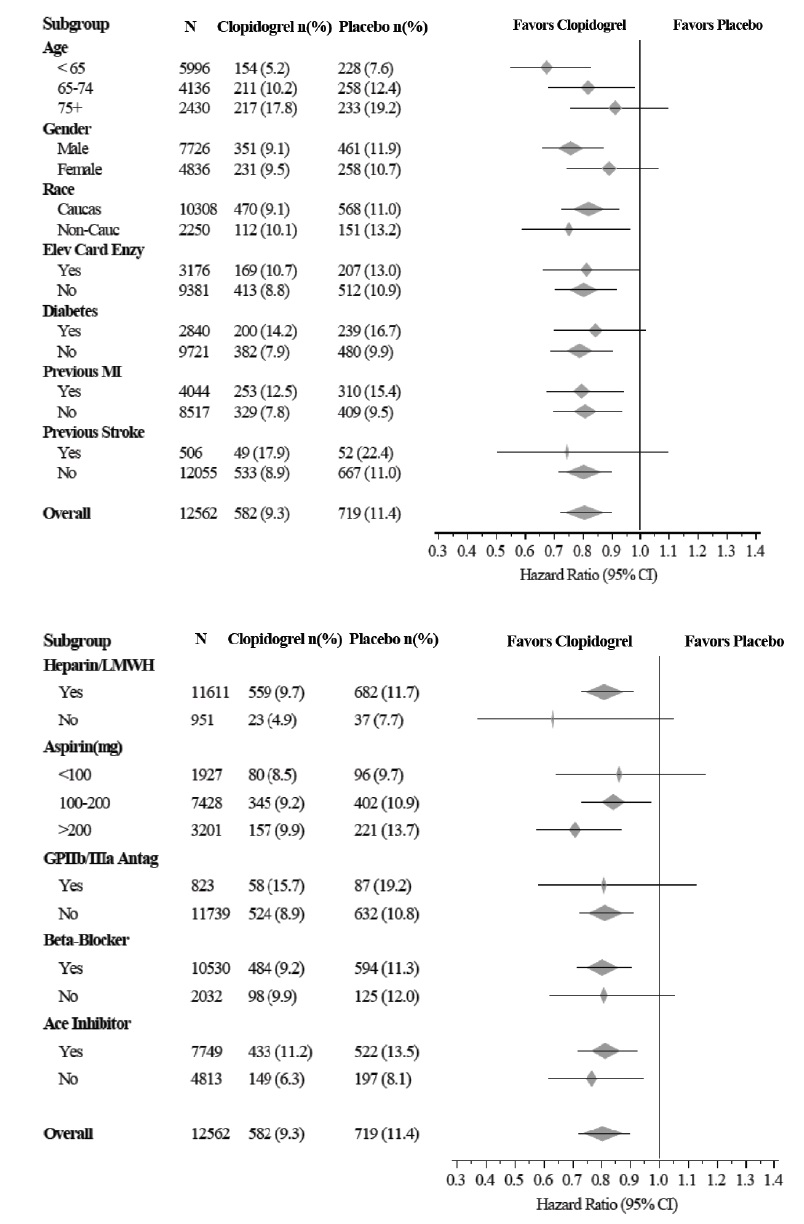
Figure3 (Clopidogrel Fig3)

FDA Label Image

Figure4 (Clopidogrel Fig4)

Figure4 (Clopidogrel Fig4)
The text is describing the results of the COMMIT study, where patients received either placebo or clopidogrel, in addition to aspirin. It shows the cumulative event rates for death before discharge, with the placebo group having 8.1% deaths and the clopidogrel group having 7.5% deaths. The study found a 7% proportional risk reduction with clopidogrel, with p-value 0.03. The data is also presented in a figure with days since randomization on the x-axis and the percentage of dead patients on the y-axis.*
FDA Label Image

Figure5 (Clopidogrel Fig5)

Figure5 (Clopidogrel Fig5)
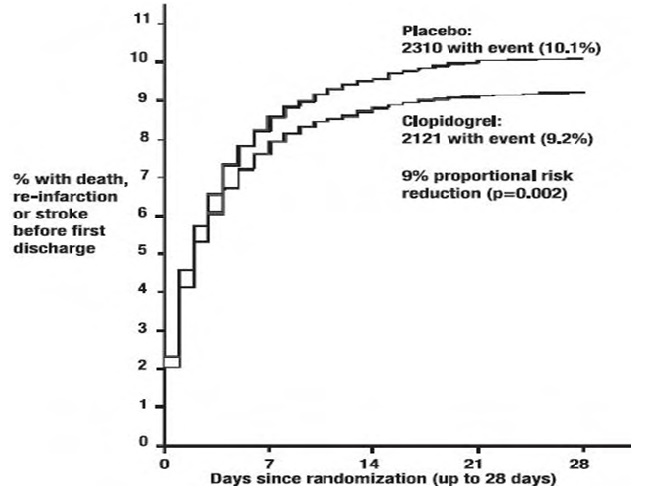
This text appears to be a statistical analysis of two treatments - Placebo and Clopidogrel - used in a clinical trial. The text includes the number of events (deaths or incidences of re-infarction or stroke) that occurred with each treatment, and the proportional risk reduction associated with using Clopidogrel versus Placebo. The data also includes the percentage of patients with death, the reduction in this percentage, and the p-value associated with this reduction. Finally, the data includes the number of days since randomization (up to 28 days).*
FDA Label Image

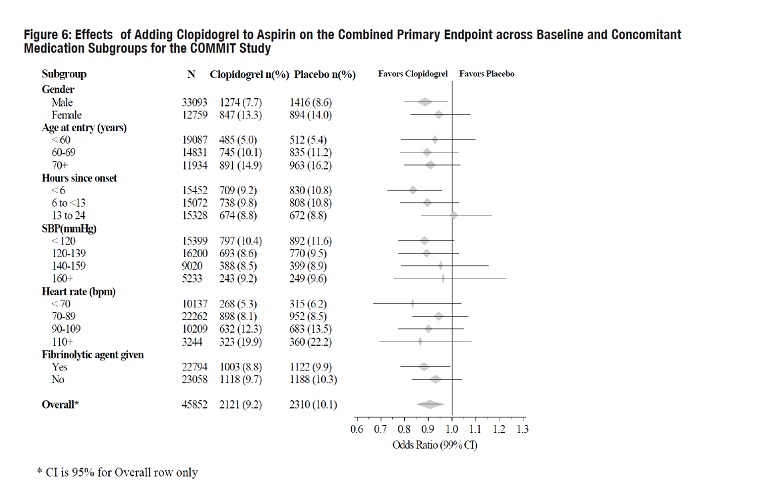
Figure6 (Clopidogrel Fig6)

FDA Label Image

Figure7 (Clopidogrel Fig7)

Figure7 (Clopidogrel Fig7)
This appears to be a chart or table comparing the cumulative event rate of fatal or non-fatal vascular events for two types of medication, aspirin and clopidogrel, at different time intervals (6, 12, 18 and 24 months). The number of participants (n) and symbols (@ and &) are also included. No further information is available.*
FDA Label Image

Figure8 (Clopidogrel Fig8)

FDA Label Image

Structure (Clopidogrel Str)

* These product label images have been analyzed using experimental machine learning. Please verify findings with the primary label text.