Gabapentin Tablet, Film Coated
Product Images NDC 70518-2616

10 FDA label images from Remedyrepack Inc. · Packaging, Regulatory Labels, and Product Appearance

Product Visual Gallery

This gallery contains 10 technical images submitted to the FDA as part of the official labeling for Gabapentin (NDC 70518-2616). Unlike standard consumer photos, these assets often include clinical data figures, molecular chemical structures, and official manufacturer packaging layouts.

As provided by Remedyrepack Inc., these visuals offer a comprehensive scientific overview of the product's physical and chemical identity, aiding pharmacists and researchers in product verification and study.

FDA Label Image

Gabapentin 600mg 70518 2616 01

Gabapentin 600mg 70518 2616 01
Gabapentin 600 mg tablet label by RemedyRepack Inc. The label includes the NDC 70518-2616-01, quantity of 90 tablets, and manufacturer information indicating packaging by RemedyRepack Inc., Indiana. Storage instructions specify 20-25°C with allowed excursions. A QR code is present on the label.*
FDA Label Image

Gabapentin 600mg 70518 2616 02

Gabapentin 600mg 70518 2616 02
Label for Gabapentin 600 mg film-coated tablets, quantity 28, repackaged by RemedyRepack Inc. The label includes storage instructions, repackaging information, and manufacturer details from Aurobindo, India, with a source NDC of 65362-0523-01. The product is marked RX only.*
FDA Label Image

Gabapentin 600mg 70518 2616 03

Gabapentin 600mg 70518 2616 03
Gabapentin 600 mg film-coated tablet label by RemedyRepack Inc. The label indicates a quantity of 30 tablets, with directions to see the package insert for use. It includes storage instructions, repackaging information, and a QR code, with manufacturing details stating Aurobindo, Nagar, India as the manufacturer.*
FDA Label Image

Remedy_label (Remedy Label)

Remedy_label (Remedy Label)
Gabapentin 600 mg film-coated tablets carton label showing a quantity of 30 tablets. The label includes the product name, strength, dosage form, manufacturer location (Aurobindo, India), and repackager RemedyRepack Inc., with storage instructions and a QR code.*
FDA Label Image

Creatinine Clearance (Gabapentin Fig1)

Creatinine Clearance (Gabapentin Fig1)
The image shows a pharmacokinetic formula used to estimate creatinine clearance (CLCr) based on age, weight, serum creatinine level, and a correction factor for female patients. It is a mathematical expression relevant to pharmacokinetic calculations, not specific to the Gabapentin tablet itself.*
FDA Label Image

Figure 1. Weekly Mean Pain Scores (observed Cases In Itt Population): Study 1 (Gabapentin Fig2)

Figure 1. Weekly Mean Pain Scores (observed Cases In Itt Population): Study 1 (Gabapentin Fig2)
A line graph titled 'Weekly Mean Pain Scores (Observed Cases in ITT Population): Study 1,' showing mean pain scores over 8 weeks. It compares placebo (open circles) and Gabapentin 3600 mg/day (filled triangles) during a 4-week dose titration period followed by a 4-week fixed dose period, with Gabapentin showing a consistent decrease in mean pain score compared to placebo.*
FDA Label Image

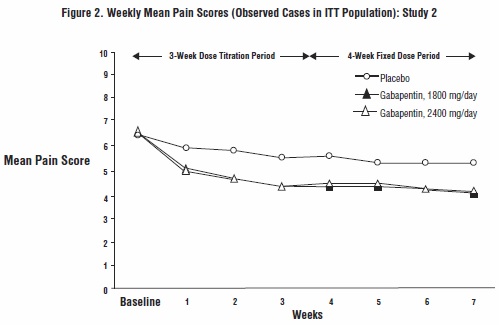
Figure 2. Weekly Mean Pain Scores (observed Cases In Itt Population): Study 2 (Gabapentin Fig3)

Figure 2. Weekly Mean Pain Scores (observed Cases In Itt Population): Study 2 (Gabapentin Fig3)
A line graph titled 'Weekly Mean Pain Scores (Observed Cases in ITT Population): Study 2' showing mean pain scores on the vertical axis and weeks on the horizontal axis, with data for placebo, Gabapentin 1800 mg/day, and Gabapentin 2400 mg/day over a 7-week period including a 3-week dose titration and 4-week fixed dose period.*
FDA Label Image

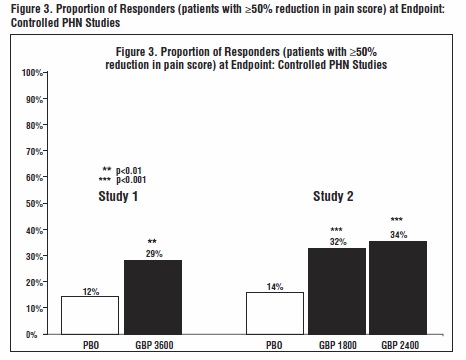
Figure 3. Proportion Of Responders (patients With ≥50% Reduction In Pain Score) At Endpoint: Controlled Phn Studies (Gabapentin Fig4)

Figure 3. Proportion Of Responders (patients With ≥50% Reduction In Pain Score) At Endpoint: Controlled Phn Studies (Gabapentin Fig4)
A bar chart titled 'Proportion of Responders (patients with ≥50% reduction in pain score) at Endpoint: Controlled PHN Studies.' It compares pain reduction percentages between placebo (PBO) and Gabapentin (GBP) at different doses (3600 mg, 1800 mg, and 2400 mg) across two studies. Study 1 shows 12% for placebo and 29% for GBP 3600 mg. Study 2 shows 14% for placebo, 32% for GBP 1800 mg, and 34% for GBP 2400 mg. Statistical significance is indicated with p-values.*
FDA Label Image

Figure 4. Responder Rate In Patients Receiving Gabapentin Expressed As A Difference From Placebo By Dose And Study: Adjunctive Therapy Studies In Patients ≥12 Years Of Age With Partial Seizures (Gabapentin Fig5)

Figure 4. Responder Rate In Patients Receiving Gabapentin Expressed As A Difference From Placebo By Dose And Study: Adjunctive Therapy Studies In Patients ≥12 Years Of Age With Partial Seizures (Gabapentin Fig5)
A scatter plot chart showing responder rate differences (%) in patients receiving Gabapentin compared to placebo by daily dose (mg). It compares adjunctive therapy studies in patients aged 12 years and older with partial seizures, with data points distinguished by three studies labeled a, b, and c.*
FDA Label Image

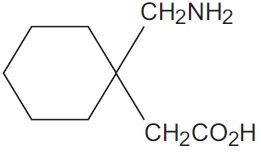
Chemical Structure (Gabapentin Str)

Chemical Structure (Gabapentin Str)
Chemical structure of Gabapentin, showing a cyclohexane ring with amino (CH2NH2) and carboxymethyl (CH2CO2H) side groups attached.*

* About these descriptions: Image descriptions on this page are generated by automated AI analysis of the product label images from the manufacturer's FDA label submission (SPL). They are provided for reference only and may contain errors or omissions. Always rely on the printed label itself and the official FDA labeling, and consult a pharmacist or healthcare professional with any questions about this product.