Trintellix Tablet, Film Coated
Product Images NDC 70518-4284

View Photos of Packaging, Regulatory Labels, and Product Appearance

Product Visual Gallery

This gallery contains 12 technical images submitted to the FDA as part of the official labeling for Trintellix (NDC 70518-4284). Unlike standard consumer photos, these assets often include clinical data figures, molecular chemical structures, and official manufacturer packaging layouts.

As provided by Remedyrepack Inc., these visuals offer a comprehensive scientific overview of the product's physical and chemical identity, aiding pharmacists and researchers in product verification and study.

FDA Label Image

Remedy_label (Remedy Label)

Remedy_label (Remedy Label)
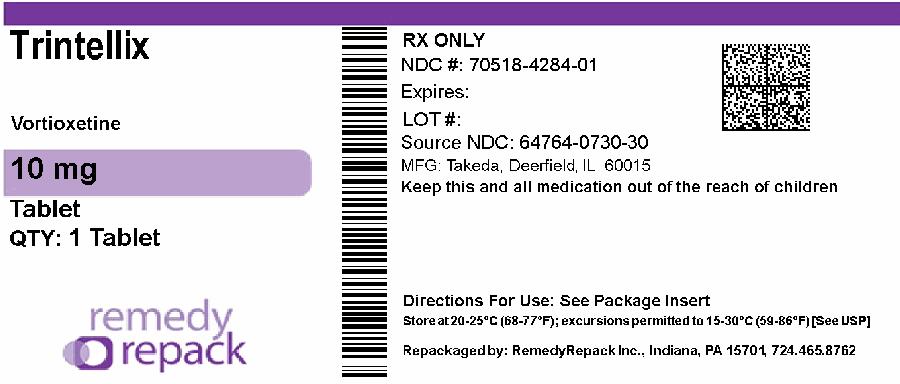
This is a description of Trintellix, a medication containing Vortioxetine in the 10mg tablet form. Each box contains 30 tablets and it is a prescription-only drug. The manufacturer is Takeda, based in Deerfield, IL. The medication should be stored between 20-25°C (58-77°F) with excursions permitted to 15-30°C (59-86°F). The repackager is RemedyRepack, based in Indiana, PA. Directions for use can be found in the package insert.*
FDA Label Image

Mm2 (Trintellix 10mg 70518 4284 01)

Mm2 (Trintellix 10mg 70518 4284 01)
This is a description of a medication called Trintellix, with the dosage of 10 mg in a tablet form. It is a prescription-only drug with the NDC number 70518-4284-01. The manufacturer is Takeda located in Deerfield, IL. The medication should be stored at 20-25°C (58-77°F) with excursions permitted to 15.30°C (59-86°F). For usage instructions, refer to the package insert. The medication was repackaged by RemedyRepack Inc. located in Indiana, PA.*
FDA Label Image

Chemical Structure (Trintellix 01)

FDA Label Image

Figure 1 (Trintellix 02)

Figure 1 (Trintellix 02)
This text provides a population description related to age, gender, race, renal impairment, hepatc impairment, and PK parameters including AUC and Cmax. The data seems to include information on mild, moderate, severe, and ESRD conditions along with fold change and 90% CI. Additionally, there are details on changes relative to a reference.*
FDA Label Image

Figure 2 (Trintellix 03)

Figure 2 (Trintellix 03)
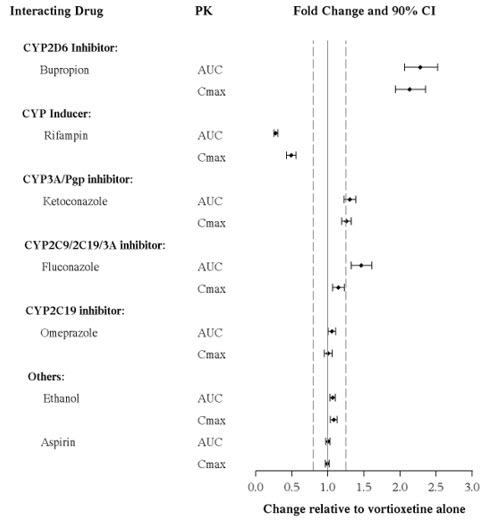
This text provides information on interacting drugs, including CYP enzyme inhibitors and inducers such as Bupropion, Rifampin, Ketoconazole, Fluconazole, Omeprazole, and others like Ethanol and Aspirin. It also presents pharmacokinetic parameters like Cmax and AUC (area under curve) for different scenarios and compares them to vortioxetine alone. The study seems to assess the impact of various drugs on metabolism and drug levels in the body.*
FDA Label Image

Figure 3 (Trintellix 04)

Figure 3 (Trintellix 04)
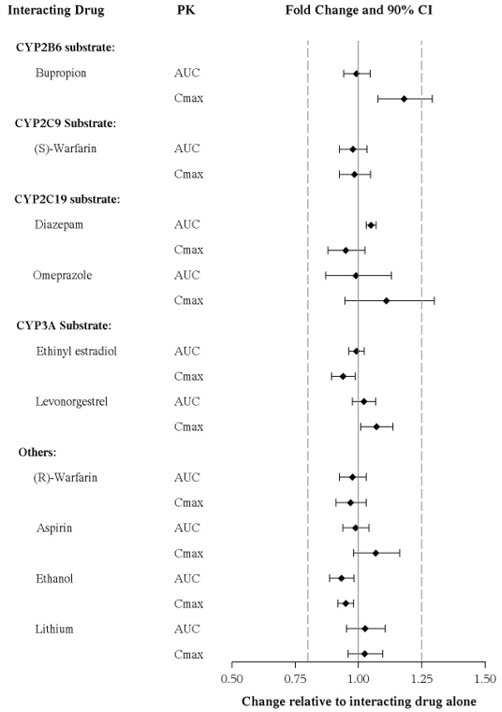
This text appears to be a list of different drugs categorized as CYP enzyme substrates, along with pharmacokinetic (PK) parameters such as AUC, Cmax, and data on fold change and confidence intervals. The drugs mentioned include Bupropion, Warfarin (S and R stereoisomers), Diazepam, Omeprazole, Ethinyl estradiol, Levonorgestrel, Aspirin, Ethanol, and Lithium. The text also seems to include data on drug interactions and their impact on PK parameters.*
FDA Label Image

Figure 4 (Trintellix 05)

Figure 4 (Trintellix 05)
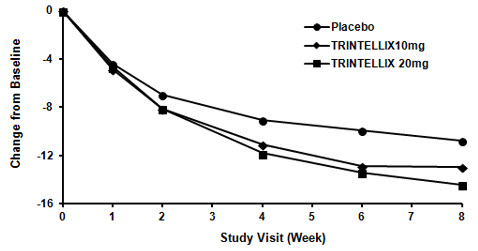
This text appears to be referring to a study or evaluation related to two doses of a drug called TRINTELLIX - 10mg and 20mg. The study involves a "Change from Baseline" parameter and appears to track progress over multiple study visits (week 1, week 2, and so on). The term "Placebo" is also mentioned. This information seems to detail the structure or methodology of the study involving TRINTELLIX and possibly compares its effects to a placebo.*
FDA Label Image

Figure 5 (Trintellix 06)

Figure 5 (Trintellix 06)
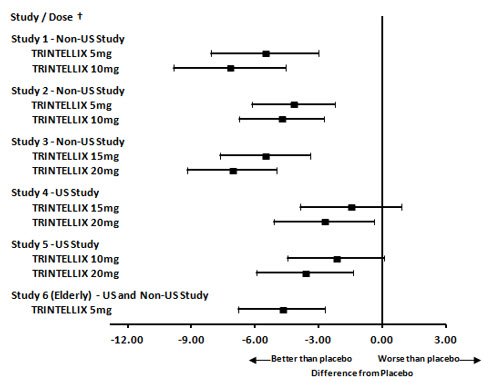
This text provides a list of different studies involving TRINTELLIX in various doses (5mg, 10mg, 15mg, and 20mg) across different populations (US and Non-US, including elderly individuals). The studies compare the efficacy of TRINTELLIX in treating certain conditions against a placebo. The information from these studies can be valuable for understanding the effectiveness of TRINTELLIX at different doses in different populations.*
FDA Label Image

Figure 6 (Trintellix 07)

Figure 6 (Trintellix 07)
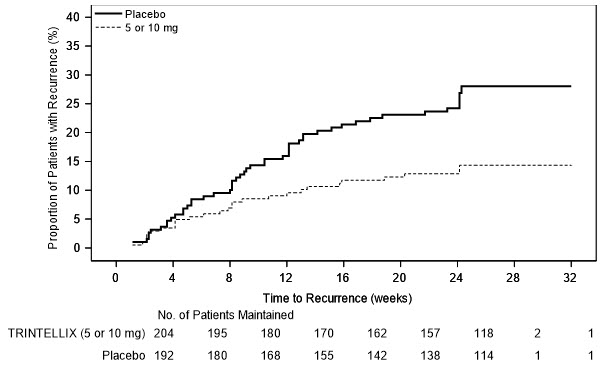
This text provides data on the proportion of patients with recurrence over time for the drug TRINTELLIX (50-10mg) and placebo. It shows the number of patients maintained on the treatment and the time to recurrence in weeks, helping in evaluating the efficacy of the drug compared to the placebo.*
FDA Label Image

Figure 7 (Trintellix 08)

Figure 7 (Trintellix 08)
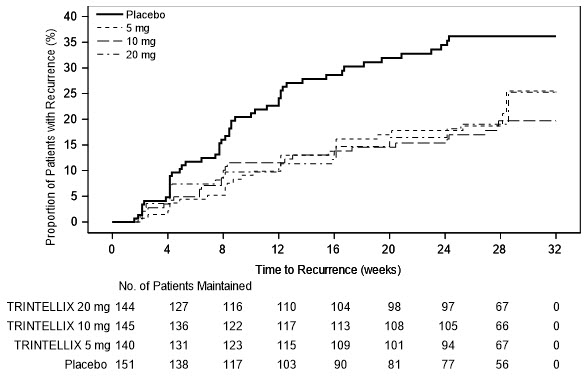
This text appears to contain a comparison of treatment options for a condition, possibly related to mental health. Different dosages of a medication named TRINTELLIX are provided (20mg, 10mg, and 5mg) along with a placebo. The data includes the number of patients maintained over time and the time to recurrence in weeks. The table format and the information suggest a clinical study evaluating the effectiveness of TRINTELLIX at different dosages compared to a placebo.*
FDA Label Image

Figure 8 (Trintellix 09)

Figure 8 (Trintellix 09)
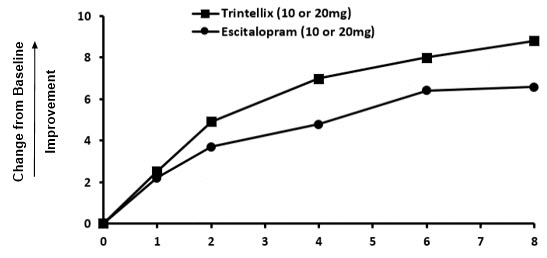
This is a comparison between the improvement seen in patients treated with Trintellix (10 or 20mg) and Escitalopram (10 or 20mg) from baseline. The focus appears to be on changes in improvement.*
FDA Label Image

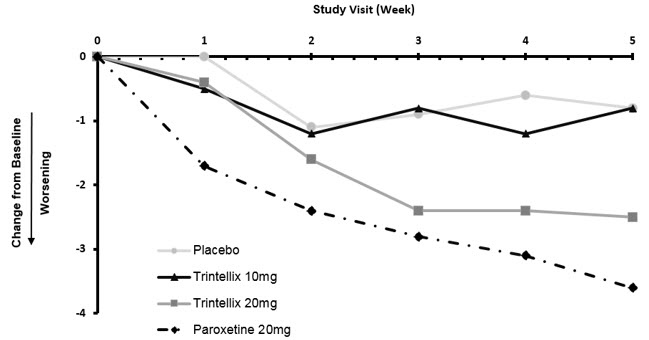
Figure 9 (Trintellix 10)

Figure 9 (Trintellix 10)
This text appears to be a comparison or evaluation of different treatments during a study visit week. It includes the mention of placebo, Trintelix at 10mg and 20mg doses, and Paroxetine at 20mg. The context seems to relate to the effectiveness or outcomes of these treatments during the study visit.*

* These product label images have been analyzed using experimental machine learning. Please verify findings with the primary label text.