Sirolimus pharmacokinetics activity have been determined following oral administration in healthy subjects, pediatric patients, hepatically impaired patients, and renal transplant patients.
The pharmacokinetic parameters of sirolimus in low- to moderate-immunologic risk adult renal transplant patients following multiple dosing with sirolimus 2 mg daily, in combination with cyclosporine and corticosteroids, is summarized in Table 4.
TABLE 4: MEAN ± SD STEADY STATE SIROLIMUS PHARMACOKINETIC PARAMETERS IN LOW-TO MODERATE-IMMUNOLOGIC RISK ADULT RENAL TRANSPLANT PATIENTS FOLLOWING SIROLIMUS 2 MG DAILY
a,b | Multiple
Dose (daily dose) |
|---|
| Solution | Tablets |
|---|
| a: In presence of cyclosporine administered 4 hours before sirolimus dosing. |
| b: Based on data collected at months 1 and 3 post-transplantation. |
c: Average C
minover 6 months.
|
C
max (ng/mL)
| 14.4 ± 5.3 | 15 ± 4.9 |
t
max (hr)
| 2.1 ± 0.8 | 3.5 ± 2.4 |
AUC (ng•h/mL) | 194 ± 78 | 230 ± 67 |
C
min (ng/mL)
c
| 7.1 ± 3.5 | 7.6 ± 3.1 |
CL/F (mL/h/kg) | 173 ± 50 | 139 ± 63 |
Whole blood trough sirolimus concentrations, as measured by LC/MS/MS in renal transplant patients, were significantly correlated with AUC
τ,ss. Upon repeated, twice-daily administration without an initial loading dose in a multiple-dose study, the average trough concentration of sirolimus increases approximately 2- to 3-fold over the initial 6 days of therapy, at which time steady-state is reached. A loading dose of 3 times the maintenance dose will provide near steady-state concentrations within 1 day in most patients [
see Dosage and Administration (
2.3,
2.5), Warning and Precautions (
5.17)
].
Absorption
Following administration of sirolimus oral solution, the mean times to peak concentration (t
max) of sirolimus are approximately 1 hour and 2 hours in healthy subjects and renal transplant patients, respectively. The systemic availability of sirolimus is low, and was estimated to be approximately 14% after the administration of sirolimus oral solution. In healthy subjects, the mean bioavailability of sirolimus after administration of the tablet is approximately 27% higher relative to the solution. Sirolimus tablets are not bioequivalent to the solution; however, clinical equivalence has been demonstrated at the 2 mg dose level. Sirolimus concentrations, following the administration of sirolimus oral solution to stable renal transplant patients, are dose-proportional between 3 and 12 mg/m
2.
Food Effects
To minimize variability in sirolimus concentrations, both sirolimus oral solution and tablets should be taken consistently with or without food [
see Dosage and Administration (
2)
]. In healthy subjects, a high-fat meal (861.8 kcal, 54.9% kcal from fat) increased the mean total exposure (AUC) of sirolimus by 23 to 35%, compared with fasting. The effect of food on the mean sirolimus C
maxwas inconsistent depending on the sirolimus dosage form evaluated.�
Distribution
The mean (± SD) blood-to-plasma ratio of sirolimus was 36 ± 18 in stable renal allograft patients, indicating that sirolimus is extensively partitioned into formed blood elements. The mean volume of distribution (Vss/F) of sirolimus is 12 ± 8 L/kg. Sirolimus is extensively bound (approximately 92%) to human plasma proteins, mainly serum albumin (97%), α
1-acid glycoprotein, and lipoproteins.
Metabolism
Sirolimus is a substrate for both CYP3A4 and P-gp. Sirolimus is extensively metabolized in the intestinal wall and liver and undergoes counter-transport from enterocytes of the small intestine into the gut lumen. Inhibitors of CYP3A4 and P-gp increase sirolimus concentrations. Inducers of CYP3A4 and P-gp decrease sirolimus concentrations [
see Warnings and Precautions (
5.20) and Drug Interactions (
7)
]. Sirolimus is extensively metabolized by O-demethylation and/or hydroxylation. Seven (7) major metabolites, including hydroxy, demethyl, and hydroxydemethyl, are identifiable in whole blood. Some of these metabolites are also detectable in plasma, fecal, and urine samples. Sirolimus is the major component in human whole blood and contributes to more than 90% of the immunosuppressive activity.
Excretion
After a single dose of [
14C] sirolimus oral solution in healthy volunteers, the majority (91%) of radioactivity was recovered from the feces, and only a minor amount (2.2%) was excreted in urine. The mean ± SD terminal elimination half-life (t
½) of sirolimus after multiple dosing in stable renal transplant patients was estimated to be about 62 ± 16 hours.
Sirolimus Concentrations (Chromatographic Equivalent) Observed in Phase 3 Clinical Studies
The following sirolimus concentrations (chromatographic equivalent) were observed in phase 3 clinical studies for prophylaxis of organ rejection in
de novorenal transplant patients [
see Clinical Studies (
14)
].
TABLE 5: SIROLIMUS WHOLE BLOOD TROUGH CONCENTRATIONS OBSERVED IN RENAL TRANSPLANT PATIENTS ENROLLED IN PHASE 3 STUDIESPatient Population
(Study number) | Treatment | Year 1 | Year 3 |
|---|
Mean
(ng/mL) | 10
th to 90
th
percentiles
(ng/mL) | Mean
(ng/mL) | 10
th to 90
th
percentiles
(ng/mL) |
|---|
| a: Months 4 through 12 |
| b: Up to Week 2; observed CsA C
minwas 217 (56 to 432) ng/mL
|
| c: Week 2 to Week 26; observed CsA C
minrange was 174 (71 to 288) ng/mL
|
d: Week 26 to Week 52; observed CsA C
minwas 136 (54.5 to 218) ng/mL
|
Low-to-moderate risk (Studies 1 & 2) | Sirolimus
(2 mg/day) + CsA
| 7.2 | 3.6 to 11 | – | – |
Sirolimus
(5 mg/day) + CsA
| 14 | 8 to 22 | – | – |
Low-to-moderate risk (Study 3) | Sirolimus + CsA | 8.6 | 5 to 13
a | 9.1 | 5.4 to 14 |
Sirolimus alone | 19 | 14 to 22
a | 16 | 11 to 22 |
High risk
(Study 4)
| Sirolimus + CsA | 15.7
11.8
11.5
| 5.4 to 27.3
b
6.2 to 16.9
c
6.3 to 17.3
d | -
| -
|
The withdrawal of cyclosporine and concurrent increases in sirolimus trough concentrations to steady-state required approximately 6 weeks. Following cyclosporine withdrawal, larger sirolimus doses were required due to the absence of the inhibition of sirolimus metabolism and transport by cyclosporine and to achieve higher target sirolimus trough concentrations during concentration-controlled administration [
see Dosage and Administration (
2.1), Drug Interactions (
7.1)
].
Lymphangioleiomyomatosis
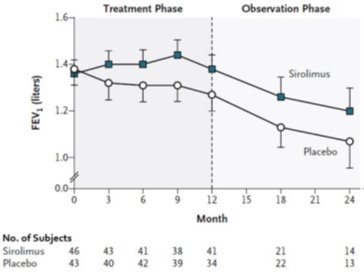
In a clinical trial of patients with lymphangioleiomyomatosis, the median whole blood sirolimus trough concentration after 3 weeks of receiving sirolimus tablets at a dose of 2 mg/day was 6.8 ng/mL (interquartile range 4.6 to 9 ng/mL; n = 37).
Pharmacokinetics in Specific Populations
Hepatic Impairment
Sirolimus was administered as a single, oral dose to subjects with normal hepatic function and to patients with Child-Pugh classification A (mild), B (moderate), or C (severe) hepatic impairment. Compared with the values in the normal hepatic function group, the patients with mild, moderate, and severe hepatic impairment had 43%, 94%, and 189% higher mean values for sirolimus AUC, respectively, with no statistically significant differences in mean C
max. As the severity of hepatic impairment increased, there were steady increases in mean sirolimus t
1/2, and decreases in the mean sirolimus clearance normalized for body weight (CL/F/kg).
The maintenance dose of sirolimus should be reduced by approximately one third in patients with mild-to-moderate hepatic impairment and by approximately one half in patients with severe hepatic impairment [
see Dosage and Administration (
2.5)
]. It is not necessary to modify the sirolimus loading dose in patients with mild, moderate, and severe hepatic impairment. Therapeutic drug monitoring is necessary in all patients with hepatic impairment [
see Dosage and Administration (
2.7)
].
Renal Impairment
The effect of renal impairment on the pharmacokinetics of sirolimus is not known. However, there is minimal (2.2%) renal excretion of the drug or its metabolites in healthy volunteers. The loading and the maintenance doses of sirolimus need not be adjusted in patients with renal impairment [
see Dosage and Administration (
2.6)
].
Pediatric Renal Transplant Patients
Sirolimus pharmacokinetic data were collected in concentration-controlled trials of pediatric renal transplant patients who were also receiving cyclosporine and corticosteroids. The target ranges for trough concentrations were either 10 to 20 ng/mL for the 21 children receiving tablets, or 5 to 15 ng/mL for the one child receiving oral solution. The children aged 6 to 11 years (n = 8) received mean ± SD doses of 1.75 ± 0.71 mg/day (0.064 ± 0.018 mg/kg, 1.65 ± 0.43 mg/m
2). The children aged 12 to 18 years (n = 14) received mean ± SD doses of 2.79 ± 1.25 mg/day (0.053 ± 0.0150 mg/kg, 1.86 ± 0.61 mg/m
2). At the time of sirolimus blood sampling for pharmacokinetic evaluation, the majority (80%) of these pediatric patients received the sirolimus dose at 16 hours after the once-daily cyclosporine dose. See Table 6 below.
TABLE 6: SIROLIMUS PHARMACOKINETIC PARAMETERS (MEAN ± SD) IN PEDIATRIC RENAL TRANSPLANT PATIENTS (MULTIPLE-DOSE CONCENTRATION CONTROL)
a,bAge (y)
| n
| Body weight
(kg) | C
max,
ss
(ng/mL) | t
max,
ss
(h) | C
min,
ss
(ng/mL) | AUC
T,ss
(ng•h/mL) | CL/F
c
(mL/h/kg) | CL/F
c
(L/h/m
2)
|
|---|
6 to 11 | 8 | 27 ± 10 | 22.1 ± 8.9 | 5.88 ± 4.05 | 10.6 ± 4.3 | 356 ± 127 | 214 ± 129 | 5.4 ± 2.8 |
12 to 18 | 14 | 52 ± 15 | 34.5 ± 12.2 | 2.7 ± 1.5 | 14.7 ± 8.6 | 466 ± 236 | 136 ± 57 | 4.7 ± 1.9 |
a: Sirolimus co-administered with cyclosporine oral solution [MODIFIED] (e.g., Neoral
®Oral Solution) and/or cyclosporine capsules [MODIFIED] (e.g., Neoral
®Soft Gelatin Capsules).
b: As measured by Liquid Chromatographic/Tandem Mass Spectrometric Method (LC/MS/MS)
c: Oral-dose clearance adjusted by either body weight (kg) or body surface area (m
2).
Table 7 below summarizes pharmacokinetic data obtained in pediatric dialysis patients with chronically impaired renal function.
TABLE 7: SIROLIMUS PHARMACOKINETIC PARAMETERS (MEAN ± SD) IN PEDIATRIC PATIENTS WITH END-STAGE KIDNEY DISEASE MAINTAINED ON HEMODIALYSIS OR PERITONEAL DIALYSIS (1, 3, 9, 15 mg/m
2SINGLE DOSE)*
| Age Group (y) | n | t
max (h)
| t
1/2 (h)
| CL/F/WT (mL/h/kg) |
|---|
5 to 11 | 9 | 1.1 ± 0.5 | 71 ± 40 | 580 ± 450 |
12 to 18 | 11 | 0.79 ± 0.17 | 55 ± 18 | |
- All subjects received sirolimus oral solution.
Geriatric
Clinical studies of sirolimus did not include a sufficient number of patients >65 years of age to determine whether they will respond differently than younger patients. After the administration of sirolimus oral solution or tablets, sirolimus trough concentration data in renal transplant patients >65 years of age were similar to those in the adult population 18 to 65 years of age.
Gender
Sirolimus clearance in males was 12% lower than that in females; male subjects had a significantly longer t
1/2than did female subjects (72.3 hours versus 61.3 hours). Dose adjustments based on gender are not recommended.
Race
In the phase 3 trials for the prophylaxis of organ rejection following renal transplantation using sirolimus solution or tablets and cyclosporine oral solution [MODIFIED] (e.g., Neoral
®Oral Solution) and/or cyclosporine capsules [MODIFIED] (e.g., Neoral
®Soft Gelatin Capsules) [
see Clinical Studies (
14)
], there were no significant differences in mean trough sirolimus concentrations over time between Black (n = 190) and non-Black (n = 852) patients during the first 6 months after transplantation.
Drug-Drug Interactions
Sirolimus is known to be a substrate for both cytochrome CYP3A4 and P-gp. The pharmacokinetic interaction between sirolimus and concomitantly administered drugs is discussed below. Drug interaction studies have not been conducted with drugs other than those described below.
Cyclosporine: Cyclosporine is a substrate and inhibitor of CYP3A4 and P-gp. Sirolimus should be taken 4 hours after administration of cyclosporine oral solution (MODIFIED) and/or cyclosporine capsules (MODIFIED). Sirolimus concentrations may decrease when cyclosporine is discontinued, unless the sirolimus dose is increased [
see Dosage and Administration (
2.2), Drug Interactions (
7.1)
].
In a single-dose drug-drug interaction study, 24 healthy volunteers were administered 10 mg sirolimus tablets either simultaneously or 4 hours after a 300-mg dose of Neoral
®Soft Gelatin Capsules (cyclosporine capsules [MODIFIED]). For simultaneous administration, mean C
maxand AUC were increased by 512% and 148%, respectively, relative to administration of sirolimus alone. However, when given 4 hours after cyclosporine administration, sirolimus C
maxand AUC were both increased by only 33% compared with administration of sirolimus alone.
In a single dose drug-drug interaction study, 24 healthy volunteers were administered 10 mg sirolimus oral solution either simultaneously or 4 hours after a 300 mg dose of Neoral
®Soft Gelatin Capsules (cyclosporine capsules [MODIFIED]). For simultaneous administration, the mean C
maxand AUC of sirolimus, following simultaneous administration were increased by 116% and 230%, respectively, relative to administration of sirolimus alone. However, when given 4 hours after Neoral
®Soft Gelatin Capsules (cyclosporine capsules [MODIFIED]) administration, sirolimus C
maxand AUC were increased by only 37% and 80%, respectively, compared with administration of sirolimus alone.
In a single-dose cross-over drug-drug interaction study, 33 healthy volunteers received 5 mg sirolimus oral solution alone, 2 hours before, and 2 hours after a 300 mg dose of Neoral
®Soft Gelatin Capsules (cyclosporine capsules [MODIFIED]). When given 2 hours before Neoral
®Soft Gelatin Capsules (cyclosporine capsules [MODIFIED]) administration, sirolimus C
maxand AUC were comparable to those with administration of sirolimus alone. However, when given 2 hours after, the mean C
maxand AUC of sirolimus were increased by 126% and 141%, respectively, relative to administration of sirolimus alone.
Mean cyclosporine C
maxand AUC were not significantly affected when sirolimus oral solution was given simultaneously or when administered 4 hours after Neoral
®Soft Gelatin Capsules (cyclosporine capsules [MODIFIED]). However, after multiple-dose administration of sirolimus given 4 hours after Neoral
®in renal post-transplant patients over 6 months, cyclosporine oral-dose clearance was reduced, and lower doses of Neoral
®Soft Gelatin Capsules (cyclosporine capsules [MODIFIED]) were needed to maintain target cyclosporine concentration.
In a multiple-dose study in 150 psoriasis patients, sirolimus 0.5, 1.5, and 3 mg/m
2/day was administered simultaneously with Sandimmune
®Oral Solution (cyclosporine Oral Solution) 1.25 mg/kg/day. The increase in average sirolimus trough concentrations ranged between 67% to 86% relative to when sirolimus was administered without cyclosporine. The intersubject variability (% CV) for sirolimus trough concentrations ranged from 39.7% to 68.7%. There was no significant effect of multiple-dose sirolimus on cyclosporine trough concentrations following Sandimmune
®Oral Solution (cyclosporine oral solution) administration. However, the % CV was higher (range 85.9% to 165%) than those from previous studies.
Diltiazem: Diltiazem is a substrate and inhibitor of CYP3A4 and P-gp; sirolimus concentrations should be monitored and a dose adjustment may be necessary [
see Drug Interactions (
7.4)
]. The simultaneous oral administration of 10 mg of sirolimus oral solution and 120 mg of diltiazem to 18 healthy volunteers significantly affected the bioavailability of sirolimus. Sirolimus C
max, t
max, and AUC were increased 1.4-, 1.3-, and 1.6-fold, respectively. Sirolimus did not affect the pharmacokinetics of either diltiazem or its metabolites desacetyldiltiazem and desmethyldiltiazem.
Erythromycin: Erythromycin is a substrate and inhibitor of CYP3A4 and P-gp; co-administration of sirolimus oral solution or tablets and erythromycin is not recommended [
see Warnings and Precautions (
5.20), Drug Interactions (
7.2)
]. The simultaneous oral administration of 2 mg daily of sirolimus oral solution and 800 mg q 8h of erythromycin as erythromycin ethylsuccinate tablets at steady state to 24 healthy volunteers significantly affected the bioavailability of sirolimus and erythromycin. Sirolimus C
maxand AUC were increased 4.4- and 4.2-fold respectively and t
maxwas increased by 0.4 hr. Erythromycin C
maxand AUC were increased 1.6- and 1.7-fold, respectively, and t
maxwas increased by 0.3 hr.
Ketoconazole: Ketoconazole is a strong inhibitor of CYP3A4 and P-gp; co-administration of sirolimus oral solution or tablets and ketoconazole is not recommended [
see Warnings and Precautions (
5.20), Drug Interactions (
7.2)
]. Multiple-dose ketoconazole administration significantly affected the rate and extent of absorption and sirolimus exposure after administration of sirolimus oral solution, as reflected by increases in sirolimus C
max, t
max, and AUC of 4.3-fold, 38%, and 10.9-fold, respectively. However, the terminal t
½of sirolimus was not changed. Single-dose sirolimus did not affect steady-state 12-hour plasma ketoconazole concentrations.
Rifampin:Rifampin is a strong inducer of CYP3A4 and P-gp; co-administration of sirolimus oral solution or tablets and rifampin is not recommended. In patients where rifampin is indicated, alternative therapeutic agents with less enzyme induction potential should be considered [
see Warnings and Precautions (
5.20), Drug Interactions (
7.2)
]. Pretreatment of 14 healthy volunteers with multiple doses of rifampin, 600 mg daily for 14 days, followed by a single 20-mg dose of sirolimus oral solution, greatly decreased sirolimus AUC and C
maxby about 82% and 71%, respectively.
Verapamil:Verapamil is a substrate and inhibitor of CYP3A4 and P-gp; sirolimus concentrations should be monitored and a dose adjustment may be necessary; [
seeDrug Interactions (
7.4)]. The simultaneous oral administration of 2 mg daily of sirolimus oral solution and 180 mg q 12h of verapamil at steady state to 25 healthy volunteers significantly affected the bioavailability of sirolimus and verapamil. Sirolimus C
maxand AUC were increased 2.3- and 2.2-fold, respectively, without substantial change in t
max. The C
maxand AUC of the pharmacologically active S(-) enantiomer of verapamil were both increased 1.5-fold and t
maxwas decreased by 1.2 hr.
Drugs Which May Be Co-administered Without Dose Adjustment
Clinically significant pharmacokinetic drug-drug interactions were not observed in studies of drugs listed below. Sirolimus and these drugs may be co-administered without dose adjustments.
- Acyclovir
- Atorvastatin
- Digoxin
- Glyburide
- Nifedipine
- Norgestrel/ethinyl estradiol (Lo/Ovral
®)
- Prednisolone
- Sulfamethoxazole/trimethoprim (Bactrim
®)
Other Drug-Drug Interactions
Co-administration of sirolimus with other known strong inhibitors of CYP3A4 and/or P-gp (such as voriconazole, itraconazole, telithromycin, or clarithromycin) or other known strong inducers of CYP3A4 and/or P-gp (such as rifabutin) is not recommended [
see Warnings and Precautions (
5.20), Drug Interactions (
7.2)
]. In patients in whom strong inhibitors or inducers of CYP3A4 are indicated, alternative therapeutic agents with less potential for inhibition or induction of CYP3A4 should be considered.
Care should be exercised when drugs or other substances that are substrates and/or inhibitors or inducers of CYP3A4 are administered concomitantly with sirolimus. Other drugs that have the potential to increase sirolimus blood concentrations include (but are not limited to):
- Calcium channel blockers: nicardipine.
- Antifungal agents: clotrimazole, fluconazole.
- Antibiotics: troleandomycin.
- Gastrointestinal prokinetic agents: cisapride, metoclopramide.
- Other drugs: bromocriptine, cimetidine, danazol, letermovir,
protease inhibitors (e.g., for HIV and hepatitis C that include drugs such as ritonavir, indinavir, boceprevir, and telaprevir).
Other drugs that have the potential to decrease sirolimus concentrations include (but are not limited to):
- Anticonvulsants: carbamazepine, phenobarbital, phenytoin.
- Antibiotics: rifapentine.
Other Drug-Food Interactions
Grapefruit juice reduces CYP3A4-mediated drug metabolism. Grapefruit juice must not be taken with or used for dilution of sirolimus [
see Drug Interactions (
7.3)
].
Drug-Herb Interactions
St. John’s Wort (
Hypericum perforatum) induces CYP3A4 and P-gp. Since sirolimus is a substrate for both cytochrome CYP3A4 and P-gp, there is the potential that the use of St. John’s Wort in patients receiving sirolimus could result in reduced sirolimus concentrations [
see Drug Interactions (
7.4)
].