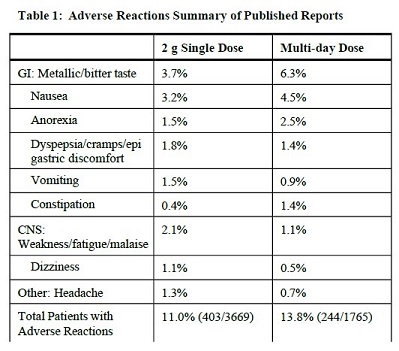
Other adverse reactions reported with tinidazole include:
Central Nervous System: Two serious adverse reactions reported include convulsions and transient peripheral neuropathy including numbness and paresthesia [see
Warnings and Precautions (5.1)]. Other CNS reports include vertigo, ataxia, giddiness, insomnia, drowsiness.
Gastrointestinal: tongue discoloration, stomatitis, diarrhea
Hypersensitivity: urticaria, pruritis, rash, flushing, sweating, dryness of mouth, fever, burning sensation, thirst, salivation, angioedema
Renal: darkened urine Cardiovascular: palpitations
Hematopoietic: transient neutropenia, transient leukopenia
Other:
Candidaovergrowth, increased vaginal discharge, oral candidiasis, hepatic abnormalities including raised transaminase level, arthralgias, myalgias, and arthritis.
Rare reported adverse reactions include bronchospasm, dyspnea, coma, confusion, depression, furry tongue, pharyngitis and reversible thrombocytopenia.
Adverse Reactions in Pediatric Patients: In pooled pediatric studies, adverse reactions reported in pediatric patients taking tinidazole were similar in nature and frequency to adult findings including nausea, vomiting, diarrhea, taste change, anorexia, and abdominal pain.
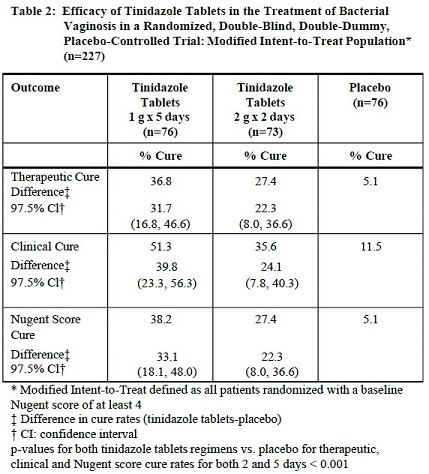
Bacterial vaginosis:The most common adverse reactions in treated patients (incidence >2%), which were not identified in the trichomoniasis, giardiasis and amebiasis studies, are gastrointestinal: decreased appetite, and flatulence; renal: urinary tract infection, painful urination, and urine abnormality; and other reactions including pelvic pain, vulvo-vaginal discomfort, vaginal odor, menorrhagia, and upper respiratory tract infection
[see
Clinical Studies (14.5)]
Warfarin and Other Oral Coumarin Anticoagulants:As with metronidazole, tinidazole may enhance the effect of warfarin and other coumarin anticoagulants, resulting in a prolongation of prothrombin time. The dosage of oral anticoagulants may need to be adjusted during tinidazole co-administration and up to 8 days after discontinuation.
Alcohols, Disulfiram:Alcoholic beverages and preparations containing ethanol or propylene glycol should be avoided during tinidazole therapy and for 3 days afterward because abdominal cramps, nausea, vomiting, headaches, and flushing may occur. Psychotic reactions have been reported in alcoholic patients using metronidazole and disulfiram concurrently. Though no similar reactions have been reported with tinidazole, tinidazole should not be given to patients who have taken disulfiram within the last two weeks.
Lithium:Metronidazole has been reported to elevate serum lithium levels. It is not known if tinidazole shares this property with metronidazole, but consideration should be given to measuring serum lithium and creatinine levels after several days of simultaneous lithium and tinidazole treatment to detect potential lithium intoxication.
Phenytoin, Fosphenytoin:Concomitant administration of oral metronidazole and intravenous phenytoin was reported to result in prolongation of the half-life and reduction in the clearance of phenytoin. Metronidazole did not significantly affect the pharmacokinetics of orally-administered phenytoin.
Cyclosporine, Tacrolimus: There are several case reports suggesting that metronidazole has the potential to increase the levels of cyclosporine and tacrolimus. During tinidazole co-administration with either of these drugs, the patient should be monitored for signs of calcineurin-inhibitor associated toxicities.
Fluorouracil: Metronidazole was shown to decrease the clearance of fluorouracil, resulting in an increase in side-effects without an increase in therapeutic benefits. If the concomitant use of tinidazole and fluorouracil cannot be avoided, the patient should be monitored for fluorouracil-associated toxicities.
CYP3A4 Inducers and Inhibitors:Simultaneous administration of tinidazole with drugs that induce liver microsomal enzymes, i.e., CYP3A4 inducers such as
phenobarbital, rifampin,
phenytoin, and
fosphenytoin(a pro-drug of phenytoin), may accelerate the elimination of tinidazole, decreasing the plasma level of tinidazole. Simultaneous administration of drugs that inhibit the activity of liver microsomal enzymes, i.e., CYP3A4 inhibitors such as
cimetidineand
ketoconazole, may prolong the half-life and decrease the plasma clearance of tinidazole, increasing the plasma concentrations of tinidazole.
Cholestyramine:Cholestyramine was shown to decrease the oral bioavailability of metronidazole by 21%. Thus, it is advisable to separate dosing of cholestyramine and tinidazole to minimize any potential effect on the oral bioavailability of tinidazole.
Oxytetracycline:Oxytetracycline was reported to antagonize the therapeutic effect of metronidazole.
Absorption
After oral administration, tinidazole is rapidly and completely absorbed. A bioavailability study of tinidazole tablets was conducted in adult healthy volunteers. All subjects received a single oral dose of 2 g (four 500 mg tablets) of tinidazole tablets following an overnight fast. Oral administration of four 500 mg tablets of tinidazole tablets under fasted conditions produced a mean peak plasma concentration (C
max) of 47.7 (±7.5) μg/mL with a mean time to peak concentration (T
max) of 1.6 (±0.7) hours, and a mean area under the plasma concentration-time curve (AUC
0 to ∞) of 901.6 (± 126.5) μg hr/mL at 72 hours. The elimination half-life (T
1/2) was 13.2 (±1.4) hours. Mean plasma levels decreased to 14.3 μg/mL at 24 hours, 3.8 μg/mL at 48 hours and 0.8 μg/mL at 72 hours following administration. Steady-state conditions are reached in 2½ to 3 days of multi-day dosing.
Administration of tinidazole tablets with food resulted in a delay in T
maxof approximately 2 hours and a decline in C
maxof approximately 10%, compared to fasted conditions. However, administration of tinidazole tablets with food did not affect AUC or T
1/2in this study.
In healthy volunteers, administration of crushed tinidazole tablets in artificial cherry syrup, [prepared as described in
Dosage and Administration (2.2)] after an overnight fast had no effect on any pharmacokinetic parameter as compared to tablets swallowed whole under fasted conditions.
Distribution
Tinidazole is distributed into virtually all tissues and body fluids and also crosses the blood-brain barrier. The apparent volume of distribution is about 50 liters. Plasma protein binding of tinidazole is 12%.
Elimination
The plasma half-life of tinidazole is approximately 12 to 14 hours.
Metabolism:Tinidazole is significantly metabolized in humans prior to excretion. Tinidazole is partly metabolized by oxidation, hydroxylation, and conjugation. Tinidazole is the major drug-related constituent in plasma after human treatment, along with a small amount of the 2-hydroxymethyl metabolite. Tinidazole is biotransformed mainly by CYP3A4. In an
in vitrometabolic drug interaction study, tinidazole concentrations of up to 75 μg/mL did not inhibit the enzyme activities of CYP1A2, CYP2B6, CYP2C9, CYP2D6, CYP2E1, and CYP3A4. The potential of tinidazole to induce the metabolism of other drugs has not been evaluated.
Excretion:Tinidazole is excreted by the liver and the kidneys. Tinidazole is excreted in the urine mainly as unchanged drug (approximately 20-25% of the administered dose). Approximately 12% of the drug is excreted in the feces.
Specific Populations
Patients with impaired renal function:The pharmacokinetics of tinidazole in patients with severe renal impairment (CrCL < 22 mL/min) are not significantly different from the pharmacokinetics seen in healthy subjects. However, during hemodialysis, clearance of tinidazole is significantly increased; the half-life is reduced from 12.0 hours to 4.9 hours. Approximately 43% of the amount present in the body is eliminated during a 6-hour hemodialysis session
[See
Use in Specific Populations (8.6)]
. The pharmacokinetics of tinidazole in patients undergoing routine continuous peritoneal dialysis have not been investigated.
Patients with impaired hepatic function:There are no data on tinidazole pharmacokinetics in patients with impaired hepatic function. Reduction of metabolic elimination of metronidazole, a chemically-related nitroimidazole, in patients with hepatic dysfunction has been reported in several studies
[See
Use in Specific Populations (8.7)]
.
Antibacterial
Culture and sensitivity testing of bacteria are not routinely performed to establish the diagnosis of bacterial vaginosis
[see
Indications and Usage (1.4)]
; standard methodology for the susceptibility testing of potential bacterial pathogens,
Gardnerella vaginalis, Mobiluncus spp.or
Mycoplasma hominis,has not been defined. The following
in vitrodata are available, but their clinical significance is unknown. Tinidazole is active
in vitroagainst most strains of the following organisms that have been reported to be associated with bacterial vaginosis:
Bacteroides spp.
Gardnerella vaginalis
Prevotella spp.
Tinidazole does not appear to have activity against most strains of vaginal lactobacilli.
Antiprotozoal
Tinidazole demonstrates activity both
in vitroand in clinical infections against the following protozoa:
Trichomonas vaginalis;
Giardia duodenalis(also termed
G. lamblia); and
Entamoeba histolytica.
For protozoal parasites, standardized susceptibility tests do not exist for use in clinical microbiology laboratories.
Drug Resistance
The development of resistance to tinidazole by
G. duodenalis, E. histolytica, or bacteria associated with bacterial vaginosis has not been examined.
Cross-resistance
Approximately 38% of
T. vaginalisisolates exhibiting reduced susceptibility to metronidazole also show reduced susceptibility to tinidazole
in vitro. The clinical significance of such an effect is not known.
Administration of Drugs
Patients should be told to take tinidazole tablets with food to minimize the incidence of epigastric discomfort and other gastrointestinal side-effects. Food does not affect the oral bioavailability of tinidazole.
Patients should be told to avoid alcoholic beverages and preparations containing ethanol or propylene glycol during tinidazole tablets therapy and for 3 days afterward because abdominal cramps, nausea, vomiting, headaches, and flushing may occur.
Lactation
Advise women not to breastfeed during treatment with Tinidazole and to discontinue breastfeeding for 72 hours following the administration of Tinidazole. Also, advise a nursing mother that she may choose to pump and discard her milk for 72 hours after administration of Tinidazole [see
Use in Specific Populations (8.2)].
Infertility
Advise males of reproductive potential that Tinidazole may impair fertility [see
Use in Specific Populations (8.3) and
Nonclinical Toxicology (13.1)].
Drug Resistance
Patients should be counseled that antibacterial drugs including tinidazole tablets should only be used to treat bacterial infections. They do not treat viral infections (e.g., the common cold). When tinidazole tablets is prescribed to treat a bacterial infection, patients should be told that although it is common to feel better early in the course of therapy, the medication should be taken exactly as directed. Skipping doses or not completing the full course of therapy may (1) decrease the effectiveness of the immediate treatment and (2) increase the likelihood that bacteria will develop resistance and will not be treatable by tinidazole tablets or other antibacterial drugs in the future.
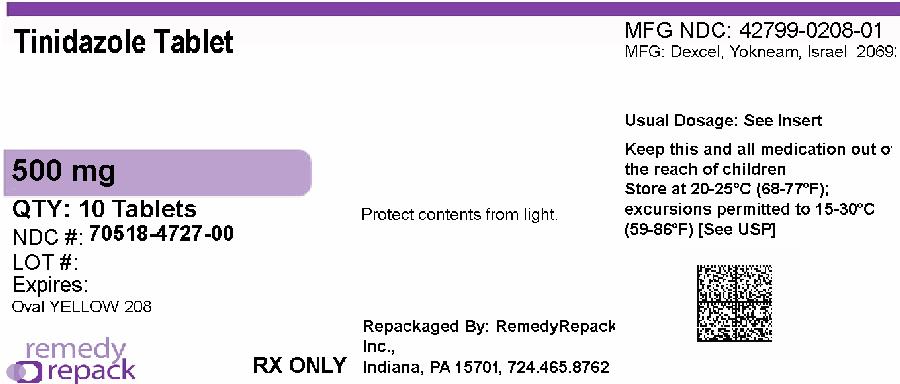
Repackaged and Distributed By:
Remedy Repack, Inc.
625 Kolter Dr. Suite #4 Indiana, PA 1-724-465-8762