Other
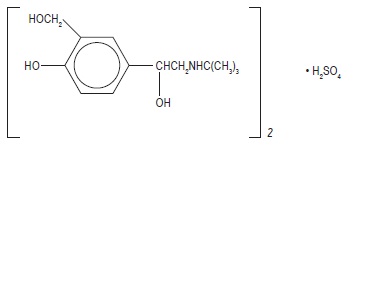
Albuterol tablets, USP contain albuterol sulfate, USP, the racemic form of albuterol and a relatively selective beta2 -adrenergic bronchodilator. Albuterol sulfate has the chemical name α1-[(tert-Butylamino)methyl]- 4-hydroxy-m-xylene-α,α'-diol sulfate (2:1) (salt) and the following structural formula:
Albuterol Tablet (8a66c2fd 299c 4bc2 9a3e Edd672718d2e 01)
The molecular weight of albuterol sulfate is 576.71, and the molecular formula is (C13H21NO3)2 •H2SO4. Albuterol sulfate, USP is a white or practically white powder. It is freely soluble in water, slightly soluble in alcohol, in chloroform and in ether.
The World Health Organization recommended name for albuterol base is salbutamol.
Each albuterol tablet, USP for oral administration contains 2 mg or 4 mg of albuterol as 2.4 mg or 4.8 mg of albuterol sulfate, USP respectively and following inactive ingredients: colloidal silicon dioxide, lactose monohydrate, magnesium stearate, microcrystalline cellulose, povidone, pregelatinized starch (botanical source: maize) and sodium starch glycolate.
FDA approved dissolution specification differs from the USP dissolution specification.
The primary action of beta-adrenergic agonist drugs, including albuterol, is to stimulate adenyl cyclase, the enzyme which catalyzes the formation of cyclic-3',5'- adenosine monophosphate (cyclic AMP) from adenosine triphosphate (ATP) in beta-adrenergic cells. The cyclic AMP thus formed mediates the cellular responses. Increased cyclic AMP levels are associated with relaxation of bronchial smooth muscle and inhibition of release of mediators of immediate hypersensitivity from cells, especially from mast cells.
In vitro studies and in vivo pharmacologic studies have demonstrated that albuterol has a preferential effect on beta2 -adrenergic receptors compared with isoproterenol. While it is recognized that beta2-adrenergic receptors are the predominant receptors in bronchial smooth muscle, data indicate that there is a population of beta2-receptors in the human heart existing in a concentration between 10% and 50%. The precise function of these receptors has not been established (see WARNINGS).
In controlled clinical trials, albuterol has been shown to have more effect on the respiratory tract, in the form of bronchial smooth muscle relaxation, than isoproterenol at comparable doses while producing fewer cardiovascular effects. Controlled clinical studies and other clinical experience have shown that inhaled albuterol, like other beta-adrenergic agonist drugs, can produce a significant cardiovascular effect in some patients, as measured by pulse rate, blood pressure, symptoms, and/or ECG changes.
Albuterol is longer acting than isoproterenol in most patients by any route of administration because it is not a substrate for the cellular uptake processes for catecholamines nor for catechol-O-methyl transferase.
Albuterol tablets, USP are indicated for the relief of bronchospasm in adults and children 6 years of age and older with reversible obstructive airway disease.
Albuterol tablets are contraindicated in patients with a history of hypersensitivity to albuterol, or any of its components.
The adverse reactions to albuterol are similar in nature to those of other sympathomimetic agents.
| Adverse Event | Percent Incidence |
| Central nervous system | |
| Nervousness | 20% |
| Tremor | 20% |
| Headache | 7% |
| Dizziness | 2% |
| Weakness | 2% |
| Sleeplessness | 2% |
| Irritability | <1% |
| Drowsiness | <1% |
| Restlessness | <1% |
| Cardiovascular | |
| Palpitations | 5% |
| Tachycardia | 5% |
| Flushing | <1% |
| Chest discomfort | <1% |
| Musculoskeletal | |
| Muscle cramps | 3% |
| Gastrointestinal | |
| Nausea | 2% |
| Genitourinary | |
| Difficulty in micturition | <1% |
Cases of urticaria, angioedema, rash, bronchospasm, oropharyngeal edema and antirhytmias (including atrial fibrillation, supraventricular tachycardia, and extrasystoles) have been reported after the use of albuterol tablets.
In addition to those adverse reactions reported above, albuterol, like other sympathomimetic agents, can cause adverse reactions such as angina, central nervous system stimulation, drying or irritation of the oropharynx, hypertension, unusual taste, and vertigo.
The reactions are generally transient in nature, and it is usually not necessary to discontinue treatment with albuterol tablets. In selected cases, however, dosage may be reduced temporarily; after the reaction has subsided, dosage should be increased in small increments to the optimal dosage.
The expected symptoms with overdosage are those of excessive beta-adrenergic stimulation and/or occurrence or exaggeration of any of the symptoms listed under ADVERSE REACTIONS, e.g., angina, hypertension tachycardia with rates up to 200 beats per minute, nervousness, headache, tremor, dry mouth, palpitation, nausea, dizziness, and insomnia. In addition, seizures, hypotension, arrhythmias, fatigue, malaise and hypokalemia may also occur. As with all sympathomimetic medications, cardiac arrest and even death may be associated with abuse of albuterol tablets. Treatment consists of discontinuation of albuterol tablets together with appropriate symptomatic therapy. The judicious use of a cardioselective beta-receptor blocker may be considered, bearing in mind that such medication can produce bronchospasm. There is insufficient evidence to determine if dialysis is beneficial for overdosage of albuterol tablets.
The oral median lethal dose of albuterol sulfate in mice is greater than 2000 mg/kg (approximately 250 times the maximum recommended daily oral dose for adults on an mg/m2 basis, and approximately 200 times the maximum recommended daily oral dose for children on a mg/m2 basis). In mature rats, the subcutaneous (sc) median lethal dose of albuterol sulfate is approximately 450 mg/kg (approximately 110 times the maximum recommended daily oral dose for adults on an mg/m2 basis, and approximately 90 times the maximum recommended daily oral dose for children on an mg/m2 basis). In small young rats, the subcutaneous median lethal dose is approximately 2000 mg/kg (approximately 510 times the maximum recommended daily oral dose for adults on an mg/m2 basis, and approximately 400 times the maximum recommended daily oral dose for children on an mg/m2 basis).
The following dosages of albuterol tablets are expressed in terms of albuterol base.
Albuterol tablets
Each albuterol tablet, USP for oral administration contains 2 mg or 4 mg of albuterol as 2.4 mg or 4.8 mg of albuterol sulfate, USP respectively.
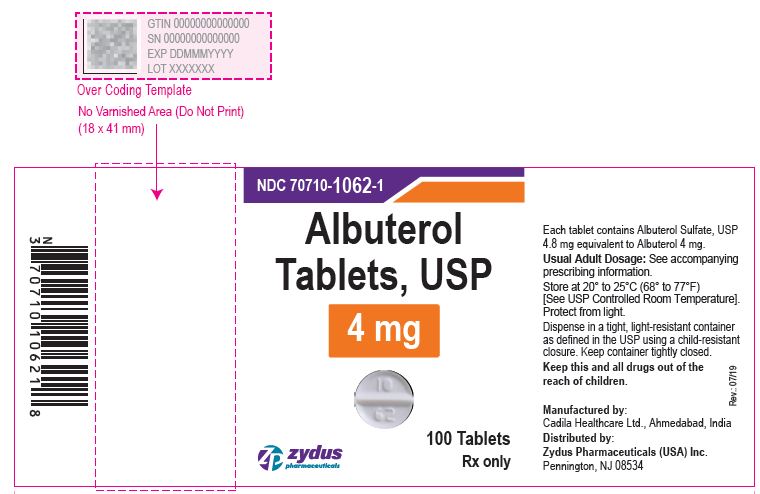
Albuterol tablets USP, 2 mg are white to off white colored, round shaped, flat faced, beveled edge uncoated tablets debossed with '10' on upper half of score line and '61' on lower half of score line on one side and plain on other side and are supplied as follows:
NDC 70710-1061-1 in bottle of 100 tablets
Albuterol tablets USP, 4 mg are white to off white colored, round shaped, flat faced, beveled edge uncoated tablets debossed with '10' on upper half of score line and '62' on lower half of score line on one side and plain on other side and are supplied as follows:
NDC 70710-1062-1 in bottle of 100 tablets
NDC 70710-1062-5 in bottle of 500 tablets
Store at 20° to 25°C (68° to 77°F) [See USP Controlled Room Temperature]. Protect from light.
Dispense in a tight, light-resistant container as defined in the USP using a child-resistant closure.
Call your doctor for medical advice about side effects. You may report side effects to FDA at 1-800-FDA-1088.
Please address medical inquiries to, [email protected] or Tel.: 1-877-993-8779.
Manufactured by:
Cadila Healthcare Ltd.
Ahmedabad, India.
Distributed by:
Zydus Pharmaceuticals (USA) Inc.
Pennington, NJ 08534
Rev.: 05/20