Comparative Study of Sugammadex versus Neostigmine as a Reversal Agent for Neuromuscular Blockade Induced by Rocuronium or Vecuronium at Reappearance of T2 (Moderate Blockade)
A multicenter, randomized, parallel-group, active-controlled, safety-assessor blinded study comparing sugammadex and neostigmine enrolled 189 patients (87 women and 102 men, 95% were ASA class 1 and 2 and 99% were Caucasian, median weights were 72 kg and 76 kg and median ages were 50 years and 51 years in the rocuronium and vecuronium groups, respectively). Patients were randomly assigned to the rocuronium or vecuronium group and underwent elective surgical procedures under general anesthesia that required endotracheal intubation and maintenance of neuromuscular blockade. The surgical procedures were mainly endocrine, ocular, ENT, abdominal (gynecological, colorectal, urological), orthopedic, vascular, or dermatological. At the reappearance of T2, after the last dose of rocuronium or vecuronium, 2 mg/kg sugammadex or 50 mcg/kg neostigmine was administered in a randomized order as a single bolus injection. The time from start of administration of sugammadex or neostigmine to recovery of the TOF (T4/T1) ratio to 0.9 was assessed. Generally, a T4/T1 ratio ≥0.9 correlates with recovery from neuromuscular blockade.
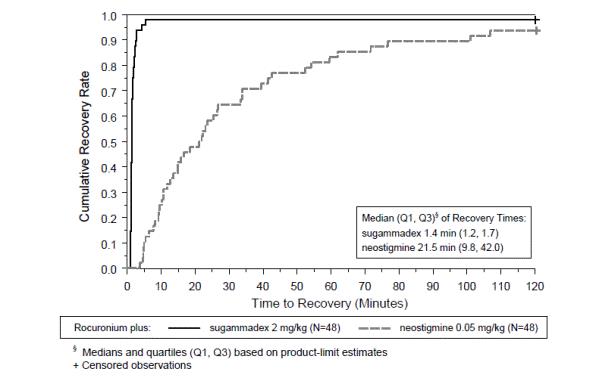
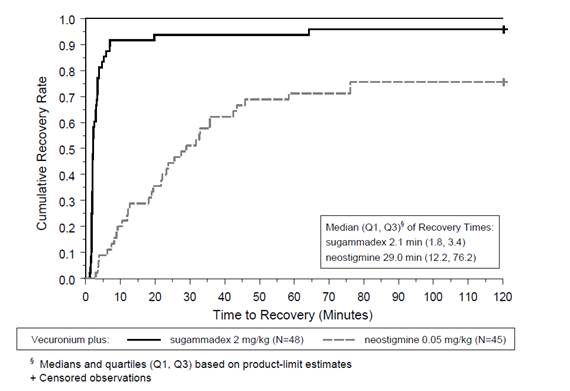
Return of the T4/T1 ratio to 0.9 after the reappearance of T2 was overall faster with sugammadex 2 mg/kg as compared to neostigmine 50 mcg/kg in the setting of rocuronium or vecuronium-induced neuromuscular blockade (Figures 1 and 2).
Figure 1
Time (Minutes) from Administration of Sugammadex or Neostigmine at the Reappearance of T2 after Rocuronium to Recovery of the T4/T1 Ratio to 0.9
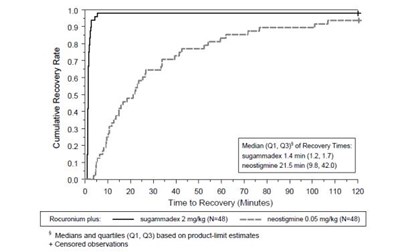
Image (75ac6da6 477a 483f Aced F266e2e8c2a9 03)
Figure 2
Time (Minutes) from Administration of Sugammadex or Neostigmine at the Reappearance of T2 after Vecuronium to Recovery of the T4/T1 Ratio to 0.9
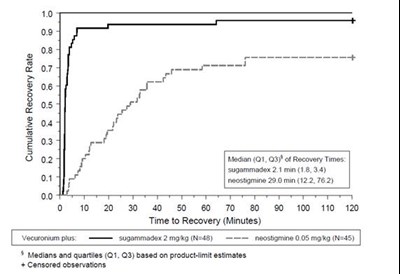
Image (75ac6da6 477a 483f Aced F266e2e8c2a9 04)
Comparative Study of Sugammadex versus Neostigmine as a Reversal Agent for Neuromuscular Blockade Induced by Rocuronium or Vecuronium at 1 to 2 PTCs (Deep Blockade)
A multicenter, randomized, parallel-group, active-controlled, safety-assessor blinded study comparing sugammadex and neostigmine enrolled 157 patients (86 women and 71 men; 8% ASA class 1, 71% class 2, and 21% class 3; 79% Caucasian; median weights of 81 kg and 84 kg, and median ages of 54 years and 56 years in the rocuronium and vecuronium groups, respectively). Patients were randomly assigned to the rocuronium or vecuronium group and underwent elective surgical procedures under general anesthesia that required endotracheal intubation and maintenance of neuromuscular blockade. The surgical procedures were mainly abdominal (gynecological, colorectal, urological), orthopedic, reconstructive, or neurological. At 1 to 2 PTCs, after the last dose of rocuronium or vecuronium, 4 mg/kg sugammadex or 70 mcg/kg neostigmine was administered in a randomized order as a single bolus injection. The time from start of administration of sugammadex or neostigmine to recovery of the TOF (T4/T1) ratio to 0.9 was assessed, although neostigmine was not expected to reverse neuromuscular blockade at a depth of 1 to 2 PTCs. Generally, a T4/T1 ratio ≥0.9 correlates with recovery from neuromuscular blockade.
Return of the T4/T1 ratio to 0.9 in patients with 1 to 2 PTCs with sugammadex 4 mg/kg had a wider range of recovery times but the median time to recovery was comparable to the study of reversal at T2 (2.7 minutes with 25th and 75th percentiles of 2.1 and 4.3 minutes for rocuronium [N=37], and 3.3 minutes with 25th and 75th percentiles of 2.3 and 6.6 minutes for vecuronium [N=47]). There were 7 and 6 censored observations in the rocuronium and vecuronium groups, respectively.
Reversal of Neuromuscular Blockade 3 Minutes after Rocuronium 1.2 mg/kg
Time to recovery from neuromuscular blockade induced by succinylcholine compared with recovery from neuromuscular blockade induced by rocuronium followed 3 minutes later with sugammadex was assessed in a multicenter, randomized, parallel-group, active-controlled, safety assessor blinded study. The study was conducted in 110 patients (64 women and 46 men, ASA class 1 and 2, 78% were Caucasian, median weight was 70 kg, median age was 43 years). Patients underwent elective surgical procedures under general anesthesia that required endotracheal intubation and a short duration of neuromuscular relaxation. The laparoscopic or open surgical procedures were mainly gynecological, orthopedic, or reconstructive. Return of the first twitch in a TOF (T1) to 10% of baseline was compared between sugammadex 16 mg/kg for reversal of rocuronium 1.2 mg/kg versus spontaneous recovery from succinylcholine 1 mg/kg.
Recovery to T1 of 10% of baseline (relative to the time of administration of rocuronium or succinylcholine) was overall faster in the rocuronium/ sugammadex group compared with succinylcholine alone (Table 5).
Table 5
Time (minutes) from Start of Administration of Rocuronium or Succinylcholine to Recovery of T1 to 10% of Baseline
| Treatment Regimen
|
R ocuronium (1.2 mg/kg) and
sugammadex (16 mg/kg)
| Succinylcholine (1 mg/kg)
|
N
| 55
| 55
|
Mean (SD)
| 4.4 (0.7)
| 7.1 (1.6)
|
Median (Range)
| 4.2 (3.5 to 7.7)
| 7.1 (3.8 to 10.5)
|
Comparative Studies of Sugammadex versus Neostigmine as a Reversal Agent for Neuromuscular Blockade Induced by Rocuronium or Vecuronium in Pediatric Patients
2 Years to <17 Years of Age
Time to recovery from neuromuscular blockade induced by rocuronium or vecuronium followed by administration of sugammadex or neostigmine was assessed in a randomized, double-blind, active comparatorcontrolled study. The study was conducted in 288 randomized pediatric patients 2 years to <17 years of age, of which 276 patients received treatment (153 boys and 123 girls; ASA class 1, 2, and 3; 89.5% were Caucasian; median weight was 25 kg; median age was 7 years). The primary efficacy objective was to evaluate the effect of sugammadex compared to neostigmine for reversal of moderate neuromuscular blockade as measured by time to recovery to a TOF ratio of ≥ 0.9.
Recovery to a TOF ratio of ≥0.9 was statistically significantly faster in pediatric patients 2 years to <17 years of age dosed with sugammadex 2 mg/kg (N=33) compared with neostigmine (N=34) for reversal of moderate block based on a geometric mean of 1.7 minutes for sugammadex 2 mg/kg and 7.4 minutes for neostigmine (ratio of geometric means was 0.22, 95% CI (0.16, 0.32)). These effects were consistent across age cohorts studied (2 to <6; 6 to <12; 12 years to <17 years of age) and neuromuscular blocking agent (rocuronium and vecuronium).
Additional pediatric use information is approved for Merck Sharp & Dohme LLC's BRIDION® (sugammadex) injection. However, due to Merck Sharp & Dohme LLC's marketing exclusivity rights, this drug product is not labeled with that information.