1 Indications And Usage
Fluorescein injection 10% (100 mg/mL) and 25% (250 mg/mL) is indicated in diagnostic fluorescein angiography or angioscopy of the retina and iris vasculature.
The following Structured Product Label (SPL) was submitted to the FDA by Zydus Pharmaceuticals Usa Inc. for the product Fluorescein (NDC 70710-2045). This document serves as the official prescribing information, containing essential scientific data and clinical materials required for healthcare providers and patients.
This specific version of the label includes detailed information regarding 1 indications and usage, 2.1 dosing, 2.2 preparation for administration, 2.3 administration, 3 dosage forms and strengths, 4.1 hypersensitivity, 5.1 respiratory reactions, 5.2 severe local tissue damage, and other regulatory disclosures. Use the navigation below to review specific sections of the FDA submission.
Fluorescein injection 10% (100 mg/mL) and 25% (250 mg/mL) is indicated in diagnostic fluorescein angiography or angioscopy of the retina and iris vasculature.
Adult Dose
The recommended dosage of fluorescein injection 10% (100 mg/mL) and of 25% (250 mg/mL) is 500 mg via intravenous administration.
Pediatric Dose
For children, the dose is 7.7 mg/kg (actual body weight) up to a maximum of 500 mg, via intravenous infusion calculated on the basis of 35 mg for each 4.54 kg of body weight.
Parenteral drug products should be inspected visually for particulate matter and discoloration prior to administration. Do not mix or dilute with other solutions or drugs.
Discard unused portion.
Inject the dose (over 5 seconds to 10 seconds is normally recommended) into the antecubital vein, after taking precautions to avoid extravasation. A syringe, filled with fluorescein, may be attached to transparent tubing and a 23 gauge butterfly needle for injection. Insert the needle and draw the patient's blood to the hub of the syringe so that a small air bubble separates the patient's blood in the tubing from the fluorescein. With the room lights on, slowly inject the blood back into the vein while watching the skin over the needle tip. If the needle has extravasated, the patient's blood will be seen to bulge the skin and the injection should be stopped before any fluorescein is injected. When assured that extravasation has not occurred, the room light may be turned off and the fluorescein injection completed. Luminescence usually appears in the retina and choroidal vessels in 7 seconds to 14 seconds and can be observed by standard viewing equipment.
Reduction in dose from 500 mg to 200 mg of fluorescein injection 10% may be appropriate in cases when a highly sensitive imaging system e.g., scanning laser ophthalmoscope is used.
Injection:
Caution should be exercised in patients with a history of allergy or bronchial asthma. An emergency tray should always be available.
If a potential allergy is suspected, an intradermal skin test may be performed prior to intravenous administration, i.e., 0.05 mL injected intradermally to be evaluated 30 minutes to 60 minutes following injection. Given the sensitivity and specificity of skin testing, a negative skin test is not proof that a patient is not allergic to fluorescein.
Extravasation during injection can result in severe local tissue damage due to high pH of fluorescein solution. The following complications resulting from extravasation of fluorescein have been noted to occur: Sloughing of the skin, superficial phlebitis, subcutaneous granuloma, and toxic neuritis along the median nerve in the antecubital area. Complications resulting from extravasation can cause severe pain in the arm for up to several hours. When extravasation occurs, the injection should be discontinued and conservative measures to treat damaged tissue and to relieve pain should be implemented. [see Administration (2.3) and Adverse Reactions (6.6)].
The most common reaction is discoloration of the skin and urine. Skin will attain a temporary yellowish discoloration. Urine attains a bright yellow color. Discoloration of the skin usually fades in 6 hours to 12 hours and usually fades in urine in 24 hours to 36 hours.
The next most common adverse reaction is nausea. Vomiting, and gastrointestinal distress have also occurred. A strong taste may develop after injection.
Syncope and hypotension may occur. Cardiac arrest, basilar artery ischemia, severe shock and death may occur rarely. [see Warnings and Precautions (5.1)]
Headache may occur. Convulsions may rarely occur following injection.
Adequate animal reproduction studies have not been conducted with fluorescein sodium. It is also not known whether fluorescein sodium can cause fetal harm when administered to a pregnant woman. Fluorescein sodium should be given to a pregnant woman only if clearly needed.
Fluorescein sodium has been demonstrated to be excreted in human milk. Caution should be exercised when fluorescein sodium is administered to a nursing woman.
Pediatric patients have been included in clinical studies. No overall differences in safety or effectiveness have been observed between pediatric and adult patients.
No overall differences in safety or effectiveness have been observed between elderly and other adult patients.
Fluorescein injection, USP contains fluorescein sodium, a diagnostic aid, in a sterile solution for use intravenously. It is a clear dark reddish orange solution with a pH of 8.0 to 9.8 and an osmolality of 572 mOsm/kg to 858 mOsm/kg for the 10% and 1,800 mOsm/kg to 2,200 mOsm/kg for the 25%. Its chemical name is spiro[isobenzofuran-1 (3H),9'-[9H]xanthene]-3-one,3'6'- dihydroxy, disodium salt. Its molecular weight is 376.27 g/mol. The active ingredient is represented by the chemical structure:
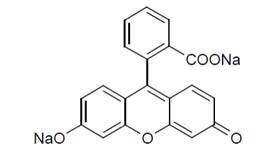
Image (3d7bac75 0d7d 46aa 8f0d 60bda9b2e380 01)
Fluorescein injection, USP 10% (500 mg/5 mL) (100 mg/mL) contains:
Fluorescein injection, USP 25% (500 mg/2 mL) (250 mg/mL) contains:
Fluorescein sodium responds to electromagnetic radiation and light between the wavelengths of 465 nm to 490 nm and fluoresces, i.e., emits light at wavelengths of 520 nm to 530 nm. Thus, the hydrocarbon is excited by blue light and emits light that appears yellowish green. Following intravenous injection of fluorescein sodium in an aqueous solution, the unbound fraction of the fluorescein can be excited with a blue light flash from a fundus camera as it circulates through the ocular vasculature, and the yellowish green fluorescence of the dye is captured by the camera. In the fundus, the fluorescence of the dye demarcates the retinal and/or choroidal vasculature under observation, distinguishing it from adjacent areas/structures.
Distribution
Within 7 seconds to 14 seconds after intravenous (IV) administration into the antecubital vein, fluorescein usually appears in the central retinal artery of the eye. Within a few minutes of IV administration of fluorescein sodium, a yellowish discoloration of the skin occurs, which begins to fade 6 hours to 12 hours after dosing. Various estimates of volume of distribution indicate that fluorescein distributes into interstitial space (0.5 L/kg).
Metabolism
Fluorescein is metabolized to fluorescein monoglucuronide. After IV administration of fluorescein sodium (14 mg/kg) to 7 healthy subjects, approximately 80% of fluorescein in plasma was converted to glucuronide conjugate after a period of 1 hour post dose.
Excretion
Fluorescein and its metabolite are mainly eliminated via renal excretion. After IV administration, the urine remains slightly fluorescent for 24 hours to 36 hours. A renal clearance of 1.75 mL/min/kg and a hepatic clearance (due to conjugation) of 1.50 mL/min/kg have been estimated. The systemic clearance of fluorescein was essentially complete by 48 hours to 72 hours after administration of 500 mg fluorescein.
There have been no long-term studies done using fluorescein in animals to evaluate carcinogenic potential.
Fluorescein injection, USP 10% is supplied in a single-dose 5 mL glass vial with clear dark reddish orange color solution filled in clear glass vial with gray colored rubber stopper and red aluminum flip-off seal.
(NDC 70710-2045-9) 5 mL, single dose vials in a package of 12.
Fluorescein injection, USP 25% is supplied in a single-dose 2 mL glass vial with clear dark reddish orange color solution filled in clear glass vial with gray colored rubber stopper and red aluminum flip-off seal.
(NDC 70710-2046-9) 2 mL, single dose vials in a package of 12.
Store Fluorescein injection, USP at 20°C to 25°C (68°F to 77°F) [See USP Controlled Room Temperature]. Protect from freezing. Discard unused portion.
After administration of fluorescein sodium, skin will attain a temporary yellowish discoloration. Urine attains a bright yellow color. Discoloration of the skin usually fades in 6 hours to 12 hours and usually fades in urine in 24 hours to 36 hours. [see Warnings and Precautions (6.1)].
Manufactured by:
Zydus Lifesciences Ltd.
Vadodara-391510, India
Distributed by:
Zydus Pharmaceuticals (USA) Inc.
Pennington, NJ 08534
Rev.: 04/26
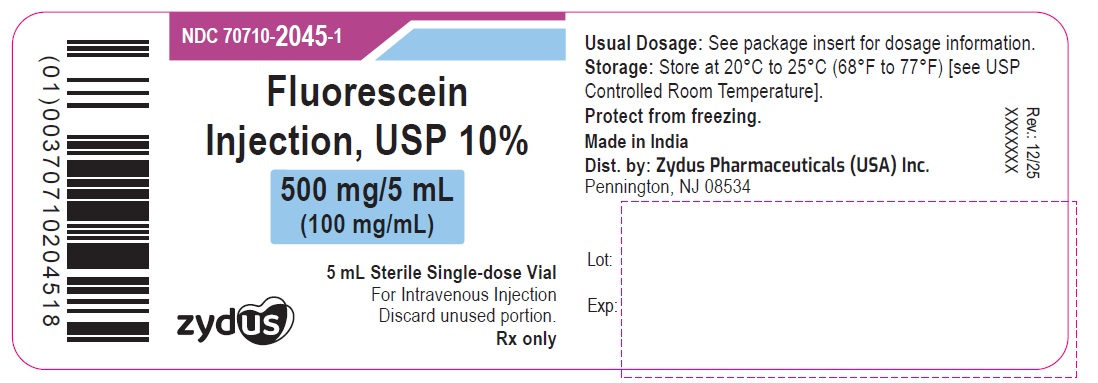
NDC 70710-2045-1
Fluorescein Injection, USP 10%
500 mg/5 mL (100 mg/mL)
Sterile Single-dose Vial
For Intravenous Injection
Discard unused portion.
Rx only
Zydus
Fluorescein Injection 10% (3d7bac75 0d7d 46aa 8f0d 60bda9b2e380 02)
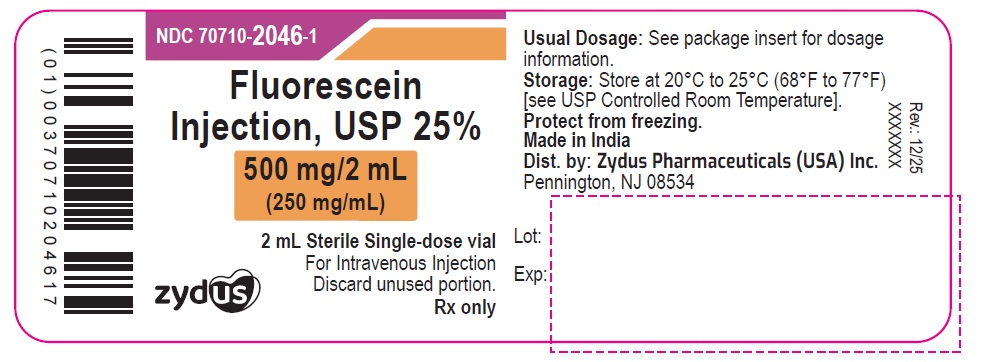
NDC 70710-2046-1
Fluorescein Injection, USP 25%
500 mg/2 mL (250 mg/mL)
Sterile Single-dose Vial
For Intravenous Injection
Discard unused portion.
Rx only
Zydus
Fluorescein Injection 25% (3d7bac75 0d7d 46aa 8f0d 60bda9b2e380 03)
* Please review the disclaimer below.
