Absorption
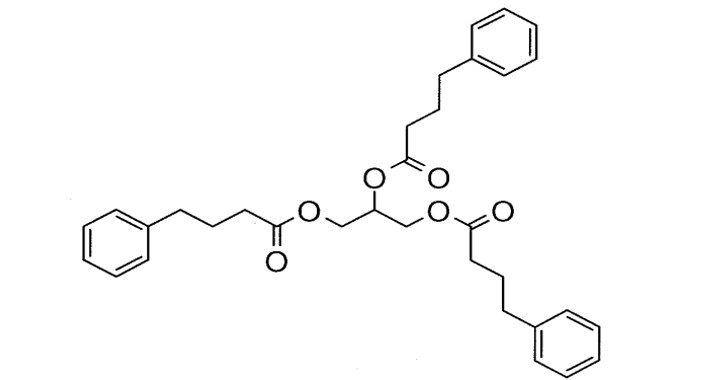
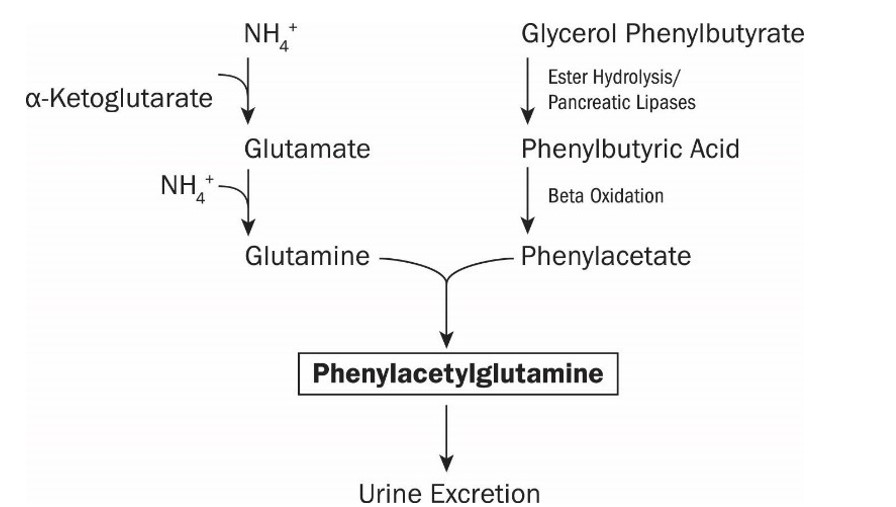
Glycerol phenylbutyrate is a pro-drug of PBA. Upon oral ingestion, PBA is released from the glycerol backbone in the gastrointestinal tract by lipases. PBA derived from glycerol phenylbutyrate is further converted by β-oxidation to PAA.
In healthy, fasting adult subjects receiving a single oral dose of 2.9 mL/m2 of glycerol phenylbutyrate, peak plasma levels of PBA, PAA, and PAGN occurred at 2 hours, 4 hours, and 4 hours, respectively. Upon single-dose administration of glycerol phenylbutyrate oral liquid, plasma concentrations of PBA were quantifiable in 15 of 22 participants at the first sample time postdose (0.25 hours). Mean maximum concentration (Cmax) for PBA, PAA, and PAGN was 37.0 micrograms/mL, 14.9 micrograms/mL, and 30.2 micrograms/mL, respectively. In healthy subjects, intact glycerol phenylbutyrate was detected in plasma. While the study was inconclusive, the incomplete hydrolysis of glycerol phenylbutyrate cannot be ruled out.
In healthy subjects, the systemic exposure to PAA, PBA, and PAGN increased in a dose- dependent manner. Following 4 mL of glycerol phenylbutyrate oral liquid 3 times a day for 3 days, the mean Cmax and AUC were 66 micrograms/mL and 930 micrograms•h/mL for PBA and 28 micrograms/mL and 942 micrograms•h/mL for PAA, respectively. In the same study, following 6 mL of glycerol phenylbutyrate oral liquid three times a day for 3 days, mean Cmax and AUC were 100 micrograms/mL and 1400 micrograms•h/mL for PBA and 65 µg/mL and 2064 micrograms•h/mL for PAA, respectively.
In adult patients with UCDs receiving multiple doses of glycerol phenylbutyrate oral liquid, maximum plasma concentrations at steady state (Cmax,ss) of PBA, PAA, and PAGN occurred at 8 hours, 12 hours, and 10 hours, respectively, after the first dose in the day. Intact glycerol phenylbutyrate was not detectable in plasma in patients with UCDs.
In clinical studies of glycerol phenylbutyrate oral liquid in patients with UCDs, the peak observed PAA concentrations by age group are shown in Table 2.
Table 2: Peak PAA Concentrations in Patients with UCDs Treated with glycerol phenylbutyrate oral liquid in Clinical Trials
Age Range
| Glycerol phenylbutyrate oral liquid Dose
| Mean Peak PAA Concentration*
(SD)
| Median Peak PAA Concentration * (Range)
|
Less than 2 months (n=16)
| 3.1 to 12.7 mL/m2/day
(3.4 to 14 g/m2/day)
| 257 (162)
| 205 (96 to 707)
|
2 months to less than 2 years (n=17)
| 3.3 to 12.3 mL/m2/day
(3.7 to 13.5 g/m2/day)
| 142 (299)
| 35 (1 to 1215)
|
2 years to 17 years (n=53)
| 1.4 to 13.7 mL/m2/day
(1.5 to 15.1 g/m2/day)
| 70 (79)
| 50 (1 to 410)
|
Adults
(n=43)
| 0.6 to 14 mL/m2/day
(0.7 to 15.4 g/m2/day)
| 39 (40)
| 25 (1.6 to 178)
|
*micrograms/mL
Distribution
In vitro, the extent of plasma protein binding for 14C-labeled metabolites was 81% to 98% for PBA (over 1 to 250 micrograms/mL), and 37% to 66% for PAA (over 5 to 500 micrograms/mL). The protein binding for PAGN was 7% to 12% and no concentration effects were noted.
Elimination
Metabolism
Upon oral administration, pancreatic lipases hydrolyze glycerol phenylbutyrate, and release PBA. PBA undergoes β-oxidation to PAA, which is conjugated with glutamine in the liver and in the kidney through the enzyme phenylacetyl-CoA: L- glutamine-N-acetyltransferase to form PAGN. PAGN is subsequently eliminated in the urine.
Saturation of conjugation of PAA and glutamine to form PAGN was suggested by increases in the ratio of plasma PAA to PAGN with increasing dose and with increasing severity of hepatic impairment.
In healthy subjects, after administration of 4 mL, 6 mL, and 9 mL 3 times daily for 3 days, the ratio of mean AUC0-23h of PAA to PAGN was 1, 1.25, and 1.6, respectively. In a separate study, in patients with hepatic impairment (Child-Pugh B and C), the ratios of mean Cmax values for PAA to PAGN among all patients dosed with 6 mL and 9 mL twice daily were 3 and 3.7.
In in vitro studies, the specific activity of lipases for glycerol phenylbutyrate was in the following decreasing order: pancreatic triglyceride lipase, carboxyl ester lipase, and pancreatic lipase–related protein 2. Further, glycerol phenylbutyrate was hydrolyzed in vitro by esterases in human plasma. In these in vitro studies, a complete disappearance of glycerol phenylbutyrate did not produce molar equivalent PBA, suggesting the formation of mono- or bis-ester metabolites. However, the formation of mono- or bis-esters was not studied in humans.
Excretion
The mean (SD) percentage of administered PBA excreted as PAGN was approximately 69% (17) in adults and 66% (24) in pediatric patients with UCDs at steady state. PAA and PBA represented minor urinary metabolites, each accounting for less than 1% of the administered dose of PBA.
Specific Populations
Age: Pediatric Population
Population pharmacokinetic modeling and dosing simulations suggest body surface area to be the most significant covariate explaining the variability of PAA clearance. PAA clearance was 10.9 L/h, 16.4 L/h, and 24.4 L/h, respectively, for patients ages 3 to 5, 6 to 11, and 12 to 17 years with UCDs.
In pediatric patients with UCDs (n = 14) ages 2 months to less than 2 years, PAA clearance was 6.8 L/h.
In pediatric patients with UCDs (n = 16) ages less than 2 months, PAA clearance was 3.8 L/h. The mean peak ratio of PAA to PAGN in UCD patients aged birth to less than 2 months was higher (mean: 1.6; range 0.1 to 7.1) than that of UCD patients aged 2 months to less than 2 years (mean 0.5; range 0.1 to 1.2).
Sex
In healthy adult subjects, a gender effect was found for all metabolites, with women generally having higher plasma concentrations of all metabolites than men at a given dose level. In healthy female subjects, mean Cmax for PAA was 51 and 120% higher than in male volunteers after administration of 4 mL and 6 mL 3 times daily for 3 days, respectively. The dose normalized mean AUC0-23h for PAA was 108% higher in females than in males.
Renal Impairment
The pharmacokinetics of glycerol phenylbutyrate in patients with impaired renal function, including those with end-stage renal disease (ESRD) or those on hemodialysis, have not been studied [see Use in Specific Populations (8.6)].
Hepatic Impairment
The effects of hepatic impairment on the pharmacokinetics of glycerol phenylbutyrate were studied in patients with mild, moderate and severe hepatic impairment of (Child-Pugh class A, B, and C, respectively) receiving 100 mg/kg of glycerol phenylbutyrate twice daily for 7 days.
Plasma glycerol phenylbutyrate was not measured in patients with hepatic impairment.
After multiple doses of glycerol phenylbutyrate oral liquid in patients with hepatic impairment of Child-Pugh A, B, and C, geometric mean AUCt of PBA was 42%, 84%, and 50% higher, respectively, while geometric mean AUCt of PAA was 22%, 53%, and 94% higher, respectively, than in healthy subjects.
In patients with hepatic impairment of Child-Pugh A, B, and C, geometric mean AUCt of PAGN was 42%, 27%, and 22% lower, respectively, than that in healthy subjects.
The proportion of PBA excreted as PAGN in the urine in Child-Pugh A, B, and C was 80%, 58%, and 85%, respectively, and, in healthy volunteers, was 67%.
In another study in patients with moderate and severe hepatic impairment (Child-Pugh B and C), mean Cmax of PAA was 144 micrograms/mL (range: 14 to 358 micrograms/mL) after daily dosing of 6 mL of glycerol phenylbutyrate oral liquid twice daily, while mean Cmax of PAA was 292 micrograms/mL (range: 57 to 655 micrograms/mL) after daily dosing of 9 mL of glycerol phenylbutyrate oral liquid twice daily. The ratio of mean Cmax values for PAA to PAGN among all patients dosed with 6 mL and 9 mL twice daily were 3 and 3.7, respectively.
After multiple doses, a PAA concentration greater than 200 micrograms/mL was associated with a ratio of plasma PAA to PAGN concentrations higher than 2.5 [see Dosage and Administration (2.5)].
Drug Interaction Studies
In vitro PBA or PAA did not induce CYP1A2, suggesting that in vivo drug interactions via induction of CYP1A2 is unlikely.
In in vitro studies, PBA at a concentration of 800 micrograms/mL caused greater than 60% reversible inhibition of cytochrome P450 isoenzymes CYP2C9, CYP2D6, and CYP3A4/5 (testosterone 6β-hydroxylase activity). The in vitro study suggested that in vivo drug interactions with substrates of CYP2D6 cannot be ruled out. The inhibition of CYP isoenzymes 1A2, 2C8, 2C19, and 2D6 by PAA at the concentration of 2.8 mg/mL was observed in vitro. Clinical implication of these results is unknown.
Effects of glycerol phenylbutyrate on other drugs
Midazolam
In healthy subjects, when oral midazolam was administered after multiple doses of glycerol phenylbutyrate oral liquid (4 mL three times a day for 3 days) under fed conditions, the mean Cmax and AUC for midazolam were 25% and 32% lower, respectively, compared to administration of midazolam alone. In addition, the mean Cmax and AUC for 1-hydroxy midazolam were 28% and 58% higher, respectively, compared to administration of midazolam alone [see Drug Interactions (7.3)].
Celecoxib
Concomitant administration of glycerol phenylbutyrate oral liquid did not significantly affect the pharmacokinetics of celecoxib, a substrate of CYP2C9. When 200 mg of celecoxib was orally administered with glycerol phenylbutyrate after multiple doses of glycerol phenylbutyrate oral liquid (4 mL three times a day for 6 days) under fed conditions (a standard breakfast was consumed 5 minutes after celecoxib administration), the mean Cmax and AUC for celecoxib were 13% and 8% lower than after administration of celecoxib alone.