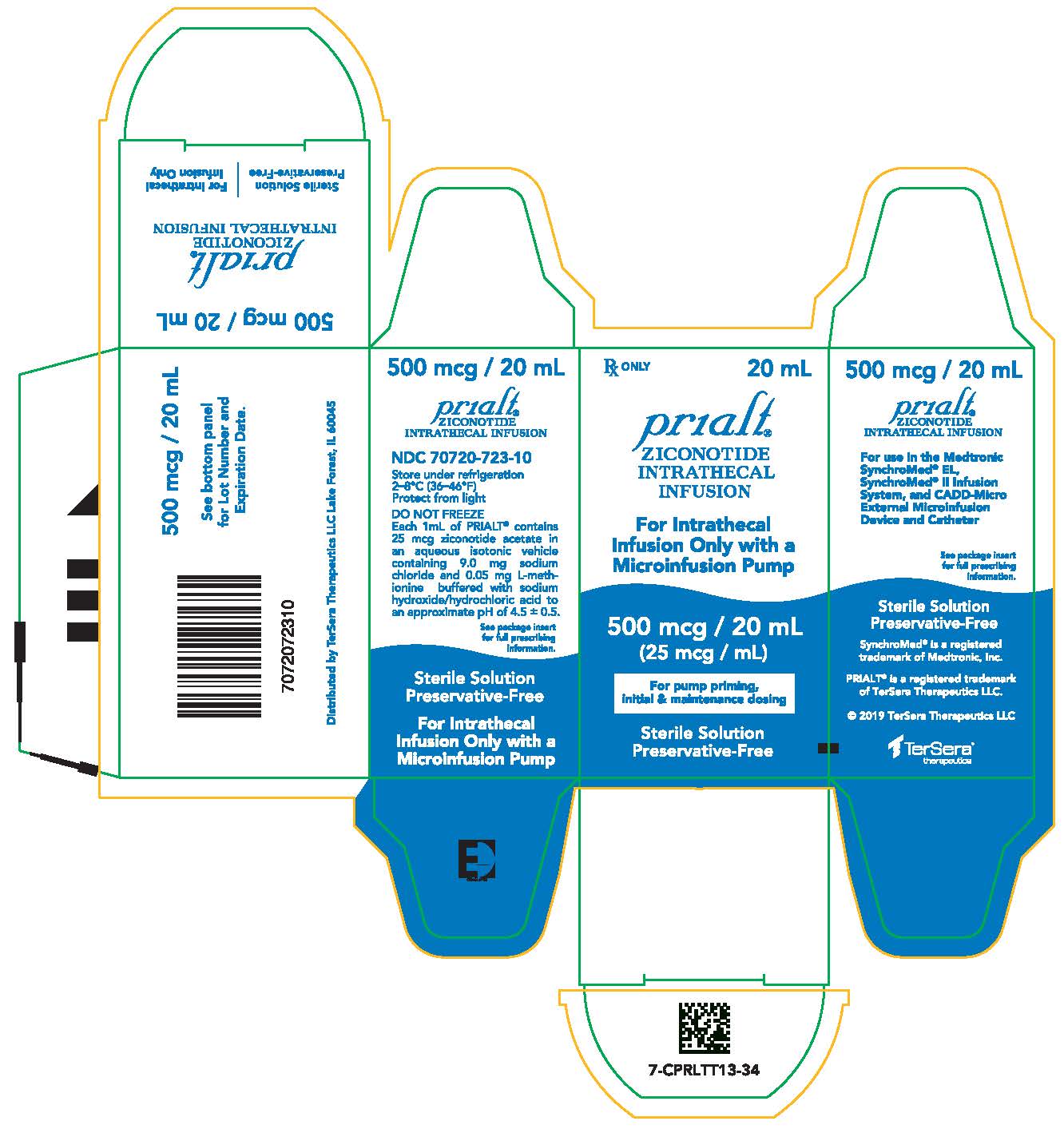
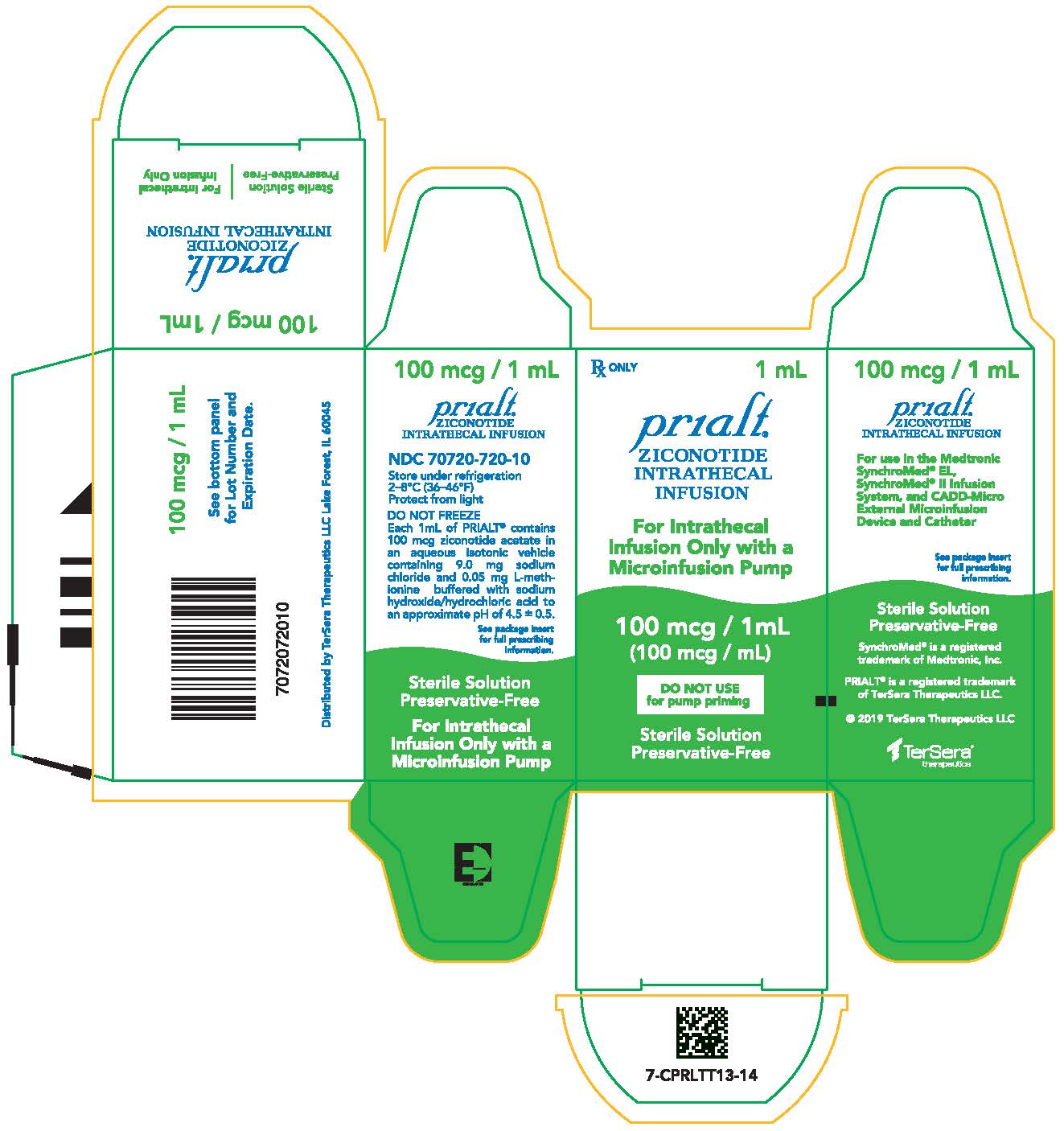
Dose Initiation
Initiate dosing with PRIALT via intrathecal device at no more than 2.4 mcg/day (0.1 mcg/hr).
Dose Titration
Titrate doses by up to 2.4 mcg/day (0.1 mcg/hr) at intervals of no more than 2 to 3 times per week based on analgesic response and adverse events. Dose increases in increments of less than 2.4 mcg/day (0.1 mcg/hr) and less frequently than 2 to 3 times per week may be used. For each dose titration, assess the dosing requirements and adjust the pump infusion flow rate as required to achieve the new dosing.
The maximum recommended dose is 19.2 mcg/day (0.8 mcg/hr).
Adjust the dose of intrathecal PRIALT according to the severity of pain, the patient's response to therapy, and the occurrence of adverse reactions.
Naïve Pump Priming (i.e., first time use with PRIALT)
Use only the undiluted 25 mcg/mL formulation for naïve pump priming. Rinse the internal surfaces of the pump with 2 mL of PRIALT at 25 mcg/mL. Repeat twice for a total of three rinses.
Initial Pump Fill
Use only the undiluted 25 mcg/mL formulation for the initial pump fill. Fill the naïve pump after priming with the appropriate volume of PRIALT 25 mcg/mL. Begin dosing at a delivery rate no higher than 2.4 mcg/day (0.1 mcg/hr). In a naïve pump, PRIALT is lost due to two factors that do not occur upon subsequent refills: adsorption on internal device surfaces, such as titanium, and by dilution in the residual space of the device. Consequently, the pump reservoir should be refilled with PRIALT within 14 days of the initial fill to ensure appropriate dose administration.
Pump Refills
For subsequent pump refills, fill the pump at least every 40 days if PRIALT is used diluted. For undiluted PRIALT, fill the pump at least every 84 days. To ensure aseptic transfer of PRIALT into the device, use the Medtronic refill kit. Empty the pump contents prior to refill with PRIALT.
If the internal infusion system must be surgically replaced while the person is receiving PRIALT, rinse the replacement pump with PRIALT according to Naïve Pump Priming [see Dosage and Administration (2.4)], and replace the initial fill solution within 14 days according to Initial Pump Fill [see Dosage and Administration (2.4)].
PRIALT
(ziconotide) solution, intrathecal infusion | Initial Fill
Expiry | Refill
Expiry |
| 25 mcg/mL, undiluted
| 14 Days
| 84 Days
|
| 100 mcg/mL, undiluted
| N/A
| 84 Days
|
| 100 mcg/mL, diluted
| N/A
| 40 Days
|
Other Adverse Reactions Observed During Clinical Studies of PRIALT
The following adverse reactions assessed as related to PRIALT have been reported in 2% or greater of patients participating in the clinical studies:
EYE DISORDERS: diplopia, visual disturbance
GASTROINTESTINAL DISORDERS: abdominal pain, constipation, dry mouth, nausea aggravated
GENERAL DISORDERS AND ADMINISTRATION SITE CONDITIONS: fall, fatigue, lethargy, edema peripheral
INVESTIGATIONS: blood creatine phosphokinase increased
METABOLISM AND NUTRITION DISORDERS: appetite decreased
MUSCULOSKELETAL AND CONNECTIVE TISSUE DISORDERS: muscle cramp, muscle weakness, myalgia, pain in limb
NERVOUS SYSTEM DISORDERS: aphasia, areflexia, balance impaired, burning sensation, coordination abnormal, disturbance in attention, dizziness postural, dysarthria, dysgeusia, hypoaesthesia, mental impairment, paraesthesia, sedation, speech disorder
PSYCHIATRIC DISORDERS: agitation, anxiety, cognitive disorder, confusional state, depression, depression aggravated, disorientation, hallucination, hallucination auditory, hallucination visual, insomnia, irritability, mood disorder, nervousness, paranoia
RENAL AND URINARY DISORDERS: dysuria, urinary hesitation
VASCULAR DISORDERS: hypotension, orthostatic hypotension.
The following medically important adverse reactions occurred in less than 2% of patients were assessed by the clinical investigators as related to PRIALT: acute renal failure, atrial fibrillation, cerebrovascular accident, sepsis, meningitis, psychotic disorder, suicidal ideation, respiratory distress, rhabdomyolysis, electrocardiogram abnormal, stupor, loss of consciousness, clonic convulsion and grand mal convulsion. Fatal aspiration pneumonia and suicide attempt were reported in less than 1% of patients.
Pregnancy Category C:
Ziconotide was embryolethal in rats when given as a continuous intravenous infusion during the major period of organogenesis as evidenced by significant increases in post-implantation loss because of an absence or a reduced number of live fetuses. Estimated exposure for embryolethality in the rat was approximately 700-fold above the expected exposure resulting from the maximum recommended human daily intrathecal dose of 0.8 mcg/hr (19.2 mcg/day). Ziconotide was not teratogenic in female rats when given as a continuous intravenous infusion at doses up to 30 mg/kg/day or in female rabbits up to 5 mg/kg/day during the major period of organ development. Estimated exposures in the female rat and rabbit were approximately 26,000-fold and 940-fold higher than the expected exposure resulting from the maximum recommended human daily dose of 0.8 mcg/hr (19.2 mcg/day) based on plasma exposure. Maternal toxicity in the rat and rabbit, as evidenced by decreased body weight gain and food consumption, was present at all dose levels. Maternal toxicity in the rat led to reduced fetal weights and transient, delayed ossification of the pubic bones at doses ≥ 15 mg/kg/day, which is approximately 8900-fold higher than the expected exposure resulting from the maximum recommended human daily intrathecal dose of 0.8 mcg/hr (19.2 mcg/day) based on plasma exposure. The no observable adverse effect level (NOAEL) for embryo-fetal development in rats was 0.5 mg/kg/day and in rabbits was 5 mg/kg/day. Estimated NOAEL exposures in the rat and rabbit were approximately 400-fold and 940-fold higher than the expected exposure resulting from the maximum recommended human daily intrathecal dose of 0.8 mcg/hr (19.2 mcg/day) based on plasma exposure.
In a pre- and post-natal study in rats, ziconotide given as a continuous intravenous infusion did not affect pup development or reproductive performance up to a dose of 10 mg/kg/day, which is approximately 3800-fold higher than the expected exposure resulting from the maximum recommended human daily intrathecal dose of 0.8 mcg/hr (19.2 mcg/day) based on plasma exposure. Maternal toxicity, as evidenced by clinical observations, and decreases in body weight gain and food consumption were observed at all doses.
No adequate and well-controlled studies have been conducted in pregnant women. Because animal studies are not always predictive of human response, PRIALT should be used during pregnancy only if the potential benefit justifies risk to the fetus.
Distribution
Ziconotide is about 50% bound to human plasma proteins. The mean CSF volume of distribution (Vd) of ziconotide following intrathecal administration approximates the estimated total CSF volume (140 mL).
Metabolism
Ziconotide is cleaved by endopeptidases and exopeptidases at multiple sites on the peptide. Following passage from the CSF into the systemic circulation during continuous intrathecal administration, ziconotide is expected to be susceptible to proteolytic cleavage by various ubiquitous peptidases/proteases present in most organs (e.g., kidney, liver, lung, muscle, etc.), and thus readily degraded to peptide fragments and their individual constituent free amino acids. Human and animal CSF and blood exhibit minimal hydrolytic activity toward ziconotide in vitro. The biological activity of the various expected proteolytic degradation products of ziconotide has not been assessed.
Elimination
Minimal amounts of ziconotide (< 1%) were recovered in human urine following intravenous infusion. The terminal half-life of ziconotide in CSF after an intrathecal administration was around 4.6 hours (range 2.9 to 6.5 hours). Mean CSF clearance (CL) of ziconotide approximates adult human CSF turnover rate (0.3 to 0.4 mL/min).
Special Populations
No formal studies were conducted to assess the effect of demographic factors (age, race, gender, and weight), renal or hepatic dysfunction, or to assess the effect of concomitant drugs on the pharmacokinetics of ziconotide due to the low systemic exposure of ziconotide following intrathecal administration.