- Withdraw and discard 40 mL from a 250 mL intravenous bag of 0.9% sodium chloride injection or D5W.
- Withdraw 40 mL of the reconstituted vial of KIMYRSA and add to the intravenous bag of 0.9% sodium chloride injection or D5W to bring the bag volume to 250 mL. This yields a concentration of 4.8 mg/mL.
Discard any unused portion of the reconstituted solution remaining in the vial.
Storage and Use of Intravenous Solution: Diluted intravenous solution in an infusion bag should be used within 4 hours when stored at room temperature, or used within 12 hours when refrigerated at 2 to 8°C (36 to 46°F). The combined storage time (reconstituted solution in the vial and diluted solution in the bag) and 1 hour infusion time should not exceed 4 hours at room temperature or 12 hours if refrigerated.
Prolongation of Certain Laboratory Coagulation Tests
KIMYRSA may artificially prolong certain laboratory coagulation tests (see Table 2) by binding to and preventing the action of the phospholipid reagents which activate coagulation in commonly used laboratory coagulation tests [see Contraindications (4.1) and Warnings and Precautions (5.1, 5.5)]. For patients who require monitoring of anticoagulation effect within the indicated time after KIMYRSA dosing, a non-phospholipid dependent coagulation test such as a Factor Xa (chromogenic) assay or an alternative anticoagulant not requiring aPTT monitoring may be considered.
Oritavancin does not interfere with coagulation in vivo. In addition, oritavancin does not affect tests that are used for diagnosis of Heparin Induced Thrombocytopenia (HIT).
Table 2: Coagulation Tests Affected and Unaffected by Oritavancin| Elevated by Oritavancin | Unaffected by Oritavancin |
|---|
| Prothrombin time (PT) up to 12 hours | Chromogenic Factor Xa Assay |
| International normalized ratio (INR) up to 12 hours | Thrombin Time (TT) |
| Activated partial thromboplastin time (aPTT) up to 120 hours | |
| Activated clotting time (ACT) up to 24 hours | |
| Silica clot time (SCT) up to 18 hours | |
| Dilute Russell's viper venom time (DRVVT) up to 72 hours | |
| D-dimer up to 72 hours | |
Positive Indirect and Direct Antiglobulin Tests (IAT/DAT)
Positive IAT/DAT were noted with administration of oritavancin products, including KIMYRSA, in studies with healthy volunteers and patients with ABSSSI. Positive IAT may interfere with cross-matching before blood transfusion [see Adverse Reactions (6.2)].
Risk Summary
There are no available data on KIMYRSA use in pregnant women to evaluate for a drug- associated risk of major birth defects, miscarriage or adverse maternal or fetal outcomes. In animal reproduction studies, no effects on embryo-fetal development or survival were observed in pregnant rats or rabbits treated at the highest doses throughout organogenesis with intravenous oritavancin, at doses equivalent to 25% of the single clinical dose of 1,200 mg (see Data).
The estimated background risk of major birth defects and miscarriage for the indicated population is unknown. All pregnancies have a background risk of birth defect, loss, or other adverse outcomes. In the U.S. general population, the estimated background risk of major birth defects and miscarriage in clinically recognized pregnancies is 2% to 4% and 15% to 20%, respectively.
Data
Animal Data
Reproduction studies performed in rats and rabbits have revealed no evidence of harm to the fetus due to oritavancin at the highest doses administered throughout organogenesis, 30 mg/kg/day (gestation days 6-17) and 15 mg/kg/day (gestation days 7-19), respectively. Those doses would be equivalent to a human dose of 300 mg, or 25% of the single clinical dose of 1,200 mg. Higher doses were not evaluated in nonclinical developmental and reproductive toxicology studies.
Risk Summary
There are no data on the presence of oritavancin in human milk, the effects on the breastfed- child, or the effects on milk production. Oritavancin is present in the breast milk of rats (see Data). When a drug is present in animal milk, it is likely that the drug will be present in human milk.
The developmental and health benefits of breastfeeding should be considered along with the mother's clinical need for KIMYRSA and any potential adverse effects on the breast-fed child from KIMYRSA or from the underlying maternal condition.
Data
Following a single intravenous infusion in lactating rats, radio-labeled [14C]-oritavancin was excreted in milk and absorbed by nursing pups.
Cardiac Electrophysiology
In a thorough QTc study of 135 healthy subjects at a dose 1.3 times the 1,200 mg recommended dose, oritavancin did not prolong the QTc interval to any clinically relevant extent.
Distribution
Oritavancin is approximately 85% bound to human plasma proteins.
Based on population PK analysis, the population mean total volume of distribution is estimated to be approximately 87.6 L, indicating oritavancin is extensively distributed into the tissues.
Exposures of oritavancin in skin blister fluid were approximately 20% of those in plasma (AUC0-24) after single 800 mg dose in healthy subjects.
Metabolism/Excretion
Non-clinical studies including in vitro human liver microsome studies indicated that oritavancin is not metabolized. No mass balance study has been conducted in humans. In humans, oritavancin is slowly excreted unchanged in feces and urine with less than 1% and 5% of the dose recovered in feces and urine, respectively, after 2 weeks of collection.
Oritavancin has a terminal half-life of approximately 245 hours and a clearance of 0.445 L/h based on population pharmacokinetic analyses.
Specific Populations
No dosage adjustments of KIMYRSA are required for patients with mild to moderate renal or mild to moderate hepatic impairment or other subpopulations including age, gender, race and weight.
Renal Impairment
The pharmacokinetics of oritavancin was examined in the Phase 3 ABSSSI trials in patients with normal renal function, CrCL ≥80 mL/min (n=238), mild renal impairment, CrCL 50-79 mL/min (n=48), and moderate renal impairment, CrCL 30-49 mL/min (n=11). Population pharmacokinetic analysis indicated that mild to moderate renal impairment had no clinically relevant effect on the exposure of oritavancin. No dedicated studies in dialysis patients have been conducted.
The solubilizer HPβCD is excreted in urine. Clearance of HPβCD may be reduced in patients with renal impairment. The clinical significance of this finding is unknown.
Dosage adjustment of KIMYRSA is not needed in patients with mild or moderate renal impairment. The pharmacokinetics of oritavancin in patients with severe renal impairment have not been evaluated.
Hepatic Impairment
The pharmacokinetics of oritavancin were evaluated in study of subjects with moderate hepatic impairment (Child-Pugh Class B) (n=20) and compared with healthy subjects (n=20) matched for gender, age and weight. There were no relevant changes in pharmacokinetics of oritavancin in subjects with moderate hepatic impairment.
Dosage adjustment of KIMYRSA is not needed in patients with mild or moderate hepatic impairment. The pharmacokinetics of oritavancin in patients with severe hepatic insufficiency has not been studied.
Pediatric
The pharmacokinetics of KIMYRSA in pediatric populations (<18 years of age) have not been established [see Use in Specific Populations (8.4)].
Age, Gender, Weight and Race
Population pharmacokinetic analysis from the Phase 3 ABSSSI trials in patients indicated that gender, age, weight or race had no clinically relevant effect on the exposure of oritavancin. No dosage adjustment of KIMYRSA is warranted in these subpopulations.
Drug Interactions
In vitro studies with human liver microsomes showed that oritavancin inhibited the activities of cytochrome P450 (CYP) enzymes 1A2, 2B6, 2D6, 2C9, 2C19, and 3A4. The observed inhibition of multiple CYP isoforms by oritavancin in vitro is likely to be reversible and noncompetitive. In vitro studies indicate that oritavancin is neither a substrate nor an inhibitor of the efflux transporter P-glycoprotein (P-gp).
Drugs that Inhibit or Induce CYP450 Enzymes
A screening drug-drug interaction study was conducted in healthy volunteers (n=16) evaluating the concomitant administration of a single 1,200 mg dose of oritavancin with probe substrates for several CYP450 enzymes. The results showed that oritavancin is a weak inducer of CYP3A4 (a decrease of 18% in the mean AUC of midazolam) and CYP2D6 (decrease of 31% in the ratio of dextromethorphan to dextrorphan concentrations in the urine after administration of dextromethorphan). Oritavancin was also a weak inhibitor of CYP2C19 (increase of 15% in the ratio of omeprazole to 5-OH-omeprazole concentrations in the plasma after administration of omeprazole) and also showed to be a weak inhibitor of CYP2C9 (with an increase of 31% in the mean AUC of warfarin) [see Warnings and Precautions (5.5), and Drug Interactions (7.1)].
In the screening drug-drug interaction study, co-administration of oritavancin resulted in an increase of 18% in the ratio of 1-methylxanthine + 1 methylurate + 5-acetylamino-6-formylamino-3-methyluracil (1X + 1U + AFMU) to 1,7-dimethylurate (17U) concentrations in the urine after administration of caffeine (CYP1A2 probe substrate), and an increase of 16% in the ratio of AFMU to (1X +1U) concentrations in the urine after administration of caffeine (N-Acetyltransferase- 2 probe substrate). Co-administration of oritavancin did not change the mean systemic exposure of caffeine metabolite (Xanthine oxidase probe substrate).
A study to assess the drug-drug interaction potential of a single 1,200 mg dose of oritavancin on the pharmacokinetics of S-warfarin following a single dose was conducted in 36 healthy subjects. S-warfarin pharmacokinetics were evaluated following a single dose of warfarin 25 mg given alone, or administered at the start, 24, or 72 hours after a single 1,200 mg oritavancin dose. The results showed no effect of oritavancin on S-warfarin Cmax or AUC.
Mechanism of Action
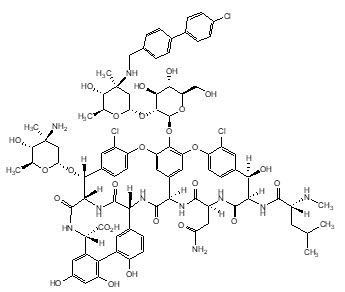
Oritavancin has three mechanisms of action: (i) inhibition of the transglycosylation (polymerization) step of cell wall biosynthesis by binding to the stem peptide of peptidoglycan precursors; (ii) inhibition of the transpeptidation (crosslinking) step of cell wall biosynthesis by binding to the peptide bridging segments of the cell wall; and (iii) disruption of bacterial membrane integrity, leading to depolarization, permeabilization, and cell death. These multiple mechanisms contribute to the concentration-dependent bactericidal activity of oritavancin.
Resistance
In serial passage studies, resistance to oritavancin was observed in isolates of S. aureus and E. faecalis. Resistance to oritavancin was not observed in clinical studies.
Interaction with Other Antimicrobial Agents
In in vitro studies, oritavancin exhibits synergistic bactericidal activity in combination with gentamicin, moxifloxacin or rifampicin against isolates of methicillin-susceptible S. aureus (MSSA), with gentamicin or linezolid against isolates of heterogeneous vancomycin-intermediate S. aureus (hVISA), VISA, and vancomycin-resistant S. aureus (VRSA), and with rifampin against isolates of VRSA. In vitro studies demonstrated no antagonism between oritavancin and gentamicin, moxifloxacin, linezolid or rifampin.
Antibacterial Activity
Oritavancin has been shown to be active against most isolates of the following microorganisms, both in vitro and in clinical infections [see Indications and Usage (1.1)].
Gram-positive Bacteria
Staphylococcus aureus (including methicillin-resistant isolates)
Streptococcus agalactiae
Streptococcus anginosus group (includes S. anginosus, S. intermedius, and S. constellatus)
Streptococcus dysgalactiae
Streptococcus pyogenes
Enterococcus faecalis (vancomycin-susceptible isolates only)
The following in vitro data are available but their clinical significance is unknown. At least 90 percent of the following bacteria exhibit an in vitro minimum inhibitory concentration (MIC) less than or equal to the susceptible breakpoint for oritavancin against isolates of a similar organism group. However, the efficacy of oritavancin in treating clinical infections due to these bacteria has not been established in adequate and well-controlled clinical trials.
Gram-positive Bacteria
Enterococcus faecium (vancomycin-susceptible isolates only)
Susceptibility Testing Methods
For specific information regarding susceptibility test interpretive criteria and associated test methods and quality control standards recognized by FDA for this drug, please see: https://www.fda.gov/STIC.
Outcomes by Baseline Pathogen: Table 7 shows outcomes in patients with an identified baseline pathogen in the microbiological Intent-to-Treat (microITT) population in a pooled analysis of Trial 1 and Trial 2. The outcomes shown in the table are clinical response rates at 48 to 72 hours and clinical success rates at follow-up study day 14 to 24.
Table 7: Outcomes by Baseline Pathogen (microITT) | At 48-72 hours | Study day 14 to 24 |
|---|
| Early Clinical Responder Early clinical response defined as a composite of the cessation of spread or reduction in size of baseline lesion, absence of fever and no rescue antibacterial drug at 48-72 hours. | ≥ 20% reduction in lesion size Patients achieving a 20% or greater reduction in lesion area from baseline at 48-72 hours after initiation of therapy. | Clinical Success Clinical success was defined if the patient experienced a complete or nearly complete resolution of baseline signs and symptoms as described above. |
|---|
| Pathogen Baseline bacteremia in the oritavancin arm with relevant microorganisms causing ABSSSI included four subjects with MSSA and seven subjects with MRSA. Eight of these eleven subjects were responders at 48 to 72 hours after initiation of therapy. | Oritavancin
n/N (%) | Vancomycin
n/N (%) | Oritavancin
n/N (%) | Vancomycin
n/N (%) | Oritavancin
n/N (%) | Vancomycin
n/N (%) |
|---|
| Staphylococcus aureus | 388/472 (82.2) | 395/473 (83.5) | 421/472 (89.2) | 407/473 (86.0) | 390/472 (82.6) | 398/473 (84.1) |
| Methicillin-susceptible | 222/268 (82.8) | 233/272 (85.7) | 231/268 (86.2) | 232/272 (85.3) | 220/268 (82.1) | 229/272 (84.2) |
| Methicillin-resistant | 166/204 (81.4) | 162/201 (80.6) | 190/204 (93.1) | 175/201 (87.1) | 170/204 (83.3) | 169/201 (84.1) |
| Streptococcus pyogenes | 21/31 (67.7) | 23/32 (71.9) | 24/31 (77.4) | 24/32 (75.0) | 25/31 (80.6) | 23/32 (71.9) |
| Streptococcus agalactiae | 7/8 (87.5) | 12/12 (100.0) | 8/8 (100.0) | 12/12 (100.0) | 7/8 (87.5) | 11/12 (91.7) |
| Streptococcus dysgalactiae | 7/9 (77.8) | 6/6 (100.0) | 6/9 (66.7) | 5/6 (83.3) | 7/9 (77.8) | 3/6 (50.0) |
| Streptococcus anginosus group | 28/33 (84.8) | 40/45 (88.9) | 29/33 (87.9) | 42/45 (93.3) | 25/33 (75.8) | 38/45 (84.4) |
| Enterococcus faecalis | 11/13 (84.6) | 10/12 (83.3) | 10/13 (76.9) | 8/12 (66.7) | 8/13 (61.5) | 9/12 (75.0) |
Allergic Reactions
Patients should be advised that allergic reactions, including serious allergic reactions, could occur and that serious reactions require immediate treatment. They should inform their healthcare provider about any previous hypersensitivity reactions to oritavancin products, other glycopeptides (vancomycin, telavancin, or dalbavancin) or other allergens.
Diarrhea
Patients should be advised that diarrhea is a common problem caused by antibacterial drugs including KIMYRSA, which usually resolves when the drug is discontinued. Sometimes, frequent watery or bloody diarrhea may occur and may be a sign of a more serious intestinal infection. If severe watery or bloody diarrhea develops, patients should contact their healthcare provider.
Development of Antibacterial Resistance
Patients should be counseled that antibacterial drugs including KIMYRSA should only be used to treat bacterial infections. They do not treat viral infections (e.g. the common cold). When KIMYRSA is prescribed to treat a bacterial infection, patients should be told that although it is common to feel better early in the course of therapy, the medication should be taken exactly as directed. Skipping doses or not completing the full course of therapy may (1) decrease the effectiveness of the immediate treatment and (2) increase the likelihood that bacteria will develop resistance and will not be treatable by KIMYRSA or other antibacterial drugs in the future.
Marketed By:
Melinta Therapeutics, LLC
Lincolnshire, IL 60069 USA
©2021 Melinta Therapeutics, LLC. All rights reserved.
MEL100