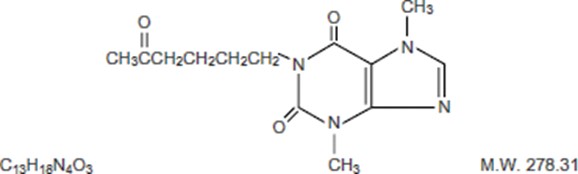
Mode of Action
Pentoxifylline and its metabolites improve the flow properties of blood by decreasing its viscosity. In patients with chronic peripheral arterial disease, this increases blood flow to the affected microcirculation and enhances tissue oxygenation. The precise mode of action of pentoxifylline and the sequence of events leading to clinical improvement are still to be defined. Pentoxifylline administration has been shown to produce dose-related hemorrheologic effects, lowering blood viscosity, and improving erythrocyte flexibility. Leukocyte properties of hemorrheologic importance have been modified in animal and in vitro human studies. Pentoxifylline has been shown to increase leukocyte deformability and to inhibit neutrophil adhesion and activation. Tissue oxygen levels have been shown to be significantly increased by therapeutic doses of pentoxifylline in patients with peripheral arterial disease.
Pharmacokinetics and Metabolism
After oral administration in aqueous solution pentoxifylline is almost completely absorbed. It undergoes a first-pass effect and the various metabolites appear in plasma very soon after dosing. Peak plasma levels of the parent compound and its metabolites are reached within 1 hour. The major metabolites are Metabolite I (1-[5-hydroxyhexyl]-3,7-dimethylxanthine) and Metabolite V (1-[3-carboxypropyl]-3,7-dimethylxanthine), and plasma levels of these metabolites are 5 and 8 times greater, respectively, than pentoxifylline.
Following oral administration of aqueous solutions containing 100 to 400 mg of pentoxifylline, the pharmacokinetics of the parent compound and Metabolite I are dose-related and not proportional (non-linear), with half-life and area under the blood-level time curve (AUC) increasing with dose. The elimination kinetics of Metabolite V are not dose-dependent. The apparent plasma half-life of pentoxifylline varies from 0.4 to 0.8 hours and the apparent plasma half-lives of its metabolites vary from 1 to 1.6 hours. There is no evidence of accumulation or enzyme induction (Cytochrome P450) following multiple oral doses.
Excretion is almost totally urinary; the main biotransformation product is Metabolite V. Essentially no parent drug is found in the urine. Despite large variations in plasma levels of parent compound and its metabolites, the urinary recovery of Metabolite V is consistent and shows dose proportionality. Less than 4% of the administered dose is recovered in feces. Food intake shortly before dosing delays absorption of an immediate-release dosage form but does not affect total absorption. The pentoxifylline AUC was increased and elimination rate decreased in an older population (60-68 years, n=6) compared to younger individuals (22-30 years, n=6) (see PRECAUTIONS, Geriatric Use).
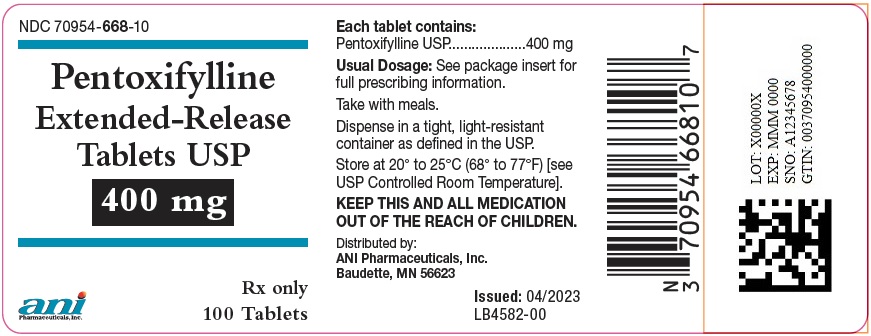
After administration of the 400 mg Pentoxifylline Extended-Release Tablet, plasma levels of the parent compound and its metabolites reach their maximum within 2 to 4 hours and remain constant over an extended period of time. Coadministration of Pentoxifylline Extended-Release Tablets with meals resulted in an increase in mean AUC and Cmax of about 1.1 and 1.3 fold for pentoxifylline, respectively. Cmax for Metabolite I also increased about1.2 fold. The extended release of pentoxifylline from the tablet eliminates peaks and troughs in plasma levels for improved gastrointestinal tolerance.
Patients with Hepatic Impairment
In patients with mild to moderate liver impairment AUC and Cmax of pentoxifylline increased 6.5 and 7.5 fold, respectively, after a single 400 mg dose of Pentoxifylline Extended-Release Tablets. AUC and Cmax of the active Metabolite I also increased 6.9 and 8.2 fold, respectively, in hepatic impaired subjects.
Pentoxifylline Extended-Release Tablets have not been studied in patients with severe hepatic failure.
Patients with Renal Impairment
In patients with mild, moderate, or severe renal impairment the exposure to pentoxifylline and its active Metabolite I are not increased. In contrast, AUC0-tss and Cmax of the active Metabolite V in patients with mild to moderate renal impairment increased 2.4 and 2.1 fold, respectively, with a 400 mg TID regimen of Pentoxifylline Extended-Release Tablets. In severe renal impairment AUC0-tss and Cmax of the active Metabolite V increased 12.9 and 10.6 fold, respectively, with a 400 mg Pentoxifylline Extended-Release Tablet TID regimen. The increase in exposure to Metabolite V is only slightly smaller in both renal impairment groups if Pentoxifylline Extended-Release Tablets are administered BID.