The amount (length) of PLIAGLIS that should be dispensed is determined by the size of the area to be treated (see
Table 1).
- Using the ruler on the applicator included in the carton, squeeze out and measure the amount of PLIAGLIS that approximates the amount required to achieve proper coverage.
- Spread PLIAGLIS evenly and thinly (approximately 1 mm or the thickness of a dime) across the treatment area using a flat-surfaced tool such as a metal spatula or tongue depressor.
- After waiting the required application time, remove the PLIAGLIS by grasping a free-edge with your fingers and pulling it away from the skin.
Table 1. Amount of PLIAGLIS According to Treatment Site Surface Area| Surface Area of Treatment Site (inch
2)
| Length of PLIAGLIS for 1 mm Thickness (inch) | Weight of PLIAGLIS Dispensed (g) |
|---|
| 2 | 1 | 1 |
| 3 | 2 | 3 |
| 6 | 5 | 5 |
| 12 | 9 | 11 |
| 16 | 12 | 13 |
| 23 | 18 | 20 |
| 31 | 24 | 26 |
| 39 | 30 | 33 |
| 47 | 36 | 40 |
| 54 | 42 | 46 |
| 62 | 48 | 53 |
Most common adverse reactions in clinical trials
Localized Reactions:In clinical studies, the most common local reactions were erythema (47%), skin discoloration (e.g., blanching, ecchymosis, and purpura) (16%), and edema (14%). There were no serious adverse reactions. However, one patient withdrew due to burning pain at the treatment site.
Other Localized Reactions:The following dermal adverse reactions occurred in 1% or less of PLIAGLIS-treated patients: ecchymosis, petechial rash, vesiculobullous rash, perifollicular erythema, perifollicular edema, pruritus, rash, maculopapular rash, dry skin, contact dermatitis, and acne.
Systemic (Dose-Related) Reactions:Across all trials, 19 subjects experienced a systemic adverse reaction, 15 of whom were treated with PLIAGLIS and 4 with placebo. The frequency of systemic adverse reactions was greater for the PLIAGLIS group (1%) than the placebo group (0.3%). The most common systemic adverse events were headache, vomiting, dizziness, and fever, all of which occurred with a frequency of <1%. Other systemic reactions were syncope, nausea, confusion, dehydration, hyperventilation, hypotension, nervousness, paresthesia, pharyngitis, stupor, pallor, and sweating.
Systemic adverse reactions of lidocaine and tetracaine are similar in nature to those observed with other amide and ester local anesthetic agents, including CNS excitation and/or depression (lightheadedness, nervousness, apprehension, euphoria, confusion, dizziness, drowsiness, tinnitus, blurred or double vision, vomiting, sensation of heat, cold or numbness, twitching, tremors, convulsions, unconsciousness, respiratory depression and arrest). Excitatory CNS reactions may be brief or not occur at all, in which case the first manifestation may be drowsiness merging into unconsciousness. Signs of CNS toxicity may start at plasma concentrations of lidocaine at 1000 ng/mL. The plasma concentrations at which tetracaine toxicity may occur are less well characterized; however, systemic toxicity with tetracaine is thought to occur with much lower plasma concentrations compared with lidocaine. The toxicity of co-administered local anesthetics is thought to be at least additive. Cardiovascular manifestations may include bradycardia, hypotension and cardiovascular collapse leading to arrest.
Risk Summary
There are no available data on PLIAGLIS use in pregnant women to determine a drug-associated risk of major birth defects, miscarriage, or adverse maternal or fetal outcomes. Available data from an epidemiologic study and case series with parenteral lidocaine use in pregnant women have not identified a drug-associated risk of major birth defects, miscarriage or other adverse maternal or fetal outcomes. Published data on tetracaine use in pregnant women are not sufficient to determine any drug-associated risks. The amount of lidocaine and tetracaine systemically absorbed from PLIAGLIS is low compared to the parenteral route of administration and is not expected to result in significant fetal exposure. Systemic exposure of PLIAGLIS is directly related to both the duration of application and the surface area over which it is applied [
see
Clinical Pharmacology (12.3)]
.
In a published animal reproduction study, pregnant rats administered lidocaine by continuous subcutaneous infusion at doses approximately 1.3 times the maximum recommended human dose (MRHD) of 53 grams of PLIAGLIS during the period of organogenesis resulted in lower fetal body weights. In a published animal reproduction study, pregnant rats administered lidocaine, containing 1:100,000 epinephrine, injected into the masseter muscle of the jaw or into the gum of the lower jaw on Gestation Day 11 at 0.02 times the MRHD of PLIAGLIS resulted in developmental delays in neonates. Subcutaneous administration of tetracaine to pregnant rats and rabbits during organogenesis did not produce adverse embryofetal effects at 0.03 times the MRHD of PLIAGLIS
(see
Data)
.
The estimated background risk of major birth defects and miscarriage for the indicated population is unknown. All pregnancies have a background risk of birth defect, loss, or other adverse outcomes. In the U.S. general population, the estimated background risk of major birth defects and miscarriage in clinically recognized pregnancies is 2 to 4% and 15 to 20%, respectively.
Data
Animal Data
Lidocaine administered by subcutaneous injection to pregnant rats during organogenesis was not teratogenic at doses up to 60 mg/kg (0.16 times the level of lidocaine contained in the MRHD of 53 grams of PLIAGLIS based on a mg/m
2body surface area (BSA) comparison). Lidocaine administered by subcutaneous injection to pregnant rabbits during organogenesis was not teratogenic at doses up to 15 mg/kg (0.08 times the level of lidocaine in the MRHD of PLIAGLIS on a mg/m
2basis).
In a published study, lidocaine administered to pregnant rats by continuous subcutaneous infusion during the period of organogenesis at 100, 250, and 500 mg/kg/day, did not produce any structural abnormalities, but did result in lower fetal weights at 500 mg/kg/day dose (approximately 1.3 times the level of lidocaine in the MRHD of PLIAGLIS on a mg/m
2basis) in the absence of maternal toxicity.
Tetracaine administered by subcutaneous injection to pregnant rats during organogenesis was not teratogenic at doses up to 10 mg/kg or in rabbits at doses up to 5 mg/kg (equivalent to 0.03 times of tetracaine in the MRHD of PLIAGLIS on a mg/m
2basis).
Lidocaine and tetracaine administered by subcutaneous injection to pregnant rats during organogenesis as a 1:1 eutectic mixture of 10 mg/kg each (equivalent to 0.03 times the active components in the MRHD of PLIAGLIS on a mg/m
2basis) was not teratogenic. Lidocaine and tetracaine by subcutaneous injection to pregnant rabbits during organogenesis as a 1:1 eutectic mixture of 5 mg/kg each was not teratogenic in rabbits (equivalent to 0.03 times the active components in the MRHD of PLIAGLIS on a mg/m
2basis).
Lidocaine containing 1:100,000 epinephrine at a dose of 6 mg/kg (approximately 0.02 times the level of lidocaine in the MRHD of PLIAGLIS on a mg/m
2basis) injected into the masseter muscle of the jaw or into the gum of the lower jaw of pregnant Long-Evans hooded rats on Gestation Day 11, lead to developmental delays in neonatal behavior among offspring. Developmental delays were observed for negative geotaxis, static righting reflex, visual discrimination response, sensitivity and response to thermal and electrical shock stimuli, and water maze acquisition. The developmental delays of the neonatal animals were transient with responses becoming comparable to untreated animals later in life. The clinical relevance of the animal data is uncertain.
Pre- and post-natal maturational, behavioral, or reproductive development was not affected by maternal subcutaneous administration of tetracaine during gestation (Gestation Day 6 to Post-Partum Day 20) and lactation up to doses of 7.5 mg/kg (equivalent to 0.02 times the level of tetracaine in the MRHD of PLIAGLIS on a mg/m
2basis).
Risk Summary
There are no data on the presence of tetracaine in human milk, the effects on a breastfed infant, or the effects on milk production. Published studies on parenterally administered lidocaine have reported the presence of lidocaine in human milk with milk:plasma ratios ranging between 0.4 to 1.1. Available data on lidocaine's effects on the breastfed child have not revealed a consistent pattern of associated adverse effects. The amount of lidocaine present in human milk following topical administration is unknown, but systemic absorption from topical lidocaine is low
[see
Clinical Pharmacology (12.3)]
. The developmental and health benefits of breastfeeding should be considered along with the mother's clinical need for PLIAGLIS and any potential adverse effects on the breastfed child from PLIAGLIS or the mother's underlying condition.
Clinical Considerations
Advise breastfeeding women not to apply PLIAGLIS directly to the nipple and areola to avoid direct infant exposure.
Absorption:The amount of lidocaine and tetracaine systemically absorbed from PLIAGLIS is directly related to both the duration of application and the surface area over which it is applied, Table 2.
Application of 59 g of PLIAGLIS over 400 cm
2(62 inch
2) for up to 120 minutes to adults produces peak plasma concentrations of lidocaine of 220 ng/mL. Tetracaine plasma levels were not measurable (<0.9 ng/mL). Systemic exposure to lidocaine, as measured by C
maxand AUC
0-24, was proportional to the application area, and increased with application time up to 60 minutes.
Table 2. Absorption of lidocaine and tetracaine following application of PLIAGLIS| PLIAGLIS Cream (g) | Area
(cm
2)
| Age Range
(yr)
| n | Application Time (min) | Drug Content
(g)
| Mean C
max
(ng/mL)
| Mean T
max
(hr)
|
|---|
na=not applicable
400 cm
2= approximately 62 inch
2 |
| 21 | 400 | 18-64 | 4 | 30 | Lidocaine, 1.5 | 49 | 4.0 |
| | | | | Tetracaine, 1.5 | <0.9 | na |
| 33 | 400 | 18-64 | 4 | 60 | Lidocaine, 2.3 | 96 | 2.8 |
| | | | | Tetracaine, 2.3 | <0.9 | na |
| 31 | 400 | ≤ 65 | 6 | 60 | Lidocaine, 2.2 | 48 | 3.8 |
| | | | | Tetracaine, 2.2 | <0.9 | na |
Distribution:When lidocaine is administered intravenously to healthy volunteers, the steady-state volume of distribution is approximately 0.8 to 1.3 L/kg. At lidocaine concentrations observed following the recommended product application, approximately 75% of lidocaine is bound to plasma proteins, primarily alpha-1-acid glycoprotein. At much higher plasma concentrations (1 to 4 mg/mL of free base) the plasma protein binding of lidocaine is concentration dependent. Lidocaine crosses the placental and blood brain barriers, presumably by passive diffusion. CNS toxicity may typically be observed around 5000 ng/mL of lidocaine; however, a small number of patients reportedly may show signs of toxicity at approximately 1000 ng/mL
[see
Overdosage (10)]
. Volume of distribution and protein binding have not been determined for tetracaine due to rapid hydrolysis in plasma.
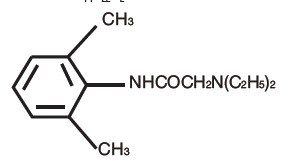
Metabolism:It is not known if lidocaine or tetracaine is metabolized in the skin. Lidocaine is metabolized rapidly by the liver to a number of metabolites, including monoethylglycinexylidide (MEGX) and glycinexylidide (GX), both of which have pharmacologic activity similar to, but less potent than that of lidocaine. The major metabolic pathway of lidocaine, sequential N-deethylation to MEGX and GX, is primarily mediated by CYP1A2 with a minor role of CYP3A4. The metabolite, 2,6- xylidine, has unknown pharmacologic activity. Following intravenous administration of lidocaine, MEGX and GX concentrations in serum range from 11% to 36% and from 5% to 11% of lidocaine concentrations, respectively. Serum concentrations of MEGX were about one-third the serum lidocaine concentrations.
Tetracaine undergoes rapid hydrolysis by plasma esterases. Primary metabolites of tetracaine include para-aminobenzoic acid and diethylaminoethanol, both of which have an unspecified activity.
Elimination:The half-life of lidocaine elimination from the plasma following intravenous administration is approximately 1.8 hr. Lidocaine and its metabolites are excreted by the kidneys. More than 98% of an absorbed dose of lidocaine can be recovered in the urine as metabolites or parent drug. Less than 10% of lidocaine is excreted unchanged in adults, and approximately 20% is excreted unchanged in neonates. The systemic clearance is approximately 8 to 10 mL/min/kg. During intravenous studies, the elimination half-life of lidocaine was statistically significantly longer in elderly patients (2.5 hours) than in younger patients (1.5 hours). The half-life and clearance for tetracaine has not been established for humans, but hydrolysis in the plasma is rapid.
Special Populations
Elderly:After application of 31g of PLIAGLIS over 400 cm
2(62 inch
2) for 60 minutes, mean peak plasma levels of lidocaine were 48 ng/mL for elderly patients (>65 years of age, mean 68.0 ± 3.2 years, n = 6). These levels are similar to or lower than those for younger patients receiving similar amounts of PLIAGLIS.
Cardiac, Renal and Hepatic Impairment:No specific pharmacokinetic studies were conducted. The half-life of lidocaine may be increased in patients with cardiac or hepatic dysfunction. There is no established half-life for tetracaine due to rapid hydrolysis in the plasma.
Carcinogenesis:Long-term studies in animals have not been performed to evaluate the carcinogenic potential of either lidocaine or tetracaine.
Mutagenesis:The mutagenic potential of lidocaine base and tetracaine base has been determined in the
in vitroAmes bacterial reverse mutation assay, the
in vitrochromosome aberration assay using Chinese hamster ovary cells, and the
in vivomouse micronucleus assay. Lidocaine was negative in all three assays. Tetracaine was negative in the
in vitroAmes assay and the
in vivomouse micronucleus assay. In the
in vitrochromosome aberration assay, tetracaine was negative in the absence of metabolic activation, and equivocal in the presence of metabolic activation.
Impairment of Fertility:Lidocaine did not affect fertility in female rats when given via continuous subcutaneous infusion via osmotic minipumps up to doses of 250 mg/kg/day (0.66 times the level of lidocaine in the MRHD of PLIAGLIS based on a mg/m
2body surface area comparison). Lidocaine treatment did not affect overall fertility in male rats when given as subcutaneous doses up to 60 mg/kg (0.16 times the level of lidocaine contained in the MRHD of PLIAGLIS based on a mg/m
2basis), although the treatment caused an increased copulatory interval and led to a dose-related decrease in homogenization resistant sperm head count, daily sperm production, and spermatogenic efficiency. Tetracaine did not affect fertility in male or female rats when given as subcutaneous doses up to 7.5 mg/kg (equivalent to 0.04 times the level of tetracaine in the MRHD of PLIAGLIS on a mg/m
2basis).
Distributed by: IPG Pharmaceuticals, Inc, Tempe, AZ 85281
PLIAGLIS is a licensed trademark of Crescita Therapeutics Inc.
Made in Canada Issued: January 2025