ALPROLIX is not indicated for induction of immune tolerance in patients with hemophilia B.
ALPROLIX dosing for on-demand treatment and control of bleeding episodes is provided in Table 1.
- The recommended starting regimens for adults and adolescents ≥12 years of age are either 50 IU/kg once weekly, or 100 IU/kg once every 10 days.
- For children <12 years of age, start with 60 IU/kg once weekly.
- Adjust dosing regimen based on individual response. More frequent or higher doses may be needed in children <12 years of age, especially in children <6 years of age.
Immunogenicity
Clinical trial subjects were monitored for neutralizing antibodies to Factor IX. No subjects developed neutralizing antibodies to Factor IX.
The detection of antibodies that are reactive to Factor IX is highly dependent on many factors, including the sensitivity and specificity of the assay, assay methodology, sample handling, timing of sample collection, concomitant medications and underlying disease. Therefore, it may be misleading to compare the incidence of antibodies to ALPROLIX with the incidence of antibodies to other products.
Risk Summary
There are no studies of ALPROLIX use in pregnant women to inform a drug-associated risk.
The background risk of major birth defects and miscarriage for the indicated population is unknown; however, the background risk in the U.S. general population of major birth defects is 2-4% and of miscarriage is 15-20% of clinically recognized pregnancies.
Animal reproductive and developmental toxicity studies have not been conducted with ALPROLIX. In a placental transfer study, ALPROLIX was detected in murine fetal blood samples at approximately 2.6% of the maternal blood levels (range, 1.7% to 3.3%), 3 to 4 hours following dosing of pregnant mice with 3.3 to 6.6 times the clinical dose of 50 to 100 IU/kg ALPROLIX [see Data].
It is not known whether ALPROLIX can cause fetal harm when administered to a pregnant woman or can affect reproduction capacity. If ALPROLIX is clearly needed to treat a pregnant woman, advise the patient that the risks to the mother and to the fetus are unknown.
Data
Animal Data
Pregnant, genetically-modified, FIX-deficient mice (HemB mice) were injected intravenously with a single dose of 330 IU/kg ALPROLIX at the end of pregnancy on Gestation Day 18, or with repeat doses of 330 IU/kg ALPROLIX on Gestation Days 18 and 20. Blood samples were collected from the maternal mice and the fetuses after dosing, and FIX activity was measured in both maternal and fetal plasma using a FIX chromogenic assay. After dosing pregnant HemB mice with ALPROLIX, FIX activity in fetal blood was approximately 2.6% of the maternal blood levels, suggesting that placental transfer of ALPROLIX may occur in pregnant female patients. The relevance of these data to humans is unknown.
Risk Summary
It is not known whether ALPROLIX is excreted into human milk. There are no data available to assess the effects of ALPROLIX on milk production or the breastfed child.
The developmental and health benefits of breastfeeding should be considered along with the mother's clinical need for ALPROLIX and any potential adverse effects on the breastfed child from ALPROLIX or from the underlying maternal condition.
Adults (≥18 Years)
The pharmacokinetics (PK) of ALPROLIX (rFIXFc) were evaluated in 22 adults (≥18 years of age) following a 10 minute intravenous infusion of a single dose of 50 IU/kg. Blood samples for PK analysis were collected prior to dosing and up to 240 hours (10 days) after dosing with 50 IU/kg. In addition, PK was assessed for 27 patients receiving the 100 IU/kg dose (Table 4). Blood samples were collected up to 336 hours after dosing. Table 4 presents the PK parameters in adults. The pharmacokinetics of ALPROLIX following single and repeat dosing (at week 26) were similar.
Table 4: Pharmacokinetic Parameters in Adults (Arithmetic Mean, (%CV))
|
| PK Parameters | ALPROLIX (50 IU/kg)
(N=22) | ALPROLIX (100 IU/kg)
(N=24) |
| Cmax (IU/dL) | 46 (68%)
| 101 (20%)
|
| AUCinf (h*IU/dL) | 1619 (26%)
| 3964 (19%)
|
| CL (mL/ h/kg) | 3.3 (28%)
| 2.6 (23%)
|
| Vss (mL/kg) | 327 (28%)
| 236 (24%)
|
| Terminal T1/2 (h) | 86 (37%)
| 97 (35%)
|
| MRT (h) | 102 (30%)
| 91 (23%)
|
| IR (IU/dL per IU/kg) | 1.02 (59%)
| 1.12 (22%)
|
| Time to 1% FIX activity (d) | 12 (24%)
| 16 (20%)
|
Adolescents (12 to 17 Years):
Pharmacokinetic parameters were evaluated following a 10 minute intravenous infusion in 11 evaluable adolescents (12 to 17 years of age) who received a single dose of 50 IU/kg or 100 IU/kg of ALPROLIX. Blood samples were collected prior to dosing and at multiple time points up to 336 hours (14 days) after dosing. PK parameters of ALPROLIX in adolescents are summarized in Table 5. The pharmacokinetics of ALPROLIX in adolescents are comparable with adults.
Pediatrics (2 to 10 Years):
In the pediatric study, pharmacokinetic parameters were evaluated following a 10 minute intravenous infusion in 24 evaluable children (2 to 10 years of age) who received a single 50 IU/kg dose of ALPROLIX. PK samples were collected prior to dosing and at multiple time points up to 168 hours (7 days) after dosing.
Table 5 presents the PK parameters in adolescents and children. Compared to adults, incremental recovery was lower and body weight adjusted clearance was higher in children under 12 years of age, particularly in children under 6 years of age. Incremental recovery in children 2 to 4 years and 6 to 10 years was lower by 41% and 27%, respectively. Compared to adults, body weight-adjusted clearance in children 2 to 4 years and 6 to 10 years was higher by 36% and 11%, respectively. This may result in a need for per kg body weight dose and/or interval adjustments in children under 12 years of age [see Use in Specific Populations (8.4)].
Table 5: Pharmacokinetic parameters of ALPROLIX in children and adolescents following 50 IU/kg or 100 IU/kg dose (Arithmetic Mean, %CV)
|
| PK Parameters | < 6 years
(range: 2 to 4 years) (N=11, 50 IU/kg)
| 6 to < 12 years
(range: 6 to 10 years)
(N=13, 50 IU/kg)
| 12 to 17 years
(N=8, 50 IU/kg)
| 12 to 17 years
(N=3, 100 IU/kg)
|
| Cmax (IU/dL) | 30 (19%)
| 37 (29%)
| 43 (44%)
| 96 (9%)
|
| IR (IU/dL per IU/kg) | 0.60 (20%)
| 0.74 (29%)
| 0.87 (44%)
| 0.96 (10%)
|
| AUCinf (h*IU/dL) | 1169 (15%)
| 1471 (27%)
| 1439 (24%)
| 3420 (13%)
|
| Terminal T½ (h) | 68 (24%)
| 72 (23%)
| 80 (15%)
| 94 (24%)
|
| MRT (h) | 86 (23%)
| 84 (19%)
| 95 (17%)
| 95 (29%)
|
| CL (mL/h/kg) | 4. 4 (17%)
| 3.6 (25%)
| 3.7 (26%)
| 3.0 (12%)
|
| Vss (mL/kg) | 373 (23%)
| 302 (29%)
| 345 (24%)
| 275 (20%)
|
Adult and Adolescent Study (12 to 71 Years)
The non-randomized adult and adolescent study compared each of two prophylactic treatment regimens (fixed weekly and individualized interval) to episodic (on-demand) treatment; determined hemostatic efficacy in the treatment of bleeding episodes; and determined hemostatic efficacy during perioperative management of subjects undergoing major surgical procedures. A total of 123 previously treated patients (PTPs) with severe to moderately severe hemophilia B (≤2% endogenous FIX activity) were followed for up to 77 weeks. Subjects who were on prophylaxis before the study were assigned to one of the prophylaxis arms. Subjects who were treating on-demand before the study were assigned to either one of the two prophylaxis arms or to the on-demand treatment arm. Treatment arm assignments were based on standard of care and discussion between the investigator and the subject.
Sixty-three subjects in the fixed weekly interval arm received ALPROLIX for routine prophylaxis starting at an initial dose of 50 IU/kg. The dose was adjusted to maintain FIX trough level between 1% and 3% above baseline or higher, as clinically indicated to prevent bleeding. Fifty subjects (79%) required at least one dose adjustment and the median number of dose adjustments was one. The overall median dose on study was 45.2 IU/kg (interquartile range: 38.1, 53.7). The median weekly dose during the last 6 months on study in 58 subjects who were on study for at least 9 months was 40.7 IU/kg (interquartile range: 32.3, 54.1).
Twenty-nine subjects in the individualized interval arm initially received ALPROLIX for routine prophylaxis at a dose of 100 IU/kg every 10 days, with the interval adjusted to maintain FIX trough level between 1% and 3% above baseline or higher, as clinically indicated to prevent bleeding. The overall median interval on study was 12.5 days (interquartile range: 10.4, 13.4). The median interval during the last 6 months in 26 subjects who were on study for at least 9 months was 13.8 days (interquartile range: 10.5, 14.0).
Twenty-seven subjects received ALPROLIX as needed for the treatment of bleeding episodes in the episodic (on-demand) treatment arm.
Twelve subjects received ALPROLIX for perioperative management in 14 major surgical procedures. Major surgery was defined as any surgical procedure with or without general anesthesia in which a major body cavity was penetrated and exposed, or a substantial impairment of physical or physiological functions was produced. Four subjects in this arm did not participate in the other arms.
Pediatric Study (1 to 11 Years)
The pediatric study enrolled a total of 30 previously treated male pediatric patients with severe to moderately severe hemophilia B (≤ 2% endogenous FIX activity). Subjects were less than 12 years of age (15 were 1 to 5 years of age and 15 were 6 to 11 years of age). All subjects received treatment with ALPROLIX and were followed for up to 52 weeks.
All 30 subjects were treated with ALPROLIX on an individualized prophylactic dose regimen starting with 50-60 IU/kg every 7 days, with adjustment of dose to a maximum of 100 IU/kg and dosing interval adjusted between once and twice weekly. The median dosing interval was 7.0 days (interquartile range: 6.9 to 7.0) with no difference between the age cohorts. The median average weekly dose of ALPROLIX was 59.4 IU/kg and (interquartile range: 53.0 to 64.8) for subjects 1 to 5 years of age and 57.8 IU/kg (interquartile range: 51.7 to 65.0) for subjects 6 to 11 years of age. At the end of the trial the median prescribed once weekly prophylactic dose was 60 IU/kg across both pediatric age subgroups (range: 40 to 70 IU/kg).
On-demand Treatment and Control of Bleeding Episodes
Adult and Adolescent Study (12 to 71 Years)
A total of 636 bleeding events were observed by 114 subjects in the fixed weekly interval prophylaxis, individualized interval prophylaxis, and the episodic (on-demand) arms. The median total dose to treat a bleeding episode was 47.0 IU/kg (interquartile range: 33.3, 62.5). Assessment of response to each injection was recorded by subjects at 8-12 hours after treatment. Efficacy in control of bleeding episodes is summarized in Table 6.
Table 6: Efficacy in Control of Bleeding in Adults and Adolescents
| Bleeding Episodes | (N=636) |
|---|
|
| Number of injections to treat bleeding episodes
| |
| 1 injection
| 575 (90.4%)
|
| 2 injections
| 44 (6.9%)
|
| 3 injections
| 17 (2.7%)
|
| Response* to first injection
| (N=613)
|
| Excellent or good
| 513 (83.7%)
|
| Moderate
| 90 (14.7%)
|
| None
| 10 (1.6%)
|
Pediatric Study (1 to 11 Years)
A total of 60 bleeding events were observed by 20 subjects during the study. The median total dose to treat a bleeding episode was 68.2 IU/kg (interquartile range: 50.9, 126.2). Assessment of response to each injection was recorded by subjects at 8 to12 hours post treatment. Efficacy in control of bleeding episodes is summarized in Table 7.
Table 7: Efficacy in Control of Bleeding in Pediatric Subjects
|
| 1 to 5 Years | 6 to 11 Years
| Total (1 to 11 Years)
|
| Bleeding episodes | (N=22)
| (N=38)
| (N=60)
|
| Number of injections to treat bleeding episodes
| |
| 1 injection
| 19 (86.4%)
| 26 (68.4%)
| 45 (75.0%)
|
| 2 injections
| 2 (9.1 %)
| 8 (21.1%)
| 10 (16.7%)
|
| 3 injections
| 1 (4.5%)
| 4 (10.5%)
| 5 (8.3%)
|
| Response to first injection*
| (N=53)
|
| Excellent or good
| 47 (88.7%)
|
| Moderate
| 5 (9.4%)
|
| None
| 1 (1.9%)
|
Routine Prophylaxis
Adult and Adolescent Study (12 to 71 Years)
Using a negative binomial model, a reduction in annualized bleeding rate (ABR) of 83% (76-89%) for subjects in the fixed weekly interval arm and a reduction of 87% (80-92%) for subjects in the individualized interval arm compared to the episodic (on-demand) treatment arm was observed.
The median duration of treatment on study was 51.4 weeks (range <1-77). A comparison of the ABRs in subjects evaluable for efficacy is summarized in Table 8.
Table 8: Median Annualized Bleeding Rate (ABR) by Treatment Arm in Adults and Adolescents
|
| Bleeding Episodes | Prophylaxis Fixed Weekly Interval (N=61) | Prophylaxis Individualized Interval (N=26) | Episodic (On-Demand) (N=27) |
Overall ABR
(IQR)* | 2.95
(1.01, 4.35)
| 1.38
(0.00, 3.43)
| 17.69
(10.77, 23.24)
|
| Spontaneous ABR (IQR)* | 1.04
(0.00, 2.19)
| 0.88
(0.00, 2.30)
| 11.78
(2.62, 19.78)
|
Joint ABR
(IQR)* | 1.11
(0.00, 4.01)
| 0.36
(0.00, 3.24)
| 13.58
(6.13, 21.61)
|
Pediatric Study (1 to 11 Years)
The median duration of treatment on study was 49.4 weeks (range 12 - 52). A comparison of the median ABRs in pediatric subjects evaluable for efficacy is summarized in Table 9.
Table 9: Median Annualized Bleeding Rate (ABR) in Pediatric Subjects
|
| Bleeding Episodes | 1 to 5 Years
(N=15) | 6 to 11 Years
(N=15) | Total (< 12 Years)
(N=30) |
Overall ABR
(IQR)*
| 1.09
| 2.13 | 1.97 |
| (0.00, 2.90)
| (0.00, 4.17) | (0.00, 3.13) |
Spontaneous ABR
(IQR)* | 0.00 | 0.00 | 0.00 |
| (0.00, 1.09) | (0.00, 2.09) | (0.00, 1.16) |
Joint ABR
(IQR)* | 0.00 | 1.06 | 0.00 |
| (0.00, 0.00) | (0.00, 2.09)
| (0.00, 1.12) |
Perioperative Management
Twenty-six major surgical procedures were performed in 19 subjects (age range: 10-63 years) in the adult and adolescent study and in an ongoing extension study. Of the 26 major surgeries, 21 surgeries (80.8%) required a single pre-operative dose to maintain hemostasis during surgery. The median average dose per injection to maintain hemostasis during surgery was 89.9 IU/kg (range: 49 to 152). Perioperative Factor IX replacement with ALPROLIX was by bolus infusion only. The safety of continuous infusion was not evaluated.
Hemostasis was assessed by the investigator after surgery. Assessment of intra- and post-operative hemostatic response for major surgeries in the adult and adolescent study and the ongoing extension study are summarized in Table 10.
Table 10: Summary of Hemostatic Response for Major Surgery
|
|
| | | Response |
Major Surgery | Number of Procedures
(Number of Subjects)2 |
Excellent | Good | Fair | Poor/None |
| Arthroscopy
| 2 (2)
| 2
| | | |
| Closure of Rectal Fistula
| 1 (1)
| 1
| | | |
| Craniotomy1 | 2 (1)
| 1
| | | |
| Dental Abscess
| 1 (1)
| 1
| | | |
| Finger Amputation or Partial Amputation
| 2 (1)
| 2
| | | |
| Hip Replacement or Repair
| 2 (2)
| 1
| 1
| | |
| Install or Removal of External Ilizarov Fixation
| 2 (1)
| 2
| | | |
| Liver Transplant
| 1 (1)
| 1
| | | |
| Orchiectomy
| 1 (1)
| 1
| | | |
| Percutaneous-Ablation of Hepatic Carcinoma
| 1 (1)
| 1
| | | |
| Pilonidal Cyst
| 1 (1)
| 1
| | | |
| Spinal Surgery
| 1 (1)
| 1
| | | |
| Tendon Transfer in Right Arm
| 1 (1)
| 1
| | | |
| Tonsillectomy
| 1 (1)
| 1
| | | |
|
| | | | | |
| Unilaterial Ankle Fusion
| 2 (2)
| 2
| | | |
| Unilaterial Knee Replacement or Revision
| 5 (5)
| 4
| 1
| | |
There were an additional 46 minor surgical procedures in 28 subjects in the adult and adolescent study, the pediatric study, and the ongoing extension study. Hemostatic response was assessed for 28 minor surgeries; 26 minor surgeries were rated as excellent or good and 2 as fair.
How Supplied
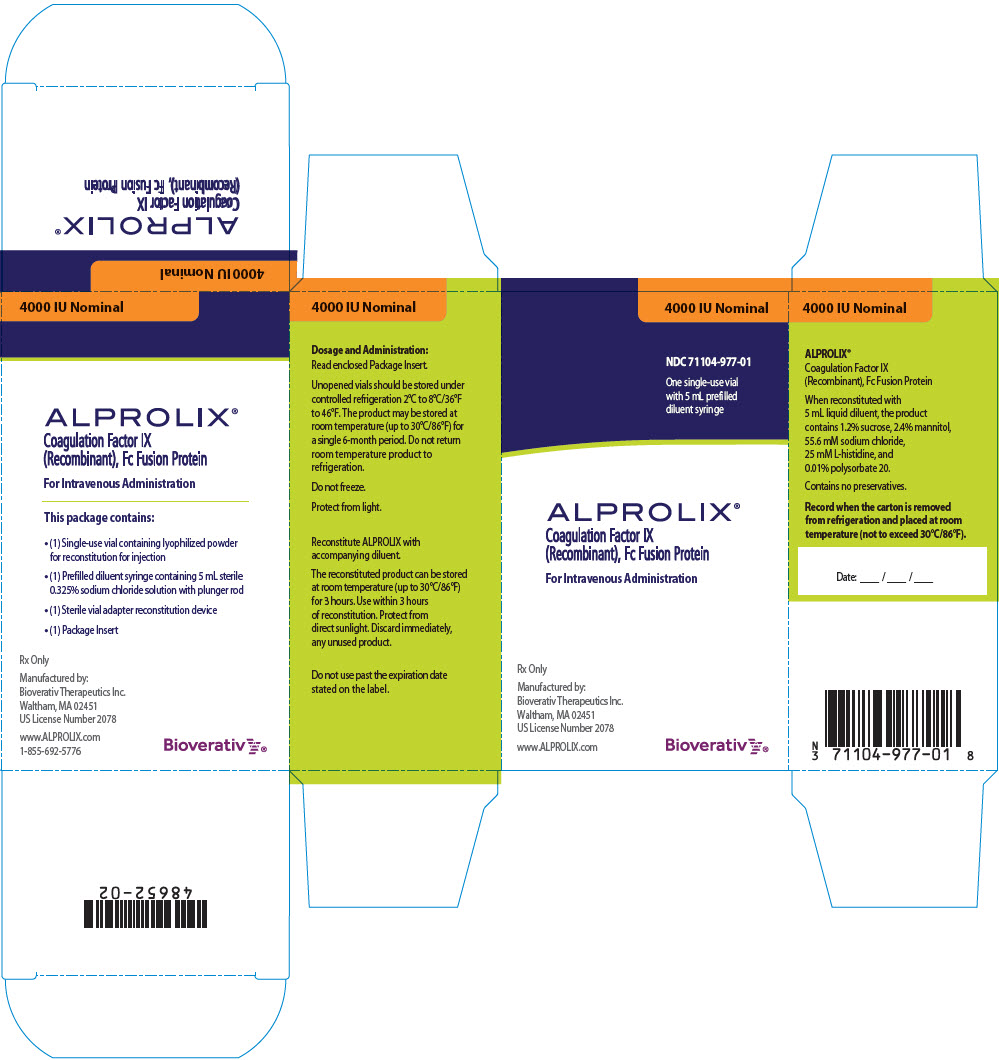
ALPROLIX is supplied as a kit comprising:
- one single-use glass vial containing rFIXFc powder,
- one pre-filled syringe containing 5 mL diluent and sealed with a plunger stopper and tip-cap, and
- one sterile vial adapter (reconstitution device).
ALPROLIX is available in 250 IU, 500 IU, 1000 IU, 2000 IU, 3000 IU or 4000 IU nominal (approximate) dosage strengths. The actual Factor IX potency, expressed in IU, is stated on each rFIXFc vial and carton label. Not made with natural rubber latex.
| Nominal (Approximate) Strength | Kit NDC Number |
| 250 IU
| 71104-966-01
|
| 500 IU
| 71104-911-01
|
| 1000 IU
| 71104-922-01
|
| 2000 IU
| 71104-933-01
|
| 3000 IU
| 71104-944-01
|
| 4000 IU
| 71104-977-01
|
Storage and Handling
- Store ALPROLIX in the original package in order to protect it from light.
- Store ALPROLIX at 2°C to 8°C (36°F to 46°F). Do not freeze. Freezing will damage the pre-filled diluent syringe.
- ALPROLIX can be stored at room temperature, not to exceed 30°C (86°F), for a single period of up to 6 months within the expiration date printed on the carton and vial label. If stored at room temperature, record the date on the carton when the product was removed from refrigeration. Use the product before the end of this 6-month period or discard it. Do not place the product back into refrigeration after warming to room temperature. The shelf-life then expires after storage at room temperature for 6 months, or after the expiration date on the product vial, whichever is earlier.
- Do not use product or diluent after the expiration date printed on the carton, vial or syringe.
- Reconstituted product may be stored at room temperature, not to exceed 30°C (86°F) for no longer than 3 hours. Protect from direct sunlight. Discard any product not used within 3 hours after reconstitution.