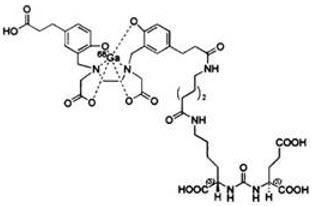
In adults, the recommended amount of radioactivity to be administered for PET is 111 MBq to 259 MBq (3 mCi to 7 mCi) administered as an intravenous bolus injection.
- Use aseptic technique and radiation shielding when withdrawing and administering Gallium Ga 68 gozetotide injection.
- Calculate the necessary volume to administer based on calibration time and required dose.
- Inspect Gallium Ga 68 gozetotide injection visually for particulate matter and discoloration before administration. Do not use the drug if the solution contains particulate matter or is discolored.
- Gallium Ga 68 gozetotide injection may be diluted with sterile 0.9% Sodium chloride injection, USP.
- Assay the final dose immediately before administration to the patient in a dose calibrator.
- After injection of Gallium Ga 68 gozeotide injection, administer an intravenous flush of sterile 0.9% Sodium chloride injection, USP to ensure full delivery of the dose.
- Dispose of any unused drug in a safe manner in compliance with applicable regulations.
- Unless contraindicated, a diuretic expected to act within the uptake time period may be administered at the time of radiotracer injection to potentially decrease artifact from radiotracer accumulation in the urinary bladder and ureters.
Clinical Trials Experience
Because clinical trials are conducted under widely varying conditions, adverse reaction rates observed in the clinical trials of a drug cannot be directly compared to rates in the clinical trials of another drug and may not reflect the rates observed in practice.
The safety of Gallium Ga 68 gozetotide injection was evaluated in 960 patients, each receiving one dose of Gallium Ga 68 gozetotide injection. The average injected activity was 188.7 ± 40.7 MBq (5.1 ± 1.1 mCi).
The most commonly reported adverse reactions were nausea, diarrhea, and dizziness, occurring at a rate of <1%
Androgen deprivation therapy and other therapies targeting the androgen pathway
Androgen deprivation therapy (ADT) and other therapies targeting the androgen pathway, such as androgen receptor antagonists, can result in changes in uptake of gallium Ga 68 gozetotide in prostate cancer. The effect of these therapies on performance of gallium Ga 68 gozetotide PET has not been established.
Risk Summary
Gallium Ga 68 gozetotide injection is not indicated for use in females. There are no available data with Gallium Ga 68 gozetotide injection use in pregnant women to evaluate for a drug-associated risk of major birth defects, miscarriage, or adverse maternal or fetal outcomes. All radiopharmaceuticals, including Gallium Ga 68 gozetotide injection, have the potential to cause fetal harm depending on the fetal stage of development and the magnitude of the radiation dose. Animal reproduction studies have not been conducted with gallium Ga 68 gozetotide injection.
Risk Summary
Gallium Ga 68 gozetotide injection is not indicated for use in females. There are no data on the presence of gallium Ga 68 gozetotide in human milk, the effect on the breastfed infant, or the effect on milk production.
Distribution
Intravenously injected gallium Ga 68 gozetotide is cleared from the blood and is accumulated preferentially in the liver (15%), kidneys (7%), spleen (2%), and salivary glands (0.5%). Gallium Ga 68 gozetotide uptake is also seen in the adrenals and prostate. There is no uptake in the cerebral cortex or in the heart, and usually lung uptake is low.
Elimination
A total of 14% of the injected dose is excreted in urine in the first 2 hours post-injection.
PSMA-PreRP
This two-center study enrolled 325 patients with biopsy-proven prostate cancer who were considered
candidates for prostatectomy and pelvic lymph node dissection. All enrolled patients met at least one of
the following criteria: serum prostate-specific antigen (PSA) of at least 10 ng/mL, tumor stage cT2b or
greater, or Gleason score greater than 6. Each patient received a single gallium Ga 68 gozetotide PET/CT
or PET/MR from mid-thigh to skull base.
A total of 123 patients (38%) proceeded to standard-of-care prostatectomy and template pelvic lymph
node dissection and had sufficient histopathology data for evaluation (evaluable patients). Three members
of a pool of six central readers independently interpreted each PET scan for the presence of abnormal
gallium Ga 68 gozetotide uptake in pelvic lymph nodes located in the common iliac, external iliac,
internal iliac, and obturator subregions bilaterally as well as in any other pelvic location. The readers were
blinded to all clinical information except for the history of prostate cancer prior to definitive treatment.
Extrapelvic sites and the prostate gland itself were not analyzed in this study. For each patient, gallium Ga
68 gozetotide PET results and reference standard histopathology obtained from dissected pelvic lymph
nodes were compared by region (left hemipelvis, right hemipelvis, and other).
For the 123 evaluable patients, the mean age was 65 years (range 45 to 76 years), and 89% were white.
The median serum PSA was 11.8 ng/mL. The summed Gleason score was 7 for 44%, 8 for 20%, and 9 for
31% of the patients, with the remainder of the patients having Gleason scores of 6 or 10.
Table 5 compares majority PET reads to pelvic lymph node histopathology results at the patient-level
with region matching, such that at least one true positive region defines a true positive patient. As shown,
approximately 24% of subjects studied were found to have pelvic nodal metastases based on
histopathology (95% confidence interval: 17%, 32%).
Table 5: Patient-Level Performance of Gallium Ga 68 Gozetotide PET for Detection of Pelvic Lymph Node Metastasis
with region matching where at least one true positive region defines a true positive patient
in the PSMA-PreRP Study (n=123)
| Histopathology | Predictive value (95% CI)
PPV: positive predictive value, NPV: negative predictive value |
|---|
| Positive | Negative |
|---|
| PET scan | Positive | 14 | 9 | PPV
61% (41%, 81%)
|
| Negative | 16 | 84 | NPV
84% (79%, 91%)
|
| Total | 30 | 93 | |
| Diagnostic performance (95% CI) | Sensitivity
47% (29%, 65%)
| Specificity
90% (84%, 96%)
| |
Among the pool of six readers, sensitivity ranged from 36% to 60%, specificity from 83% to 96%, positive predictive value from 38% to 80%, and negative predictive value from 80% to 88%.
In an exploratory subgroup analysis based on summed Gleason score, there was a numerical trend toward more true positives in patients with Gleason score of 8 or higher compared to those with Gleason score of 7 or lower.
An exploratory analysis was performed to estimate the sensitivity and specificity for pelvic nodal metastasis detection in all scanned patients, including the patients who were lacking histopathology reference standard. An imputation method was used based on patient-specific factors. This exploratory analysis resulted in an imputed sensitivity of 47%, with a 95% confidence interval ranging from 38% to 55%, and an imputed specificity of 74%, with a 95% confidence interval ranging from 68% to 80% for all patients imaged with gallium Ga 68 gozetotide PET.
PSMA-BCR
This two-center study enrolled 635 patients with biochemical evidence of recurrent prostate cancer after definitive therapy, defined by serum PSA of >0.2 ng/mL more than 6 weeks after prostatectomy or by an increase in serum PSA of at least 2 ng/mL above nadir after definitive radiotherapy. All patients received a single gallium Ga 68 gozetotide PET/CT or PET/MR from mid-thigh to skull base. Three members of a pool of nine independent central readers evaluated each scan for the presence and regional location (20 subregions grouped into four regions) of abnormal gallium Ga 68 gozetotide uptake suggestive of recurrent prostate cancer. The readers were blinded to all clinical information other than type of primary therapy and most recent serum PSA level.
A total of 469 patients (74%) had at least one positive region detected by gallium Ga 68 gozetotide PET majority read. The distribution of gallium Ga 68 gozetotide PET positive regions was 34% bone, 25% prostate bed, 25% pelvic lymph node, and 17% extrapelvic soft tissue. Two hundred and ten patients had composite reference standard information collected in a PET positive region (evaluable patients), consisting of at least one of the following: histopathology, imaging (bone scintigraphy, CT, or MRI) acquired at baseline or within 12 months after gallium Ga 68 gozetotide PET, or serial serum PSA. Composite reference standard information for gallium Ga 68 gozetotide PET negative regions was not systematically collected in this study.
In the 210 evaluable patients, the mean age was 70 years (range 49 to 88 years) and 82% were 65 years of age or older. White patients made up 90% of the group. The median serum PSA was 3.6 ng/mL. Prior treatment included radical prostatectomy in 64% and radiotherapy in 73%.
Of the 210 evaluable patients, 192 patients (91%) were found to be true positive in one or more regions against the composite reference standard (95% confidence interval: 88%, 95%). Among the pool of nine readers used in the study, the proportion of patients who were true positive in one or more regions ranged from 82% to 97%. The prostate bed had the lowest proportion of true positive results at the region-level (76% versus 96% for non-prostate regions).
An exploratory analysis was also performed in which gallium Ga 68 gozetotide PET positive patients who lacked reference standard information were imputed using an estimated likelihood that at least one location-matched PET positive lesion was reference standard positive based on patient-specific factors. In this exploratory analysis, 340 of 475 patients (72%) were imputed as true positive in one or more regions (95% confidence interval: 68%, 76%).
In another exploratory analysis using the same imputation approach for PET positive patients who lacked reference standard information, 340 of 635 patients (54%) were correctly detected as true positive (95% confidence interval: 50%, 57%) among all BCR patients who received a PET scan, whether it was read as positive or negative.
The likelihood of identifying a gallium Ga 68 gozetotide PET positive lesion in this study generally increased with higher serum PSA level. Table 6 shows the patient-level gallium Ga 68 gozetotide PET results stratified by serum PSA level. The mean time between PSA measurement and PET scan was 40 days with a range of 0 to 367 days. Percent PET positivity was calculated as the proportion of patients with a positive gallium Ga 68 gozetotide PET out of all patients scanned. Percent PET positivity includes patients determined to be either true positive or false positive as well as those in whom such determination was not made due to the absence of composite reference standard data.
Table 6: Patient-Level gallium Ga 68 gozetotide PET Results and Percent PET Positivity Stratified by Serum PSA Level in the PSMA-BCR Study (n=628)
7 patients were excluded from this table due to protocol deviations
| PSA (ng/mL) | PET positive patients | PET negative patients | Percent PET positivity (95% CI)
Percent PET positivity = PET positive patients/total patients scanned |
|---|
| Total | TP
TP: true positive, FP: false positive | FP
‡ | Without reference standard | | |
|---|
| With reference standard | | | |
|---|
| <0.5 | 48 | 11 | 1 | 36 | 87 | 36% |
| | 12 | | | (27%, 44%) |
| ≥0.5 and <1 | 44 | 15 | 3 | 26 | 35 | 56% |
| | 18 | | | (45%, 67%) |
| ≥1 and <2 | 71 | 29 | 1 | 41 | 15 | 83% |
| | 30 | | | (75%, 91%) |
| ≥2 | 299 | 137 | 13 | 149 | 29 | 91% |
| | 150 | | | (88%, 94%) |
| Total | 462 | 192 | 18 | 252 | 166 | 74% |
| | 210 | | | (70%, 77%) |
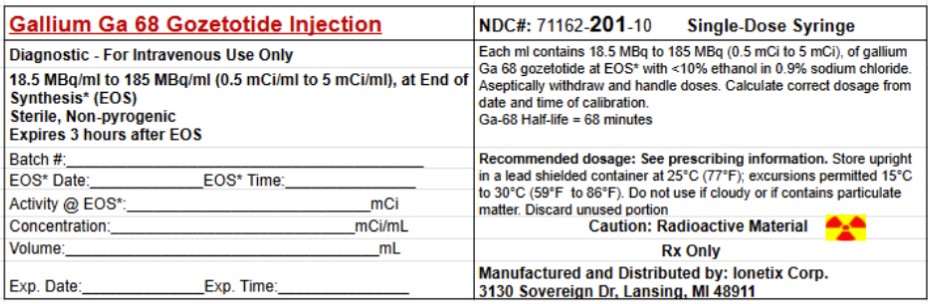
Gallium Ga 68 gozetotide injection (NDC 71162-201-10) is a clear, colorless solution, supplied in a single-dose capped syringe containing 18.5 MBq/mL to 185 MBq/mL (0.5 mCi/mL to 5 mCi/mL) of gallium Ga 68 gozetotide at end of synthesis, in approximately 8 to 10 mL. The contents of each syringe are sterile and pyrogen-free. The expiration date and time are provided on the container label. Use Gallium Ga 68 gozetotide injection within 3 hours of calibration time.
Storage
Store Gallium Ga 68 gozetotide injection upright in a lead shielded container at 25°C (77°F); excursions are permitted from 15°C to 30°C (59°F to 86°F). Store Gallium Ga 68 gozetotide injection within the original container in radiation shielding.
Handling
Receipt, transfer, handling, possession, or use of this product is subject to the radioactive material regulations and licensing requirements of the U.S. Nuclear Regulatory Commission, Agreement States, or Licensing States as appropriate.
Adequate Hydration
Instruct patients to drink a sufficient amount of water to ensure adequate hydration before their PET study and urge them to drink and urinate as often as possible during the first hours following the administration of Gallium Ga 68 gozetotide injection, in order to reduce radiation exposure
[see
Dosage and Administration (2.3)and
Warnings and Precautions (5.2)]
.
Manufactured and Distributed by:
Ionetix Corporation
3130 Sovereign Drive
Lansing, MI 48911 USA