1. Indication And Usage
ESKATA is indicated for the treatment of seborrheic keratoses that are raised.
The following Structured Product Label (SPL) was submitted to the FDA by Aclaris Therapeutics, Inc. for the product Eskata (NDC 71180-002). This document serves as the official prescribing information, containing essential scientific data and clinical materials required for healthcare providers and patients.
This specific version of the label includes detailed information regarding 1. indication and usage, 2.1 important administration information, 2.2 dosage and administration instructions, 3. dosage forms and strengths, 4. contraindications, 5.1 eye disorders, 5.2 local skin reactions, 6.1 clinical trials experience, and other regulatory disclosures. Use the navigation below to review specific sections of the FDA submission.
ESKATA is indicated for the treatment of seborrheic keratoses that are raised.
ESKATA is to be administered by a health care provider.
For topical use only. Not for oral, ophthalmic, or intravaginal use.
Do not apply ESKATA topical solution to open or infected seborrheic keratoses.
During a single in-office treatment session, apply ESKATA to seborrheic keratosis lesions 4 times, approximately 1 minute apart. After one use, discard the unit dose applicator.
If the treated lesions have not completely cleared approximately 3 weeks after treatment, another treatment may be administered following the same procedure.
Preparation of lesions
Prior to application of ESKATA, clean seborrheic keratoses to be treated using an alcohol wipe. When treating seborrheic keratoses on the face, take appropriate actions to ensure that ESKATA will not come into contact with the eyes.
Preparation of the ESKATA applicator
Wear nitrile or vinyl examination gloves during the activation of the ESKATA applicator and during the administration of the solution to the lesion(s).
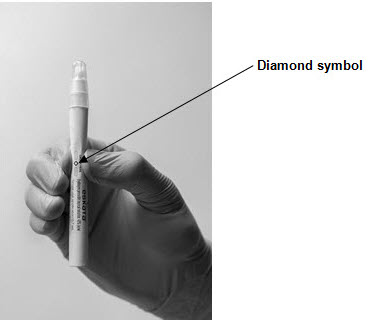
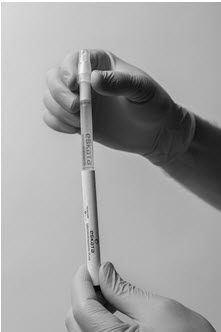
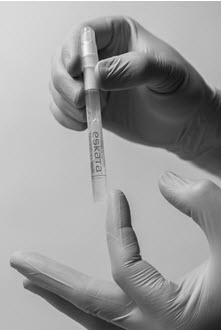
The method for preparing the ESKATA applicator for use is illustrated below. While activating the applicator, hold it away from the patient.

Preparation Of The Eskata Applicator, Step 1 (Eskata 01)
Preparation Of The Eskata Applicator, Step 2 (Eskata 02)
Preparation Of The Eskata Applicator, Step 3 (Eskata 03)
Preparation Of The Eskata Applicator, Step 4 (Eskata 04)
Application of ESKATA topical solution
Following release of the solution from the ampule, remove the cap from the ESKATA applicator. Gently squeeze the applicator barrel to express a drop of ESKATA and ensure wetting of the applicator tip. Apply solution directly to the seborrheic keratosis in a circular motion. Apply enough solution to uniformly wet the lesion surface, including the edges without excess running or dripping. During the application, remove any excess solution from the surrounding skin using a clean absorbent wipe (do not use paper towels or tissue). Apply again in the same manner, 3 additional applications 1 minute apart.
ESKATA topical solution is a clear, colorless solution containing 40% (w/w) hydrogen peroxide.
None.
Do not apply to the eyes or mucous membranes. Avoid treating seborrheic keratoses within the orbital rim. Direct contact with the eye can cause corneal injury (erosion, ulceration, perforation, and scarring), chemical conjunctivitis, eyelid edema, severe eye pain, or permanent eye injury, including blindness.
If accidental exposure occurs, flush with water for 15 to 30 minutes and initiate monitoring, and further evaluation as appropriate.
Skin reactions occurred in the treatment area after application of ESKATA. Severe local skin reactions included erosion, ulceration, vesiculation and scarring [See Adverse Reactions (6.1)]. Do not initiate a second treatment course with ESKATA until the skin has recovered from any reaction caused by the previous treatment.
Because clinical trials are conducted under widely varying conditions, adverse reaction rates observed in the clinical trials of a drug cannot be directly compared to rates in the clinical trials of another drug and may not reflect the rates observed in practice.
The data described below reflect exposure to ESKATA or vehicle in a total of 937 subjects with seborrheic keratoses that are raised. Overall, 42% of the subjects were male and 58% were female. Ninety-eight (98) percent of the subjects were Caucasian and the mean age was 68.7 years.
At each visit, local skin reactions were graded for severity to determine the maximum severity after treatment. Table 1 presents the percentage of subjects with the local adverse reactions by the most severe grade reported during the course of the trials.
| ESKATA N=467 | Vehicle N=470 | |||||||
|---|---|---|---|---|---|---|---|---|
| Mild | Moderate | Severe | Total | Mild | Moderate | Severe | Total | |
| Erythema | 13 | 67 | 19 | 99 | 29 | 5 | <1 | 34 |
| Stinging | 34 | 49 | 15 | 97 | 9 | 1 | <1 | 10 |
| Edema | 28 | 48 | 15 | 91 | 6 | 1 | 0 | 6 |
| Scaling | 49 | 36 | 5 | 90 | 28 | 5 | 1 | 33 |
| Crusting | 34 | 38 | 8 | 81 | 13 | 5 | 1 | 19 |
| Pruritus | 34 | 18 | 5 | 58 | 7 | 1 | <1 | 8 |
| Hyperpigmentation | 32 | 7 | <1 | 39 | 1 | <1 | 0 | 1 |
| Vesicles | 21 | 3 | 1 | 24 | <1 | 0 | 0 | <1 |
| Hypopigmentation | 16 | 3 | <1 | 19 | 1 | <1 | 0 | 1 |
| Erosion | 12 | 2 | 1 | 15 | <1 | 0 | 0 | 1 |
| Ulceration | 6 | 2 | <1 | 9 | 1 | 1 | 0 | 2 |
| Atrophy | 4 | 0 | 0 | 4 | 0 | 0 | 0 | 0 |
| Scarring | 3 | <1 | <1 | 3 | 0 | 0 | 0 | 0 |
Common local skin reactions observed 10 minutes after treatment include: erythema (98%), stinging (93%), edema (85%), pruritus (32%), and vesiculation (18%).
Common local skin reactions observed 1 week after treatment are scaling (72%), erythema (66%), crusting (67%), pruritus (18%), erosion (9%), and ulceration (4%).
Common local skin reactions observed 15 weeks after the initial treatment are erythema (21%), hyperpigmentation (18%), scaling (16%), crusting (12%), and hypopigmentation (7%).
Less common adverse reactions occurring in ≥ 0.5% of subjects treated with ESKATA include eyelid edema (0.6%) and herpes zoster (0.6%).
Risk Summary
Hydrogen peroxide is not absorbed systemically by the mother following topical administration, and breastfeeding is not expected to result in exposure of the child to hydrogen peroxide.
Seborrheic keratosis is not seen in the pediatric population.
Of the 841 subjects treated with ESKATA in the clinical trials, 70% were 65 years of age and older and 26% were 75 years of age and older. No overall differences in safety or effectiveness were observed between these subjects and younger subjects.
Topical overdosing of ESKATA could result in an increased incidence and severity of local skin reactions.
ESKATA (hydrogen peroxide) topical solution, 40% (w/w) is a clear, colorless solution for topical administration, which contains the active ingredient, hydrogen peroxide.
The chemical name of hydrogen peroxide is dihydrogen dioxide.
The molecular formula of hydrogen peroxide is H2O2 and the molecular weight is 34.01. Hydrogen peroxide is represented by the following structural formula:

Chemical Structure (Eskata 05)
ESKATA contains 40% (w/w) hydrogen peroxide in an aqueous solution of isopropyl alcohol and water.
The mechanism of action for ESKATA for the treatment of seborrheic keratosis is unknown.
The pharmacodynamics of ESKATA in the treatment of seborrheic keratosis are unknown.
Following application of ESKATA in patients with seborrheic keratosis lesions, hydrogen peroxide rapidly dissociates into water and reactive oxygen species. Indirect assessment of reactive oxygen species in patients with seborrheic keratosis lesions did not demonstrate any systemic absorption of hydrogen peroxide.
Long-term animal studies have not been performed to evaluate the carcinogenic potential of ESKATA or hydrogen peroxide.
Hydrogen peroxide has been found to exhibit positive results in in vitro tests for genotoxicity, but has not exhibited positive results in in vivo tests for genotoxicity, presumably due to the rapid metabolism of hydrogen peroxide.
The effects of hydrogen peroxide on fertility have not been evaluated. Hydrogen peroxide has been associated with effects on sperm function and elevated testicular hydrogen peroxide concentration has been implicated in male infertility, although in vivo, no effect of hydrogen peroxide on sperm function has been demonstrated.
In two double-blind, vehicle-controlled clinical trials, 937 subjects with 4 clinically typical seborrheic keratoses that are raised on the face, trunk, or extremities were randomized to treatment with either ESKATA or vehicle. Subjects ranged from 42 to 91 years of age (mean 68.7 years), 58% percent were female, and 98% were Caucasian. A total of 925 subjects completed the trials. Each lesion was treated with 4 applications, at baseline and again at Day 22, if needed, and subjects were followed through Day 106.
Efficacy was assessed at Day 106. Success rate was defined as the proportion of subjects achieving “clear” on the Physician’s Lesion Assessment Scale for all 4 treated lesions. Efficacy was also assessed for the proportion of subjects achieving “clear” on the Physician’s Lesion Assessment Scale for at least 3 of 4 lesions. Table 2 presents the efficacy results for the two clinical trials.
| Study 1 | Study 2 | |||
|---|---|---|---|---|
| ESKATA N=223 | Vehicle N=227 | ESKATA N=244 | Vehicle N=243 | |
| All 4 lesions “Clear” | 4% | 0% | 8% | 0% |
| At least 3 of 4 lesions “Clear” | 13% | 0% | 23% | 0% |
ESKATA (hydrogen peroxide) topical solution, 40% (w/w) is a clear, colorless solution and is supplied in a unit dose package. The available carton packages are presented below:
| Dosage Strength | Fill Volume | Deliverable Volume | Number of unit dose packages per carton | NDC# |
|---|---|---|---|---|
| 40% (w/w) | 1.5 mL | 0.7 mL | 1 | 71180-001-01 |
| 3 | 71180-001-03 | |||
| 12 | 71180-001-12 | |||
| 2.2 mL | 1.3 mL | 1 | 71180-002-01 | |
| 3 | 71180-002-03 | |||
| 12 | 71180-002-12 |
Store ESKATA at controlled room temperature of 20°C to 25°C (68°F to 77°F), excursions permitted between 15°C and 30°C (59° F and 86° F).
Advise the patient to read the FDA-approved patient labeling (Patient Information).
Ophthalmic Adverse Reactions
Inform patients that severe eye injury can occur with ESKATA application. Advise patients to inform the healthcare provider immediately if ESKATA runs into eyes, mouth, or nose during administration [see Warnings and Precautions (5.1)].
Local Skin Reactions
Inform patients that treatment with ESKATA may lead to local skin reactions [see Warnings and Precautions (5.2)].
Manufactured & Packaged by:
James Alexander Corp.
845 Route 94
Blairstown, NJ 07825
United States
For:
Aclaris Therapeutics, Inc.
101 Lindenwood Drive
Malvern, PA 19355
United States
US Patent Numbers: US 7,381,427 and US 9,675,639
This Patient Information has been approved by the U.S. Food and Drug Administration. | Issued: December 2017 |
Patient Information ESKATA™ (es-KAH-tah)
| |
IMPORTANT: ESKATA topical solution is for use as an in-office treatment. ESKATA is applied by your healthcare provider and is not for use at home. | |
What is ESKATA ? ESKATA is a prescription medicine used to treat seborrheic keratoses that are raised. | |
Before treatment with ESKATA, tell your healthcare provider about all of your medical conditions, including if you
Tell your healthcare provider about all the medications you take, including prescription and over-the-counter medicines, vitamins and herbal supplements. | |
How should I receive ESKATA ?
| |
What are the possible side effects with ESKATA? ESKATA can cause serious side effects, including:
The most common side effects of ESKATA include: itching, stinging, crusting, swelling, redness and scaling. Your healthcare provider will not apply another treatment of ESKATA if your treated area is still irritated from the previous treatment. Tell your healthcare provider right away if ESKATA gets into your eyes, mouth or nose during application.These are not all of the possible side effects of ESKATA. Call your doctor for medical advice about side effects. You may report side effects to FDA at 1-800-FDA-1088. | |
General information about the safe and effective use of ESKATA. Medicines are sometimes prescribed for purposes other than those listed in a Patient Information leaflet. You can ask your pharmacist or healthcare provider for information that is written for healthcare professionals. | |
What are the ingredients in ESKATA? Active ingredient: hydrogen peroxide Inactive ingredients: isopropyl alcohol and water. Manufactured & Packaged by: James Alexander Corp., 845 Route 94, Blairstown, NJ 07825 United States For: Aclaris Therapeutics, Inc., 101 Lindenwood Drive, Malvern, PA 19355 United States US Patent Number: US 7,381,427and US 9,675,639 | |

0.7 mL 3 Unit Carton Label (Eskata 06)
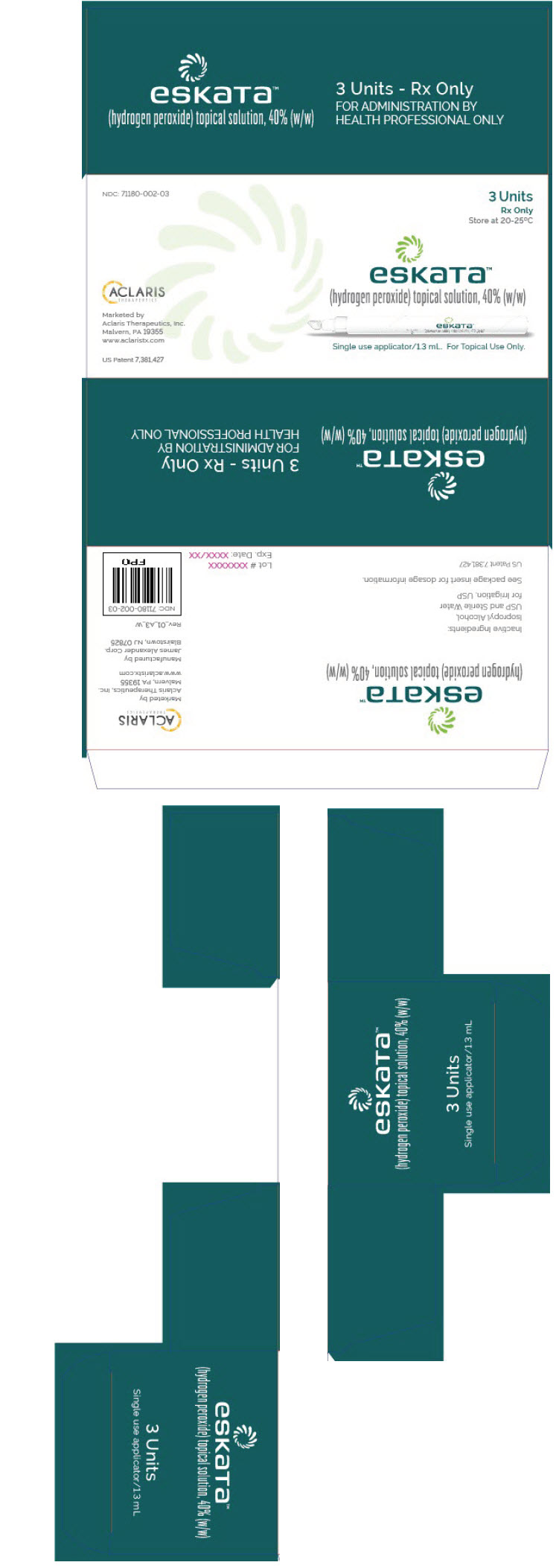
0.7 mL 12 Unit Carton Label (Eskata 07)
* Please review the disclaimer below.
