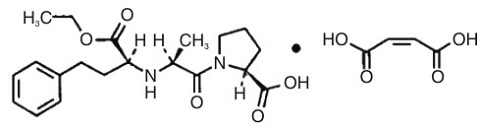
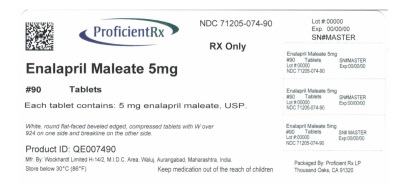
In trials in patients treated with digitalis and diuretics, treatment with enalapril resulted in decreased systemic vascular resistance, blood pressure, pulmonary capillary wedge pressure and heart size, and increased cardiac output and exercise tolerance. Heart rate was unchanged or slightly reduced, and mean ejection fraction was unchanged or increased. There was a beneficial effect on severity of heart failure as measured by the New York Heart Association (NYHA) classification and on symptoms of dyspnea and fatigue. Hemodynamic effects were observed after the first dose, and appeared to be maintained in uncontrolled studies lasting as long as four months. Effects on exercise tolerance, heart size, and severity and symptoms of heart failure were observed in placebo-controlled studies lasting from eight weeks to over one year.
Enalapril maleate is indicated for the treatment of symptomatic congestive heart failure, usually in combination with diuretics and digitalis. In these patients enalapril maleate improves symptoms, increases survival, and decreases the frequency of hospitalization (see CLINICAL PHARMACOLOGY, Heart Failure, Mortality Trials for details and limitations of survival trials).
Adverse experiences occurring in greater than one percent of patients with heart failure treated with enalapril maleate are shown below. The incidences represent the experiences from both controlled and uncontrolled clinical trials (maximum duration of therapy was approximately one year). In the placebo treated patients, the incidences reported are from the controlled trials (maximum duration of therapy is 12 weeks). The percentage of patients with severe heart failure (NYHA Class IV) was 29 percent and 43 percent for patients treated with enalapril maleate and placebo, respectively.
| Enalapril Maleate
(n=673)
Incidence
(discontinuation)
| Placebo
(n=339)
Incidence
|
Body As A Whole
| | |
Orthostatic Effects
| 2.2 (0.1)
| 0.3
|
Syncope
| 2.2 (0.1)
| 0.9
|
Chest Pain
| 2.1 (0.0)
| 2.1
|
Fatigue
| 1.8 (0.0)
| 1.8
|
Abdominal Pain
| 1.6 (0.4)
| 2.1
|
Asthenia
| 1.6 (0.1)
| 0.3
|
| | |
Cardiovascular
| | |
Hypotension
| 6.7 (1.9)
| 0.6
|
Orthostatic Hypotension
| 1.6 (0.1)
| 0.3
|
Angina Pectoris
| 1.5 (0.1)
| 1.8
|
Myocardial Infarction
| 1.2 (0.3)
| 1.8
|
| | |
Digestive
| | |
Diarrhea
| 2.1 (0.1)
| 1.2
|
Nausea
| 1.3 (0.1)
| 0.6
|
Vomiting
| 1.3 (0.0)
| 0.9
|
| | |
Nervous/Psychiatric
| | |
Dizziness
| 7.9 (0.6)
| 0.6
|
Headache
| 1.8 (0.1)
| 0.9
|
Vertigo
| 1.6 (0.1)
| 1.2
|
| | |
Respiratory
| | |
Cough
| 2.2 (0.0)
| 0.6
|
Bronchitis
| 1.3 (0.0)
| 0.9
|
Dyspnea
| 1.3 (0.1)
| 0.4
|
Pneumonia
| 1.0 (0.0)
| 2.4
|
| | |
Skin
| | |
Rash
| 1.3 (0.0)
| 2.4
|
| | |
Urogenital
| | |
Urinary Tract Infection
| 1.3 (0.0)
| 2.4
|
Other serious clinical adverse experiences occurring since the drug was marketed or adverse experiences occurring in 0.5 to 1.0 percent of patients with hypertension or heart failure in clinical trials are listed below and, within each category, are in order of decreasing severity.
Body As A Whole: Anaphylactoid reactions (see WARNINGS, Anaphylactoid and Possibly Related Reactions).
Cardiovascular: Cardiac arrest; myocardial infarction or cerebrovascular accident, possibly secondary to excessive hypotension in high risk patients (see WARNINGS, Hypotension); pulmonary embolism and infarction; pulmonary edema; rhythm disturbances including atrial tachycardia and bradycardia; atrial fibrillation; palpitation, Raynaud's phenomenon.
Digestive: Ileus, pancreatitis, hepatic failure, hepatitis (hepatocellular [proven on rechallenge] or cholestatic jaundice) (see WARNINGS, Hepatic Failure), melena, anorexia, dyspepsia, constipation, glossitis, stomatitis, dry mouth.
Hematologic: Rare cases of neutropenia, thrombocytopenia and bone marrow depression.
Musculoskeletal: Muscle cramps.
Nervous/Psychiatric: Depression, confusion, ataxia, somnolence, insomnia, nervousness, peripheral neuropathy (e.g., paresthesia, dysesthesia), dream abnormality.
Respiratory: Bronchospasm, rhinorrhea, sore throat and hoarseness, asthma, upper respiratory infection, pulmonary infiltrates, eosinophilic pneumonitis.
Skin: Exfoliative dermatitis, toxic epidermal necrolysis, Stevens-Johnson syndrome, pemphigus, herpes zoster, erythema multiforme, urticaria, pruritus, alopecia, flushing, diaphoresis, photosensitivity.
Special Senses: Blurred vision, taste alteration, anosmia, tinnitus, conjunctivitis, dry eyes, tearing.
Urogenital: Renal failure, oliguria, renal dysfunction (see PRECAUTIONS and DOSAGE AND ADMINISTRATION), flank pain, gynecomastia, impotence.
Miscellaneous: A symptom complex has been reported which may include some or all of the following: a positive ANA, an elevated erythrocyte sedimentation rate, arthralgia/arthritis, myalgia/myositis, fever, serositis, vasculitis, leukocytosis, eosinophilia, photosensitivity, rash and other dermatologic manifestations.
Angioedema: Angioedema has been reported in patients receiving enalapril maleate with an incidence higher in black than in non-black patients. Angioedema associated with laryngeal edema may be fatal. If angioedema of the face, extremities, lips, tongue, glottis and/or larynx occurs, treatment with enalapril maleate should be discontinued and appropriate therapy instituted immediately (see WARNINGS).
Hypotension: In the hypertensive patients, hypotension occurred in 0.9 percent and syncope occurred in 0.5 percent of patients following the initial dose or during extended therapy. Hypotension or syncope was a cause for discontinuation of therapy in 0.1 percent of hypertensive patients. In heart failure patients, hypotension occurred in 6.7 percent and syncope occurred in 2.2 percent of patients. Hypotension or syncope was a cause for discontinuation of therapy in 1.9 percent of patients with heart failure (see WARNINGS).
Cough: See PRECAUTIONS, Cough.
Enalapril maleate tablets are indicated for the treatment of symptomatic heart failure, usually in combination with diuretics and digitalis. In the placebo-controlled studies that demonstrated improved survival, patients were titrated as tolerated up to 40 mg, administered in two divided doses.
The recommended initial dose is 2.5 mg. The recommended dosing range is 2.5 to 20 mg given twice a day. Doses should be titrated upward, as tolerated, over a period of a few days or weeks. The maximum daily dose administered in clinical trials was 40 mg in divided doses.
After the initial dose of enalapril maleate tablets, the patient should be observed under medical supervision for at least two hours and until blood pressure has stabilized for at least an additional hour (see WARNINGS and PRECAUTIONS, Drug Interactions). If possible, the dose of any concomitant diuretic should be reduced which may diminish the likelihood of hypotension. The appearance of hypotension after the initial dose of enalapril maleate tablets does not preclude subsequent careful dose titration with the drug, following effective management of the hypotension.