Duloxetine Capsule, Delayed Release
Product Images NDC 71205-602

View Photos of Packaging, Regulatory Labels, and Product Appearance

Product Visual Gallery

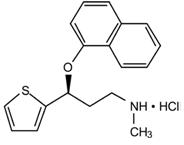
This gallery contains 11 technical images submitted to the FDA as part of the official labeling for Duloxetine (NDC 71205-602). Unlike standard consumer photos, these assets often include clinical data figures, molecular chemical structures, and official manufacturer packaging layouts.

As provided by Proficient Rx Lp, these visuals offer a comprehensive scientific overview of the product's physical and chemical identity, aiding pharmacists and researchers in product verification and study.

FDA Label Image

71205-602-90 (Duloxetine 30mg)

71205-602-90 (Duloxetine 30mg)
This is a medication label for Duloxetine 30mg capsules, one of which contains 33.7mg of the active ingredient Duloxetine Hydrochloride USP, equivalent to 30mg Duloxetine. The medication is RX Only and dispensed with a Medication Guide to each patient. The capsule is enteric-coated and a blue color with "DLXG0" and "60260" imprinted on it. It is manufactured in India by Aara Pram USA, Inc. and marketed in the United States. The medication needs to be stored at 25°C (77°F) and kept out of the reach of children.*
FDA Label Image

Figure1 (Duloxetine Fig1)

Figure1 (Duloxetine Fig1)
This appears to be a graph displaying the number of patients who experienced relapse over time after receiving treatment with either a placebo or Duloxetine. The x-axis represents the time from when the patient was randomized into the study to the point of relapse, while the y-axis indicates the number of patients who relapsed. The graph seems to suggest that Duloxetine was more effective in preventing relapse compared to the placebo.*
FDA Label Image

Figure10 (Duloxetine Fig10)

Figure10 (Duloxetine Fig10)
This appears to be a medication prescription for Duloxetine with dosage information. There is also a chart showing percentage improvement in pain from baseline. There is no additional information available.*
FDA Label Image

Figure2 (Duloxetine Fig2)

Figure2 (Duloxetine Fig2)
This appears to be a graph showing the proportion of patients who experienced relapse over time in relation to treatment with a placebo versus a drug called duloxetine. The x-axis indicates the time from randomization to relapse in days, while the y-axis shows the percentage of patients experiencing relapse. The graph displays a clear difference between the two treatments, with a lower proportion of patients experiencing relapse when taking duloxetine compared to a placebo.*
FDA Label Image

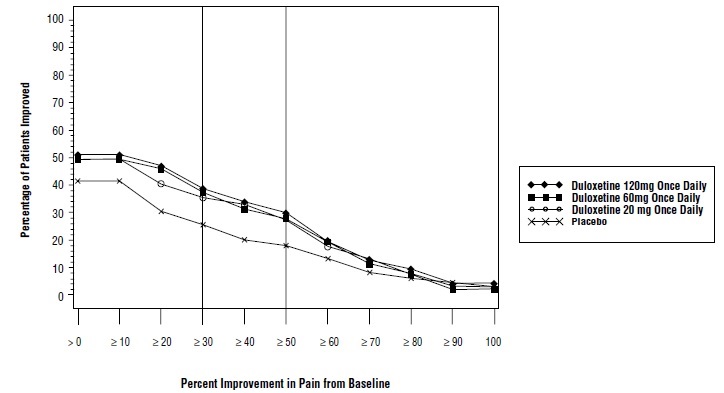
Figure3 (Duloxetine Fig3)

Figure3 (Duloxetine Fig3)
The text describes a chart or table showing the percentage of patient improvement for different dosages of duloxetine and a placebo. The data includes information on pain improvement from a baseline.*
FDA Label Image

Figure4 (Duloxetine Fig4)

FDA Label Image

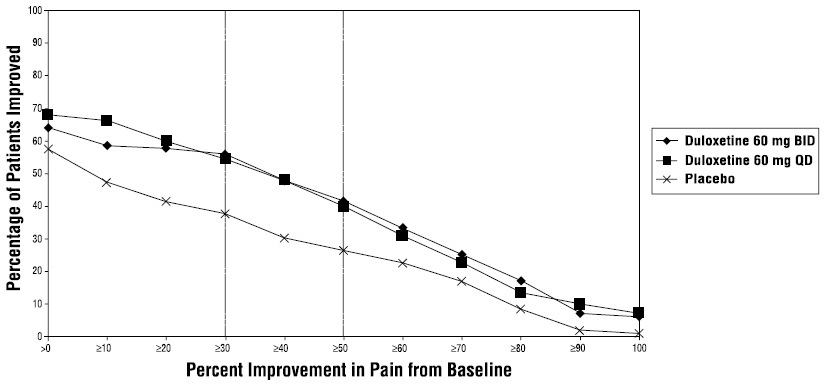
Figure5 (Duloxetine Fig5)

Figure5 (Duloxetine Fig5)
This appears to be a table showing the percentage of patients who have reported improvement in pain from baseline while taking different doses of Duloxetine, a medication used to treat depression and anxiety disorders. The table indicates that 100% of patients taking Duloxetine 60mg twice daily reported improvement, while the percentage of improvement for those taking Duloxetine 60mg once daily is not visible. The third column shows that for patients taking a placebo, there was no reported improvement in pain.*
FDA Label Image

Figure6 (Duloxetine Fig6)

FDA Label Image

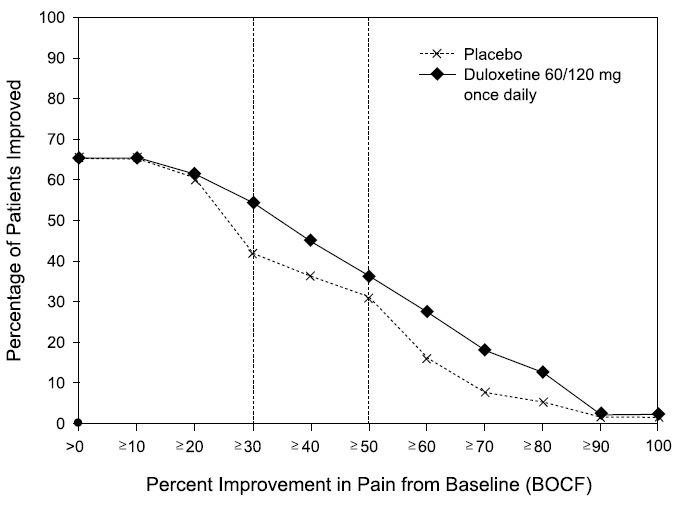
Figure8 (Duloxetine Fig8)

Figure8 (Duloxetine Fig8)
The text describes a treatment involving the medication "Duloxetine" at a dose of either 60 or 120 mg taken once daily. The text also includes some numeric codes that are unclear in their meaning or context. The treatment aims to provide improvement in pain based on a baseline measurement. The term "Placebo" at the beginning may indicate that this is the control group for a clinical trial.*
FDA Label Image

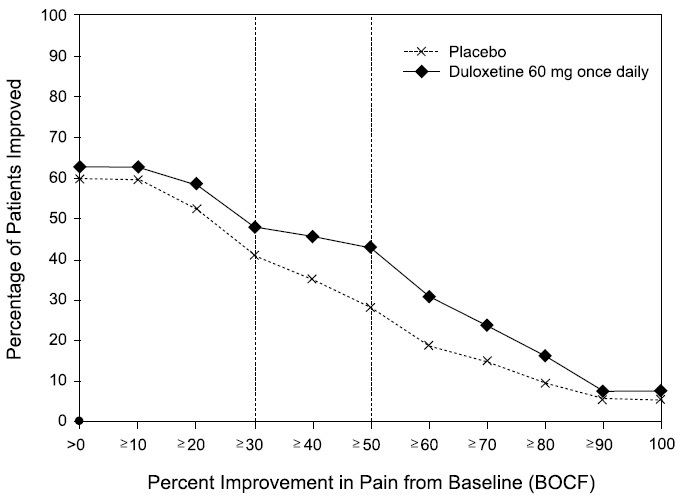
Figure9 (Duloxetine Fig9)

Figure9 (Duloxetine Fig9)
This text appears to be a graph or table related to a clinical trial or study evaluating the effectiveness of Duloxetine (presumably as a pain medication) compared to a placebo. It includes a list of dosage levels (up to 60 mg once daily), and a chart showing percent improvement in pain from baseline. The text is not sufficient to provide any further details or context.*
FDA Label Image

Structure (Duloxetine Structure)

* These product label images have been analyzed using experimental machine learning. Please verify findings with the primary label text.