Risedronate Sodium Tablet, Film Coated
Product Images NDC 71205-714

View Photos of Packaging, Regulatory Labels, and Product Appearance

Product Visual Gallery

This gallery contains 8 technical images submitted to the FDA as part of the official labeling for Risedronate Sodium (NDC 71205-714). Unlike standard consumer photos, these assets often include clinical data figures, molecular chemical structures, and official manufacturer packaging layouts.

As provided by Proficient Rx Lp, these visuals offer a comprehensive scientific overview of the product's physical and chemical identity, aiding pharmacists and researchers in product verification and study.

FDA Label Image

Risedronatefig3 (Figure3)
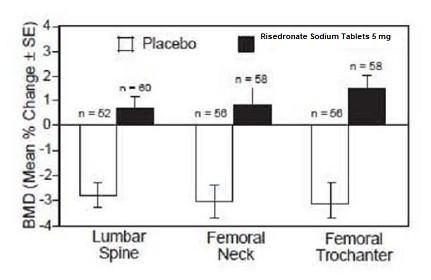
Risedronatefig3 (Figure3)
A bar graph comparing mean percentage change in bone mineral density (BMD) with standard error for Risedronate Sodium Tablets 5 mg versus placebo across three anatomical sites: lumbar spine, femoral neck, and femoral trochanter. Sample sizes for each group are indicated above the bars.*
FDA Label Image

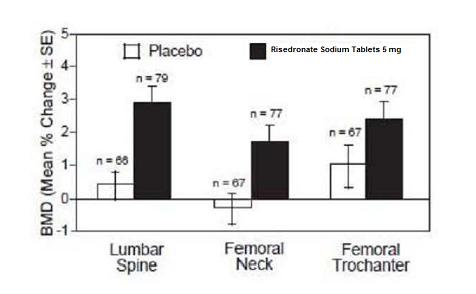
Risedronatefig4 (Figure4)

Risedronatefig4 (Figure4)
A bar chart comparing mean percentage change in bone mineral density (BMD) ± standard error at three anatomical sites: lumbar spine, femoral neck, and femoral trochanter. The chart contrasts placebo and Risedronate Sodium Tablets 5 mg groups, with sample sizes (n) indicated for each group at each site. Risedronate Sodium shows greater increases in BMD across all sites compared to placebo.*
FDA Label Image

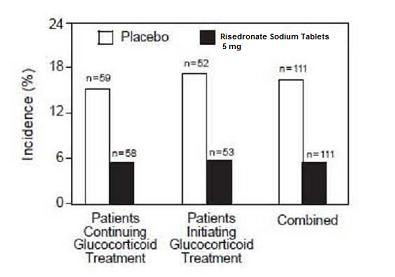
Risedronatefig5 (Figure5)

Risedronatefig5 (Figure5)
A bar chart comparing incidence percentages between placebo and risedronate sodium 5 mg tablets groups. It shows data for patients continuing glucocorticoid treatment, patients initiating glucocorticoid treatment, and a combined group with sample sizes noted for each.*
FDA Label Image

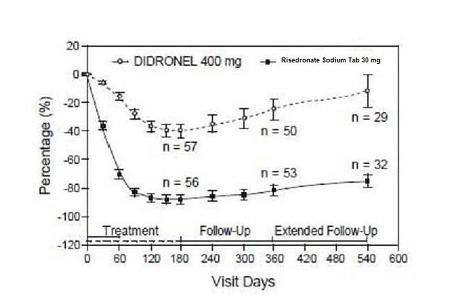
Risedronatefig6 (Figure6)

Risedronatefig6 (Figure6)
A line graph comparing the percentage change over visit days for Risedronate Sodium 30 mg tablets and Didronel 400 mg, showing treatment, follow-up, and extended follow-up phases. The y-axis represents percentage change, and the x-axis represents visit days up to 600 days. Sample sizes (n) vary across time points for both groups.*
FDA Label Image

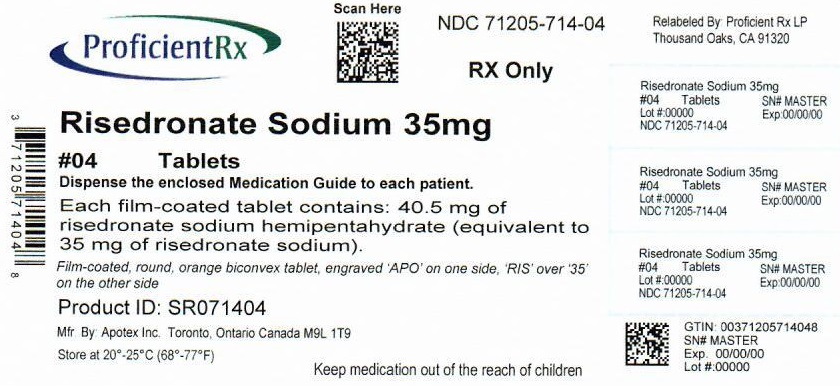
71205-714-04 (Rise35mgblscarton4tabs)

71205-714-04 (Rise35mgblscarton4tabs)
Label for Risedronate Sodium 35 mg film-coated tablets by Proficient Rx LP, manufactured by Apotex Inc. The label describes each orange, biconvex tablet as containing 40.5 mg of risedronate sodium hemipentahydrate (equivalent to 35 mg risedronate sodium). It includes product ID SR071404 and storage instructions at 20-25°C (68-77°F).*
FDA Label Image

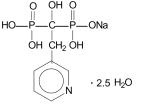
Risedronatestructure (Risedronatechemstructure)

Risedronatestructure (Risedronatechemstructure)
Chemical structure of Risedronate Sodium dihydrate, showing the molecular arrangement including phosphate groups, hydroxyl groups, and a pyridine ring, with water of hydration indicated as 2.5 H2O.*
FDA Label Image

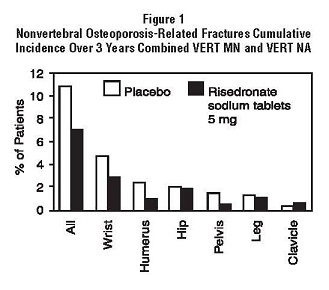
Risedronatefig1 (Risedronatefig1)

Risedronatefig1 (Risedronatefig1)
A bar chart titled 'Nonvertebral Osteoporosis-Related Fractures Cumulative Incidence Over 3 Years Combined VERT MN and VERT NA.' It compares the percentage of patients experiencing fractures at various body sites (All, Wrist, Humerus, Hip, Pelvis, Leg, Clavicle) between placebo and risedronate sodium 5 mg tablets groups.*
FDA Label Image

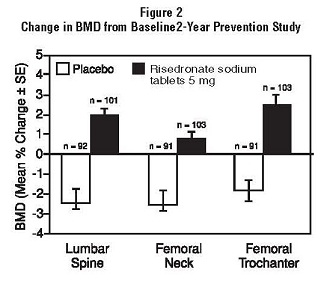
Risedronatefig2 (Risedronatefig2)

Risedronatefig2 (Risedronatefig2)
A bar chart titled 'Figure 2 Change in BMD from Baseline 2-Year Prevention Study' compares mean percentage changes in bone mineral density (BMD) with standard error at three anatomical sites: lumbar spine, femoral neck, and femoral trochanter. The chart includes data for placebo and Risedronate sodium tablets 5 mg groups, with sample sizes indicated for each comparison.*

* About these descriptions: Image descriptions on this page are generated by automated AI analysis of the product label images from the manufacturer's FDA label submission (SPL). They are provided for reference only and may contain errors or omissions. Always rely on the printed label itself and the official FDA labeling, and consult a pharmacist or healthcare professional with any questions about this product.