Absorption and Distribution
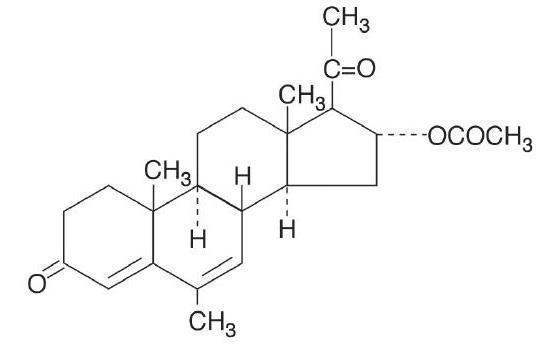
Mean plasma concentrations of megestrol acetate after administration of 625 mg (125 mg/mL) of megestrol acetate oral suspension are equivalent under fed conditions to 800 mg (40 mg/mL) of megestrol acetate oral suspension in healthy volunteers.
In order to characterize the dose proportionality of megestrol acetate oral suspension, pharmacokinetic studies across a range of doses were conducted when administered under fasting and fed conditions. Pharmacokinetics of megestrol acetate was linear in the dosing range between 150 mg and 675 mg after megestrol acetate oral suspension administration regardless of meal condition. The mean peak plasma concentration (Cmax) and the mean area under the concentration time-curve (AUC) after a high fat meal were increased by 48% and 36%, respectively, compared to those under the fasting condition after 625 mg megestrol acetate oral suspension administration. This food effect is less than that seen for the original formulation, megestrol acetate 800 mg/20 mL, where a high fat meal significantly increased AUC and Cmax of megestrol acetate to 2-fold and 7-fold, respectively, compared to those under the fasting condition. There was no difference in safety following administration in the fed state, therefore megestrol acetate oral suspension could be taken without regard to meals.
Plasma steady state pharmacokinetics of megestrol acetate was evaluated in 10 adult, cachectic male adult patients with acquired immunodeficiency syndrome (AIDS) and an involuntary weight loss greater than 10% of baseline who received single oral doses of 800 mg/day of megestrol acetate oral suspension for 21 days. The Mean (±1SD) Cmax of megestrol acetate was 753 (±539) ng/mL. The mean AUC was 10476 (±7788) ng x hr/mL. Median Tmax value was five hours.
In another study, 24 asymptomatic HIV seropositive male adult subjects were dosed once daily with 750 mg of megestrol acetate oral suspension for 14 days. Mean Cmax and AUC values were 490 (±238) ng/mL and 6779 (±3048) hr x ng/mL, respectively. The median Tmax value was three hours. The mean Cmin value was 202 (±101) ng/mL. The mean % of fluctuation value was 107 (±40).
Metabolism and Excretion
The major route of drug elimination in humans is urine. When radio-labeled megestrol acetate was administered to humans in doses of 4 to 90 mg, the urinary excretion within 10 days ranged from 56.5% to 78.4% (mean 66.4%) and fecal excretion ranged from 7.7% to 30.3% (mean 19.8%). The total recovered radioactivity varied between 83.1% and 94.7% (mean 86.2%).
Megestrol acetate metabolites which were identified in urine constituted 5% to 8% of the dose administered. Respiratory excretion as labeled carbon dioxide and fat storage may have accounted for at least part of the radioactivity not found in urine and feces.
The mean elimination half-life of megestrol ranged from 20 to 50 hours in healthy subjects.
Specific Populations
The pharmacokinetics of megestrol acetate has not been studied in specific population, for example, pediatric, renal impairment, and hepatic impairment.
Drug Interactions
The effects of indinavir, zidovudine or rifabutin on the pharmacokinetics of megestrol acetate were not studied.
Zidovudine
Pharmacokinetic studies show that there are no significant alterations in exposure of zidovudine when megestrol acetate is administered with this drug.
Rifabutin
Pharmacokinetic studies show that there are no significant alterations in exposure of rifabutin when megestrol acetate is administered with this drug.
Indinavir
A pharmacokinetic study in healthy male subjects demonstrated that coadministration of megestrol acetate (675 mg for 14 days) and indinavir (single dose 800 mg) results in a significant decrease in the pharmacokinetic parameters (~32% for Cmax and ~21% for AUC) of indinavir.