Pregabalin Capsule
Product Images NDC 71209-036

View Photos of Packaging, Regulatory Labels, and Product Appearance

Product Visual Gallery

This gallery contains 22 technical images submitted to the FDA as part of the official labeling for Pregabalin (NDC 71209-036). Unlike standard consumer photos, these assets often include clinical data figures, molecular chemical structures, and official manufacturer packaging layouts.

As provided by Cadila Pharmaceuticals Limited, these visuals offer a comprehensive scientific overview of the product's physical and chemical identity, aiding pharmacists and researchers in product verification and study.

FDA Label Image

Cont-label-100mg-90-tab (Cont Label 100mg 90 Tab)
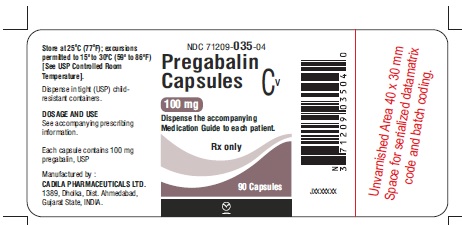
Cont-label-100mg-90-tab (Cont Label 100mg 90 Tab)
Pregabalin Capsules 100 mg oral capsules label from Cadila Pharmaceuticals Limited. The label indicates the product is prescription only, contains 90 capsules per package, and includes storage instructions to keep between 15° to 30°C. The NDC is 71209-035-04, and the label contains a barcode and dosage caution statements.*
FDA Label Image

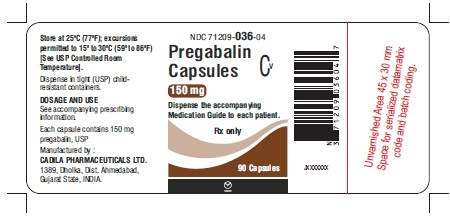
Cont-label-150mg-90-tab (Cont Label 150mg 90 Tab)

Cont-label-150mg-90-tab (Cont Label 150mg 90 Tab)
Packaged label for Pregabalin Capsules 150 mg, oral dosage form, containing 90 capsules. Manufactured by Cadila Pharmaceuticals Limited, the label includes storage instructions to keep at 25°C (77°F) and protect from light in USP child-resistant containers. The label also advises dispensing with a Medication Guide and indicates the product is for prescription use only.*
FDA Label Image

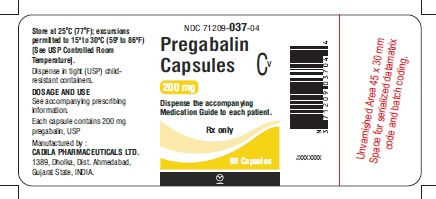
Cont-label-200mg-90-tab (Cont Label 200mg 90 Tab)

Cont-label-200mg-90-tab (Cont Label 200mg 90 Tab)
Pregabalin Capsules 200 mg oral capsules package label from Cadila Pharmaceuticals Limited. The label includes storage instructions, dosage information stating each capsule contains 200 mg pregabalin, and the package contains 90 capsules. The label also features a barcode and states the product is prescription only (Rx only).*
FDA Label Image

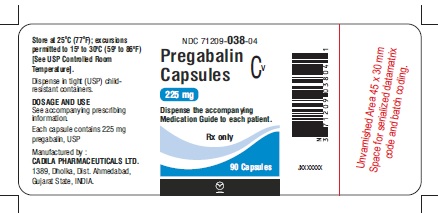
Cont-label-225mg-90-tab (Cont Label 225mg 90 Tab)

Cont-label-225mg-90-tab (Cont Label 225mg 90 Tab)
Pregabalin Capsules 225 mg oral capsules labeled by Cadila Pharmaceuticals Limited. The label includes dosing instructions to see accompanying prescribing information and patient Medication Guide. The package contains 90 capsules and features storage instructions along with a barcode and NDC number 71209-038-04. Manufactured in Ahmedabad, Gujarat State, India.*
FDA Label Image

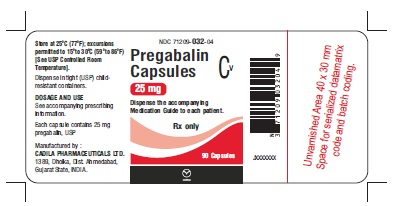
Cont-label-25mg-90-tab.jpg (Cont Label 25mg 90 Tab)

Cont-label-25mg-90-tab.jpg (Cont Label 25mg 90 Tab)
Label for Pregabalin Capsules 25 mg by Cadila Pharmaceuticals Limited. The label includes instructions to dispense the accompanying Medication Guide to each patient. It specifies that each capsule contains 25 mg of pregabalin and that the product is for oral use only, prescription only. The package size indicated is 90 capsules. Storage instructions specify temperature and humidity limits along with child-resistant packaging requirements. Manufacturer address in Ahmedabad, Gujarat, India is included.*
FDA Label Image

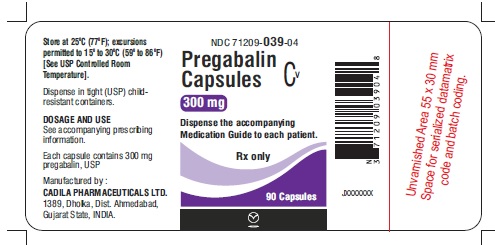
Cont-label-300mg-90-tab (Cont Label 300mg 90 Tab)

Cont-label-300mg-90-tab (Cont Label 300mg 90 Tab)
Packaging label of Pregabalin Capsules 300 mg by Cadila Pharmaceuticals Limited. The label indicates the product contains 90 capsules, specifies storage instructions at 25°C, advises dispensing the medication guide, and lists the manufacturer address in Ahmedabad, Gujarat, India. The NDC number 71209-039-04 is visible along with a barcode.*
FDA Label Image

Cont-label-50mg-90-tab (Cont Label 50mg 90 Tab)

Cont-label-50mg-90-tab (Cont Label 50mg 90 Tab)
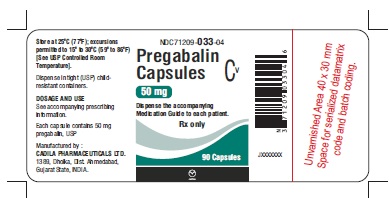
Label for Pregabalin Capsules 50 mg by Cadila Pharmaceuticals Limited. The label shows dosage form as oral capsules, with a quantity of 90 capsules. It instructs storage at 25°C with permitted excursions, indicates prescription-only usage, and advises consulting accompanying prescribing information. The label includes manufacturer details in Ahmedabad, India and shows a barcode and NDC code area.*
FDA Label Image

Cont-label-75mg-90-tab (Cont Label 75mg 90 Tab)

Cont-label-75mg-90-tab (Cont Label 75mg 90 Tab)
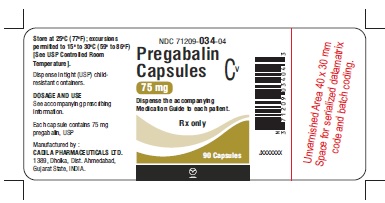
Label for Pregabalin Capsules 75 mg by Cadila Pharmaceuticals Limited. The label indicates the capsule strength as 75 mg, with a package size of 90 capsules. Instructions on storage, dosing, and dispensing are partially visible, along with the NDC number 71209-034-04. The label also mentions controlled room temperature storage and that the product is for prescription use only.*
FDA Label Image

Calc (Pregabalin Spl Calc)

Calc (Pregabalin Spl Calc)
A text panel showing the formula for calculating Creatinine Clearance (CLCr). The formula involves age, weight, and serum creatinine, with a multiplication factor of 0.85 for female patients. This panel provides a clinical calculation method relevant to dosing considerations.*
FDA Label Image

Fig1 (Pregabalin Spl Fig1)

Fig1 (Pregabalin Spl Fig1)
A line graph depicting percent improvement in pain from baseline on the x-axis against percent of patients improved on the y-axis. The graph compares the effects of Pregabalin at various dosages (25 mg, 50 mg, 150 mg, 200 mg) administered three times daily versus placebo, showing trends of pain improvement among patient groups.*
FDA Label Image

Pregabalin-spl-fig10 (Pregabalin Spl Fig10)

Pregabalin-spl-fig10 (Pregabalin Spl Fig10)
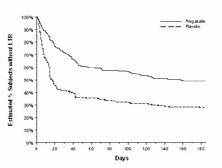
A Kaplan-Meier survival curve graph depicting estimated seizure-free survival probabilities over time in days for two groups labeled 'Pregabalin' and 'Placebo'. The x-axis shows days up to 180, and the y-axis displays estimated seizure-free survival probability in percentage.*
FDA Label Image

Pregabalin-spl-fig11 (Pregabalin Spl Fig11)

Pregabalin-spl-fig11 (Pregabalin Spl Fig11)
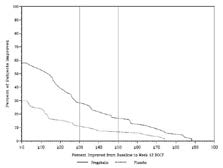
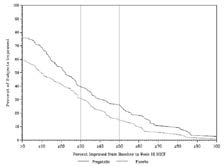
A line graph depicting the percentage of patients remaining over time (days) since baseline. The graph compares two groups labeled as 'Pregabalin' and 'Placebo,' showing a decline in patient percentage with increasing time for both groups.*
FDA Label Image

Pregabalin-spl-fig12 (Pregabalin Spl Fig12)

Pregabalin-spl-fig12 (Pregabalin Spl Fig12)
A Kaplan-Meier survival curve chart with two lines labeled 'Longitude' and 'Fronto'. It plots percent survival since baseline over time, depicting comparative survival outcomes between two groups.*
FDA Label Image

Fig2 (Pregabalin Spl Fig2)

Fig2 (Pregabalin Spl Fig2)
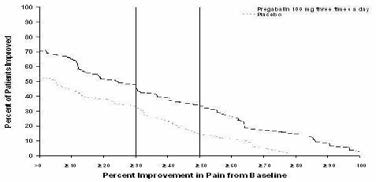
A chart showing the percent improvement in pain from baseline on the horizontal axis and the percent of patients improved on the vertical axis. The graph compares two groups: Pregabalin 100 mg three times a day and placebo, with corresponding trend lines depicting patient response rates over the range of pain improvement percentages.*
FDA Label Image

Fig3 (Pregabalin Spl Fig3)

Fig3 (Pregabalin Spl Fig3)
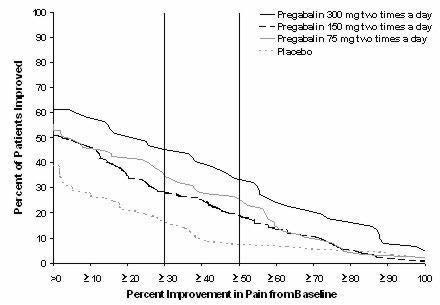
A line graph showing the percent of patients improved in relation to the percent improvement in pain from baseline. The graph includes four groups: Pregabalin 300 mg twice a day, Pregabalin 150 mg twice a day, Pregabalin 75 mg twice a day, and Placebo. The vertical axis shows the percent of patients improved, and the horizontal axis shows the percent improvement in pain from baseline, ranging from 0 to 100.*
FDA Label Image

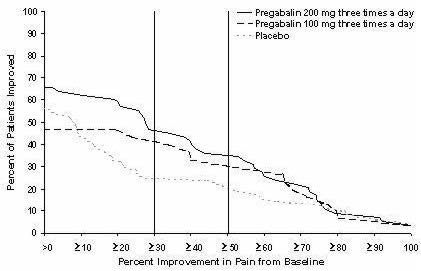
Fig4 (Pregabalin Spl Fig4)

Fig4 (Pregabalin Spl Fig4)
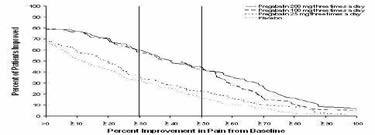
A line graph showing the percent of patients improved relative to the percent improvement in pain from baseline. It compares Pregabalin 200 mg three times a day, Pregabalin 100 mg three times a day, and placebo groups, indicating greater improvement with higher doses of Pregabalin over placebo.*
FDA Label Image

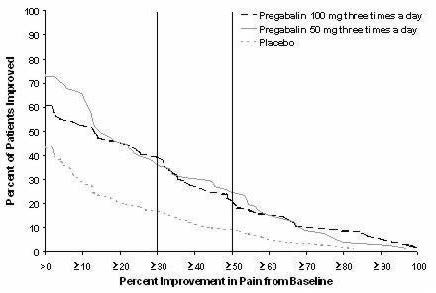
Fig5 (Pregabalin Spl Fig5)

Fig5 (Pregabalin Spl Fig5)
A line graph showing percent improvement in pain from baseline on the x-axis (0 to 100) versus percent of patients improved on the y-axis (0 to 100). Three lines represent treatment groups: Pregabalin 100 mg three times a day, Pregabalin 50 mg three times a day, and placebo. The graph depicts comparative patient improvement trends across these groups.*
FDA Label Image

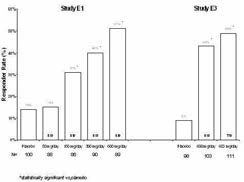
Fig 6 (Pregabalin Spl Fig6)

Fig 6 (Pregabalin Spl Fig6)
A dual-panel bar graph from studies labeled Study E1 and Study E3. The y-axis represents the measured parameter labelled as Pregabalin Ratio (%), and the x-axis shows treatment groups including placebo and various dosages of pregabalin (e.g., 50 mg, 100 mg, 200 mg, etc.). The graph presents comparative data on the effects of pregabalin at different doses versus placebo with statistical significance indicated.*
FDA Label Image

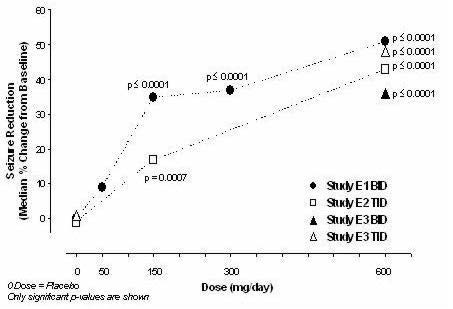
Fig 7 (Pregabalin Spl Fig7)

Fig 7 (Pregabalin Spl Fig7)
A line graph showing median percentage reduction in seizures from baseline plotted against dose in mg/day for four different studies labeled E1BD, E2TID, E3BID, and E3TID. Each study is represented by different markers: solid circles, open squares, solid triangles, and open triangles. The graph includes p-values indicating statistical significance at various doses, with higher doses generally showing greater seizure reduction.*
FDA Label Image

Pregabalin-spl-fig8 (Pregabalin Spl Fig8)

Pregabalin-spl-fig8 (Pregabalin Spl Fig8)
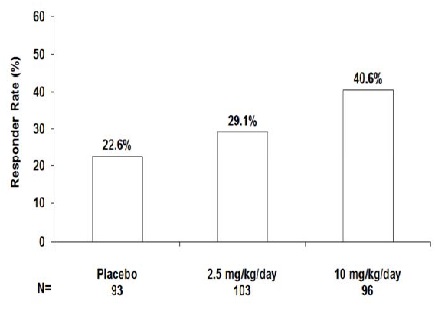
A bar chart showing responder rates (%) for placebo, 2.5 mg/kg/day, and 10 mg/kg/day dosages. The responder rates increase across these groups: approximately 22.6% for placebo, 29.1% for 2.5 mg/kg/day, and 40.6% for 10 mg/kg/day. Sample sizes are 93, 103, and 96, respectively.*
FDA Label Image

Pregabalin-spl-fig9 (Pregabalin Spl Fig9)

Pregabalin-spl-fig9 (Pregabalin Spl Fig9)
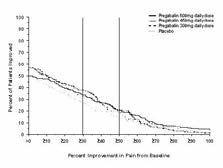
A line graph depicting percent improvement in pain from baseline plotted against the percent of patients reporting that improvement. The graph compares pregabalin at 100 mg, 150 mg, and 300 mg daily doses with a placebo group.*
FDA Label Image

Str (Pregabalin Spl Stru)

Str (Pregabalin Spl Stru)
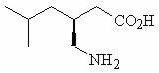
Chemical structure of pregabalin, showing its molecular geometry with key functional groups including an amino group (NH2) and a carboxylic acid group (CO2H).*

* About these descriptions: Image descriptions on this page are generated by automated AI analysis of the product label images from the manufacturer's FDA label submission (SPL). They are provided for reference only and may contain errors or omissions. Always rely on the printed label itself and the official FDA labeling, and consult a pharmacist or healthcare professional with any questions about this product.