The safety and efficacy of YESCARTA was evaluated in two subsequent cohorts of LBCL patients. The first subsequent, open label, safety management cohort in Study 2 evaluated the safety and efficacy of YESCARTA with the use of tocilizumab and/or corticosteroid and prophylactic levetiracetam (750 mg PO or IV twice daily) for Grade 1 CRS or neurologic events (see Tables 1 and 2). A total of 46 patients with relapsed or refractory LBCL were enrolled and 41 patients were treated with YESCARTA. Of the remaining 5 patients who were not treated, 2 patients died prior to receiving YESCARTA and 3 patients were ineligible due to disease progression. Twenty-eight patients (68%) treated with YESCARTA received bridging therapy between leukapheresis and lymphodepleting chemotherapy. Thirty-two patients (78%) treated with YESCARTA received tocilizumab and/or corticosteroid for CRS and/or neurologic events. Fifteen of 36 with Grade 1 CRS and 21 of 24 patients with Grade 2 CRS received tocilizumab and/or corticosteroids. Among patients who received treatment for Grade 1 or Grade 2 CRS, most patients (13 of 15 and 19 of 21 patients, respectively) received both tocilizumab and corticosteroids. Most patients received 1 or 2 doses of each drug. Ten of 27 patients with Grade 1 and 7 of 15 patients with Grade 2 neurologic events received corticosteroids alone or in combination with tocilizumab.
The second subsequent, open label, safety management cohort in Study 2 evaluated the safety and efficacy of YESCARTA with the use of prophylactic corticosteroids (oral dexamethasone 10 mg once daily for 3 days, starting prior to YESCARTA infusion on Day 0) and prophylactic levetiracetam (750 mg PO or IV) [see Warnings and Precautions (5.1 and 5.2)].
The safety of YESCARTA was evaluated in a single-arm, single-center, open-label study which included 13 patients with relapsed or refractory PCNSL. Patients with a history or presence of non-malignant CNS disorders or autoimmune disease requiring systemic immunosuppression were ineligible. All patients received lymphodepleting chemotherapy prior to YESCARTA infusion. Four of 13 (31%) patients were receiving corticosteroids at the time of YESCARTA infusion and 12/13 (92%) received a corticosteroid after YESCARTA infusion. Twelve patients (92%) received prophylactic anticonvulsants. The median age was 64 years (range 56 to 68 years), 46% were female, 77% were white, and 15% were Asian.
Table 7 summarizes non-laboratory adverse reactions that occurred in ≥ 10% of patients treated with YESCARTA.
Other clinically important adverse reactions occurred in one patient who had Grade 4 meningitis and ICANS.
The safety of YESCARTA was evaluated in Study 3, a study that included 146 patients with relapsed or refractory iNHL (124 patients with FL and 22 with marginal zone lymphoma) who received CD19-positive CAR T cells [see Clinical Studies (14)]. Patients with a history of CNS disorders or autoimmune disease requiring systemic immunosuppression were ineligible. The median age was 61 years (range: 34 to 79 years), 43% were female, 93% were white, 3% were black, and 1% were Asian.
The most common non-laboratory adverse reactions (incidence ≥ 20%) included fever, CRS, hypotension, encephalopathy, fatigue, headache, infections with pathogen unspecified, tachycardia, febrile neutropenia, musculoskeletal pain, nausea, tremor, chills, diarrhea, constipation, decreased appetite, cough, vomiting, hypoxia, arrhythmia, and dizziness. Serious adverse reactions occurred in 48% of patients. Serious adverse reactions in > 2% of patients included febrile neutropenia, encephalopathy, fever, CRS, infections with pathogen unspecified, pneumonia, hypoxia, and hypotension.
The most common (≥ 10%) Grade 3 or higher reactions included febrile neutropenia, encephalopathy, and infections with pathogen unspecified. Fatal adverse reactions occurred in 1% of patients and included CRS and fungal infection.
Fifty-one percent (75/146) of patients received tocilizumab after infusion of YESCARTA.
Table 8 summarizes the adverse reactions, excluding laboratory terms, that occurred in at least 10% of patients treated with YESCARTA and Table 9 describes Grade 3 or 4 laboratory abnormalities that developed or worsened in at least 10% of patients.
Other clinically important adverse reactions that occurred in less than 10% of patients treated with YESCARTA include the following:
- Blood and lymphatic system disorders: Coagulopathy (6%)
- Cardiac disorders: Cardiac failure (2%)
- Eye disorders: Visual impairment (5%), blindness (1%)
- Gastrointestinal disorders: Dysphagia (6%)
- General disorders and administration site conditions: Multiple organ dysfunction syndrome (1%)
- Infections and infestations: Bacterial infections (8%), sepsis (2%), herpesvirus infection (4%)
- Musculoskeletal and connective tissue disorders: Muscle injury (1%)
- Nervous system disorders: Seizure (2%), hemiparesis (2%), ischemic stroke (1%)
- Renal and urinary disorders: Renal insufficiency (8%)
- Respiratory, thoracic and mediastinal disorders: Respiratory failure (1%)
- Vascular disorders: Hemorrhage (8%)
Laboratory abnormalities:
Table 9. Grade 3 or 4 Laboratory Abnormalities Occurring in ≥ 10% of Patients with Relapsed or Refractory FL in Study 3Baseline lab values were assessed prior to lymphodepleting chemotherapy.
(N = 146)| Laboratory Abnormality | Grades 3 or 4 (%) |
|---|
| Lymphocyte decrease | 96 |
| Leukocyte decrease | 94 |
| Neutrophil decrease | 92 |
| Platelet decrease | 35 |
| Hemoglobin decrease | 32 |
| Phosphate decrease | 25 |
| Sodium decrease | 10 |
| Glucose increase | 10 |
| Calcium decrease | 10 |
Nervous System Disorders: Spinal cord edema, cerebral edema, myelitis, quadriplegia, dysphagia, and status epilepticus.
Immune System Disorders: Infusion related reactions
Neoplasms: T cell malignancies
Risk Summary
There are no available data with YESCARTA use in pregnant women. No animal reproductive and developmental toxicity studies have been conducted with YESCARTA to assess whether it can cause fetal harm when administered to a pregnant woman. It is not known if YESCARTA has the potential to be transferred to the fetus. Based on the mechanism of action, if the transduced cells cross the placenta, they may cause fetal toxicity, including B-cell lymphocytopenia. Therefore, YESCARTA is not recommended for women who are pregnant, and pregnancy after YESCARTA infusion should be discussed with the treating physician.
In the U.S. general population, the estimated background risk of major birth defects and miscarriage in clinically recognized pregnancies is 2% – 4% and 15% – 20%, respectively.
Risk Summary
There is no information regarding the presence of YESCARTA in human milk, the effect on the breastfed infant, and the effects on milk production. The developmental and health benefits of breastfeeding should be considered along with the mother's clinical need for YESCARTA and any potential adverse effects on the breastfed infant from YESCARTA or from the underlying maternal condition.
Pregnancy Testing
Pregnancy status of females with reproductive potential should be verified. Sexually active females of reproductive potential should have a pregnancy test prior to starting treatment with YESCARTA.
Contraception
See the prescribing information for fludarabine and cyclophosphamide for information on the need for effective contraception in patients who receive the lymphodepleting chemotherapy.
There are insufficient exposure data to provide a recommendation concerning duration of contraception following treatment with YESCARTA.
Infertility
There are no data on the effect of YESCARTA on fertility.
Large B-cell lymphoma
Among patients with LBCL with an ongoing response at 24 months in Study 1, 21 of 61 evaluable patients (34%) had no detectable B cells at baseline, and the majority of patients at Month 3 (43 of 69 evaluable patients [62%]) and Month 6 (8 of 13 evaluable patients [62%]) had no detectable B cells. At Month 24, 20 of 24 evaluable patients (83%) had detectable B cells.
Among patients with LBCL with an ongoing response at 24 months in Study 2, 13 of 29 evaluable patients (45%) had no detectable B cells at baseline, and the majority of patients at Month 3 (28 of 35 evaluable patients [80%]) and Month 6 (25 of 32 evaluable patients [78%]) had no detectable B cells. At Month 24, 24 of 32 evaluable patients (75%) had detectable B cells.
Large B-cell Lymphoma
Among patients with LBCL in Study 2 (n=96 evaluable), the number of anti-CD19 CAR T cells in blood was positively associated with objective response (CR or PR). The median anti-CD19 CAR T cell Cmax levels in responders (n=73) were 205% higher compared to the corresponding level in nonresponders (n=23) (43.6 cells/μL vs 21.2 cells/μL). Median AUC Day 0 - 28 in responding patients (n=73) was 251% of the corresponding level in nonresponders (n=23) (557.1 days × cells/μL vs. 222.0 days × cells/μL).
Among patients with LBCL in Study 1 (n=162 evaluable), the number of anti-CD19 CAR T cells in blood was positively associated with objective response [complete remission (CR) or partial remission (PR)]. The median anti-CD19 CAR T cell Cmax levels in responders (n=142) were 275% higher compared to the corresponding level in nonresponders (n=20) (28.9 cells/μL vs 10.5 cells/μL). Median AUC Day 0 - 28 in responding patients (n=142) was 418% of the corresponding level in nonresponders (n=20) (292.9 days × cells/μL vs. 70.1 days × cells/μL). No association between peak anti-CD19 CAR T-cell levels and OS was observed among 163 subjects with an evaluable pharmacokinetic sample when anti-CD19 CAR T-cell peaks were categorized as > median relative to ≤ median.
Follicular Lymphoma
Among patients with FL in Study 3 (n=81 evaluable), the median anti-CD19 CAR T cell Cmax levels in responders (n=74) were 40.1 cells/μL and 46.0 cells/μL in nonresponders (n=7). The median AUC Day 0 - 28 in responding FL patients (n=74) were 465.8 days × cells/μL and 404.5 days × cells/μL in nonresponders (n=7).
Some patients required tocilizumab and corticosteroids for management of CRS and neurologic toxicities. Patients treated with tocilizumab (n=44) had 262% and 232% higher anti-CD19 CAR T cells as measured by AUC Day 0 - 28 and Cmax respectively, as compared to patients who did not receive tocilizumab (n=57). Similarly, patients that received corticosteroids (n=26) had 217% and 155% higher AUC Day 0 - 28 and Cmax compared to patients who did not receive corticosteroids (n=75).
Primary Central Nervous System Lymphoma
In Study 4 (n=13), anti-CD19 CAR T cells were measurable in all 13 participants, with a median peak of 75.15 cells/μL (range: 1.97-181.61) at Day 8 and median AUC₀₋₂₈ of 519.98 cells/μL*days (range: 32.36-1549.28).
Hepatic and renal impairment studies of YESCARTA were not conducted.
Study 1
A randomized, open-label, multicenter trial evaluated the efficacy of YESCARTA in adult patients with relapsed or refractory LBCL after first-line chemoimmunotherapy that included rituximab and anthracycline (Study 1; NCT03391466). Patients had not yet received treatment for relapsed or refractory lymphoma and were potential candidates for autologous HSCT. Patients were required to have primary refractory disease or relapse within 12 months following completion of first-line therapy. The study excluded patients with primary mediastinal B-cell lymphoma, any history of central nervous system lymphoma, need for urgent therapy due to tumor mass effect, active or serious infections, and ECOG performance status of 2 or greater.
In total, 359 patients were randomized in a 1:1 ratio to receive a single infusion of YESCARTA or to receive second-line standard therapy, consisting of 2 or 3 cycles of chemoimmunotherapy followed by high-dose therapy and autologous HSCT in patients who attained CR or PR. Randomization was stratified by response to first-line therapy and second-line age-adjusted International Prognostic Index.
Following lymphodepleting chemotherapy, YESCARTA was administered as a single intravenous infusion at a target dose of 2 × 10⁶ CAR-positive viable T cells/kg (maximum permitted dose: 2 × 10⁸ cells). The lymphodepleting regimen consisted of cyclophosphamide 500 mg/m2 intravenously and fludarabine 30 mg/m2 intravenously, both given on the fifth, fourth, and third day before YESCARTA. All patients who received YESCARTA were monitored at a healthcare facility for a minimum of 7 days. Bridging therapy, administered between leukapheresis and lymphodepleting chemotherapy, was limited to corticosteroids and was permitted for patients with high disease burden.
In the overall study population, the median age was 59 years (range: 21 to 81 years), 66% were male, 83% were white, 6% were Asian, and 5% were Black. The diagnoses included de novo DLBCL NOS (63%), HGBL with or without MYC and BCL-2 and/or BCL-6 rearrangements (19%), and large cell transformation of follicular lymphoma (13%). In total, 74% of patients had primary refractory LBCL, and 26% had relapsed disease within 12 months of first-line therapy.
Of the 180 patients randomized to receive YESCARTA, 178 underwent leukapheresis and 170 were treated with YESCARTA, of whom 60 (33%) received bridging corticosteroid therapy. Eight patients (4%) were not treated following leukapheresis, primarily due to progressive disease, serious adverse events, or death. The median time from leukapheresis to product delivery was 18 days (range: 13 to 49 days), and from leukapheresis to YESCARTA infusion was 26 days (range: 16 to 52 days). The median dose was 2.0 × 10⁶ CAR-positive viable T cells/kg (range: 1.0 to 2.1 × 10⁶ cells/kg).
Of the 179 patients randomized to receive standard therapy, 168 patients received any study treatment, and 62 (35%) received high-dose therapy and on-protocol HSCT. The most common reason for not receiving HSCT was lack of response to salvage chemotherapy.
The primary efficacy measure was event-free survival (EFS) as determined by an independent review committee. Efficacy is summarized in Table 9 and Figure 1. With an estimated median follow-up of 22.1 months overall, the estimated EFS rate at 18 months was 41.5% [95% CI: 34.2, 48.6] in the YESCARTA arm and 17.0% [95% CI: 11.8, 23.0] in the standard therapy arm.
In the YESCARTA arm, the estimated median DOR was 28.4 months (95% CI: 26.9, NE) in patients who achieved CR and 1.6 months (95% CI: 1.4, 1.9) in patients who achieved a best response of PR.
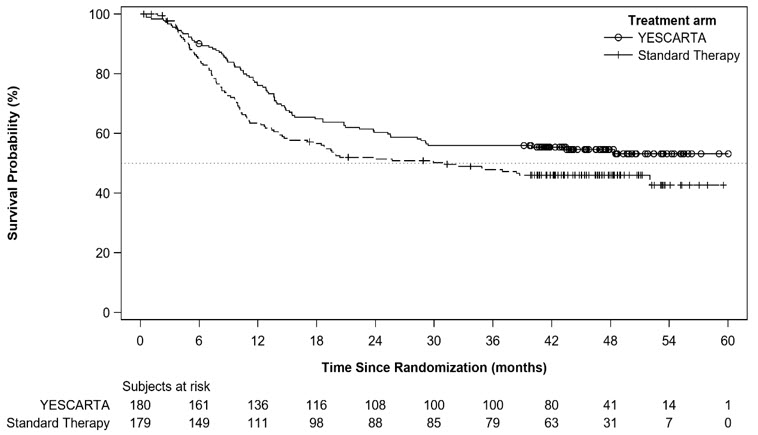
At the time of the primary EFS analysis, the interim analysis of overall survival (OS) did not meet criteria for statistical significance. With an estimated median follow-up of 46.7 months overall, the primary analysis of OS showed a statistically significant improvement in the YESCARTA arm compared to the standard therapy arm. Fifty-seven percent of patients received cellular immunotherapy after no response to or relapse after randomization to standard therapy arm.
The efficacy results are summarized in Table 10 and Figure 1 and Figure 2.
Table 10. Efficacy Results for Study 1| Outcome Per the International Working Group Lugano Classification (Cheson 2014), as assessed by the independent review committee. | YESCARTA
(N = 180)Two recipients of non-conformal product are included in the efficacy analysis. | Standard Therapy
(N = 179) |
|---|
| CI, confidence interval; NE, not estimable. |
| Event-Free Survival EFS is defined as time from randomization to the earliest date of disease progression or relapse, best response of stable disease up to and including the Day 150 assessment, commencement of new lymphoma therapy, or death from any cause. | | |
| Number of events, n (%) | 108 (60) | 144 (80) |
| Median, months [95% CI] Kaplan-Meier estimate. | 8.3 [4.5, 15.8] | 2.0 [1.6, 2.8] |
| Stratified hazard ratio [95% CI] | 0.40 [0.31, 0.51] |
| Stratified log-rank p-value | <0.0001 |
| Overall Survival Overall survival was conducted at the time of the primary OS analysis. | | |
| Number of events, n (%) | 82 (46) | 95 (53) |
| Median OS, months [95% CI] | NE (28.6, NE) | 31.1 (17.1, NE) |
| Stratified hazard ratio [95% CI] | 0.73 (0.54, 0.98) |
| Stratified log-rank p-value p-value is compared with 0.0249, the one-sided efficacy boundary (significance level) for the primary OS analysis. | 0.0168 |
| Best Objective Response Rate, % [95% CI] | 83 [77, 88] | 50 [43, 58] |
| Difference in ORR, % [95% CI] | 33 [23, 42] |
| Stratified p-value Per Cochran-Mantel-Haenszel method. For all stratified analyses, stratification was based on response to first-line therapy (primary refractory, vs relapse within 6 months of first-line therapy vs relapse within > 6 but ≤ 12 months) and second-line age-adjusted International Prognostic Index. | <0.0001 |
| Complete remission rate, % [95% CI] | 65 [58, 72] | 32 [26, 40] |
| Partial remission rate, % [95% CI] | 18 [13, 25] | 18 [13, 24] |
| Progression-Free Survival | | |
| Number of events, n (%) | 93 (52) | 81 (45) |
| Median, months [95% CI] | 14.9 [7.2, NE] | 5.0 [3.4, 8.5] |
| Stratified hazard ratio [95% CI] | 0.56 [0.41, 0.76] |
Figure 1. Kaplan-Meier Curve of Event-Free Survival in Study 1 (Primary EFS Analysis)
Figure 2. Kaplan-Meier Curve of Overall Survival in Study 1 (Primary OS Analysis)
Study 2
A single-arm, open-label, multicenter trial evaluated the efficacy of a single infusion of YESCARTA in adult patients with relapsed or refractory aggressive B-cell non-Hodgkin lymphoma (Study 2; NCT02348216). Eligible patients had refractory disease to the most recent therapy or relapse within 1 year after autologous hematopoietic stem cell transplantation (HSCT). The study excluded patients with prior allogeneic HSCT, any history of central nervous system lymphoma, ECOG performance status of 2 or greater, absolute lymphocyte count less than 100/µL, creatinine clearance less than 60 mL/min, hepatic transaminases more than 2.5 times the upper limit of normal, cardiac ejection fraction less than 50%, or active serious infection.
Following lymphodepleting chemotherapy, YESCARTA was administered as a single intravenous infusion at a target dose of 2 × 10⁶ CAR-positive viable T cells/kg (maximum permitted dose: 2 × 10⁸ cells). The lymphodepleting regimen consisted of cyclophosphamide 500 mg/m2 intravenously and fludarabine 30 mg/m2 intravenously, both given on the fifth, fourth, and third day before YESCARTA. Bridging chemotherapy between leukapheresis and lymphodepleting chemotherapy was not permitted. All patients were hospitalized for YESCARTA infusion and for a minimum of 7 days afterward.
Of 111 patients who underwent leukapheresis, 101 received YESCARTA. Of the patients treated, the median age was 58 years (range: 23 to 76 years), 67% were male, and 89% were white. Most (76%) had DLBCL, 16% had transformed follicular lymphoma, and 8% had primary mediastinal large B-cell lymphoma. The median number of prior therapies was 3 (range: 1 to 10), 77% of the patients had refractory disease to a second or greater line of therapy, and 21% had relapsed within 1 year of autologous HSCT.
One out of 111 patients did not receive the product due to manufacturing failure. Nine other patients were not treated, primarily due to progressive disease or serious adverse reactions following leukapheresis. The median time from leukapheresis to product delivery was 17 days (range: 14 to 51 days), and the median time from leukapheresis to infusion was 24 days (range: 16 to 73 days). The median dose was 2.0 × 10⁶ CAR-positive viable T cells/kg (range: 1.1 to 2.2 × 10⁶ cells/kg).
Efficacy was established on the basis of complete remission (CR) rate and duration of response (DOR), as determined by an independent review committee (Table 11 and Table 12). The median time to response was 0.9 months (range: 0.8 to 6.2 months). Response durations were longer in patients who achieved CR, as compared to patients with a best response of partial remission (PR) (Table 11). Of the 52 patients who achieved CR, 14 initially had stable disease (7 patients) or PR (7 patients), with a median time to improvement of 2.1 months (range: 1.6 to 5.3 months).
Table 11. Response Rate in Patients with Relapsed or Refractory LBCL in Study 2 | Recipients of YESCARTA
(N = 101) |
|---|
| CI, confidence interval. |
| Objective Response Rate Per 2007 revised International Working Group criteria, as assessed by the independent review committee.
(95% CI) | 73 (72%)
(62, 81) |
Complete Remission Rate
(95% CI) | 52 (51%)
(41, 62) |
Partial Remission Rate
(95% CI) | 21 (21%)
(13, 30) |
Table 12. Duration of Response in Patients with Relapsed or Refractory LBCL in Study 2 | From N of 101 |
|---|
| CR, complete remission; DOR, duration of response; NE, not estimable; PR, partial remission. |
| Number of Responders | 73 |
| DOR (Months) Among all responders. DOR is measured from the date of first objective response to the date of progression or death from relapse or toxicity. | |
| Median Kaplan-Meier estimate.
(95% CI) | 9.2
(5.4, NE) |
| Range A "+" sign indicates a censored value. | 0.03+, 14.4+ |
| DOR if Best Response is CR (Months) | |
Median
(95% CI) | NE
(8.1, NE) |
| Range | 0.4, 14.4+ |
| DOR if Best Response is PR (Months) | |
Median
(95% CI) | 2.1
(1.3, 5.3) |
| Range | 0.03+, 8.4+ |
| Median Follow-up for DOR (Months), | 7.9 |
Manufactured by, Packed by, Distributed by:
Kite Pharma, Inc.
Santa Monica, CA 90404
US License No 2064
YESCARTA is a trademark of Kite Pharma, Inc. All other trademarks referenced herein are the property of their respective owners.
© 2026 Kite Pharma, Inc. All Rights Reserved.
125643-GS-018