Limitations of Use
Levoleucovorin for Injection is not indicated for pernicious anemia and megaloblastic anemia secondary to the lack of vitamin B12, because of the risk of progression of neurologic manifestations despite hematologic remission.
Impaired Methotrexate Elimination or Renal Impairment
Decreased methotrexate elimination or renal impairment which are clinically important but less severe than the abnormalities described in Table 1 can occur following methotrexate administration. If toxicity associated with methotrexate is observed, in subsequent courses extend levoleucovorin for injection rescue for an additional 24 hours (total of 14 doses over 84 hours).
Third-Space Fluid Collection and Other Causes of Delayed Methotrexate Elimination
Accumulation in a third space fluid collection (i.e., ascites, pleural effusion), renal insufficiency, or inadequate hydration can delay methotrexate elimination. Under such circumstances, higher doses of levoleucovorin for injection or prolonged administration may be indicated.
Levoleucovorin for Injection
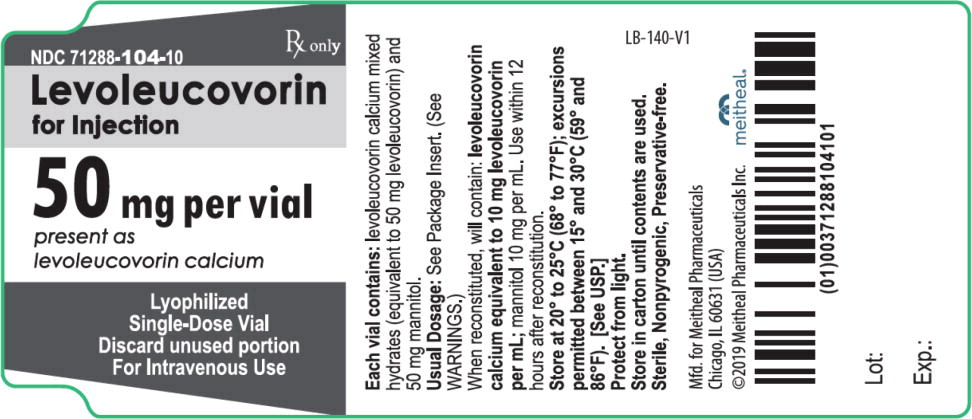
- Prior to intravenous injection, reconstitute the 50 mg vial of levoleucovorin for injection with 5.3 mL of 0.9% Sodium Chloride Injection, USP to yield a levoleucovorin concentration of 10 mg per mL. Reconstitution with Sodium Chloride solutions with preservatives (e.g. benzyl alcohol) has not been studied. The use of solutions other than 0.9% Sodium Chloride Injection, USP is not recommended.
- The reconstituted 10 mg per mL levoleucovorin contains no preservative. Observe strict aseptic technique during reconstitution of the drug product. Discard unused portion.
- Saline reconstituted levoleucovorin solutions may be further diluted, immediately, to concentrations of 0.5 mg/mL to 5 mg/mL in 0.9% Sodium Chloride Injection, USP or 5% Dextrose Injection, USP. Do not store the reconstituted product or reconstituted product diluted using 0.9% Sodium Chloride Injection, USP for more than 12 hours at room temperature. Do not store reconstituted product diluted using 5% Dextrose Injection, USP for more than 4 hours at room temperature.
- Visually inspect the reconstituted solution for particulate matter and discoloration prior to administration. Do not use if cloudiness or precipitate is observed.
- Do not intravenously inject more than 16 mL of reconstituted solutions (160 mg of levoleucovorin) per minute, because of the calcium content of the levoleucovorin solution.
High-Dose Methotrexate Therapy
Table 2 presents the frequency of adverse reactions which occurred during the administration of 58 courses of high-dose methotrexate 12 grams/m2 followed by levoleucovorin rescue for osteosarcoma in 16 patients aged 6 to 21 years. Most patients received levoleucovorin 7.5 mg every 6 hours for 60 hours or longer, beginning 24 hours after completion of methotrexate administration.
Table 2 Adverse Reactions with High-Dose Methotrexate Therapy
| Adverse Reactions | Levoleucovorin for Injection
n = 16 |
| All Grades (%) | Grades 3-4 (%) |
| Gastrointestinal |
| Stomatitis
| 38
| 6
|
| Vomiting
| 38
| 0
|
| Nausea
| 19
| 0
|
| Diarrhea
| 6
| 0
|
| Dyspepsia
| 6
| 0
|
| Typhlitis
| 6
| 6
|
| Respiratory |
| Dyspnea
| 6
| 0
|
| Skin and Appendages |
| Dermatitis
| 6
| 0
|
| Other |
| Confusion
| 6
| 0
|
| Neuropathy
| 6
| 0
|
| Renal function abnormal
| 6
| 0
|
| Taste perversion
| 6
| 0
|
Combination with Fluorouracil in Colorectal Cancer
Table 3 presents the frequency of adverse reaction which occurred in 2 arms of a randomized controlled trial conducted by the North Central Cancer Treatment Group (NCCTG) in patients with metastatic colorectal cancer. The trial failed to show superior overall survival with fluorouracil + levoleucovorin compared to fluorouracil + d,l-leucovorin. Patients were randomized to fluorouracil 370 mg/m2 intravenously and levoleucovorin 100 mg/m2 intravenously, both daily for 5 days, or to fluorouracil 370 mg/m2 intravenously and d,l-leucovorin 200 mg/m2 intravenously, both daily for 5 days. Treatment was repeated week 4 and week 8, and then every 5 weeks until disease progression or unacceptable toxicity.
Table 3 Adverse Reactions Occurring in ≥ 10% of Patients in Either Arm
|
| Adverse Reaction | Levoleucovorin/fluorouracil
n=318 | d,l-Leucovorin/fluorouracil
n=307 |
Grades 1-4
(%) | Grades 3-4
(%) | Grades 1-4
(%) | Grades 3-4
(%) |
| Gastrointestinal Disorders |
| Stomatitis
| 72
| 12
| 72
| 14
|
| Diarrhea
| 70
| 19
| 65
| 17
|
| Nausea
| 62
| 8
| 61
| 8
|
| Vomiting
| 40
| 5
| 37
| 6
|
| Abdominal Pain1 | 14
| 3
| 19
| 3
|
| General Disorders |
| Asthenia/Fatigue/Malaise
| 29
| 5
| 32
| 11
|
| Skin Disorders |
| Dermatitis
| 29
| 1
| 28
| 1
|
| Alopecia
| 26
| 0.3
| 28
| 1
|
| Metabolism and Nutrition |
| Anorexia/Decreased Appetite
| 24
| 4
| 25
| 2
|
Antiepileptic Drugs
Folic acid in large amounts may counteract the antiepileptic effect of phenobarbital, phenytoin and primidone and increase the frequency of seizures in susceptible children. It is not known whether folinic acid has the same effects; however, both folic and folinic acids share some common metabolic pathways. Monitor patients taking folinic acid in combination with antiepileptic drugs.
Fluorouracil
Leucovorin products increase the toxicity of fluorouracil. Do not initiate or continue therapy with levoleucovorin and fluorouracil in patients with symptoms of gastrointestinal toxicity until those symptoms have resolved. Monitor patients with diarrhea until the diarrhea has resolved, as rapid deterioration leading to death can occur [see Warnings and Precautions (5.2)].
Trimethoprim-Sulfamethoxazole
The concomitant use of d,l-leucovorin with trimethoprim-sulfamethoxazole for the acute treatment of Pneumocystis jiroveci pneumonia in patients with HIV infection was associated with increased rates of treatment failure and morbidity in a placebo-controlled study [see Warnings and Precautions (5.3)].
Risk Summary
There are limited data with levoleucovorin use in pregnant women. Animal reproduction studies have not been conducted with levoleucovorin.
Levoleucovorin is administered in combination with methotrexate or fluorouracil, which can cause embryo-fetal harm. Refer to methotrexate and fluorouracil prescribing information for additional information.
In the U.S. general population, the estimated background risk of major birth defects and miscarriage in clinically recognized pregnancies is 2% to 4% and 15% to 20%, respectively.
Risk Summary
There are no data on the presence of levoleucovorin in human milk or its effects on the breastfed infant or on milk production.
Levoleucovorin is administered in combination with methotrexate or fluorouracil. Refer to methotrexate and fluorouracil prescribing information for additional information.
High-Dose Methotrexate Therapy
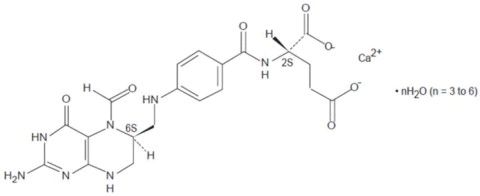
Levoleucovorin is the pharmacologically active isomer of 5-formyl tetrahydrofolic acid. Levoleucovorin does not require reduction by the enzyme dihydrofolate reductase in order to participate in reactions utilizing folates as a source of “one-carbon” moieties. Administration of levoleucovorin counteracts the therapeutic and toxic effects of folic acid antagonists such as methotrexate, which act by inhibiting dihydrofolate reductase.
Combination with Fluorouracil in Colorectal Cancer
Levoleucovorin enhances the therapeutic and toxic effects of fluorouracil. Fluorouracil is metabolized to 5-fluoro-2'-deoxyuridine-5'-monophosphate (FdUMP), which binds to and inhibits thymidylate synthase (an enzyme important in DNA repair and replication). Levoleucovorin is converted to another reduced folate, 5,10-methylenetetrahydrofolate, which acts to stabilize the binding of FdUMP to thymidylate synthase and thereby enhancing the inhibition of thymidylate synthase.
Distribution
Exploratory studies show that small quantities of systemically administered leucovorin enter the cerebrospinal fluid (CSF), primarily as its major metabolite 5-methyltetrahydrofolate (5-MTHFA). In humans, the CSF levels of 5-MTHFA remain 1-3 orders of magnitude lower than the usual methotrexate concentrations following intrathecal administration.
Elimination
The mean terminal half-life was 5.1 hours for total-THF and 6.8 hours for (6S)-5-methyl-5,6,7,8-tetrahydrofolate.
Drug Interaction Studies
The mean dose-normalized steady-state plasma concentrations for both levoleucovorin and 5-methyl-THF were comparable whether fluorouracil (370 mg/m2/day as an intravenous bolus) was given in combination with levoleucovorin (250 mg/m2 and 1000 mg/m2 as a continuous intravenous infusion for 5.5 days) or with d,l-leucovorin (500 mg/m2 as a continuous intravenous infusion for 5.5 days).