Docetaxel Anhydrous
Product Images NDC 71288-150

17 FDA label images from Meitheal Pharmaceuticals Inc · Packaging, Regulatory Labels, and Product Appearance

Product Visual Gallery

This gallery contains 17 technical images submitted to the FDA as part of the official labeling for Docetaxel Anhydrous (NDC 71288-150). Unlike standard consumer photos, these assets often include clinical data figures, molecular chemical structures, and official manufacturer packaging layouts.

As provided by Meitheal Pharmaceuticals Inc, these visuals offer a comprehensive scientific overview of the product's physical and chemical identity, aiding pharmacists and researchers in product verification and study.

FDA Label Image

Principal Display Panel – Docetaxel Injection, Usp 16 mL Carton (160mg Cart Np)

Principal Display Panel – Docetaxel Injection, Usp 16 mL Carton (160mg Cart Np)
Package label for Docetaxel Injection, USP 160 mg per 16 mL (10 mg per mL) multi-dose vial by Meitheal Pharmaceuticals Inc. The label highlights the cytotoxic agent caution, intended for intravenous use, and that the solution is ready to add to infusion solution. It includes storage instructions, usage warnings, and the Novaplus trademark.*
FDA Label Image

Principal Display Panel – Docetaxel Injection, Usp 16 mL Vial Label (160mg Vial Np)

Principal Display Panel – Docetaxel Injection, Usp 16 mL Vial Label (160mg Vial Np)
Docetaxel Injection, USP 160 mg per 16 mL (10 mg per mL) multi-dose vial label from Meitheal Pharmaceuticals Inc. The label indicates it is a cytotoxic agent for intravenous use only, preservative-free, and contains 16 mL per vial. It includes usage instructions to add to infusion solution and check concentration before preparation. The label also shows the brand novaplus and storage information.*
FDA Label Image

Principal Display Panel – Docetaxel Injection, Usp 2 mL Carton (20mg Cart Np)

Principal Display Panel – Docetaxel Injection, Usp 2 mL Carton (20mg Cart Np)
Packaging label for Docetaxel Injection, USP 20 mg per 2 mL (10 mg per mL) single-dose vial by Meitheal Pharmaceuticals Inc. Label indicates it is for intravenous use only, cytotoxic agent caution, ready to add to infusion solution, with instructions to check concentration prior to preparation and discard unused portion. Includes manufacturer details, barcode, and storage conditions.*
FDA Label Image

Principal Display Panel – Docetaxel Injection, Usp 2 mL Vial Label (20mg Vial Np)

Principal Display Panel – Docetaxel Injection, Usp 2 mL Vial Label (20mg Vial Np)
Docetaxel anhydrous Injection, USP 20 mg per 2 mL (10 mg/mL) single-dose vial label by Meitheal Pharmaceuticals Inc. Label includes caution that it is a cytotoxic agent, instructions for intravenous use, and a note to discard unused portion. Product is ready to add to infusion solution with a concentration check reminder.*
FDA Label Image

Principal Display Panel – Docetaxel Injection, Usp 8 mL Carton (80mg Cart Np)

Principal Display Panel – Docetaxel Injection, Usp 8 mL Carton (80mg Cart Np)
Packaging label for Docetaxel Injection, USP 80 mg per 8 mL (10 mg per mL) in a 1 x 8 mL multi-dose vial. The label states it is for intravenous use only and is a cytotoxic agent. Manufactured by Meitheal Pharmaceuticals Inc. The label includes preparation instructions, storage conditions, and warnings, including a caution to keep out of reach of children.*
FDA Label Image

Principal Display Panel – Docetaxel Injection, Usp 8 mL Vial Label (80mg Vial Np)

Principal Display Panel – Docetaxel Injection, Usp 8 mL Vial Label (80mg Vial Np)
Label for Docetaxel Injection, USP, an 80 mg per 8 mL (10 mg per mL) multi-dose vial by Meitheal Pharmaceuticals Inc. The label notes it is for intravenous use only and cautions that it is a cytotoxic agent. Directions indicate the vial contains 8 mL and is ready to add to infusion solution, with a reminder to check concentrations and see package insert for instructions. The label includes the NDC 71288-151-95 and the novaplus brand logo.*
FDA Label Image

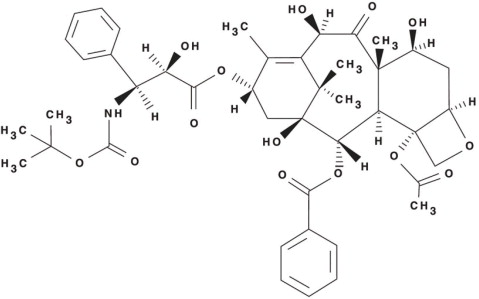
Docetaxel Structural Formula (Doc09 0000 01)

Docetaxel Structural Formula (Doc09 0000 01)
Chemical structure of docetaxel anhydrous, illustrating its molecular arrangement with various atoms and bonds, including rings, hydroxyl groups, and ester linkages.*
FDA Label Image

Figure 1 (Doc09 0000 02)

Figure 1 (Doc09 0000 02)
A line graph depicting disease-free survival (DFS) probability over time in months. The graph compares DFS for two treatments labeled TAC and FAC, showing DFS probability on the vertical axis and disease-free survival time on the horizontal axis.*
FDA Label Image

Figure 2 (Doc09 0000 03)

Figure 2 (Doc09 0000 03)
A survival probability plot comparing two treatment groups labeled TAC and FAC. The x-axis represents survival time in months, ranging from 0 to 66, and the y-axis represents survival probability percentage, ranging from 0% to 100%. The plot shows survival trends over time for each group.*
FDA Label Image

Figure 3 (Doc09 0000 04)

Figure 3 (Doc09 0000 04)
A line graph titled 'Overall Survival' showing survival time in months on the x-axis and cumulative probability on the y-axis. Two survival curves labeled T75 (solid line) and BSC (dashed line) are plotted, with a log-rank p-value of 0.010 indicated to compare survival between groups.*
FDA Label Image

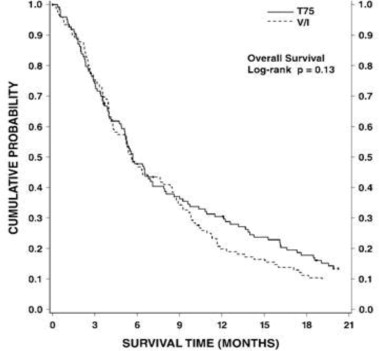
Figure 4 (Doc09 0000 05)

Figure 4 (Doc09 0000 05)
A Kaplan-Meier survival curve graph depicting cumulative probability versus survival time in months, with two groups labeled T75 and V/I. The chart includes an overall survival log-rank p-value of 0.13, showing comparative survival probabilities over a 21-month period.*
FDA Label Image

Figure 5 (Doc09 0000 06)

Figure 5 (Doc09 0000 06)
A survival curve graph showing the relationship between survival probability and survival time in months. Two lines represent different groups labeled T75 q3w and M q3w, depicting their respective probabilities of survival over a 30-month period.*
FDA Label Image

Figure 6 (Doc09 0000 07)

Figure 6 (Doc09 0000 07)
A survival probability plot showing two curves labeled TCF and CF. The y-axis represents probability (%) decreasing from 100 to 0. The x-axis shows time in months from 0 to 24. Both curves decline over time, indicating decreasing survival probability, with the TCF curve generally above the CF curve throughout the period.*
FDA Label Image

Figure 7 (Doc09 0000 08)

Figure 7 (Doc09 0000 08)
A survival curve graph depicting survival probability (%) over survival time (months) for two treatment groups labeled TCF and CF. The graph shows a declining trend in survival probability over a 36-month period for both groups, with the TCF group exhibiting a slightly higher survival probability throughout most of the timeline.*
FDA Label Image

Figure 8 (Doc09 0000 09)

Figure 8 (Doc09 0000 09)
A Kaplan-Meier curve chart depicting Progression-Free Survival (PFS) probability over time in months for two groups, TPF and PF. The y-axis shows PFS probability as a percentage, and the x-axis represents progression-free survival time in months, ranging from 0 to 42 months.*
FDA Label Image

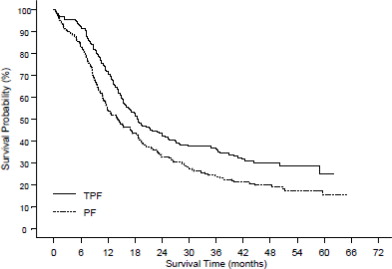
Figure 9 (Doc09 0000 10)

Figure 9 (Doc09 0000 10)
A survival probability chart plotting survival time in months on the x-axis against survival probability in percent on the y-axis. The graph compares two groups labeled TPF and PF, showing survival curves for each over time up to 72 months.*
FDA Label Image

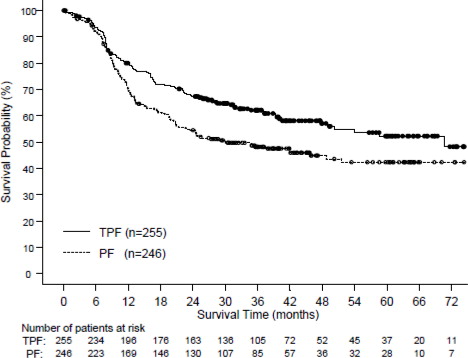
Figure 10 (Doc09 0000 11)

Figure 10 (Doc09 0000 11)
A survival probability curve chart comparing two patient groups labeled TPF (n=255) and PF (n=246). The x-axis shows survival time in months from 0 to 72, and the y-axis shows survival probability from 0% to 100%. TPF shows higher survival probabilities over time compared to PF, with patient numbers at risk indicated below the x-axis for various time points.*

* About these descriptions: Image descriptions on this page are generated by automated AI analysis of the product label images from the manufacturer's FDA label submission (SPL). They are provided for reference only and may contain errors or omissions. Always rely on the printed label itself and the official FDA labeling, and consult a pharmacist or healthcare professional with any questions about this product.