Preparation for Immediate Subcutaneous Administration
For doses requiring more than 1 vial, divide the dose equally between the syringes (e.g., dose 150 mg = 6 mL, 2 syringes with 3 mL in each syringe) and inject into two separate sites. Due to retention in the vial and needle, it may not be feasible to withdraw all of the suspension from the vial. The product may be held at room temperature for up to 1 hour, but must be administered within 1 hour after reconstitution.
Preparation for Delayed Subcutaneous Administration
The reconstituted product may be kept in the vial or drawn into a syringe. For doses requiring more than 1 vial, divide the dose equally between the syringes (e.g., dose 150 mg = 6 mL, 2 syringes with 3 mL in each syringe) and inject into two separate sites. Due to retention in the vial and needle, it may not be feasible to withdraw all of the suspension from the vial. The product must be refrigerated immediately. See Table 2 for suspension stability storage timelines based on the temperature of the diluent for delayed subcutaneous administration.
After removal from refrigerated conditions, the suspension may be allowed to equilibrate to room temperature for up to 30 minutes prior to administration.
Subcutaneous Administration
To provide a homogeneous suspension, the contents of the dosing syringe must be re-suspended immediately prior to administration. To re-suspend, vigorously roll the syringe between the palms until a uniform, cloudy suspension is achieved.
Azacitidine for injection suspension is administered subcutaneously. Rotate sites for each injection (thigh, abdomen, or upper arm). New injections should be given at least one inch from an old site and never into areas where the site is tender, bruised, red, or hard.
Table 2 Suspension Stability: Storage timelines based on the temperature of the diluent for suspension stability storage:
| Suspension Stability Storage timelines |
| Diluent | | Storage Temperature/Duration |
| Room temperature (25°C / 77°F) Sterile Water for Injection, USP | | Store at room temperature at 25°C (77°F) for up to 1 hour or refrigerated at 2°C to 8°C (36°F to 46°F) for up to 8 hours. |
| Cold (2°C to 8°C / 36°F to 46°F) Sterile Water for Injection, USP | | Store refrigerated at 2°C to 8°C (36°F to 46°F) for up to 22 hours. |
Intravenous Solution Incompatibility
Azacitidine for injection is incompatible with 5% Dextrose Injection, USP solutions, Hespan, or solutions that contain bicarbonate. These solutions have the potential to increase the rate of degradation of azacitidine for injection and should therefore be avoided.
Intravenous Administration
Azacitidine for injection solution is administered intravenously. Administer the total dose over a period of 10 to 40 minutes. The administration must be completed within 1 hour of reconstitution of the azacitidine for injection vial.
Solution Stability
Azacitidine for injection reconstituted and diluted for intravenous administration may be stored at 25°C (77°F), but administration must be completed within 1 hour of reconstitution.
Pediatric use information is approved for Celgene Corporation's Vidaza (azacitidine for injection). However, due to Celgene Corporation's marketing exclusivity rights, this drug product is not labeled with that information.
Risk Summary
Based on its mechanism of action and findings in animals, azacitidine can cause fetal harm when administered to a pregnant woman [see Clinical Pharmacology (12.1)]. There are no data on the use of azacitidine in pregnant women. Azacitidine was teratogenic and caused embryo-fetal lethality in animals at doses lower than the recommended human daily dose (see Data). Advise pregnant women of the potential risk to the fetus.
The background rate of major birth defects and miscarriage is unknown for the indicated population. All pregnancies have a background risk of birth defect, loss, or other adverse outcomes. In the U.S. general population, the estimated background risk of major birth defects and miscarriage in clinically recognized pregnancies is 2%-4% and 15%-20%, respectively.
Data
Animal Data
Early embryotoxicity studies in mice revealed a 44% frequency of intrauterine embryonal death (increased resorption) after a single IP (intraperitoneal) injection of 6 mg/m2 (approximately 8% of the recommended human daily dose on a mg/m2 basis) azacitidine on gestation day 10. Developmental abnormalities in the brain have been detected in mice given azacitidine on or before gestation day 15 at doses of ~3-12 mg/m2 (approximately 4%-16% the recommended human daily dose on a mg/m2 basis).
In rats, azacitidine was clearly embryotoxic when given IP on gestation days 4-8 (postimplantation) at a dose of 6 mg/m2 (approximately 8% of the recommended human daily dose on a mg/m2 basis), although treatment in the preimplantation period (on gestation days 1-3) had no adverse effect on the embryos. Azacitidine caused multiple fetal abnormalities in rats after a single IP dose of 3 to 12 mg/m2 (approximately 8% the recommended human daily dose on a mg/m2 basis) given on gestation day 9, 10, 11 or 12. In this study azacitidine caused fetal death when administered at 3-12 mg/m2 on gestation days 9 and 10; average live animals per litter was reduced to 9% of control at the highest dose on gestation day 9. Fetal anomalies included: CNS anomalies (exencephaly/encephalocele), limb anomalies (micromelia, club foot, syndactyly, oligodactyly), and others (micrognathia, gastroschisis, edema, and rib abnormalities).
Risk Summary
There is no information regarding the presence of azacitidine in human milk, the effects of azacitidine on the breastfed infant, or the effects of azacitidine on milk production. Because many drugs are excreted in human milk and because of the potential for tumorigenicity shown for azacitidine in animal studies [see Nonclinical Toxicology (13.1)] and the potential for serious adverse reactions in nursing infants from azacitidine, advise patients not to breastfeed during treatment with azacitidine and for 1 week after the last dose.
Pregnancy Testing
Verify the pregnancy status of females of reproductive potential prior to initiating azacitidine.
Contraception
Females
Advise pregnant women of the potential risk to a fetus. Advise females of reproductive potential to use effective contraception during treatment with azacitidine and for 6 months after the last dose.
Males
Advise males with female partners of reproductive potential to use effective contraception during treatment with azacitidine and for 3 months after the last dose.
Infertility
Based on animal data, azacitidine could have an effect on male or female fertility [see Nonclinical Toxicology (13.1)].
Absorption
Azacitidine is rapidly absorbed after subcutaneous administration; the peak plasma azacitidine concentration of 750 ± 403 ng/ml occurred in 0.5 hour after subcutaneous administration.
Distribution
The bioavailability of subcutaneous azacitidine relative to intravenous azacitidine is approximately 89%, based on area under the curve. Mean volume of distribution following intravenous dosing is 76 ± 26 L. Mean apparent subcutaneous clearance is 167 ± 49 L/hour and mean half-life after subcutaneous administration is 41 ± 8 minutes. The AUC and Cmax of subcutaneous administration of azacitidine in 21 patients with cancer were approximately dose proportional within the 25 to 100 mg/m2 dose range. Multiple dosing at the recommended dose-regimen does not result in drug accumulation with intravenous or subcutaneous administration.
Elimination
Metabolism
An in vitro study of azacitidine incubation in human liver fractions indicated that azacitidine is not metabolized by the cytochrome P450 (CYP) enzymes. Azacitidine undergoes spontaneous hydrolysis and deamination mediated by cytidine deaminase.
Excretion
Published studies indicate that urinary excretion is the primary route of elimination of azacitidine and its metabolites. Following intravenous administration of radioactive azacitidine to 5 cancer patients, the cumulative urinary excretion was 85% of the radioactive dose. Fecal excretion accounted for <1% of administered radioactivity over 3 days. Mean excretion of radioactivity in urine following subcutaneous administration of 14C-azacitidine was 50%. The mean elimination half-lives of total radioactivity (azacitidine and its metabolites) were similar after intravenous and subcutaneous administrations, about 4 hours.
Specific Populations
The effects of hepatic impairment, gender, or race/ethnicity on the pharmacokinetics of intravenous and subcutaneous azacitidine have not been studied.
Pediatric Patients
Pediatric use information is approved for Celgene Corporation's Vidaza (azacitidine for injection). However, due to Celgene Corporation's marketing exclusivity rights, this drug product is not labeled with that information.
Patients with Renal Impairment
In adult patients with cancer, the pharmacokinetics of azacitidine in 6 patients with normal renal function (CLcr >80 mL/min) and 6 patients with severe renal impairment (CLcr <30 mL/min) were compared following daily subcutaneous dosing (Days 1 through 5) at 75 mg/m2/day. Severe renal impairment increased azacitidine exposure by approximately 70% after single and 41% after multiple subcutaneous administrations. This increase in exposure was not correlated with an increase in adverse events. The exposure was similar to exposure in patients with normal renal function receiving 100 mg/m2.
Drug-Drug Interactions
No formal clinical drug interaction studies with azacitidine have been conducted.
In vitro Studies
Cytochrome P450 (CYP) Enzymes: An in vitro study at azacitidine concentrations up to 100 μM (IV Cmax = 10.6 μM) in human liver microsomes indicated that azacitidine does not cause any inhibition of CYP isoforms CYP1A2, CYP2B6, CYP2C8, CYP2C9, CYP2C19, CYP2D6, CYP3A4, or CYP2E1 at clinically achievable concentrations.
In vitro studies with human cultured hepatocytes indicate that azacitidine at concentrations of 1.0 μM to 100 μM does not induce CYP 1A2, 2C19, or 3A4/5.
Transporter Systems: An in vitro study with LLC-PK1 cells expressing P-glycoprotein (P-gp) indicated that azacitidine is not a substrate or inhibitor of P-gp.
Azacitidine does not inhibit, breast cancer resistance protein (BCRP), organic anion transporters (OAT) OAT1 and OAT3, organic anion transporting polypeptides (OATP) OATP1B1 and OATP1B3, or organic cation transporter (OCT) OCT2 at clinically relevant concentrations.
How Supplied
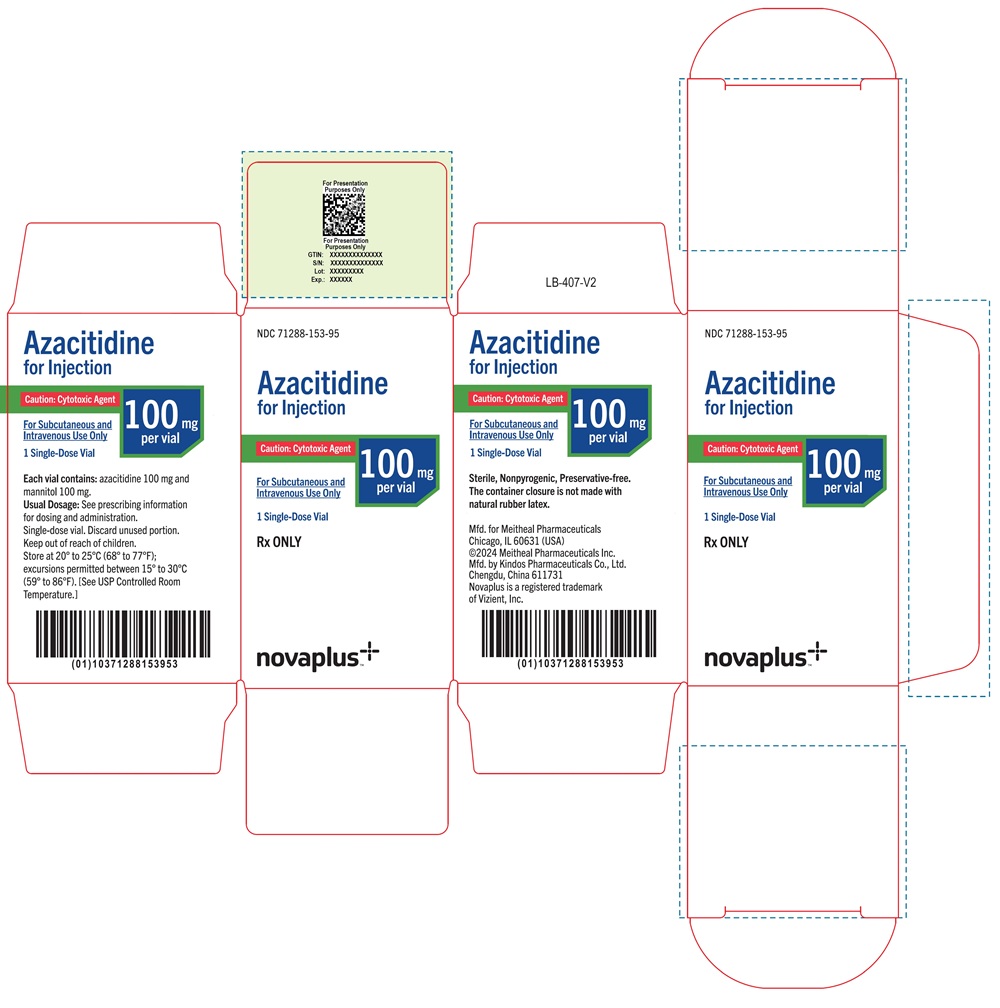
Azacitidine for Injection is a white to off-white lyophilized powder or lyophilized cake and is supplied as follows:
| NDC | Azacitidine for Injection (100 mg per vial) | Package Factor |
|---|
| 71288-153-95 | 100 mg of Azacitidine and 100 mg Mannitol in a 30mL Single-Dose Vial | 1 vial per carton |
Handling and Disposal
Azacitidine for Injection is a hazardous drug. Follow applicable special handling and disposal procedures. 1
Hepatotoxicity in Patients with Severe Pre-Existing Hepatic Impairment
Instruct patients to inform their physician about any underlying liver disease [see Warnings and Precautions (5.3)].
Renal Toxicity
Instruct patients to inform their physician about any underlying renal disease [see Warnings and Precautions (5.4)].
Embryo-Fetal Toxicity
Advise pregnant women of the potential risk to a fetus [see Warnings and Precautions (5.6) and Use in Specific Populations (8.1)].
Advise females of reproductive potential to use effective contraception during treatment with azacitidine and for 6 months after the last dose. Advise males with female partners of reproductive potential to use effective contraception during treatment with azacitidine and for 3 months after the last dose. Advise patients to report known or suspected pregnancy to their physicians immediately [see Warnings and Precautions (5.6) and Use in Specific Populations (8.3)].
Lactation
Advise patients to avoid breastfeeding while receiving azacitidine and for 1 week after the last dose [see Use in Specific Populations (8.2)].
Infertility
Advise males and females that azacitidine may impair fertility [see Use in Specific Populations (8.3) and Nonclinical Toxicology (13.1)].
Mfd. for Meitheal Pharmaceuticals
Chicago, IL 60631 (USA)
©2025 Meitheal Pharmaceuticals Inc.
Mfd. by Kindos Pharmaceuticals Co., Ltd.
Chengdu, China 611731
Novaplus is a registered trademark of Vizient, Inc.
Revised: May 2025
novaplus+
LB-408-V4