Risk Summary
Busulfan can cause fetal harm when administered to a pregnant woman based on animal data. Busulfan was teratogenic in mice, rats, and rabbits following administration during organogenesis. The solvent, DMA, may also cause fetal harm when administered to a pregnant woman. In rats, DMA doses of approximately 40% of the daily dose of DMA in the busulfan dose on a mg/m2 basis given during organogenesis caused significant developmental anomalies (see Data). There are no available human data informing the drug-associated risk. Advise pregnant women of the potential risk to a fetus.
The background risk of major birth defects and miscarriage for the indicated populations are unknown. However, the background risk in the U.S. general population of major birth defects is 2-4% and of miscarriage is 15-20% of clinically recognized pregnancies.
Animal Data
Following administration during organogenesis in animals, busulfan caused malformations and anomalies, including significant alterations in the musculoskeletal system, body weight gain, and size. In pregnant rats, busulfan produced sterility in both male and female offspring due to the absence of germinal cells in the testes and ovaries. The solvent, N, N-dimethylacetamide (DMA), administered to rats at doses of 400 mg/kg/day (about 40% of the daily dose of DMA in the busulfan dose on a mg/m2 basis) during organogenesis caused significant developmental anomalies. The most striking abnormalities included anasarca, cleft palate, vertebral anomalies, rib anomalies, and serious anomalies of the vessels of the heart.
Risk Summary
It is not known whether busulfan is present in human milk. Because many drugs are excreted in human milk and because of the potential for tumorigenicity shown for busulfan in human and animal studies, discontinue breastfeeding during treatment with busulfan.
Contraception
Females
Busulfan can cause fetal harm when administered to a pregnant woman [see Use in Specific Populations (8.1)]. Advise females of reproductive potential to use effective contraception during treatment with busulfan and for 6 months following cessation of therapy.
Males
Busulfan may damage spermatozoa and testicular tissue, resulting in possible genetic fetal abnormalities. Males with female sexual partners of reproductive potential should use effective contraception during treatment with busulfan and for 3 months after cessation of therapy [see Nonclinical Toxicology (13.1)].
Infertility
Females
Ovarian suppression and amenorrhea commonly occur in premenopausal women undergoing chronic, low-dose busulfan therapy for chronic myelogenous leukemia. Busulfan may cause temporary or permanent infertility in prepubertal girls or in females of child-bearing potential treated with high-dose busulfan in the conditioning regimen prior to allogeneic hematopoietic progenitor cell transplantation.
Males
Sterility, azoospermia, and testicular atrophy have been reported in male patients.
Dose Adjustment Based on Therapeutic Drug Monitoring
Instructions for measuring the AUC of busulfan at dose 1 (see Blood Sample Collection for AUC Determination) and the formula for adjustment of subsequent doses to achieve the desired target AUC (1125 μM•min), are provided below.
| Adjusted dose (mg) = Actual Dose (mg) x Target AUC (μM•min)/Actual AUC (μM•min)
|
For example, if a patient received a dose of 11 mg busulfan and if the corresponding AUC measured was 800 μM•min, for a target AUC of 1125 μM•min, the target mg dose would be:
| Mg dose =11 mg x 1125 μM•min /800 μM•min =15.5 mg
|
Busulfan dose adjustment may be made using this formula and instructions below.
Blood Sample Collection for AUC Determination
Calculate the AUC (μM•min) based on blood samples collected at the following time points:
For dose 1:2 hr (end of infusion), 4 hr and 6 hr (immediately prior to the next scheduled busulfan administration). Actual sampling times should be recorded.
For doses other than dose 1: Pre-infusion (baseline), 2 hr (end of infusion), 4 hr and 6 hr (immediately prior to the next scheduled busulfan administration).
AUC calculations based on fewer than the three specified samples may result in inaccurate AUC determinations.
For each scheduled blood sample, collect one to three mL of blood into heparinized (Na or Li heparin) Vacutainer® tubes. The blood samples should be placed on wet ice immediately after collection and should be centrifuged (at 4°C) within one hour. The plasma, harvested into appropriate cryovial storage tubes, is to be frozen immediately at -20°C. All plasma samples are to be sent in a frozen state (i.e., on dry ice) to the assay laboratory for the determination of plasma busulfan concentrations.
Calculation of AUC
Busulfan AUC calculations may be made using the following instructions and appropriate standard pharmacokinetic formula:
- Dose 1 AUCinfinity Calculation: AUCinfinity = AUC0-6hr +AUCextrapolated, where AUC0-6hr is to be estimated using the linear trapezoidal rule and AUC extrapolated can be computed by taking the ratio of the busulfan concentration at Hour 6 and the terminal elimination rate constant, λz. The λz must be calculated from the terminal elimination phase of the busulfan concentration vs. time curve. A “0” pre-dose busulfan concentration should be assumed, and used in the calculation of AUC.
If the AUC is assessed subsequent to Dose 1, steady-state AUCss (AUC0-6hr) is to be estimated from the trough, 2 hr, 4 hr and 6 hr concentrations using the linear trapezoidal rule.
Instructions for Drug Administration and Blood Sample Collection for Therapeutic Drug Monitoring
Use an administration set with minimal residual hold up (priming) volume (1 to 3 mL) for drug infusion to ensure accurate delivery of the entire prescribed dose and to ensure accurate collection of blood samples for therapeutic drug monitoring and dose adjustment.
Prime the administration set tubing with drug solution to allow accurate documentation of the start time of busulfan infusion. Collect the blood sample from a peripheral IV line to avoid contamination with infusing drug. If the blood sample is taken directly from the existing central venous catheter (CVC), DO NOT COLLECT THE BLOOD SAMPLE WHILE THE DRUG IS INFUSING to ensure that the end of infusion sample is not contaminated with any residual drug. At the end of infusion (2 hr), disconnect the administration tubing and flush the CVC line with 5 mL of normal saline prior to the collection of the end of infusion sample from the CVC port. Collect the blood samples from a different port than that used for the busulfan infusion. When recording the busulfan infusion stop time, do not include the time required to flush the indwelling catheter line. Discard the administration tubing at the end of the two-hour infusion [see Dosage and Administration (2.3)].
Distribution: Busulfan achieves concentrations in the cerebrospinal fluid approximately equal to those in plasma. Busulfan primarily binds to albumin (Mean ± standard deviation=32.4 ± 2.2%).
Metabolism: Busulfan is predominantly metabolized by conjugation with glutathione, both spontaneously and by glutathione S-transferase (GST) catalysis. This conjugate undergoes extensive oxidative metabolism in the liver.
Excretion: Following administration of 14C-labeled busulfan to humans, approximately 30% of the radioactivity was excreted into the urine over 48 hours; negligible amounts were recovered in feces.
Specific Populations
Pediatric Patients: In a pharmacokinetic study of busulfan in 24 pediatric patients, the population pharmacokinetic (PPK) estimates of busulfan for clearance (CL) and volume of distribution (V) were determined. For actual body weight, PPK estimates of CL and V were 4.04 L/hr per 20 kg (3.37 mL per min per kg; interpatient variability 23%); and 12.8 L per 20 kg (0.64 L per kg; interpatient variability 11%).
Prospective Clinical Trial of Busulfan: The prospective trial was a single-arm, open-label study in 61 patients who received busulfan as part of a conditioning regimen for allogeneic hematopoietic stem cell transplantation. The study included patients with acute leukemia past first remission (first or subsequent relapse), with high-risk first remission, or with induction failure; chronic myelogenous leukemia (CML) in chronic phase, accelerated phase, or blast crisis; primary refractory or resistant relapsed Hodgkin's disease or non-Hodgkin's lymphoma; and myelodysplastic syndrome. Forty-eight percent of patients (29/61) were heavily pretreated, defined as having at least one of the following: prior radiation, greater than or equal to 3 prior chemotherapeutic regimens, or prior hematopoietic stem cell transplant. Seventy-five percent of patients (46/61) were transplanted with active disease.
Patients received 16 busulfan doses of 0.8 mg per kg every 6 hours as a two-hour infusion for 4 days, followed by cyclophosphamide 60 mg per kg once per day for two days (BuCy2 regimen). All patients received 100% of their scheduled busulfan regimen. No dose adjustments were made. After one rest day, allogeneic hematopoietic progenitor cells were infused. The efficacy parameters in this study were myeloablation (defined as one or more of the following: absolute neutrophil count [ANC] less than 0.5x10⁹/L, absolute lymphocyte count [ALC] less than 0.1x10⁹/L, thrombocytopenia defined as a platelet count less than 20,000/mm3 or a platelet transfusion requirement) and engraftment (ANC greater than or equal to 0.5x10⁹/L).
All patients (61/61) experienced myeloablation. The median time to neutropenia was 4 days. All evaluable patients (60/60) engrafted at a median of 13 days post-transplant (range 9 to 29 days); one patient was considered non-evaluable because he died of a fungal pneumonia 20 days after BMT and before engraftment occurred. All but 13 of the patients were treated with prophylactic G-CSF. Evidence of donor cell engraftment and chimerism was documented in all patients who had a chromosomal sex marker or leukemic marker (43/43), and no patient with chimeric evidence of allogeneic engraftment suffered a later loss of the allogeneic graft. There were no reports of graft failure in the overall study population. The median number of platelet transfusions per patient was 6, and the median number of red blood cell transfusions per patient was 4.
Twenty-three patients (38%) relapsed at a median of 183 days post-transplant (range 36 to 406 days). Sixty-two percent of patients (38/61) were free from disease with a median follow-up of 269 days post-transplant (range 20 to 583 days). Forty-three patients (70%) were alive with a median follow up of 288 days post-transplant (range 51 to 583 days). There were two deaths before BMT Day +28 and six additional patients died by BMT Day +100. Ten patients (16%) died after BMT Day +100, at a median of 199 days post-transplant (range 113 to 275 days).
Oral Busulfan Literature Review: Four publications of randomized, controlled trials that evaluated a high-dose oral busulfan-containing conditioning regimen (busulfan 4 mg/kg/d x4 days + cyclophosphamide 60 mg/kg/d x2 days) for allogeneic transplantation in the setting of CML were identified. Two of the studies (Clift and Devergie) had populations confined to CML in chronic phase that were randomized between conditioning with busulfan/cyclophosphamide (BU/CY) and cyclophosphamide/total body irradiation (CY/TBI). A total of 138 patients were treated with BU/CY in these studies. The populations of the two remaining studies (Ringden and Blume) included patients with CML, acute lymphoblastic leukemia (ALL), and acute myelogenous leukemia (AML). In the Nordic BMT Group study published by Ringden, et al., 57 patients had CML, and of those, 30 were treated with BU/CY. Patients with CML in chronic phase, accelerated phase, and blast crisis were eligible for this study. The participants with CML (34/122 patients) in a SWOG study published by Blume, et al., had disease beyond first chronic phase. Twenty of those CML patients were treated with BU/CY, and the TBI comparator arm utilized etoposide instead of cyclophosphamide.
Table 4 summarizes the efficacy analyses reported from these 4 studies.
Table 4: Summary of efficacy analyses from the randomized, controlled trials utilizing a high dose oral busulfan-containing conditioning regimen identified in a literature review.
|
|
|
|
|
|
Clift, 1994
CML Chronic Phase; |
3 year Overall
Survival
| 3 year DFS
(p=0.43)
| Relapse
| Time to Engraftment
(ANC greater than or equal to 500)
|
| BU/CY
| CY/TBI
| BU/CY
| CY/TBI
| BU/CY
| CY/TBI
| BU/CY
| CY/TBI
|
| 80%
| 80%
| 71%
| 68%
| 13%
| 13%
| 22.6 days
| 22.3 days
|
Devergie, 1995
CML Chronic Phase; |
5 year Overall Survival
(p=0.5)
|
5 year DFS (p=0.75)
| Relapse (Relative Risk analysis
BU/CY:CY/TBI)
(p=0.04)
| Time to Engraftment (ANC greater than or equal to 500)
|
| BU/CY
| CY/TBI
| BU/CY
| CY/TBI
| BU/CY
| CY/TBI
| BU/CY
| CY/TBI
|
60.6%
±11.7%
| 65.8%
±12.5%
| 59.1%
±11.8%
| 51.0%
±14%
| 4.10
(95%CI =1.00-20.28)
| None
Given
| None
Given
|
Ringden, 1994
CML, AML, ALL; |
3 year Overall
Survival
(p<0.03)
| 3 year Relapse
Free Survival
(p=0.065)
| Relapse
(p=0.9)
| Time to Engraftment
(ANC greater than 500)
|
| BU/CY
| CY/TBI
| BU/CY
| CY/TBI
| BU/CY
| CY/TBI
| BU/CY
| CY/TBI
|
| 62%
| 76%
| 56%
| 67%
| 22%
| 26%
| 20 days
| 20 days
|
Blume, 19931
CML, AML, ALL; Relative Risk Analysis BU/CY: Etoposide/TBI |
| RR of Mortality
| DFS
| RR of Relapse
| Time to Engraftment
|
| | (Relative Risk analysis
| |
| BU/CY:Eto/TBI)
|
| BU/CY
| Eto/TBI
| BU/CY
| Eto/TBI
| BU/CY
| Eto/TBI
| BU/CY
| Eto/TBI
|
0.97
| | Not Given
| 1.02
| | Not Given
|
| (95% CI=0.64-1.48)
| (95% CI=0.56-1.86)
|
Myelosuppression
Advise patients of the possibility of developing low blood cell counts and the need for hematopoietic progenitor cell infusion. Instruct patients to immediately report to their healthcare provider if fever develops [see Warnings and Precautions (5.1)].
Seizures
Advise patients of the possibility of seizures and that they will be given medication to prevent them. Patients should be asked to report a history of seizure or head trauma [see Warnings and Precautions (5.2)].
Hepatic Veno-Occlusive Disease (HVOD)
Advise patients of the risks associated with the use of busulfan as well as the plan for regular blood monitoring during therapy. Specifically inform patients of the following: The risk of veno-occlusive liver disease [see Warnings and Precautions (5.3)].
Embryo-fetal Toxicity
Advise females of reproductive potential of the potential risk to a fetus and to inform their healthcare provider with a known or suspected pregnancy [see Warnings and Precautions (5.4) and Use in Specific Populations (8.1)].
Females of Reproductive Potential
Advise females of reproductive potential to use effective contraception during treatment with busulfan and for 6 months following cessation of therapy [see Use in Specific Populations (8.3)].
Males of Reproductive Potential
Advise males with female sexual partners of reproductive potential to use effective contraception during treatment with busulfan and for 3 months following cessation of therapy [see Use in Specific Populations (8.3)].
Lactation
Advise females to discontinue breastfeeding during treatment with busulfan [see Use in Specific Populations (8.2)].
Infertility
Advise females and males of reproductive potential that busulfan may cause temporary or permanent infertility [see Use in Specific Populations (8.3)].
Cardiac Tamponade
Advise patients of the risk of cardiac tamponade. Instruct patients to report to their healthcare provider symptoms of abdominal pain and vomiting [see Warnings and Precautions (5.5)].
Bronchopulmonary Dysplasia
Advise patients of the possibility of bronchopulmonary dysplasia with pulmonary fibrosis with chronic busulfan therapy. Instruct patients to report symptoms of shortness of breath and cough to their healthcare provider. These symptoms could occur several months or years after therapy with busulfan [see Warnings and Precautions (5.6)].
Brands listed are the trademarks of their respective owners.
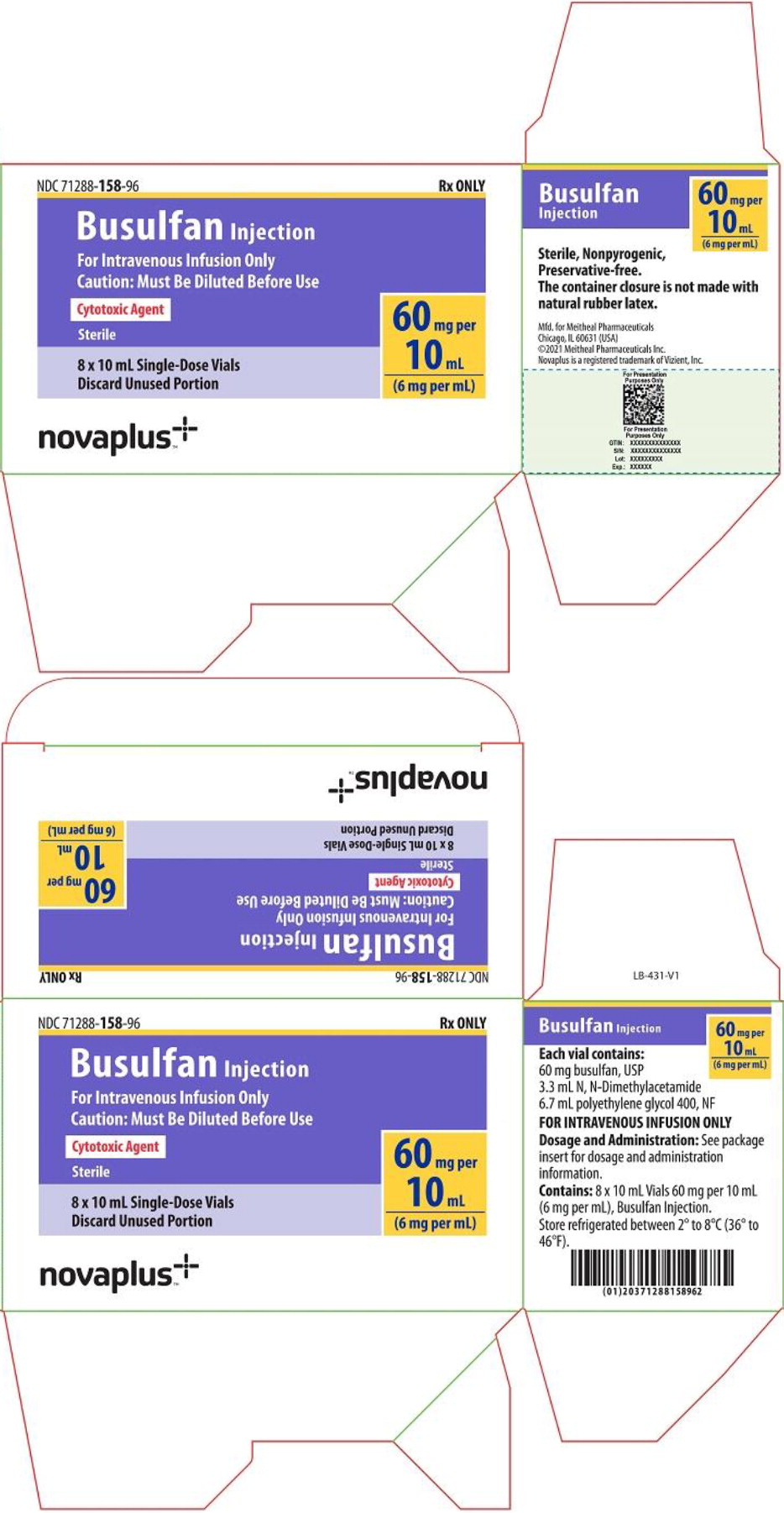
Mfd. for Meitheal Pharmaceuticals
Chicago, IL 60631 (USA)
©2021 Meitheal Pharmaceuticals Inc.
Novaplus is a registered trademark of Vizient, Inc.
April 2021
novaplus+TM