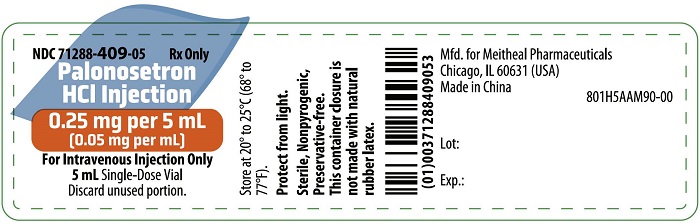
Other
Palonosetron Hydrochloride Injection is indicated in adults for prevention of:
- acute and delayed nausea and vomiting associated with initial and repeat courses of moderately emetogenic cancer chemotherapy (MEC).
- acute nausea and vomiting associated with initial and repeat courses highly emetogenic cancer chemotherapy (HEC).
- postoperative nausea and vomiting (PONV) for up to 24 hours following surgery. Efficacy beyond 24 hours has not been demonstrated.
- acute nausea and vomiting associated with initial and repeat courses of emetogenic cancer chemotherapy, including highly emetogenic cancer chemotherapy.
- Cardiovascular: non-sustained tachycardia, bradycardia, hypotension, hypertension, myocardial ischemia, extrasystoles, sinus tachycardia, sinus arrhythmia, supraventricular extrasystoles and QT prolongation.
- Dermatological: allergic dermatitis, rash
- Hearing and Vision: motion sickness, tinnitus, eye irritation and amblyopia
- Gastrointestinal System: diarrhea, dyspepsia, abdominal pain, dry mouth, hiccups and flatulence
- General: weakness, fatigue, fever, hot flash, flu-like syndrome
- Liver: transient, asymptomatic increases in AST and/or ALT and bilirubin. These changes occurred predominantly in patients receiving highly emetogenic chemotherapy
- Metabolic: hyperkalemia, electrolyte fluctuations, hyperglycemia, metabolic acidosis, glycosuria, appetite decrease, anorexia
- Musculoskeletal: arthralgia
- Nervous System: dizziness, somnolence, insomnia, hypersomnia, paresthesia
- Psychiatric: anxiety, euphoric mood
- Urinary System: urinary retention
- Vascular: vein discoloration, vein distention
- Nervous System: headache, dizziness, dyskinesia.
- General: infusion site pain.
- Dermatological: allergic dermatitis, skin disorder.
- Cardiovascular: QTc prolongation, sinus bradycardia, tachycardia, blood pressure decreased, hypotension, hypertension, arrhythmia, ventricular extrasystoles, generalized edema, ECG T wave amplitude decreased, platelet count decreased. The frequency of these adverse effects did not appear to be different from placebo.
- Dermatological: pruritus
- Gastrointestinal System: flatulence, dry mouth, upper abdominal pain, salivary hypersecretion, dyspepsia, diarrhea, intestinal hypomotility, anorexia
- General: chills
- Liver: increases in AST and/or ALT, hepatic enzyme increased
- Metabolic: hypokalemia, anorexia
- Nervous System: dizziness
- Respiratory: hypoventilation, laryngospasm
- Urinary System: urinary retention
As with other antiemetics, routine prophylaxis is not recommended in patients in whom there is little expectation that nausea and/or vomiting will occur postoperatively. In patients where nausea and vomiting must be avoided during the postoperative period, Palonosetron Hydrochloride Injection is recommended even where the incidence of postoperative nausea and/or vomiting is low.
Palonosetron Hydrochloride Injection is indicated in pediatric patients 1 month to less than 17 years of age for prevention of:
* Note different dosing units in pediatrics | ||
| Age | Dose* | Infusion Time |
| Adults | 0.25 mg as a single dose | Infuse over 30 seconds beginning approximately 30 minutes before the start of chemotherapy |
| Pediatrics (1 month to less than 17 years) | 20 micrograms per kilogram (maximum 1.5 mg) as a single dose | Infuse over 15 minutes beginning approximately 30 minutes before the start of chemotherapy |
Postoperative Nausea and Vomiting
The recommended dosage of palonosetron hydrochloride injection in adults for PONV is 0.075 mg administered as a single intravenous dose over 10 seconds immediately before the induction of anesthesia.
* Reported in at least 2% of patients in any treatment group | |||
| Adverse Reaction | Palonosetron hydrochloride injection 0.25 mg intravenously (N=633) | Ondansetron 32 mg intravenously (N=410) | Dolasetron 100 mg intravenously (N=194) |
| Headache | 9% | 8% | 16% |
| Constipation | 5% | 2% | 6% |
| Diarrhea | 1% | 2% | 2% |
| Dizziness | 1% | 2% | 2% |
| Fatigue | < 1% | 1% | 2% |
| Abdominal Pain | < 1% | < 1% | 2% |
| Insomnia | < 1% | 1% | 2% |
Less common adverse reactions, reported in 1% or less of patients, in Studies 1, 2 and 3 were:
In other studies, 2 subjects experienced severe constipation following a single palonosetron hydrochloride injection dose of approximately 0.75 mg (three times the recommended dose).
Pediatrics Aged 2 Months to 17 Years
In a pediatric clinical trial, 163 pediatric cancer patients with a mean age of 8 years received a single 20 mcg/kg (maximum 1.5 mg) intravenous infusion of palonosetron hydrochloride injection 30 minutes before beginning the first cycle of emetogenic chemotherapy [see Clinical Studies (14.2)]. Adverse reactions were evaluated in pediatric patients receiving palonosetron hydrochloride injection for up to 4 chemotherapy cycles. The following adverse reactions were reported in less than 1% of patients:
Postoperative Nausea and Vomiting
The most common adverse reactions reported in at least 2% of adults receiving palonosetron hydrochloride injection 0.075 mg intravenously immediately before induction of anesthesia in 3 randomized placebo-controlled trials [see Clinical Studies (14.3)] are shown in Table 3. Rates of adverse reactions between palonosetron hydrochloride injection and placebo groups were similar. Some events are known to be associated with, or may be exacerbated by, concomitant perioperative and intraoperative medications administered in this surgical population. A thorough QT/QTc study demonstrated palonosetron hydrochloride injection does not prolong the QT interval to any clinically relevant extent [see Clinical Pharmacology (12.2)].
* Reported in at least 2% of patients in any treatment group | ||
| Adverse Reaction | Palonosetron hydrochloride injection 0.075 mg intravenously (N=336) | Placebo (N=369) |
| Electrocardiogram QT prolongation | 5% | 3% |
| Bradycardia | 4% | 4% |
| Headache | 3% | 4% |
| Constipation | 2% | 3% |
Less common adverse reactions, reported in 1% of less of patients, in these PONV clinical trials were:
Risk Summary
There are no available data on palonosetron hydrochloride use in pregnant women to inform a drug-associated risk.
In animal reproduction studies, no effects on embryo-fetal development were observed with the administration of oral palonosetron hydrochloride during the period of organogenesis at doses up to 1,894 and 3,789 times the recommended human intravenous dose in rats and rabbits, respectively (see Data).
The estimated background risk of major birth defects and miscarriage for the indicated population is unknown. All pregnancies have a background risk of birth defect, loss, or other adverse outcomes. In the U.S. general population, the estimated background risk of major birth defects and miscarriage in clinically recognized pregnancies is 2 to 4% and 15 to 20%, respectively.
Data
Animal Data
In animal reproduction studies, no effects on embryo-fetal development were observed in pregnant rats given oral palonosetron hydrochloride at doses up to 60 mg/kg/day (1,894 times the recommended human intravenous dose based on body surface area) or pregnant rabbits given oral doses up to 60 mg/kg/day (3,789 times the recommended human intravenous dose based on body surface area) during the period of organogenesis.
Risk Summary
There are no data on the presence of palonosetron in human milk, the effects of palonosetron on the breastfed infant, or the effects of palonosetron on milk production. The developmental and health benefits of breastfeeding should be considered along with the mother’s clinical need for palonosetron hydrochloride and any potential adverse effect on the breastfed infant from palonosetron or from the underlying maternal condition.
Cardiac Electrophysiology
The effect of intravenous palonosetron on blood pressure, heart rate, and ECG parameters including QTc were comparable to intravenous ondansetron and dolasetron in CINV clinical trials. In PONV clinical trials the effect of palonosetron on the QTc interval was no different from placebo. In non-clinical studies palonosetron possesses the ability to block ion channels involved in ventricular de- and re-polarization and to prolong action potential duration.
At a dose of 9 times the maximum recommended adult dose, palonosetron hydrochloride injection does not prolong the QT interval to any clinically relevant extent.
a Geometric Mean (CV) except for t1/2 which is median values b CT is the plasma palonosetron concentration at the end of the 15-minute infusion c Clearance and Vss calculated from 10 and 20 mcg/kg and are weight adjusted | ||||
| PK Parameter a | Pediatric Age Group | |||
| Less than 2 years | 2 years to less than 6 years | 6 years to less than 12 years | 12 years to less than 17 years | |
| N=12 | N=42 | N=38 | N=44 | |
| CT b, ng/L | 9025 (197) | 9414 (252) | 16275 (203) | 11831 (176) |
| N=5 | N=7 | N=10 | ||
| AUC0-∞, h·mcg/L | 103.5 (40.4) | 98.7 (47.7) | 124.5 (19.1) | |
| N=6 | N=14 | N=13 | N=19 | |
| Clearance c, L/h/kg | 0.31 (34.7) | 0.23 (51.3) | 0.19 (46.8) | 0.16 (27.8) |
| Vss c, L/kg | 6.08 (36.5) | 5.29 (57.8) | 6.26 (40.0) | 6.20 (29.0) |
Racial or Ethnic Groups
The pharmacokinetics of palonosetron were characterized in 24 healthy Japanese subjects over an intravenous dose range of 3 to 90 mcg/kg. Total body clearance was 25% higher in Japanese subjects compared to Whites, however, this increase is not considered to be clinically meaningful.
Patients with Renal Impairment
Mild to moderate renal impairment does not significantly affect palonosetron pharmacokinetic parameters. Total systemic exposure increased by approximately 28% in patients with severe renal impairment relative to healthy subjects. This increase is not considered clinically meaningful.
Patients with Hepatic Impairment
Hepatic impairment does not significantly affect total body clearance of palonosetron compared to the healthy subjects.
Drug Interaction Studies
In vitro studies indicated that palonosetron is not an inhibitor of CYP1A2, CYP2A6, CYP2B6, CYP2C9, CYP2D6, CYP2E1 and CYP3A4/5 (CYP2C19 was not investigated) nor does it induce the activity of CYP1A2, CYP2D6, or CYP3A4/5. Therefore, the potential for clinically significant drug interactions with palonosetron appears to be low.
Dexamethasone
Coadministration of 0.25 mg palonosetron hydrochloride injection and 20 mg dexamethasone administered intravenously in healthy subjects revealed no pharmacokinetic drug-interactions between palonosetron and dexamethasone.
Oral Aprepitant
In an interaction study in healthy subjects where a single 0.25 mg intravenous dose of palonosetron hydrochloride injection was administered on day 1 and oral aprepitant for 3 days (125 mg/80 mg/80 mg), the pharmacokinetics of palonosetron were not significantly altered (AUC: no change, Cmax: 15% increase).
Metoclopramide
A study in healthy subjects involving a single 0.75 mg intravenous dose of palonosetron hydrochloride injection and steady state oral metoclopramide (10 mg four times daily) demonstrated no significant pharmacokinetic interaction.
Corticosteroids, Analgesics, Antiemetics/Antinauseants, Antispasmodics and Anticholinergic Agents
In controlled clinical trials, palonosetron hydrochloride injection has been safely administered with corticosteroids, analgesics, antiemetics/antinauseants, antispasmodics and anticholinergic agents.
a Intent-to-treat cohort b 2-sided Fisher’s exact test. Significance level at α=0.025. c These studies were designed to show non-inferiority. A lower bound greater than –15% demonstrates non-inferiority between palonosetron hydrochloride injection and comparator. | ||||||
| Chemotherapy | Study | Treatment Group | N a | % with Complete Response | p-value b | 97.5% Confidence Interval Palonosetron Hydrochloride Injection minus Comparator c |
| Moderately Emetogenic | 1 | Palonosetron hydrochloride injection 0.25 mg intravenously | 189 | 81 | 0.009 |  Table 5 Figure (Palono Tab 5) |
| Ondansetron 32 mg intravenously | 185 | 69 | ||||
| 2 | Palonosetron hydrochloride injection 0.25 mg intravenously | 189 | 63 | NS | ||
| Dolasetron 100 mg intravenously | 191 | 53 | ||||
| Highly Emetogenic | 3 | Palonosetron hydrochloride injection 0.25 mg intravenously | 223 | 59 | NS | |
| Ondansetron 32 mg intravenously | 221 | 57 | ||||
a Intent-to-treat cohort b 2-sided Fisher’s exact test. Significance level at α=0.025. c These studies were designed to show non-inferiority. A lower bound greater than –15% demonstrates non-inferiority between palonosetron hydrochloride injection and comparator. d Ondansetron 32 mg intravenous was used in the clinical trial. Although this dose was used in the trial, it is no longer the currently recommended dose. Refer to the ondansetron prescribing information for the current recommended dose. | ||||||
| Chemotherapy | Study | Treatment Group | N a | % with Complete Response | p-value b | 97.5% Confidence Interval Palonosetron Hydrochloride Injection minus Comparator c |
| Moderately Emetogenic | 1 | Palonosetron hydrochloride injection 0.25 mg intravenously | 189 | 74 | <0.001 |  Table 6 Figure (Palono Tab 6) |
| Ondansetron 32 mg intravenously d | 185 | 55 | ||||
| 2 | Palonosetron hydrochloride injection 0.25 mg intravenously | 189 | 54 | 0.004 | ||
| Dolasetron 100 mg intravenously | 191 | 39 | ||||
Table 7: Prevention of Overall Nausea and Vomiting (0 to 120 Hours) Associated with MEC in Adults in Studies 1 and 2: Complete Response Rates
a Intent-to-treat cohort b 2-sided Fisher’s exact test. Significance level at α=0.025. c These studies were designed to show non-inferiority. A lower bound greater than –15% demonstrates non-inferiority between palonosetron hydrochloride injection and comparator. d Ondansetron 32 mg intravenously was used in the clinical trial. Although this dose was used in the trial, it is no longer the currently recommended dose. Refer to the ondansetron prescribing information for the current recommended dose. | ||||||
| Chemotherapy | Study | Treatment Group | N a | % with Complete Response | p-value b | 97.5% Confidence Interval Palonosetron Hydrochloride Injection minus Comparator c |
| Moderately Emetogenic | 1 | Palonosetron hydrochloride injection 0.25 mg intravenously | 189 | 69 | <0.001 |  Table 7 Figure (Palono Tab 7) |
| Ondansetron 32 mg intravenously d | 185 | 50 | ||||
| 2 | Palonosetron hydrochloride injection 0.25 mg intravenously | 189 | 46 | 0.021 | ||
| Dolasetron 100 mg intravenously | 191 | 34 | ||||
a To adjust for multiplicity of treatment groups, a lower-bound of a 97.5% confidence interval was used to compare to -15%, the negative value of the non-inferiority margin. | ||
| Palonosetron hydrochloride injection 20 mcg/kg intravenously (N=165) | Ondansetron 0.15 mg/kg for 3 intravenous doses (N=162) | Difference [97.5% Confidence Interval]a: Palonosetron hydrochloride injection minus intravenous Ondansetron Comparator |
| 59.4% | 58.6% | 0.36% [-11.7%, 12.4%] |
In patients that received palonosetron hydrochloride injection at a lower dose than the recommended dose of 20 mcg/kg, non-inferiority criteria were not met.
a To reach statistical significance for each co-primary endpoint, the required significance limit for the lowest p-value was p<0.017. Δ Difference (%): palonosetron 0.075 mg minus placebo | |||
| Treatment | n/N (%) | Palonosetron Hydrochloride Injection vs Placebo | |
| Δ | p-value a | ||
| Co-primary Endpoints | |||
| Complete Response Rate (0 to 24 hours) | |||
| Palonosetron hydrochloride injection 0.075 mg intravenously | 59/138 (42.8%) | 16.8% | 0.004 |
| Placebo | 35/135 (25.9%) | ||
| Complete Response Rate (24 to 72 hours) | |||
| Palonosetron hydrochloride injection 0.075 mg intravenously | 67/138 (48.6%) | 7.8% | 0.188 |
| Placebo | 55/135 (40.7%) | ||
Palonosetron hydrochloride injection as a single dose of 0.075 mg reduced the severity of nausea compared to placebo. Analyses of other secondary endpoints indicate that palonosetron hydrochloride injection 0.075 mg was numerically better than placebo, however, statistical significance was not formally demonstrated.
A randomized, double-blind, multicenter, placebo-controlled, dose ranging study was performed to evaluate palonosetron hydrochloride injection for PONV following abdominal or vaginal hysterectomy. Five intravenous doses (0.1, 0.3, 1.0, 3.0 and 30 mcg/kg) were evaluated in a total of 381 intent-to-treat patients. The primary efficacy measure was the proportion of patients with CR in the first 24 hours after recovery from surgery. The lowest effective dose was palonosetron hydrochloride injection 1 mcg/kg (approximately 0.075 mg) which had a CR rate of 44% versus 19% for placebo, p=0.004 and significantly reduced the severity of nausea versus placebo, p=0.009.
Advise the patient or caregiver to read the FDA-approved patient labeling (Patient Information).
Hypersensitivity Reactions
Advise patients that hypersensitivity reactions, including anaphylaxis and anaphylactic shock, have been reported in patients with or without known hypersensitivity to other 5-HT3 receptor antagonists. Advise patients to seek immediate medical attention if any signs or symptoms of a hypersensitivity reaction occur with administration of palonosetron hydrochloride injection [see Warnings and Precautions (5.1)].
Serotonin Syndrome
Advise patients of the possibility of serotonin syndrome, especially with concomitant use of palonosetron hydrochloride injection and another serotonergic agent such as medications to treat depression and migraines. Advise patients to seek immediate medical attention if the following symptoms occur: changes in mental status, autonomic instability, neuromuscular symptoms with or without gastrointestinal symptoms [see Warnings and Precautions (5.2)].
meitheal®
Mfd. for Meitheal Pharmaceuticals
Chicago, IL 60631 (USA)
©2023 Meitheal Pharmaceuticals Inc.
Mfd. by Nanjing King-Friend Biochemical Pharmaceutical Co., Ltd.
Nanjing, China 210061
February 2023
8H5AAM9-00