Other adverse reactions reported to occur following the administration of methylene blue class products include the following:
Blood and lymphatic system disorders: hemolytic anemia, hemolysis, hyperbilirubinemia
Cardiac disorders: palpitations, tachycardia
Eye disorders: eye pruritus, ocular hyperemia, vision blurred
Gastrointestinal disorders: abdominal pain lower, dry mouth, flatulence, glossodynia, tongue eruption
General disorders and administration site conditions: death, infusion site extravasation, infusion site induration, infusion site pruritus, infusion site swelling, infusion site urticaria, peripheral swelling, thirst
Investigations: elevated liver enzymes
Musculoskeletal and connective tissue disorders: myalgia
Renal and urinary disorders: dysuria
Respiratory, thoracic and mediastinal disorders: nasal congestion, oropharyngeal pain, rhinorrhea, sneezing
Skin and subcutaneous tissue disorders: necrotic ulcer, papule, phototoxicity
Vascular disorders: hypertension
Clinically significant drug interactions with methylene blue injection are described below:
The concomitant use of methylene blue injection with other drugs that affect the serotonergic neurotransmitter system has resulted in serotonin syndrome. Although the mechanism is not clearly understood, literature reports suggest methylene blue is a potent reversible inhibitor of monoamine oxidase. Avoid concomitant use of methylene blue injection with medicinal products that enhance serotonergic transmission including antidepressants like SSRIs (selective serotonin reuptake inhibitors), SNRIs (serotonin and norepinephrine reuptake inhibitors), MAOIs (monoamine oxidase inhibitors), bupropion, buspirone, clomipramine, mirtazapine, linezolid, opioids, and dextromethorphan because of the potential for serious CNS reactions, including potentially fatal serotonin syndrome. If the intravenous use of methylene blue injection cannot be avoided in patients treated with serotonergic medicinal products, choose the lowest possible dose and observe the patient closely for CNS effects for up to 4 hours after administration [see Warning and Precautions (5.1) and Clinical Pharmacology (12.3)].
Risk Summary
Methylene blue injection may cause fetal harm when administered to a pregnant woman. Intra-amniotic injection of pregnant women with a methylene blue class product during the second trimester was associated with neonatal intestinal atresia and fetal death. Methylene blue produced adverse developmental outcomes in rats and rabbits when administered orally during organogenesis at doses at least 32 and 16 times, respectively, the clinical dose of 1 mg/kg (see Data). Advise pregnant women of the potential risk to a fetus.
In the U.S. general population, the estimated background risks of major birth defects and miscarriage in clinically recognized pregnancies are 2-4% and 15-20%, respectively.
Clinical Considerations
Fetal/neonatal adverse reactions
Intra-amniotic injection of a methylene blue class product hours to days prior to birth can result hyperbilirubinemia, hemolytic anemia, skin staining, methemoglobinemia, respiratory distress and photosensitivity in the newborn. Following administration of methylene blue injection to a pregnant woman at term, observe the newborn for these adverse reactions and institute supportive care.
Data
Animal Data
Methylene blue was administered orally to pregnant rats at doses of 50 to 350 mg/kg/day, during the period of organogenesis. Maternal and embryofetal toxicities were observed at all doses of methylene blue and were most evident at the 200 and 350 mg/kg/day doses. Maternal toxicity consisted of increased spleen weight. Embryo-fetal toxicities included reduced fetal weight, post-implantation loss, edema, and malformations including enlarged lateral ventricles. The dose of 200 mg/kg (1,200 mg/m2) in rats is approximately 32 times a clinical dose of 1 mg/kg based on body surface area.
Methylene blue was administered orally to pregnant rabbits at doses of 50, 100, or 150 mg/kg/day, during the period of organogenesis. Maternal death was observed at the methylene blue dose of 100 mg/kg. Embryofetal toxicities included spontaneous abortion at all dose levels and a malformation (umbilical hernia) at the 100 and 150 mg/kg/day doses. The dose of 50 mg/kg (600 mg/m2) in rabbits is approximately 16 times a clinical dose of 1 mg/kg based on body surface area.
Risk Summary
There is no information regarding the presence of methylene blue in human milk, the effects on the breastfed infant, or the effects on milk production. Because of the potential for serious adverse reactions, including genotoxicity discontinue breast-feeding during and for up to 8 days after treatment with methylene blue injection [see Clinical Pharmacology (12.3)].
The mean (CV%) Cmax and AUC of methylene blue 2,917 ng/mL (39%) and 13,977 ng•hr/mL (21%) following a 2 mg/kg dose administered as a 5-minute intravenous infusion.
Distribution
The mean± standard deviation steady state volume of distribution of a 2 mg/kg dose of methylene blue injection was 255 L ± 58. The mean plasma protein binding of methylene blue is approximately 94% in vitro. Methylene blue exhibits concentration-dependent partitioning into blood cells in vitro. The blood-to-plasma ratio was 5.1±2.8 at 5 minutes from the start of a 2 mg/kg dose administered as a 5-minute intravenous infusion and reached a plateau of 0.6 at 4 hours in a clinical study. Methylene blue is a substrate for the P-glycoprotein (P-gp, ABCB1) transporter, but not for BCRP or OCT2 in vitro.
Elimination
Methylene blue has a half-life of approximately 24 hours in humans.
Metabolism
Methylene blue is metabolized by CYPs 1A2, 2C19 and 2D6 in vitro; however, the predominant in vitro pathway appears to be UGT-mediated conjugation by multiple UGT enzymes, including UGT1A4 and UGT1A9.
Azure B, which is a minor impurity in methylene blue, is also formed in humans as a metabolite of methylene blue, with an overall drug/metabolite AUC ratio of greater than 6:1. Azure B has 8-fold lower potency than methylene blue.
Excretion
Approximately 40% of methylene blue is excreted into the urine unchanged.
Specific Populations
Renal Impairment
After a single 1 mg/kg dose of methylene blue injection, AUC0-96h increased by 52%, 116%, and 192% in subjects with mild (estimated glomerular filtration rate (eGFR) 60 – 89 mL/min/1.73 m2), moderate (eGFR 30-59 mL/min/1.73 m2), and severe (eGFR 15-29 mL/min/1.732 m2) renal impairment, respectively. Cmax increased by 42%, 34%, and 15% in subjects with mild, moderate, and severe renal impairment respectively [see Dosage and Administration (2.2) and Use in Specific Populations (8.6)]. The half-life was unchanged in patients with mild to moderate renal impairment.
The AUC0-96h of Azure B after a single 1 mg/kg dose increased by 29%, 94%, and 339% in subjects with mild (estimated glomerular filtration rate (eGFR) 60 – 89 mL/min/1.73 m2), moderate (eGFR 30-59 mL/min/1.73 m2), and severe (eGFR 15-29 mL/min/1.732 m2) renal impairment, respectively. Cmax increased by 23%, 13%, and 65% in subjects with mild, moderate, and severe renal impairment, respectively [see Dosage and Administration (2.2) and Use in Specific Populations (8.6)].
Drug Interactions Studies
Clinical Studies
The coadministration of 2 mg/kg dose of methylene blue injection with midazolam (a CYP3A4 substrate), caffeine (a CYP1A2 substrate), warfarin (a CYP2C9 substrate), and dextromethorphan (a CYP2D6 substrate) in a cocktail study did not affect the exposure of these substrates compared to their exposure without methylene blue injection administration.
In Vitro Studies
Cytochrome P450 (CYP450) Enzymes
Methylene blue inhibits CYP isozymes 1A2, 2B6, 2C8, 2C9, 2C19, 2D6 and 3A4/5. Possible time-dependent inhibition of CYP2C9, CYP2D6 and CYP3A4/5 (testosterone as substrate) was also observed. Methylene blue induces CYP1A2 but does not induce CYP2B6 or CYP3A4.
UDP-Glucuronosyltransferase (UGT)
Methylene blue inhibits UGT1A9 and UGT1A4, but did not significantly inhibit UGTs 1A1, 1A3, 1A6, 2B7 or 2B15.
Transporter
Methylene blue is both a substrate for and an inhibitor of P-gp but is not a substrate for BCRP or OCT2 in vitro. Methylene blue is not a significant inhibitor of BCRP, OAT1, OAT3, OAT1B1 or OAT1B3. Methylene blue inhibits OCT2, MATE1 and MATE2-K.
Serotonin Syndrome
Advise patients of the possibility of serotonin syndrome, especially with concomitant use of serotonergic agents such as medications to treat depression and migraines. Advise patients to seek immediate medical attention if the following symptoms occur after treatment with methylene blue injection: changes in mental status, autonomic instability, or neuromuscular symptoms with or without gastrointestinal symptoms [see Warnings and Precautions (5.1)].
Pregnancy
Advise pregnant women of the potential risk to the fetus with the use of methylene blue injection during pregnancy [see Use in Specific Populations (8.1)].
Breastfeeding
Advise patients to discontinue breast-feeding for up to 8 days after treatment with methylene blue injection [see Use in Specific Populations (8.2)].
Driving and Using Machines
Advise patients to avoid driving and use of machines during treatment with methylene blue injection. Driving can be affected as a result of a confusional state, dizziness and possible eye disturbances [see Warnings and Precautions (5.6)].
Phototoxicity
Advise patients to take protective measures against exposure to light, because phototoxicity may occur after administration of methylene blue [see Adverse Reactions (6.1)].
Skin and Body Fluid Blue Discoloration
Advise patients that methylene blue injection may cause a blue discoloration of the skin and body fluids [see Adverse Reactions (6.1)].
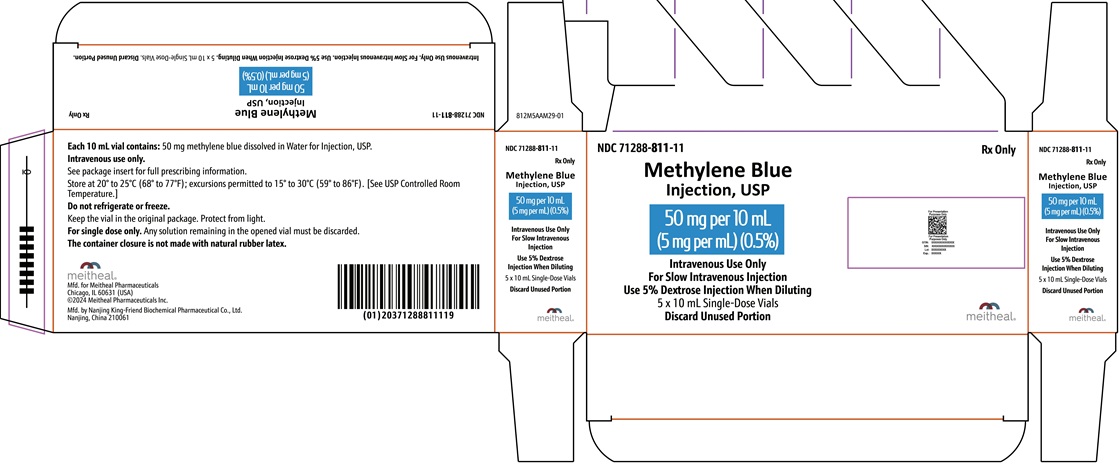
meitheal®
Mfd. for Meitheal Pharmaceuticals
Chicago, IL 60631 (USA)
©2024 Meitheal Pharmaceuticals Inc.
Mfd. by Nanjing King-Friend Biochemical Pharmaceutical Co., Ltd.
Nanjing, China 210061
December 2024
8M5AAM9-02