Because clinical trials are conducted under widely varying conditions, adverse reaction rates observed in the clinical trials of a drug cannot be directly compared to rates in the clinical trials of another drug and may not reflect the rates observed in clinical practice.
A total of 1535 patients were treated with OLINVYK in controlled and open-label trials in patients with moderate to severe acute pain. Of these, 1181 patients received a total daily dose ≤27 mg and 354 patients received a total daily dose >27 mg during the first 24-hour treatment period. Among patients who received a daily dose of >27 mg, 198 patients received a daily dose between 27 mg and 40 mg, and 142 patients received a daily dose >40 mg.
The most common adverse drug reactions (≥10%) in controlled efficacy trials (Study 1 and Study 2) were nausea, vomiting, dizziness, headache, constipation, pruritus and hypoxia. Adverse reactions leading to discontinuation of OLINVYK were hypotension, hypoxia, nausea, hypoventilation, oxygen saturation decreased, alanine aminotransferase increased, aspartate aminotransferase increased, electrocardiogram QT prolongation, and urticaria. In two randomized, double-blind, placebo- and morphine-controlled studies, when stratified by 27 mg daily dosing limit, discontinuation of OLINVYK due to adverse reactions occurred in 4% of patients who received a daily dose ≤ 27 mg, and less than 1% of patients who received a daily dose >27 mg. In these same studies, discontinuation due to adverse reactions occurred in 5% of morphine-treated patients, and no placebo-treated patients. In an open-label safety study, discontinuation of OLINVYK due to adverse drug reactions occurred in 3% of patients who received a daily dose ≤ 27 mg, and 1% of patients who received a daily dose >27 mg.
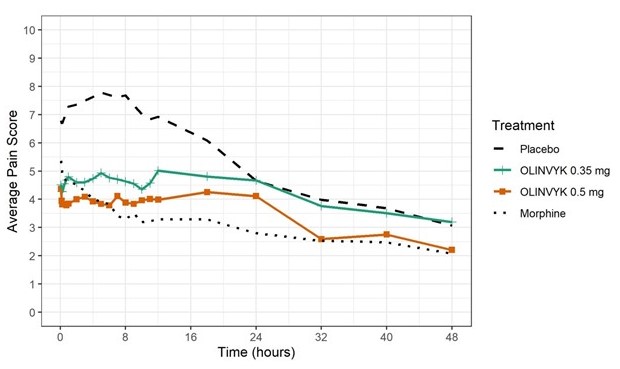
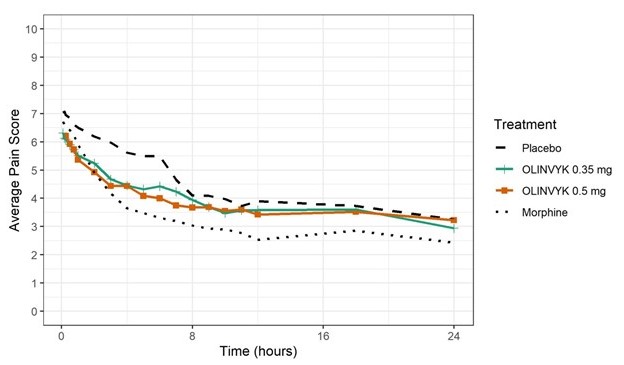
In two randomized, double-blind, placebo- and morphine-controlled studies in patients with moderate to severe acute pain following either orthopedic surgery-bunionectomy (Study 1), or plastic surgery-abdominoplasty (Study 2), patients received one of three OLINVYK dosing regimens, a morphine- control regimen, or a volume−matched placebo−control regimen. All dosing regimens were administered via patient-controlled analgesia (PCA), allowing patients to individually titrate the dose available to an acceptable level of analgesia. Patients were treated for up to 48 hours in the bunionectomy study (Study 1), and for up to 24 hours in the abdominoplasty study (Study 2) [see Clinical Studies (14)]. The loading dose for all OLINVYK treatment regimens was 1.5 mg; demand doses were 0.1, 0.35, or 0.5 mg, according to assigned treatment group; supplemental doses of 0.75 mg were permitted, beginning 1 hour after the loading dose, and hourly thereafter, as needed. The loading dose for the morphine treatment regimen was 4 mg; the demand dose was 1 mg; and supplemental doses of 2 mg were permitted, beginning 1 hour after the loading dose, and hourly thereafter, as needed. A lockout interval of 6 minutes was used for all PCA regimens.
In Study 1, a total of 136 patients received OLINVYK ≤27 mg/day, and 98 patients received OLINVYK >27 mg/day during the first 24 hours. In Study 2, a total of 180 patients received OLINVYK ≤27 mg/day, and 56 patients received OLINVYK >27 mg/day during the first 24 hours.
Table 1 and Table 2 list adverse drug reactions that were reported in ≥5% of OLINVYK-treated patients in each study, and that occurred at a frequency greater than placebo in at least one of the studies.
Table 3 lists adverse drug reactions that were reported in ≥5% of OLINVYK-treated patients for pooled Studies 1 and 2 stratified by total daily dose (≤27 mg/day or >27 mg/day).
These data are not an adequate basis for comparison of rates between the OLINVYK treatment group and the morphine treatment group. The OLINVYK and morphine dosing regimens studied are not considered equipotent.
Table 1: Adverse Drug Reactions Reported in ≥5% of OLINVYK-Treated Patients Following Orthopedic Surgery-Bunionectomy (Study 1)
Adverse Drug Reaction | Placebo
(N = 79) | OLINVYK
0.35 mga
(N = 79) | OLINVYK
0.5 mga
(N = 79) | Morphineb
(N = 76) |
| Patients with any TEAEc (%) | 68 | 86 | 91 | 96 |
| Nausea | 24 | 56 | 63 | 65 |
| Vomiting | 6 | 39 | 41 | 50 |
| Dizziness | 10 | 32 | 35 | 34 |
| Somnolence | 6 | 19 | 13 | 13 |
| Constipation | 11 | 11 | 14 | 17 |
| Pruritus | 8 | 15 | 4 | 20 |
| Hypoxia | 0 | 5 | 9 | 9 |
| Sedation | 1 | 5 | 4 | 3 |
| Oxygen saturation decreased | 0 | 4 | 5 | 9 |
a Each OLINVYK regimen included a loading dose of 1.5 mg, followed by access to demand doses of 0.35 or 0.5 mg, with a 6-minute lockout period between doses, and 0.75-mg supplemental doses, beginning 1 hour after the initial dose, and hourly thereafter, as needed.
b The morphine regimen included a loading dose of 4 mg, followed by access to a demand dose of 1 mg, with a 6-minute lockout period between doses, and 2-mg supplemental doses, beginning 1 hour after the initial dose, and hourly thereafter, as needed.
c Treatment Emergent Adverse Event |
Table 2: Adverse Drug Reactions Reported in ≥5% of OLINVYK -Treated Patients Following Plastic Surgery-Abdominoplasty (Study 2)| Adverse Drug Reaction | Placebo
(N = 79)
| OLINVYK
0.35 mga
(N = 79)
| OLINVYK
0.5 mga
(N = 79)
| Morphineb
(N = 76)
|
| Patients with any TEAEc (%) | 78 | 94 | 95 | 98 |
| Nausea | 46 | 62 | 75 | 74 |
| Vomiting | 13 | 22 | 43 | 54 |
| Hypoxia | 5 | 20 | 18 | 23 |
| Constipation | 7 | 17 | 11 | 11 |
| Pruritus | 5 | 17 | 11 | 18 |
| Dizziness | 11 | 9 | 9 | 16 |
| Sedation | 8 | 14 | 9 | 23 |
| Back pain | 6 | 13 | 11 | 9 |
| Somnolence | 1 | 0 | 5 | 7 |
a Each OLINVYK regimen included a loading dose of 1.5 mg, followed by access to demand doses of 0.35 or 0.5 mg with a 6-minute lockout period between doses, and 0.75-mg supplemental doses beginning 1 hour after the initial dose and hourly thereafter as needed.
b The morphine regimen included a loading dose of 4 mg, followed by access to a demand dose of 1 mg with a 6-minute lockout period between doses, and 2-mg supplemental doses beginning 1 hour after the initial dose, and hourly thereafter, as needed.
c Treatment Emergent Adverse Event |
Table 3: Adverse Drug Reactions Reported in ≥5% of OLINVYK-Treated Patients Stratified by Daily Dose (Study 1 and 2 Pooled)| Adverse Drug Reaction | Placebo (N = 162) | OLINVYK
≤ 27 mg
(N = 316) | OLINVYK
> 27 mg
(N= 154) | Morphine (N =158) |
| Patients with any TEAEa (%) | 73 | 86 | 92 | 96 |
| Nausea | 35 | 52 | 66 | 70 |
| Vomiting | 10 | 26 | 42 | 52 |
| Headache | 30 | 26 | 26 | 30 |
| Dizziness | 11 | 18 | 27 | 25 |
| Constipation | 9 | 14 | 12 | 14 |
| Hypoxia | 3 | 12 | 6 | 17 |
| Pruritus | 6 | 9 | 14 | 19 |
| Sedation | 5 | 7 | 7 | 13 |
| Somnolence | 4 | 6 | 10 | 10 |
| Back pain | 4 | 6 | 4 | 6 |
| Hot flush | 4 | 4 | 7 | 8 |
| Pruritus generalized | 1 | 2 | 5 | 10 |
| a Treatment Emergent Adverse Event |
In an open-label safety study of patients with moderate to severe acute pain following a surgical procedure or due to a medical condition (Study 3), a total of 768 patients received at least one dose of OLINVYK. OLINVYK was administered via clinician-administered bolus dosing, PCA, or a combination of the two. Bolus dosing was initiated at 1 to 2 mg, with supplemental doses of 1 to 3 mg every 1 to 3 hours, as needed, based on individual patient need and previous response to OLINVYK. If OLINVYK was administered via PCA, the loading dose was 1.5 mg, the demand dose was 0.5 mg, and the lockout interval was 6 minutes. Supplemental doses of 1 mg were given as needed, taking into account the patient's utilization of PCA demand doses, individual patient need, and previous response to OLINVYK.
In Study 3, for the patients within the highest cumulative dose group (exposure >36 mg), the mean cumulative exposure was 67 mg (range: 37 mg to 224 mg) and the mean cumulative duration of exposure was 54 hours (range: 6 hours to 143 hours). The mean cumulative dose of OLINVYK administered to patients in the Study 3 was 30 mg over a mean cumulative duration of 29 hours. The most frequent condition treated in Study 3 was post-surgical acute pain, and included (in order of decreasing frequency): orthopedic, gynecologic, colorectal, general, plastic, urologic, neurologic (including spinal), bariatric, and cardiothoracic surgical procedures. In Study 3, of the 768 patients treated with OLINVYK, 32% were age 65 years or older and 78% had a Body Mass Index ≥25 kg/m2. OLINVYK was administered as needed; 55% of patients received OLINVYK via clinician bolus administration only, and 45% of patients received OLINVYK via PCA self-administration or a combination of clinician bolus- and PCA self-administration.
In Study 3 (open-label), a total of 592 patients received OLINVYK ≤27 mg/day and 176 received OLINVYK >27 mg during the first 24 hours. Adverse drug reactions reported in ≥5% of patients receiving OLINVYK in Study 3, stratified by total daily dose (≤27 mg/day or >27 mg/day), are presented in Table 4.
Table 4: Adverse Drug Reactions Reported in ≥5% OLINVYK-Treated Patients in Study 3 (Open-Label)Adverse Drug Reaction
| OLINVYK
≤ 27mg
N = 592 | OLINVYK
> 27mg
N = 176 |
| Patients with any TEAEa (%) | 62 | 69 |
| Nausea | 29 | 38 |
| Constipation | 10 | 13 |
| Vomiting | 9 | 15 |
| Headache | 4 | 5 |
| Hypokalaemia | 4 | 7 |
| Pruritus | 4 | 8 |
| Pyrexia | 3 | 5 |
| a Treatment Emergent Adverse Event |
Adverse Drug Reactions Reported in >1% to <5% of Patients in the controlled and open-label studies (Study 1, Study 2, and Study 3) are listed in descending order of frequency within System Organ Class in Table 5.
Table 5: Adverse Drug Reactions Reported in >1% to <5% of Patients in Studies 1-3| System Organ Class | Adverse Drug Reaction Preferred Term |
| Blood and lymphatic disorders | Anemia |
| Cardiac disorders | Tachycardia |
| Gastrointestinal disorders | Flatulence, Dry mouth, Dyspepsia, Diarrhea |
| General disorders and administration site conditions | Pyrexia, Infusion site extravasation |
| Injury, poisoning and procedural complications | Procedural nausea |
| Investigations | Oxygen saturation decreased, Alanine aminotransferase increased, Blood pressure increased |
| Metabolism and nutritional disorders | Hypokalaemia, Hypocalcaemia, Hypophosphataemia, Hypomagnesaemia |
| Musculoskeletal and connective tissue disorders | Muscle spasms |
| Nervous system disorders | Headache |
| Psychiatric disorders | Anxiety, Insomnia, Restlessness |
| Respiratory, thoracic and mediastinal disorders | Cough, Dyspnea |
| Skin and subcutaneous tissue disorders | Hyperhidrosis, Rash, Pruritus generalised |
| Vascular disorders | Hypotension, Hot flush, Flushing |