Duloxetine Capsule, Delayed Release Pellets
Product Images NDC 71335-0165
View Photos of Packaging, Regulatory Labels, and Product Appearance
Product Visual Gallery
This gallery contains 11 technical images submitted to the FDA as part of the official labeling for Duloxetine (NDC 71335-0165). Unlike standard consumer photos, these assets often include clinical data figures, molecular chemical structures, and official manufacturer packaging layouts.
As provided by Bryant Ranch Prepack, these visuals offer a comprehensive scientific overview of the product's physical and chemical identity, aiding pharmacists and researchers in product verification and study.
Product Images & Figures Index
Figure 1 (Duloxetine 02)
The text represents a graph showing the proportion of patients with relapse based on the treatment with either placebo or Duloxetine delayed-release capsules. The X-axis indicates the time frame from randomization to relapse in days, while the Y-axis shows the proportion of patients in percentage. The graph shows that the proportion of patients who relapsed is comparatively lower in those who took Duloxetine delayed-release capsules than Placebo.*
Figure 2 (Duloxetine 03)
This appears to be a graph showing the proportion of patients experiencing relapse over time. The x-axis represents time in days, and the y-axis shows the proportion of patients with relapse. The graph compares a treatment (likely Duloxetine delayed-release capsules) with a placebo. However, without more context or information, it is difficult to draw further conclusions or provide more detail.*
Figure 3 (Duloxetine 04)
Figure 4 (Duloxetine 05)
Figure 7 (Duloxetine 06)
Figure 8 (Duloxetine 07)
Figure 9 (Duloxetine 08)
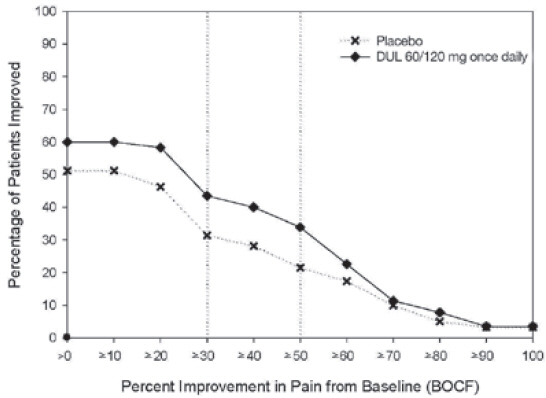
This text shows two sets of data related to medication effects on patients. The first set indicates the percentage of patients who were improved after taking the medication compared to a placebo. The second set shows the percentage improvement in pain from the baseline after treatment. The medication used was DUL 60/120 mg once daily. The data suggests that the medication had a positive effect on patients, but additional information is needed to determine the significance of these results.*
Duloxetine 09
This appears to be a graph depicting the percentage of patients who improved while taking placebo and DUL (assumed to be a medication). The x-axis shows a range of numbers from 50 to 290, which may represent different time points or levels of pain improvement. The y-axis shows the percentage of patients improved, with the scale ranging from 0 to 100. The graph includes two lines, one for placebo and one for DUL 60 mg once daily. The graph also includes a note about BOCF (baseline observation carried forward), which may be a statistical analysis method. A more detailed explanation or context is not available.*
Duloxetine 10
This is a graph showing the percentage of patients who improved after taking placebo or DUL60/120 mg once daily for pain management. The x-axis shows the percentage of improvement, ranging from 0 to 80 percent. The y-axis indicates the treatment group, where the top group represents the DUL60/120 mg group, and the bottom group represents the placebo group. However, this information is insufficient to know the full context of the study or its purpose.*
Label Image (Lbl713350165)
This is a package label of a drug named Cymbalta 20mg Capsule manufactured by Towa Pharmaceutical Europe, S.L. The package contains 30 capsules and is set to expire on a specific month and year. It contains a warning mentioning that the drug may cause drowsiness and instructions on how to store it at room temperature. The code at the bottom may be a product identifier, but its exact purpose is not clear.*
* These product label images have been analyzed using experimental machine learning. Please verify findings with the primary label text.