Gabapentin Capsule
Product Images NDC 71335-0214

8 FDA label images from Bryant Ranch Prepack · Packaging, Regulatory Labels, and Product Appearance

Product Visual Gallery

This gallery contains 8 technical images submitted to the FDA as part of the official labeling for Gabapentin (NDC 71335-0214). Unlike standard consumer photos, these assets often include clinical data figures, molecular chemical structures, and official manufacturer packaging layouts.

As provided by Bryant Ranch Prepack, these visuals offer a comprehensive scientific overview of the product's physical and chemical identity, aiding pharmacists and researchers in product verification and study.

FDA Label Image

Formula (Gabapentin Capsules Usp 1)

Formula (Gabapentin Capsules Usp 1)
A mathematical formula for estimating creatinine clearance (CLCr), which includes variables for age, weight, serum creatinine, and a factor adjustment for female patients. The formula is presented as a text equation with brackets and multiplication signs.*
FDA Label Image

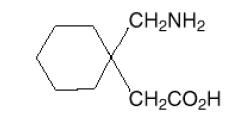
Chem Structure (Gabapentin Capsules Usp 2)

Chem Structure (Gabapentin Capsules Usp 2)
Chemical structure of Gabapentin showing a cyclohexane ring connected to an amino group (CH2NH2) and a carboxyl group (CH2CO2H).*
FDA Label Image

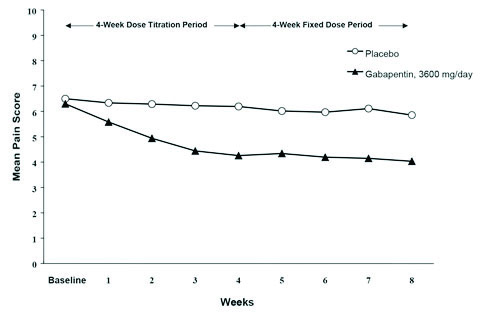
10 (Gabapentin Capsules Usp 3)

10 (Gabapentin Capsules Usp 3)
Line graph depicting mean pain score versus weeks, comparing Gabapentin 3600 mg/day and placebo during a 4-week dose titration period followed by a 4-week fixed dose period. Gabapentin shows a notable decrease in pain score over time, while placebo remains relatively stable.*
FDA Label Image

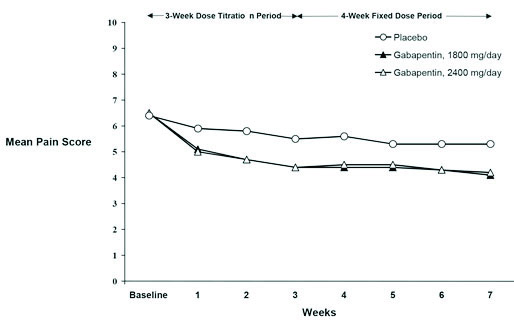
10 (Gabapentin Capsules Usp 4)

10 (Gabapentin Capsules Usp 4)
A line graph showing mean pain scores over 7 weeks for placebo and Gabapentin at 1800 mg/day and 2400 mg/day doses. The x-axis represents weeks with baseline and periods labeled '3-Week Dose Titration' and '4-Week Fixed Dose.' The y-axis shows mean pain scores from 0 to 10. Gabapentin treatment groups show decreasing pain scores compared to placebo.*
FDA Label Image

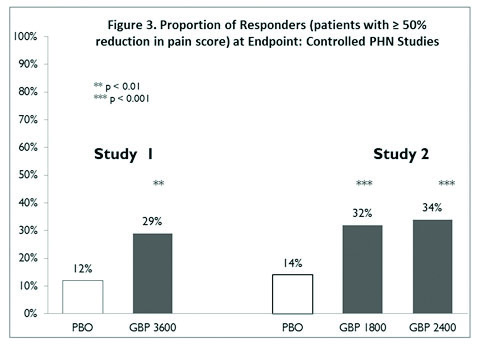
10 (Gabapentin Capsules Usp 5)

10 (Gabapentin Capsules Usp 5)
A bar chart titled 'Figure 3. Proportion of Responders (patients with ≥ 50% reduction in pain score) at Endpoint: Controlled PHN Studies' displaying results from two studies. The x-axis shows treatment groups (PBO, GBP 3600 in Study 1; PBO, GBP 1800, GBP 2400 in Study 2). The y-axis represents the percentage of responders from 0% to 100%. Study 1 shows 12% for placebo and 29% for Gabapentin 3600 mg; Study 2 shows 14% for placebo, 32% for Gabapentin 1800 mg, and 34% for Gabapentin 2400 mg. Statistical significance is indicated with p values <0.01 and <0.001.*
FDA Label Image

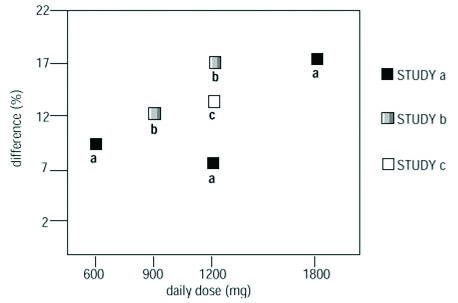
Figure 4 (Gabapentin Capsules Usp 6)

Figure 4 (Gabapentin Capsules Usp 6)
A scatter plot showing difference percentages on the y-axis and daily dose in milligrams on the x-axis, comparing three studies labeled a, b, and c with data points at 600, 900, 1200, and 1800 mg doses.*
FDA Label Image

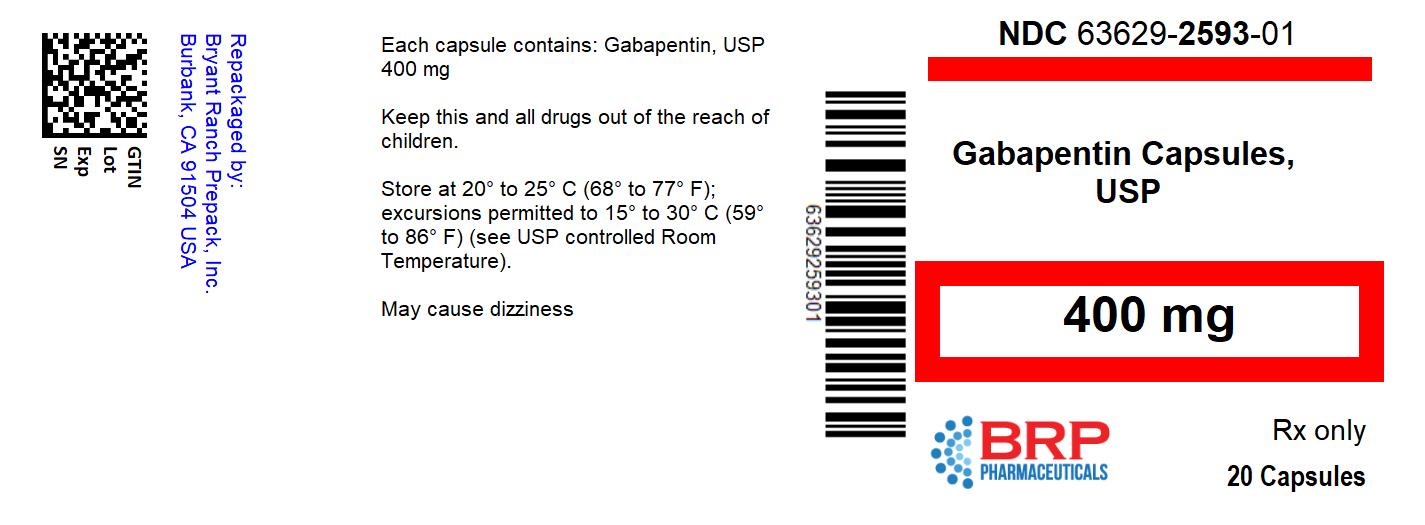
Label Image (Lbl713350214)

Label Image (Lbl713350214)
Label for Gabapentin Capsules, USP 400 mg by Bryant Ranch Prepack. The label shows the strength (400 mg) prominently with the NDC 63629-2593-01. The package contains 20 capsules, marked Rx only. Storage instructions and a caution about dizziness are also included. The label features the BRP Pharmaceuticals logo.*
FDA Label Image

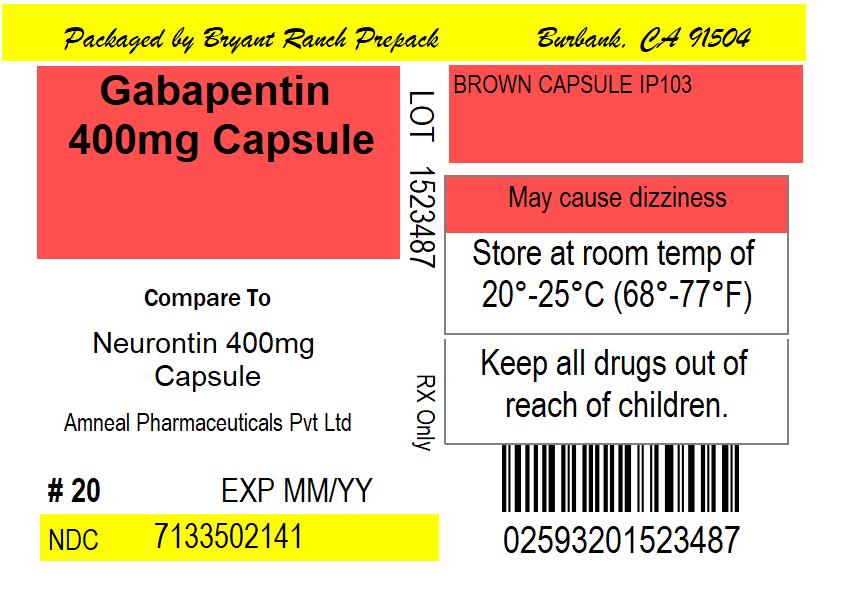
Lbl7133502142

Lbl7133502142
Gabapentin 400 mg capsules label by Bryant Ranch Prepack. The label includes a lot number and states it is a brown capsule, with storage instructions at room temperature (20°-25°C). It includes warnings to keep drugs out of children's reach and a caution about dizziness. The label compares this product to Neurontin 400 mg capsules by Amneal Pharmaceuticals Pvt Ltd and displays a package count of 20 capsules along with the NDC 7133502141.*

* About these descriptions: Image descriptions on this page are generated by automated AI analysis of the product label images from the manufacturer's FDA label submission (SPL). They are provided for reference only and may contain errors or omissions. Always rely on the printed label itself and the official FDA labeling, and consult a pharmacist or healthcare professional with any questions about this product.