Tamsulosin Hydrochloride Capsule
Product Images NDC 71335-0398

7 FDA label images from Bryant Ranch Prepack · Packaging, Regulatory Labels, and Product Appearance

Product Visual Gallery

This gallery contains 7 technical images submitted to the FDA as part of the official labeling for Tamsulosin Hydrochloride (NDC 71335-0398). Unlike standard consumer photos, these assets often include clinical data figures, molecular chemical structures, and official manufacturer packaging layouts.

As provided by Bryant Ranch Prepack, these visuals offer a comprehensive scientific overview of the product's physical and chemical identity, aiding pharmacists and researchers in product verification and study.

FDA Label Image

Label Image (Lbl713350398)

Label Image (Lbl713350398)
Label for Tamsulosin Hydrochloride 0.4 mg capsules by Bryant Ranch Prepack, packaged in Burbank, CA. The capsule is described as olive green opaque and orange opaque. The label compares this product to Flomax 0.4 mg capsules by Aurobindo Pharma Limited and indicates a quantity of 30 capsules. Storage recommendations and safety warnings are also included.*
FDA Label Image

Figure 1 Mean Plasma Tamsulosin Hydrochloride Concentrations Following Single-dose Administration Of Tamsulosin Hydrochloride Capsules 0.4 mg Under Fasted And Fed Conditions (n=8) (Tamsulosin Fig1)

Figure 1 Mean Plasma Tamsulosin Hydrochloride Concentrations Following Single-dose Administration Of Tamsulosin Hydrochloride Capsules 0.4 mg Under Fasted And Fed Conditions (n=8) (Tamsulosin Fig1)
A line graph showing mean plasma concentrations of Tamsulosin Hydrochloride over 36 hours following a single 0.4 mg oral capsule dose under fasted and fed conditions in eight subjects. The graph plots plasma concentration (ng/mL) against time (hours), with separate curves for fasted and fed states, illustrating absorption and elimination profiles.*
FDA Label Image

Figure 2a Mean Change From Baseline In Total Aua Symptom Score (0 To 35) Study 1 (Tamsulosin Fig2)

Figure 2a Mean Change From Baseline In Total Aua Symptom Score (0 To 35) Study 1 (Tamsulosin Fig2)
A line graph titled 'Figure 2A Mean Change from Baseline in Total AUA Symptom Score (0 to 35) Study 1' showing mean change versus duration of treatment in weeks. It compares three treatments: 0.8 mg, 0.4 mg, and placebo. The vertical axis measures mean change, decreasing from 0 to -11. The horizontal axis shows treatment duration from baseline (0) to 13 weeks with an LOCF data point. Symbols indicate sample sizes at each time point.*
FDA Label Image

Figure 2b Mean Change From Baseline In Total Aua Symptom Score (0 To 35) Study 2 (Tamsulosin Fig3)

Figure 2b Mean Change From Baseline In Total Aua Symptom Score (0 To 35) Study 2 (Tamsulosin Fig3)
Line graph titled 'Figure 2B Mean Change from Baseline in Total AUA Symptom Score (0 to 35) Study 2' showing mean change over duration of treatment in weeks. The x-axis represents duration of treatment from 0 to 13 weeks (including LOCF), and the y-axis represents mean change with values from 0 to -11. Three treatment groups are plotted: 0.8 mg dosage (circles, solid line), 0.4 mg dosage (triangles, dashed line), and placebo (squares, solid line). Mean symptom score decreases over time for all treatments, with both dosages showing greater improvement than placebo.*
FDA Label Image

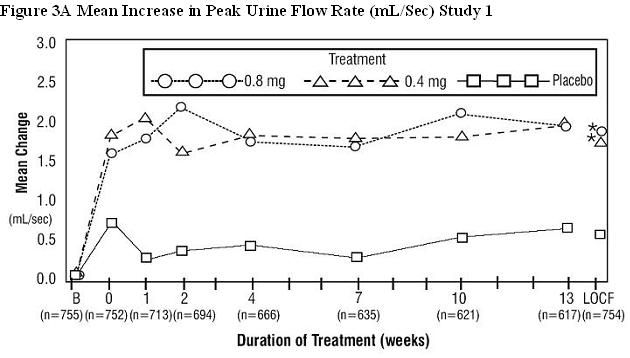
Figure 3a Mean Increase In Peak Urine Flow Rate (ml/sec) Study 1 (Tamsulosin Fig4)

Figure 3a Mean Increase In Peak Urine Flow Rate (ml/sec) Study 1 (Tamsulosin Fig4)
A line graph titled 'Mean Increase in Peak Urine Flow Rate (mL/Sec) Study 1' depicting mean change in mL/sec on the y-axis and duration of treatment in weeks on the x-axis. It compares treatments of 0.8 mg, 0.4 mg, and placebo, showing mean changes over 13 weeks with labeling at baseline, weeks 0, 1, 2, 4, 7, 10, 13, and LOCF (last observation carried forward).*
FDA Label Image

Figure 3b Mean Increase In Peak Urine Flow Rate (ml/sec) Study 2 (Tamsulosin Fig5)

Figure 3b Mean Increase In Peak Urine Flow Rate (ml/sec) Study 2 (Tamsulosin Fig5)
Line graph titled 'Figure 3B Mean Increase in Peak Urine Flow Rate (mL/Sec) Study 2' showing mean change in urine flow rate over duration of treatment in weeks. The graph compares three treatments—0.8 mg, 0.4 mg, and placebo—displaying their effects on urine flow rate from week 0 to 13 and at last observation carried forward (LOCF). Each treatment is marked with distinct symbols: circles for 0.8 mg, triangles for 0.4 mg, and squares for placebo.*
FDA Label Image

Chemical Structure (Tamsulosin Str)

Chemical Structure (Tamsulosin Str)
Chemical structure of Tamsulosin Hydrochloride, showing its molecular arrangement with labeled chemical groups including H2NO2S, CH3O, and C2H5O, along with the presence of hydrochloride (HCl).*

* About these descriptions: Image descriptions on this page are generated by automated AI analysis of the product label images from the manufacturer's FDA label submission (SPL). They are provided for reference only and may contain errors or omissions. Always rely on the printed label itself and the official FDA labeling, and consult a pharmacist or healthcare professional with any questions about this product.