Carvedilol Phosphate Capsule, Extended Release
Product Images NDC 71335-9707

7 FDA label images from Bryant Ranch Prepack · Packaging, Regulatory Labels, and Product Appearance

Product Visual Gallery

This gallery contains 7 technical images submitted to the FDA as part of the official labeling for Carvedilol Phosphate (NDC 71335-9707). Unlike standard consumer photos, these assets often include clinical data figures, molecular chemical structures, and official manufacturer packaging layouts.

As provided by Bryant Ranch Prepack, these visuals offer a comprehensive scientific overview of the product's physical and chemical identity, aiding pharmacists and researchers in product verification and study.

FDA Label Image

Structure (Carvedilol 1)

Structure (Carvedilol 1)
Chemical structure diagram of Carvedilol Phosphate showing its molecular composition including rings, hydroxyl groups, and phosphate and water components.*
FDA Label Image

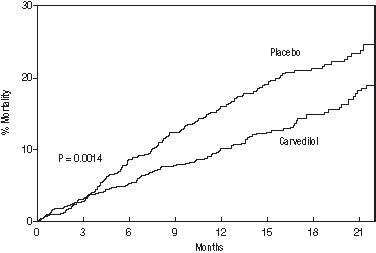
Figure-1 (Carvedilol Figure1)

Figure-1 (Carvedilol Figure1)
A line graph comparing percentage mortality over 24 months between two groups: one receiving Carvedilol Phosphate and the other a placebo. The vertical axis shows % mortality, and the horizontal axis shows months. The Carvedilol group has consistently lower mortality than placebo, with p = 0.0014 indicating statistical significance.*
FDA Label Image

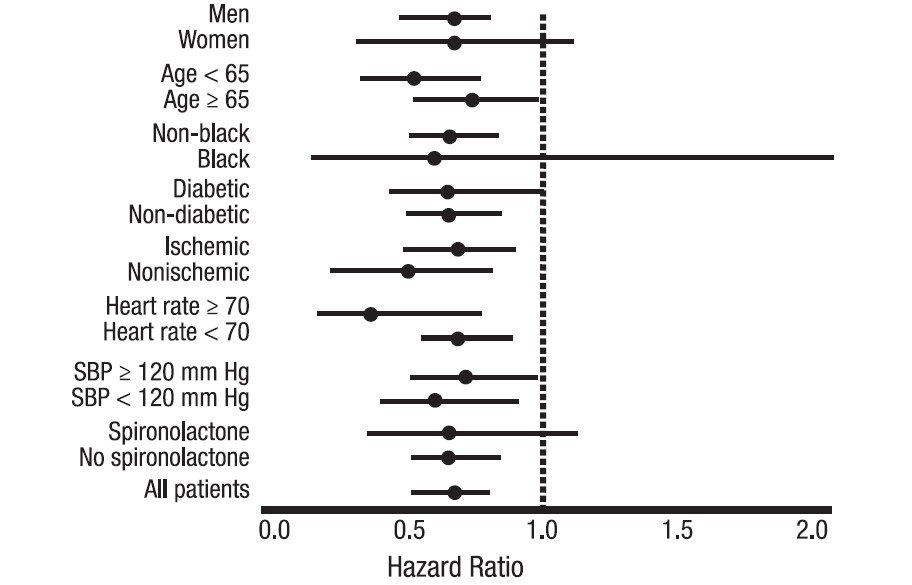
Figure-2 (Carvedilol Spl Figure 2)

Figure-2 (Carvedilol Spl Figure 2)
A horizontal dot plot chart depicting hazard ratios for various patient subgroups including men, women, age less than 65, age 65 or older, non-black, black, diabetic, non-diabetic, ischemic, nonischemic, heart rate categories, systolic blood pressure categories, spironolactone usage, and all patients. Each subgroup includes a point estimate and confidence interval bars plotted along a hazard ratio axis ranging from 0.0 to 2.0 with a vertical reference line at 1.0.*
FDA Label Image

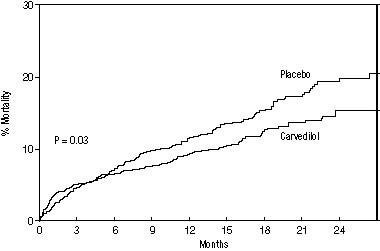
Figure-3 (Carvedilol Figure3)

Figure-3 (Carvedilol Figure3)
A line chart depicting percent mortality over 24 months comparing Carvedilol and Placebo groups. The x-axis represents months, and the y-axis percent mortality. The graph shows lower mortality in the Carvedilol group with a P-value of 0.03 indicating statistical significance.*
FDA Label Image

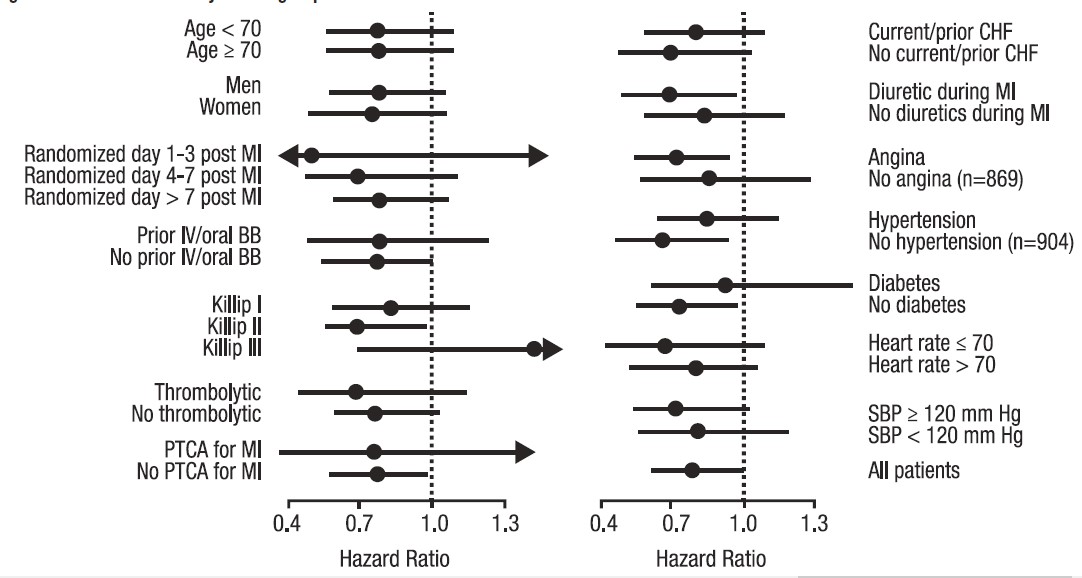
Figure-4 (Carvedilol Spl Figure 4)

Figure-4 (Carvedilol Spl Figure 4)
A forest plot chart showing hazard ratios with confidence intervals for various patient subgroups related to myocardial infarction (MI) treatment outcomes. The horizontal axes represent hazard ratios from 0.4 to 1.3, with subgroups including age, sex, timing of randomization post MI, prior beta-blocker use, Killip class, thrombolytic treatment, PTCA for MI, heart failure status, diuretic use, angina, hypertension, diabetes, heart rate, and systolic blood pressure. Each subgroup displays points and error bars indicating hazard ratio estimates and their uncertainty.*
FDA Label Image

Figure (Carvedilol 2)

Figure (Carvedilol 2)
Two line graphs showing the change in systolic blood pressure (SBP) and diastolic blood pressure (DBP) over 24 hours after a morning dose of Carvedilol Phosphate extended-release capsules at 20 mg, 40 mg, and 80 mg strengths. The graphs depict trends for each dosage over time in hours, with lines smoothed using locally weighted regression smoothing methodology.*
FDA Label Image

Label (Lbl713359707)

Label (Lbl713359707)
Label for Carvedilol Phosphate Extended-Release Capsules 20 mg by Bryant Ranch Prepack. The label includes warnings about storage at 25°C, keeping out of children's reach, and seal integrity. The package contains 30 capsules and is repackaged by Bryant Ranch Prepack, Inc. in Burbank, CA, with manufacturing by Frontida BioPharm Inc. NDC 71335-9707-1 is displayed.*

* About these descriptions: Image descriptions on this page are generated by automated AI analysis of the product label images from the manufacturer's FDA label submission (SPL). They are provided for reference only and may contain errors or omissions. Always rely on the printed label itself and the official FDA labeling, and consult a pharmacist or healthcare professional with any questions about this product.