Tadalafil
Product Images NDC 71455-597

View Photos of Packaging, Regulatory Labels, and Product Appearance

Product Visual Gallery

This gallery contains 33 technical images submitted to the FDA as part of the official labeling for Tadalafil (NDC 71455-597). Unlike standard consumer photos, these assets often include clinical data figures, molecular chemical structures, and official manufacturer packaging layouts.

As provided by Unyter Enterprises, these visuals offer a comprehensive scientific overview of the product's physical and chemical identity, aiding pharmacists and researchers in product verification and study.

FDA Label Image

20mg Tadalafil (20mg Tadalafil Label)

20mg Tadalafil (20mg Tadalafil Label)
This is a package of 10 tablets containing 20 mg of Tadalafil USP meant for oral ingestion. The package insert contains the dosage information which should be strictly followed by the patient. The tablets are to be kept in a tight container at room temperature of 20°-25°C (68°-77°F). The medicine is manufactured by ACCORD HEALTHCARE and packaged by Q% @mem ENTERPRISES, located in Cumming GA, 3004. It is recommended to keep the medication away from children.*
FDA Label Image

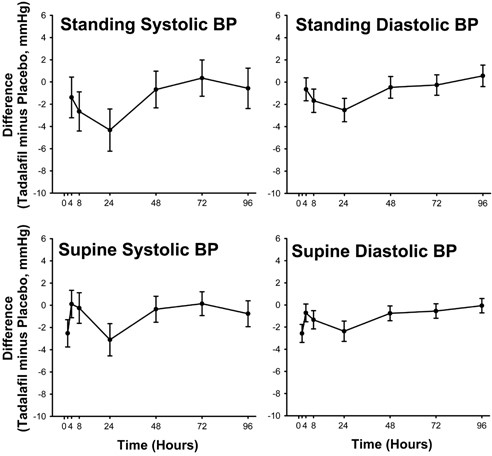
Figure 1 (Figure 1)

FDA Label Image

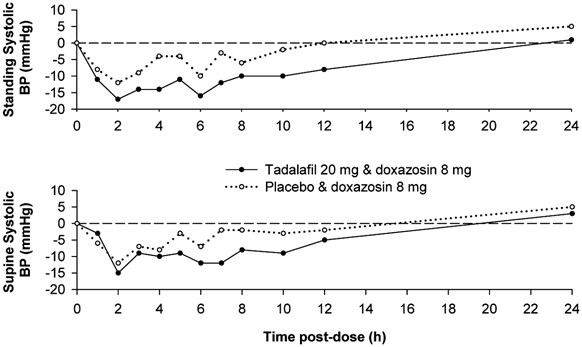
Figure 2 (Figure 2)

Figure 2 (Figure 2)
This is a chart displaying the results for a study comparing Tadalafil 20 mg & doxazosin 8 mg to Placebo & doxazosin 8 mg over time post-dose. The chart has different measurements on the x and y-axes.*
FDA Label Image

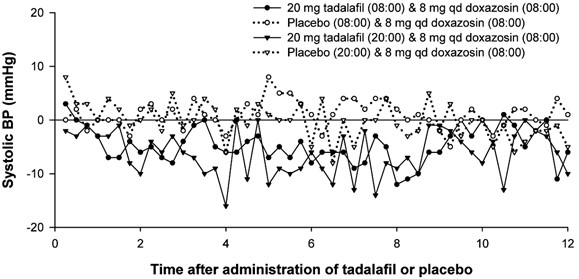
Figure 3 (Figure 3)

Figure 3 (Figure 3)
This appears to be a table or graph showing the measurement of systolic blood pressure at different times after the administration of different doses of tadalafil, doxazosin and placebo. Not enough information is given to determine the full details of the study or its results.*
FDA Label Image

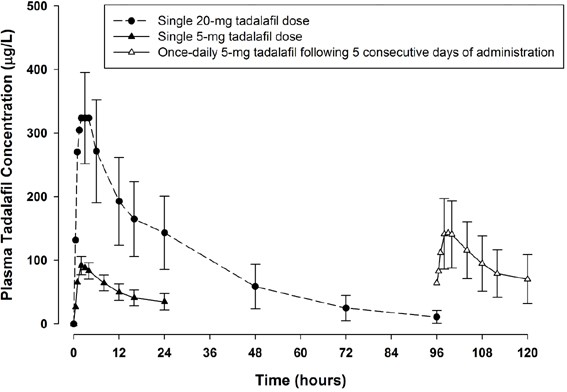
Figure 4 (Figure 4)

FDA Label Image

Figure 5 (Figure 5)

Figure 5 (Figure 5)
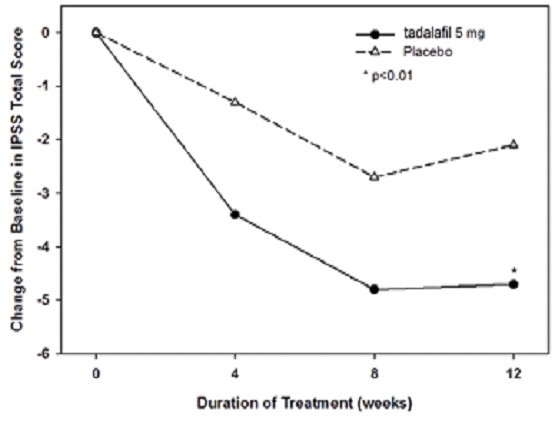
The text describes the change in the IPSS total score in patients taking tadalafil 5mg compared to placebo over a period of 12 weeks. The asterisk notes a statistical significance of p<0.01.*
FDA Label Image

Figure 6 (Figure 6)

Figure 6 (Figure 6)
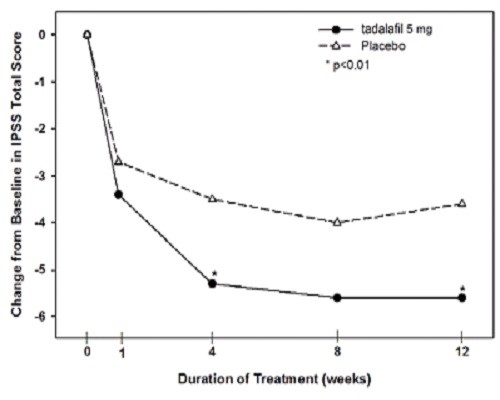
The text contains a graph displaying the change from baseline in IPSS total score with a placebo group and a measure of statistical significance. The graph is over a duration of treatment weeks. No further information is available to provide a useful description.*
FDA Label Image

Figure 7 (Figure 7)

FDA Label Image

Figure 8 (Figure 8)

FDA Label Image

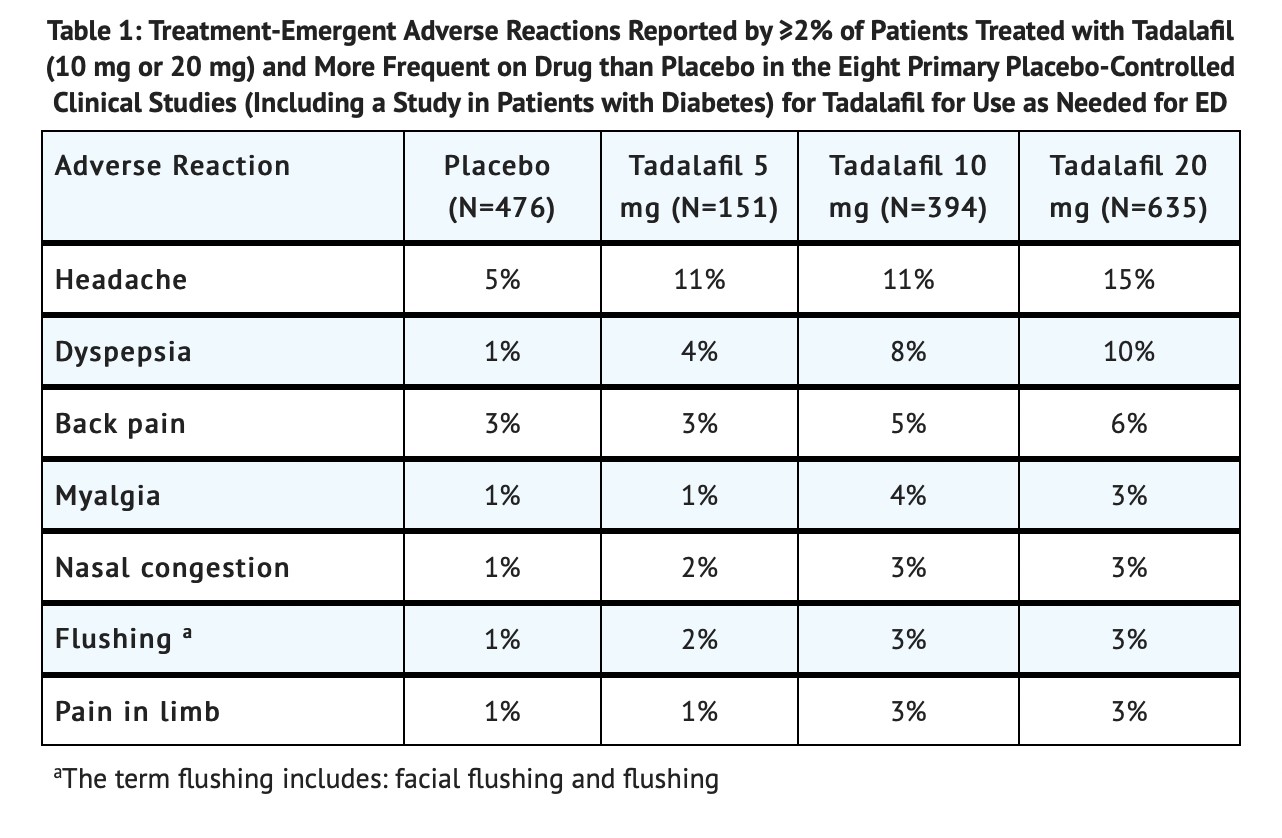
Table 1 (Table 1)

Table 1 (Table 1)
This text describes a table showing adverse reactions reported by a percentage of patients treated with Tadalafil for erectile dysfunction. The table lists the percentage of patients who experienced headaches, dyspepsia, back pain, myalgia, nasal congestion, flushing, and pain in limb. The percentage of patients who experienced these reactions while taking Tadalafil at different doses (5 mg, 10 mg, and 20 mg) is compared to the placebo group. "Flushing" includes facial flushing and flushing.*
FDA Label Image

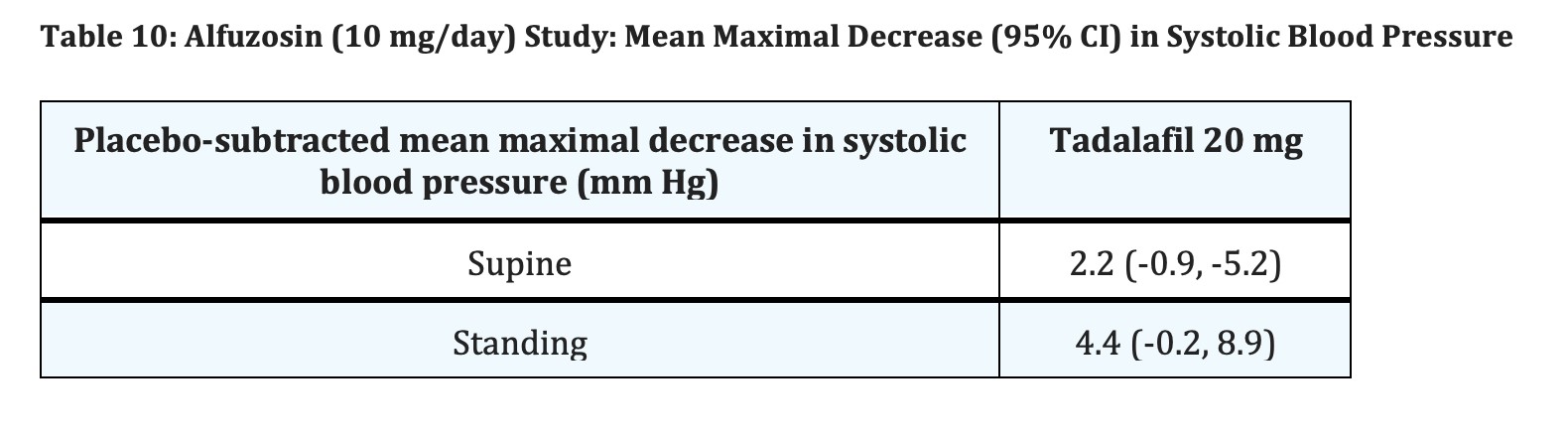
Table 10 (Table 10)

Table 10 (Table 10)
This is a table showing the mean maximal decrease (with 95% confidence intervals) in systolic blood pressure for a study using a daily dose of 10 mg Alfuzosin. The results are compared to a placebo, with the results for a Tadalafil 20 mg dose also included. The values for the supine and standing positions are displayed separately.*
FDA Label Image

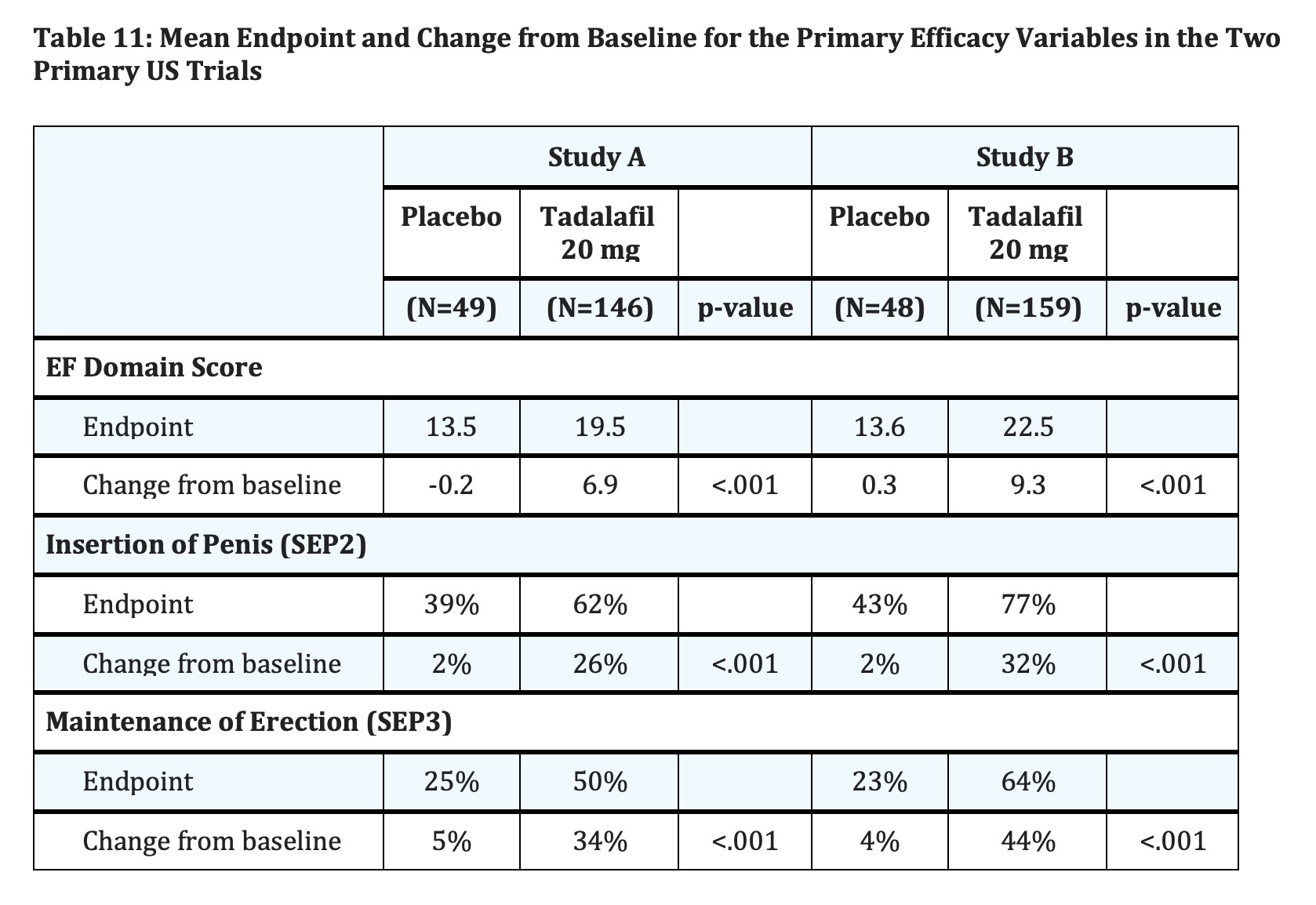
Table 11 (Table 11)

Table 11 (Table 11)
This is a table showing the mean endpoint and change from baseline for primary efficacy variables in two US trials. The trials compare the efficacy of a placebo with Tadalafil at 20 mg in Endpoint and Changes from Baseline of EF Domain Score, Insertion of Penis (SEP2), and Maintenance of Erection (SEP3). The results show statistically significant improvement in all variables for Tadalafil compared to placebo.*
FDA Label Image

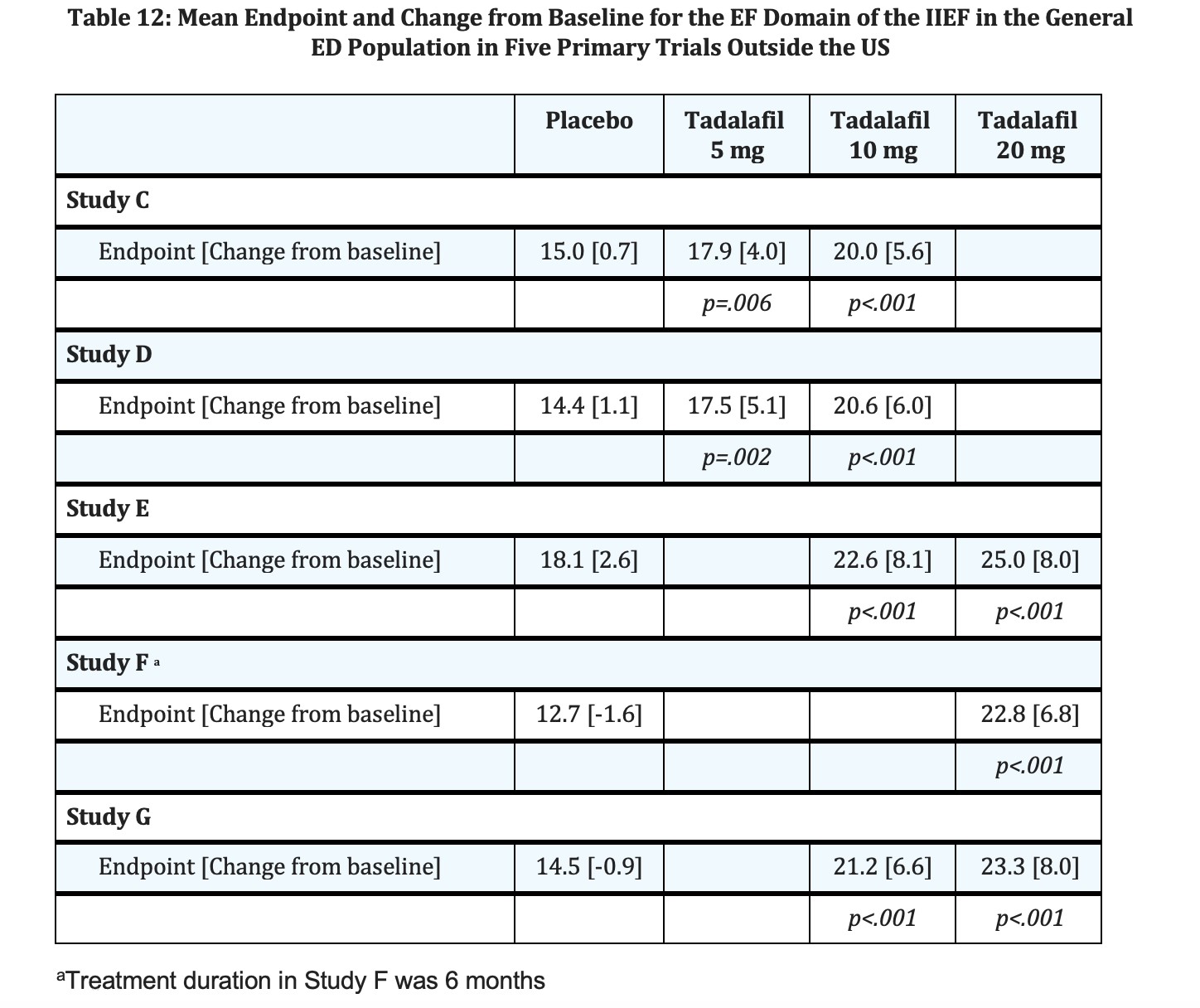
Table 12 (Table 12)

Table 12 (Table 12)
The text describes the mean endpoint and change from baseline for the EF Domain of the IIEF in the general ED population in five primary trials outside the US. It shows the results of studies C, D, E, F, and G, where placebo and different doses of Tadalafil (5mg,10mg, and 20mg) were administered to the subjects. The data includes the endpoint and the change from the baseline, with the corresponding p-values for statistical significance. The text also notes that the treatment duration in Study F was 6 months.*
FDA Label Image

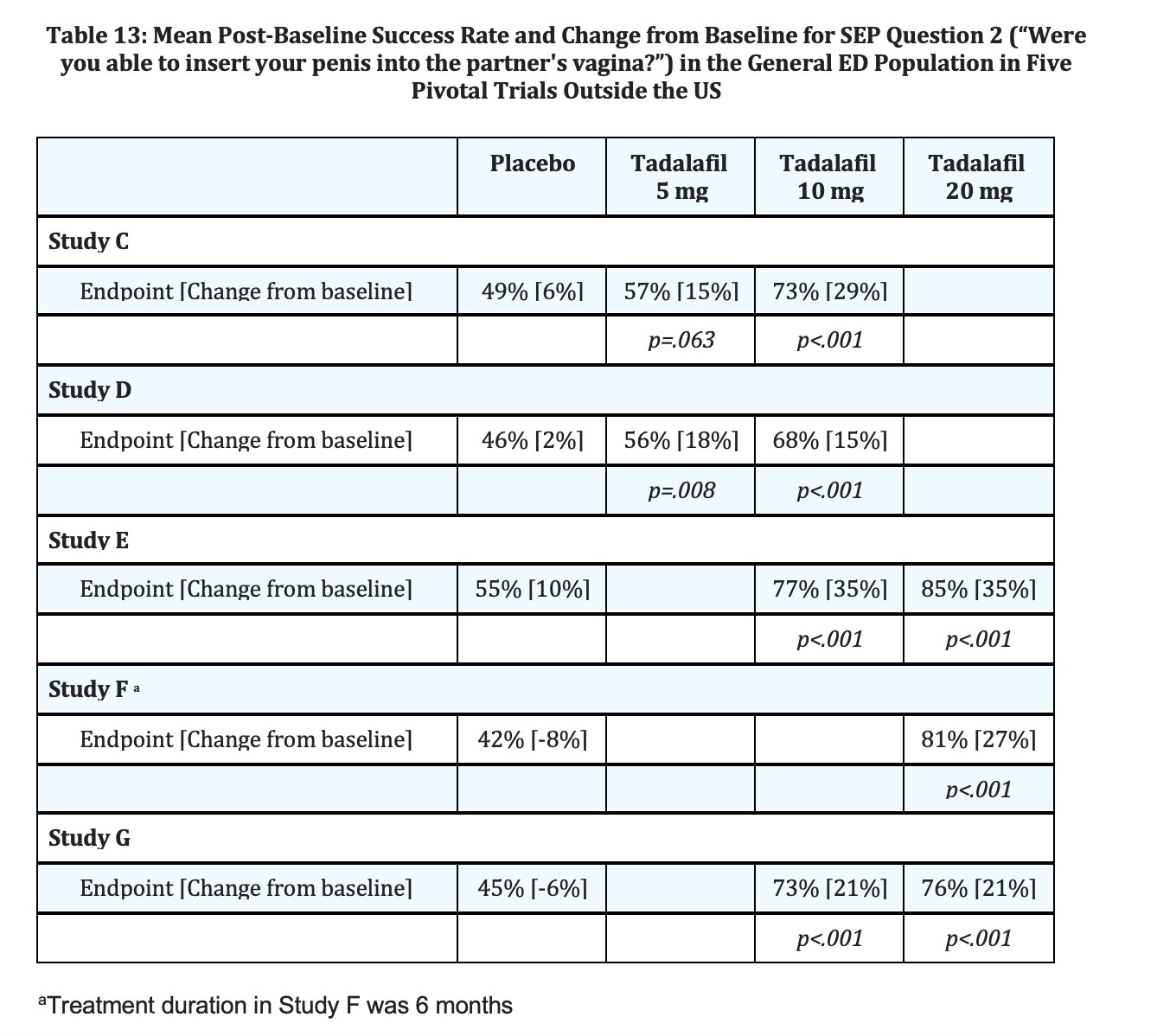
Table 13 (Table 13)

Table 13 (Table 13)
The table presents mean success rates and changes in baseline for a SEP Question 2 among patients with General ED in 5 pivotal trials outside the US. The success rates are measured for Placebo, Tadalafil 5mg, 10mg, and 20mg. Study F had a duration of 6 months.*
FDA Label Image

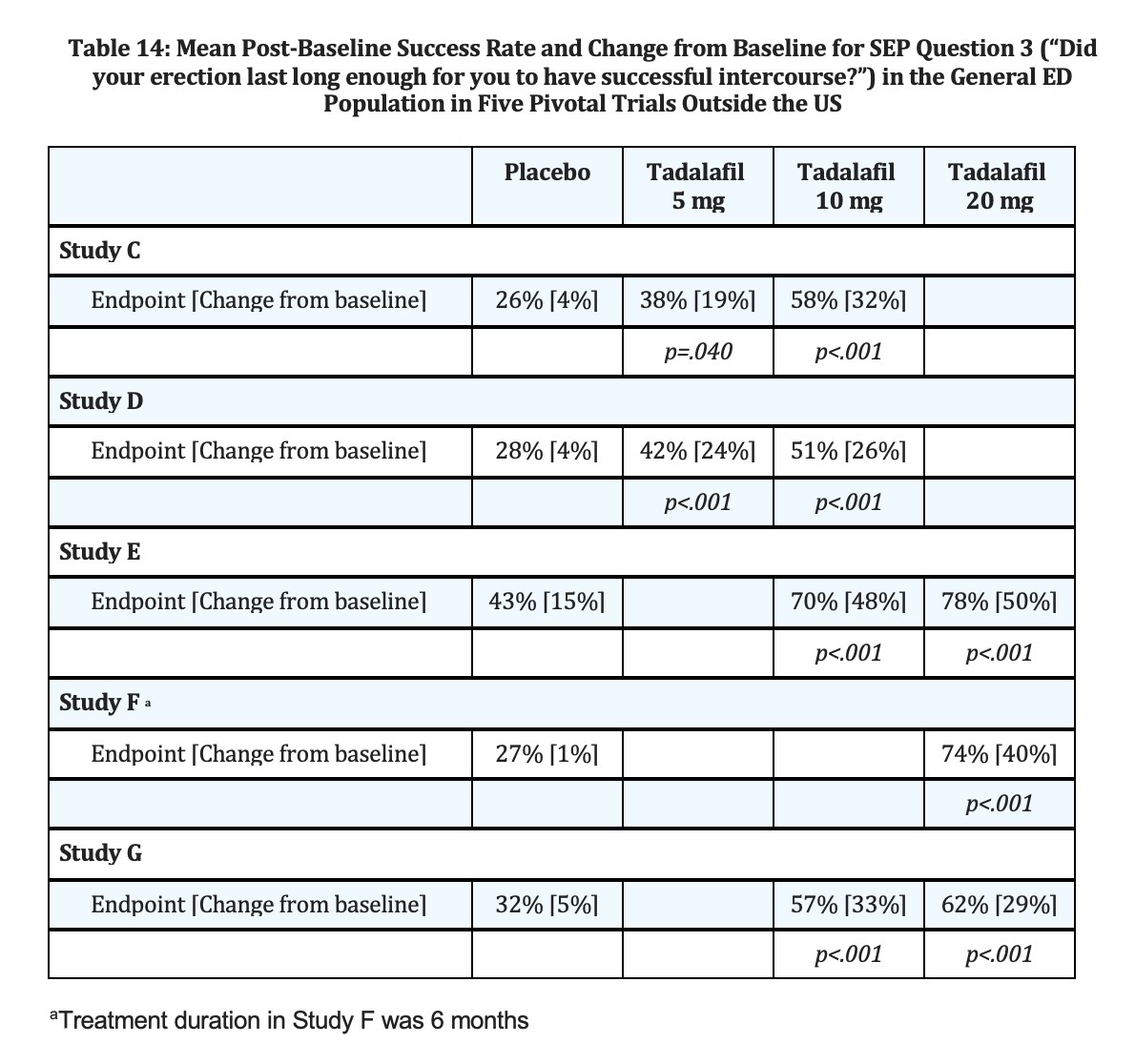
Table 14 (Table 14)

Table 14 (Table 14)
The table shows the success rate and change in SEP question 3 for the general population with Erectile Dysfunction in five pivotal trials outside the US. The trials were conducted on a placebo, Tadalafil 5mg, 10mg, and 20mg. The results indicate the percentage change from baseline, and significant differences were observed between placebo and Tadalafil in all studies. The study F had a duration of six months.*
FDA Label Image

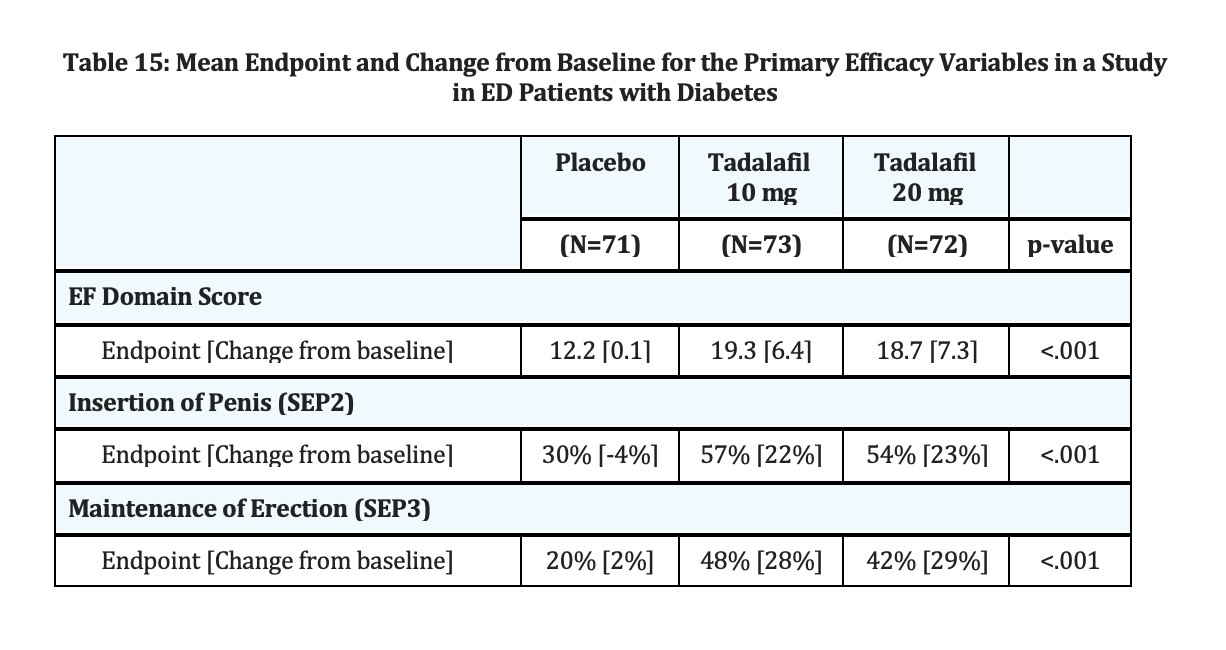
Table 15 (Table 15)

Table 15 (Table 15)
Table 15 shows the mean endpoints and changes from baseline for primary efficacy variables in a study conducted with diabetic ED patients. The study involved taking Placebo, Tadalafil 10 mg, and Tadalafil 20 mg. The study showed that Tadalafil significantly improves EF Domain score, Insertion of Penis (SEP2), and Maintenance of Erection (SEP3) compared to placebo.*
FDA Label Image

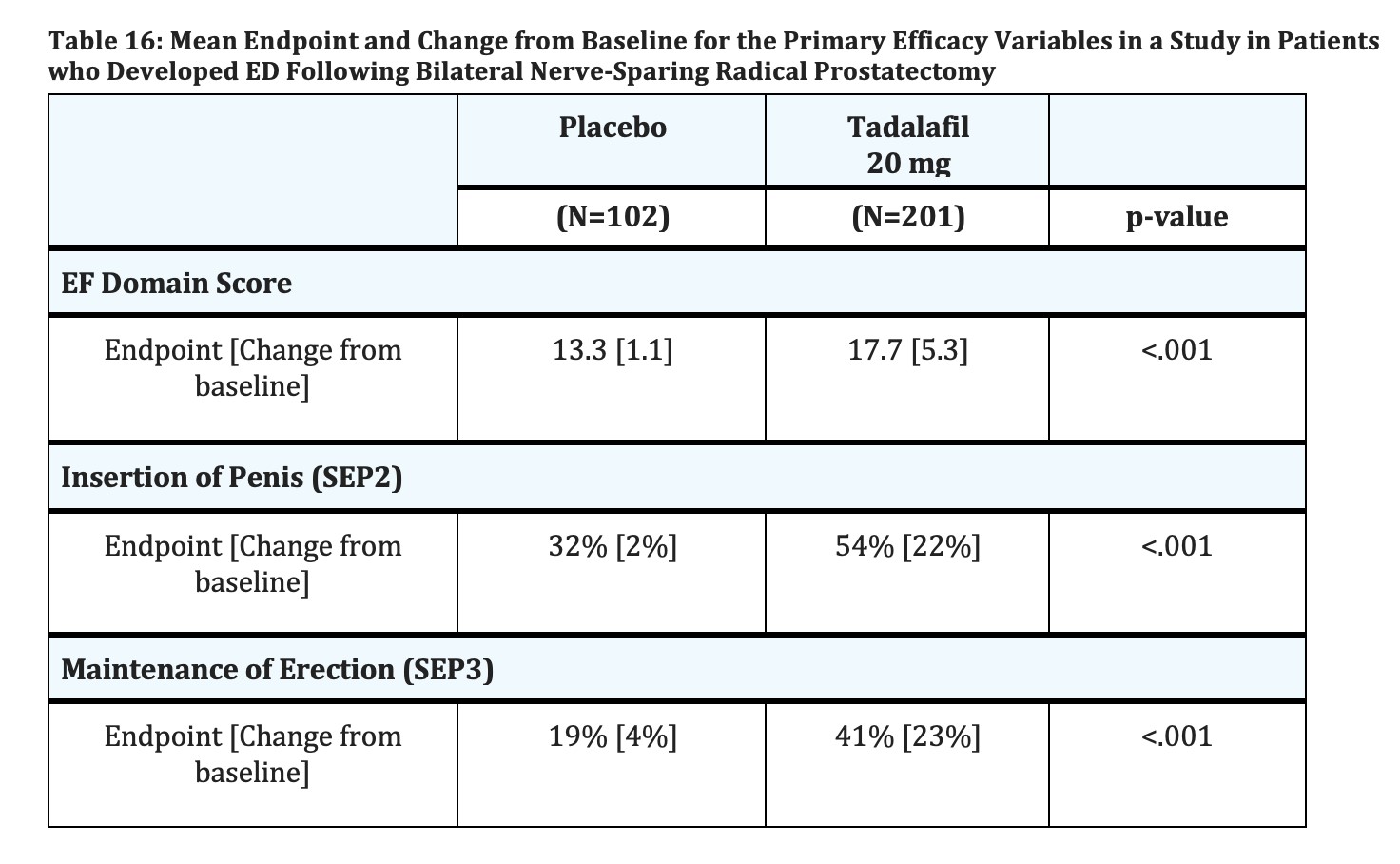
Table 16 (Table 16)

Table 16 (Table 16)
This is a table that shows the mean endpoint and change from baseline for primary efficacy variables in a study on patients who developed ED following bilateral nerve-sparing radical prostatectomy. The study is comparing the effects of a placebo and Tadalafil 20mg. The primary efficacy variables include the EF Domain Score, Insertion of Penis (SEP2), and Maintenance of Erection (SEP3). The results show statistically significant improvements in all three variables with Tadalafil compared to the placebo.*
FDA Label Image

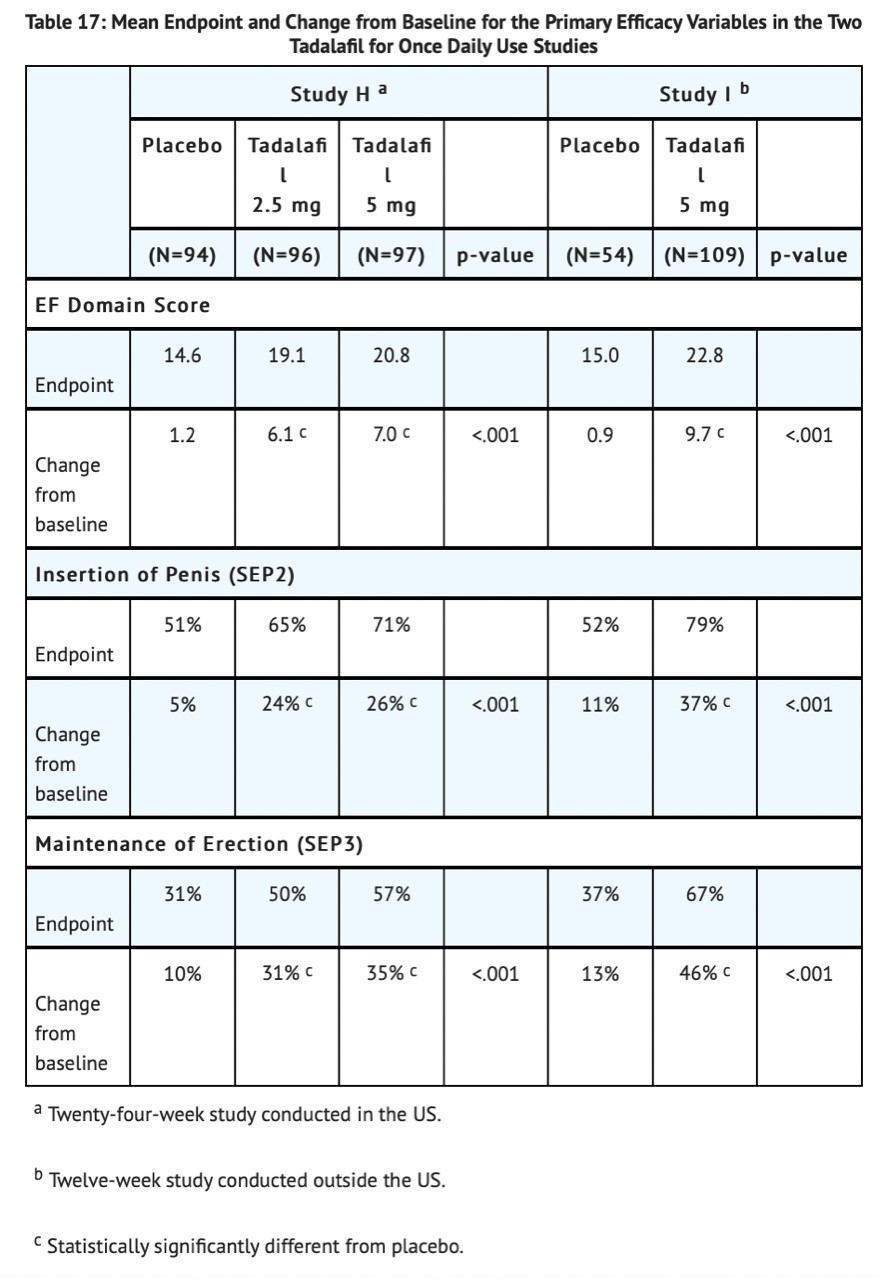
Table 17 (Table 17)

Table 17 (Table 17)
The table shows the mean endpoint and change from baseline for primary efficacy variables in two studies using Tadalafil once daily for use. The studies, H2 and I, had different sample sizes and dosages, and the results were compared to a placebo group. The efficacy variables measured were the EF domain score, insertion of the penis (SEP2), and maintenance of erection (SEP3). The results showed statistically significant improvements in the Tadalafil groups compared to the placebo group.*
FDA Label Image

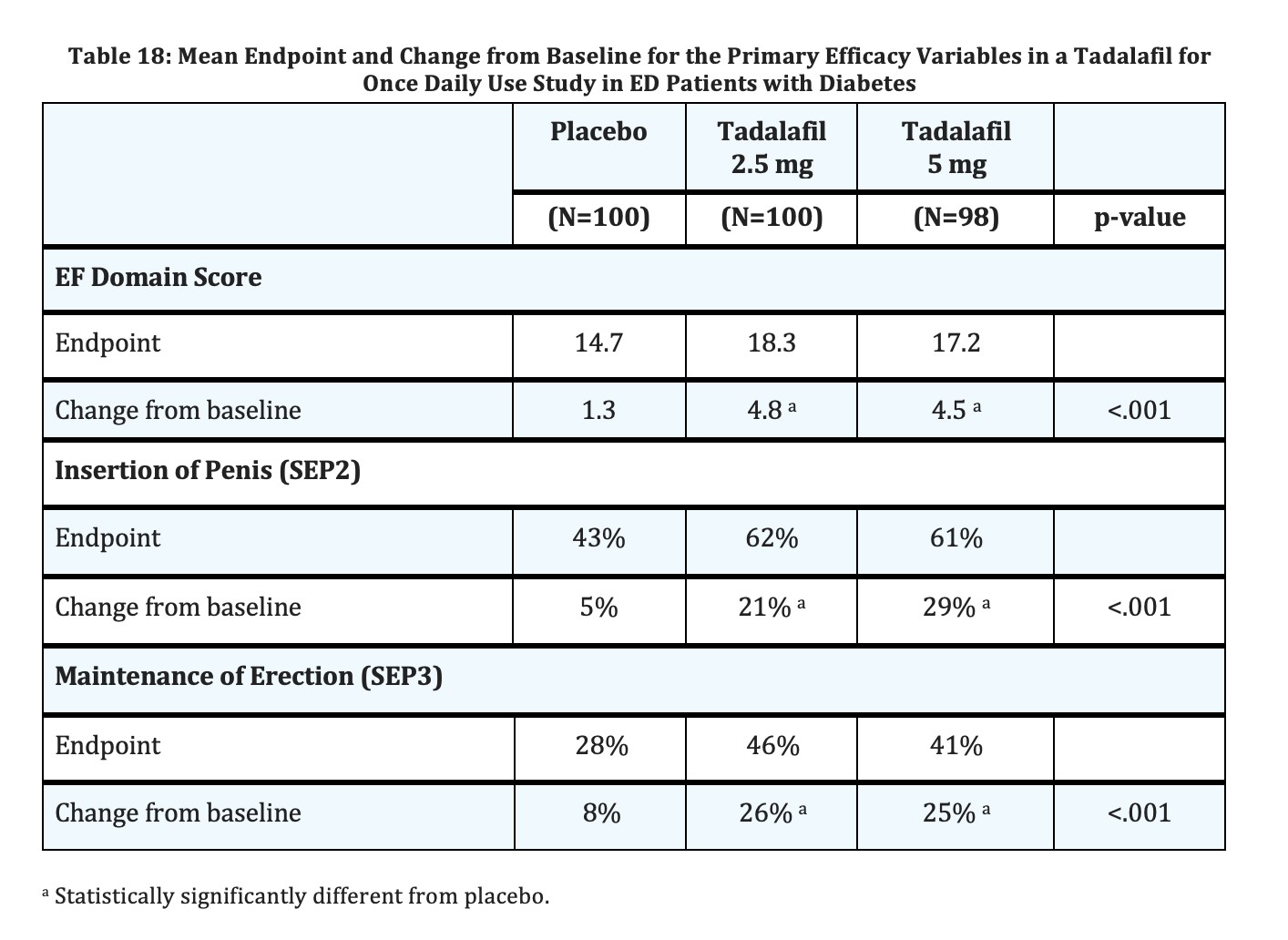
Table 18 (Table 18)

Table 18 (Table 18)
Table 18 displays the mean results of a study on Tadalafil for once daily use in treating ED patients with diabetes. The table shows the results for the primary efficacy variables and reports the scores of the placebo group, Tadalafil 2.5mg group, and Tadalafil 5mg group for each variable. The p-value indicates a significant difference compared to the placebo.*
FDA Label Image

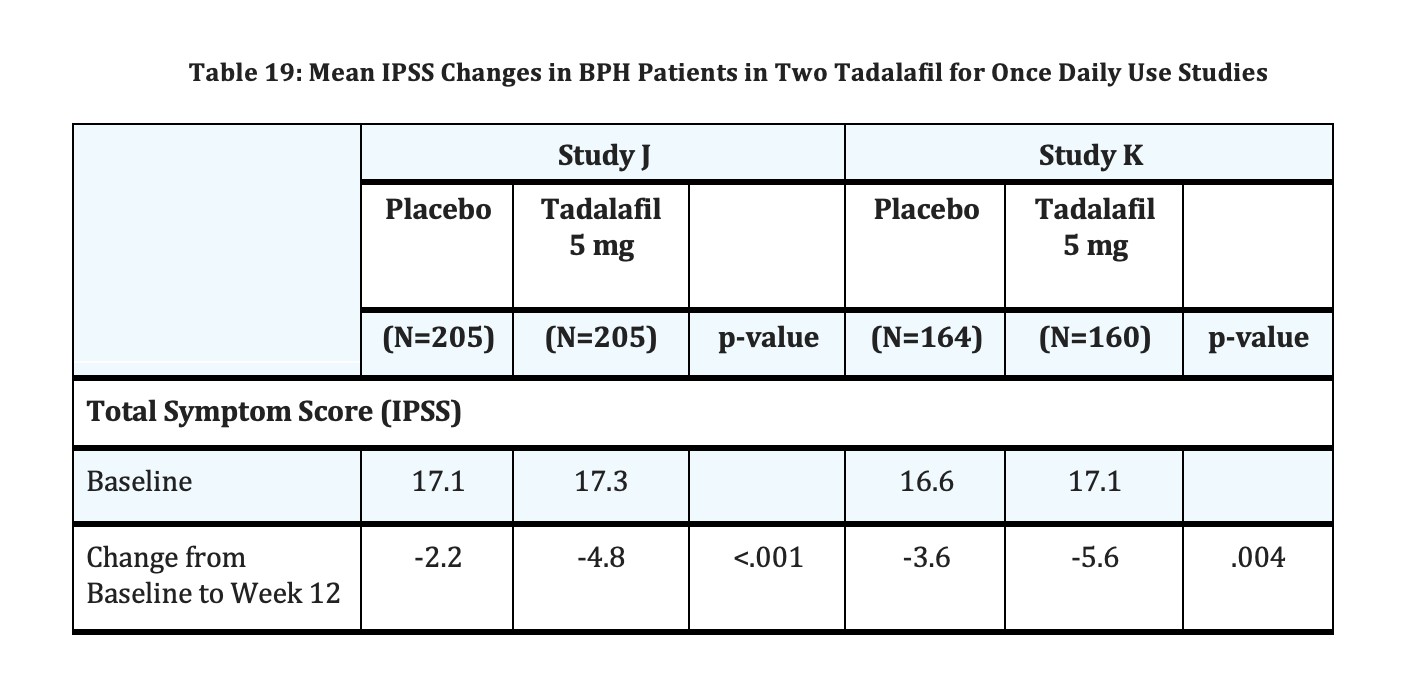
Table 19 (Table 19)

Table 19 (Table 19)
Table 19 shows the mean changes in IPSS (Total Symptom Score) in BPH patients for two Tadalafil studies conducted on a once-daily basis. The first study (J) consisted of N=205 patients who were administered Tadalafil 5mg, while the second study (K) consisted of N=160 patients who were also administered Tadalafil 5mg. For both studies, the placebo group showed a mean baseline of 17.1 and had a change of -2.2 and -3.6 from baseline to week 12 for Study J and Study K, respectively. The p-value for Study J was <.001 and for Study K was .004.*
FDA Label Image

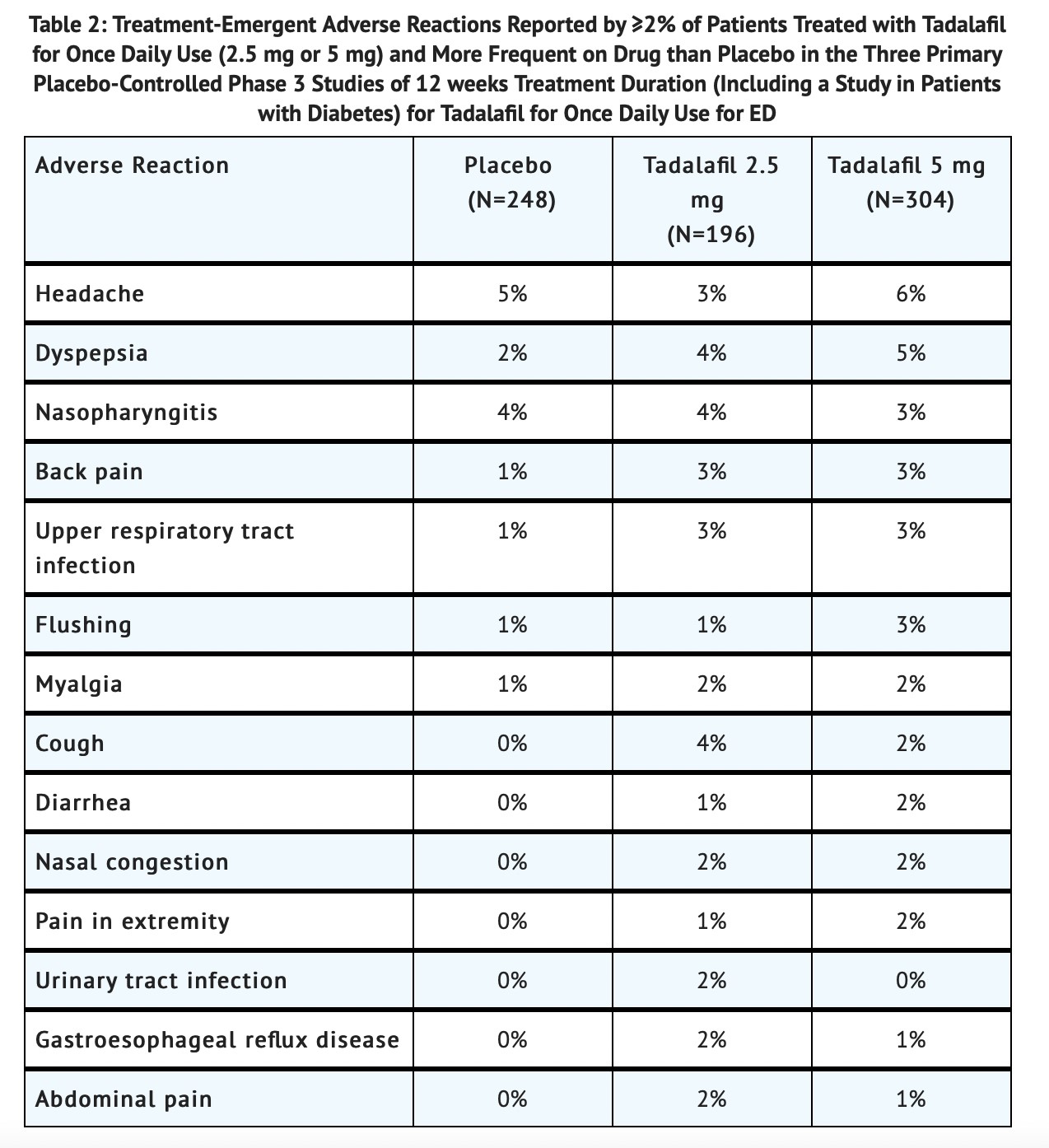
Table 2 (Table 2)

Table 2 (Table 2)
This table summarizes the treatment-emergent adverse reactions reported by patients who were treated with Tadalafil for once daily use (2.5mg or 5mg) in three primary placebo-controlled studies of 12 weeks treatment duration, including a study in patients with Diabetes, for Erectile Dysfunction. The table includes adverse reactions that were reported by 22% or more of the patients and were more frequent on drug than placebo. Adverse reactions are listed in order of decreasing frequency. The table includes the percentage of patients reporting each adverse reaction for placebo, Tadalafil 2.5 mg and Tadalafil 5mg. The adverse reactions are headache, dyspepsia, nasopharyngitis, back pain, upper respiratory tract infection, flushing, myalgia, cough, diarrhea, nasal congestion, pain in extremity, urinary tract infection, gastroesophageal reflux disease, and abdominal pain.*
FDA Label Image

Table 20 (Table 20)

Table 20 (Table 20)
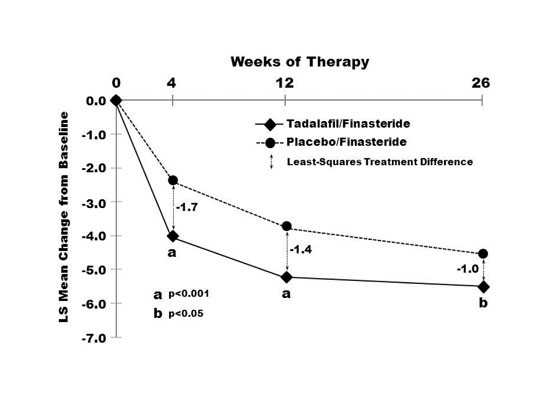
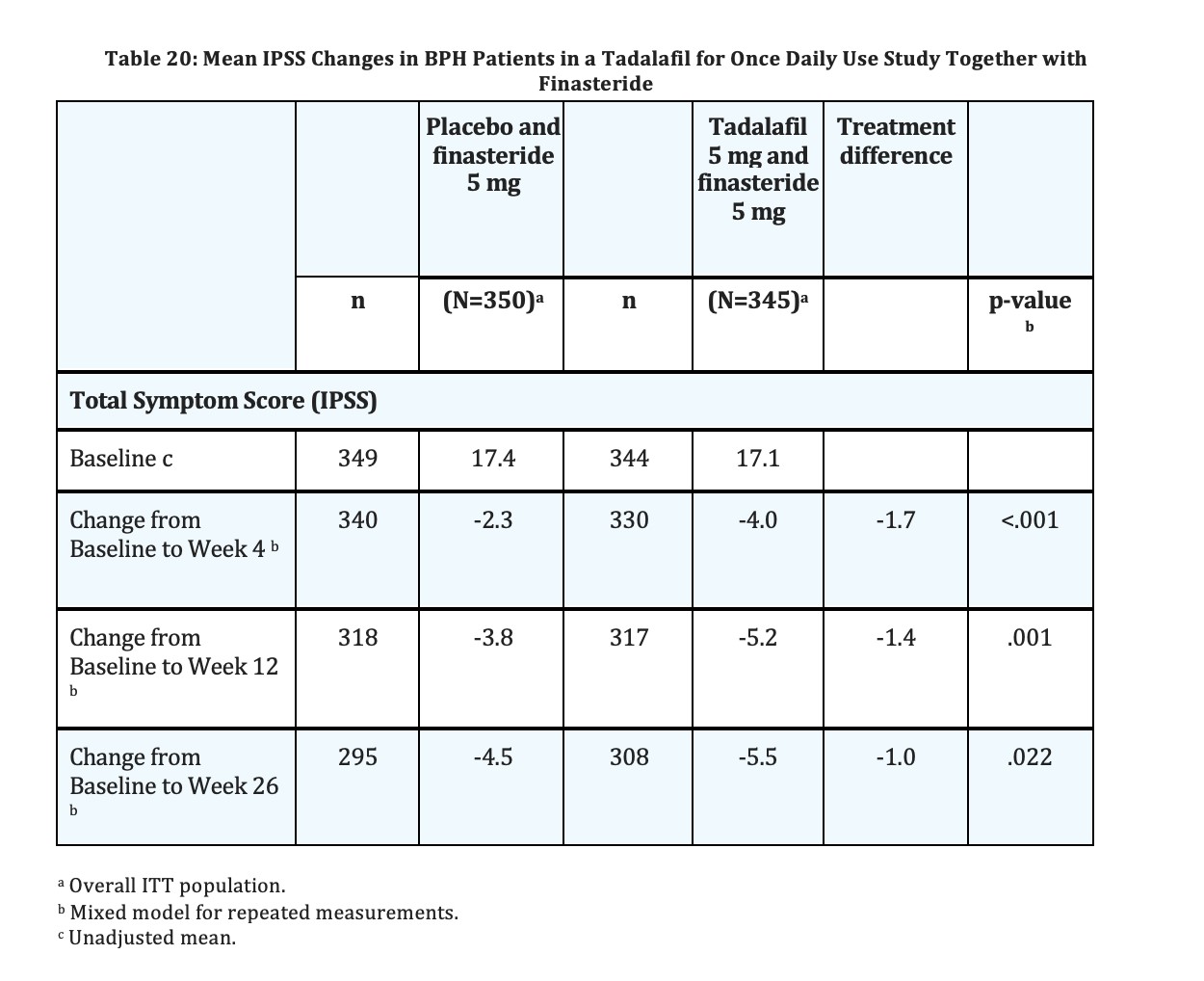
This is a table showing the mean IPSS changes in BPH (benign prostatic hyperplasia) patients in a study using Tadalafil for once daily use in combination with finasteride. The table compares the results from the placebo group, the Tadalafil group, the finasteride group, and the group using both Tadalafil and finasteride. It shows the baseline score and the changes from baseline at week 4, week 12, and week 26. The results are based on a mixed model for repeated measurements, with the unadjusted mean presented.*
FDA Label Image

Table 21 (Table 21)

Table 21 (Table 21)
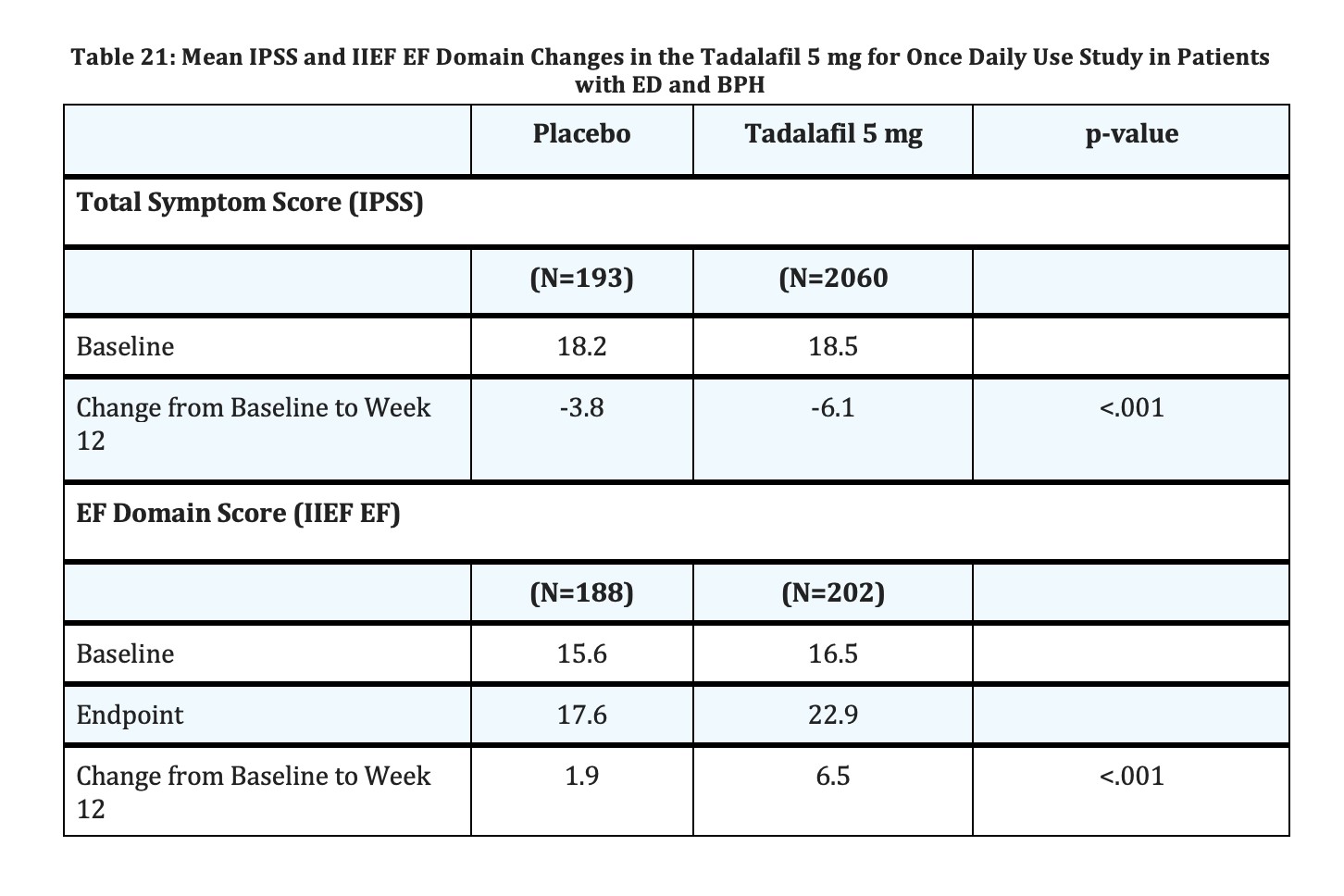
The table provides mean changes in IPSS and IIEF EF Domain scores of patients with ED and BPH using Tadalafil 5 mg for once-daily use. It compares the results with Placebo group and highlights the p-value.*
FDA Label Image

Table 22 (Table 22)

Table 22 (Table 22)
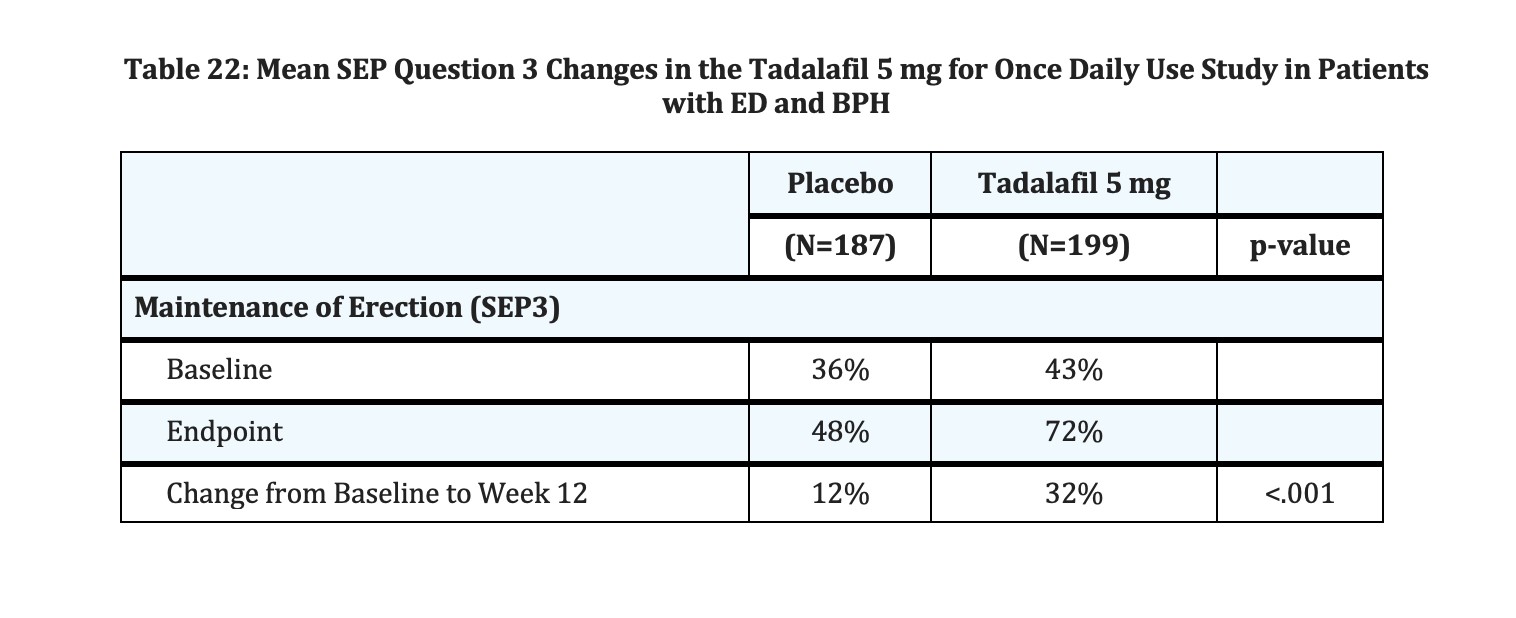
This is a table displaying results from a study on Tadalafil 5mg for once daily use in patients with ED and BPH. The table shows the mean changes in SEP Question 3 scores between patients who took placebo and those who took Tadalafil 5mg. The baseline and endpoint scores for each group are shown, as well as the change from baseline to week 12. The study indicates that patients taking Tadalafil 5mg had a significant improvement in their ability to maintain an erection compared to those who took the placebo.*
FDA Label Image

Table 3 (Table 3)

Table 3 (Table 3)
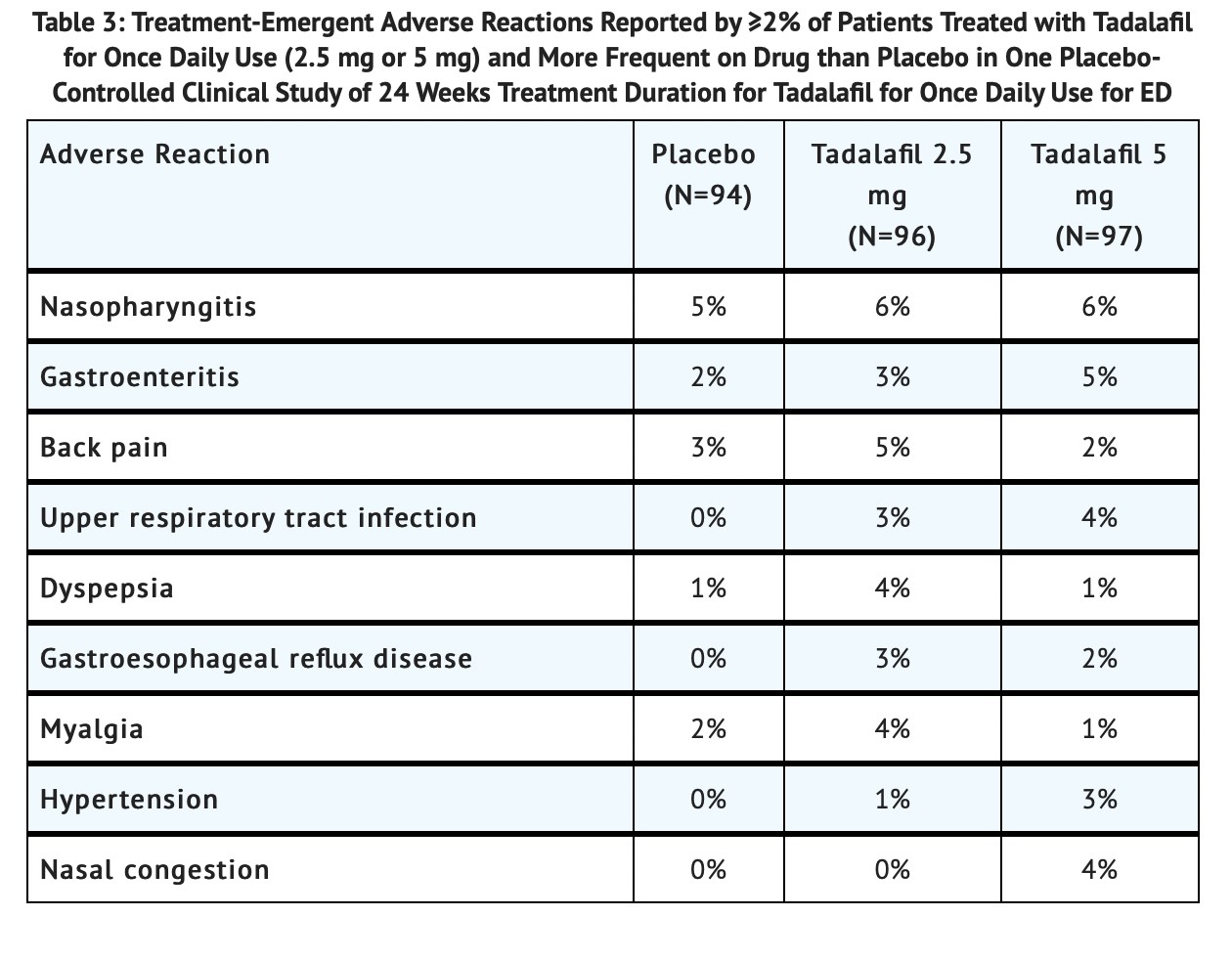
This is a table showing the treatment-emergent adverse reactions reported by patients treated with Tadalafil for once daily use in a clinical study of 24 weeks. The table includes the percentages of patients experiencing adverse reactions for Tadalafil 2.5 mg, Tadalafil 5 mg, and placebo. The adverse reactions include nasopharyngitis, gastroenteritis, back pain, upper respiratory tract infection, dyspepsia, gastroesophageal reflux disease, myalgia, hypertension, and nasal congestion.*
FDA Label Image

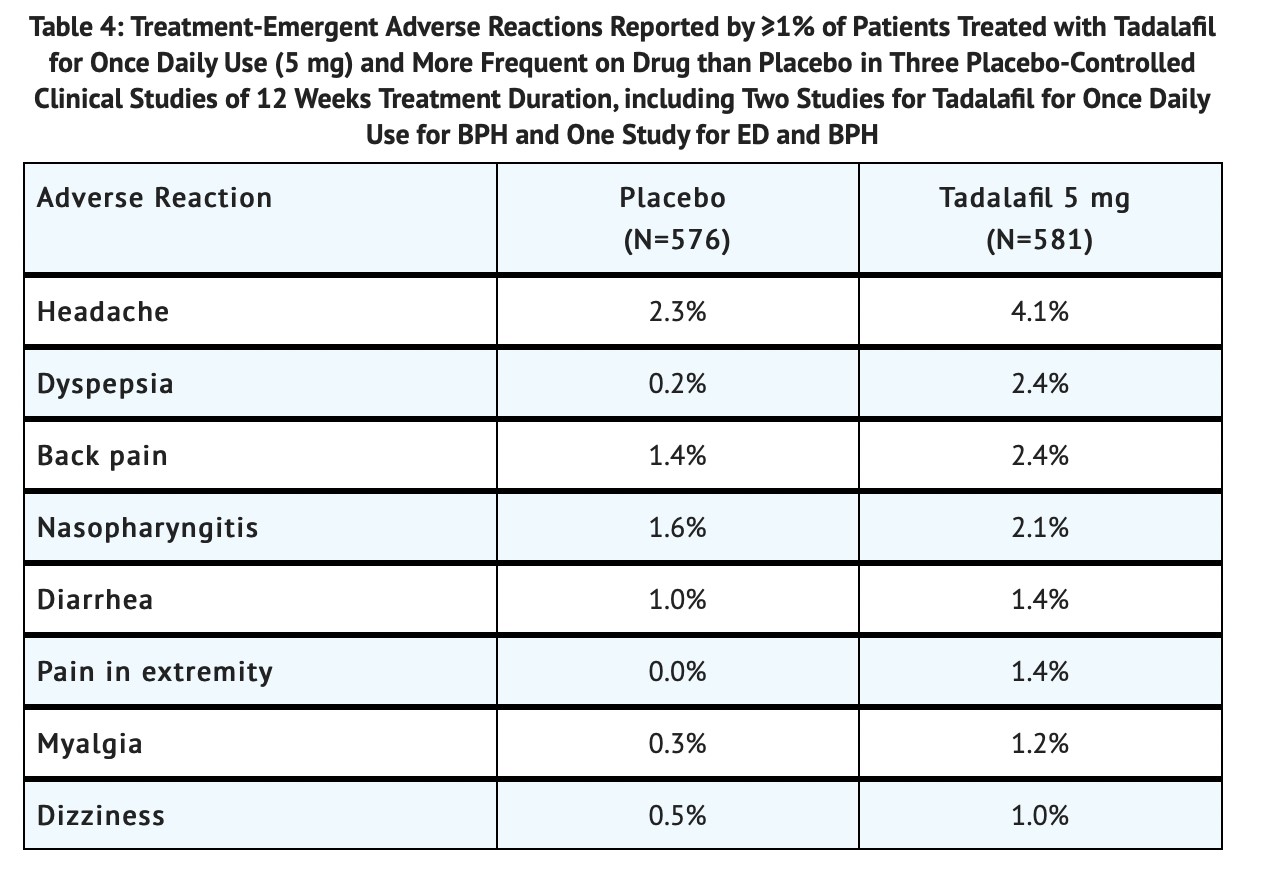
Table 4 (Table 4)

Table 4 (Table 4)
This is a table showing treatment-emergent adverse reactions reported by patients who were treated with Tadalafil for once daily use and experienced adverse reactions that were more frequent than those on placebo during three placebo-controlled clinical studies of 12 weeks treatment durations. Some of the commonly reported adverse reactions were headache, dyspepsia, back pain, nasopharyngitis, and diarrhea.*
FDA Label Image

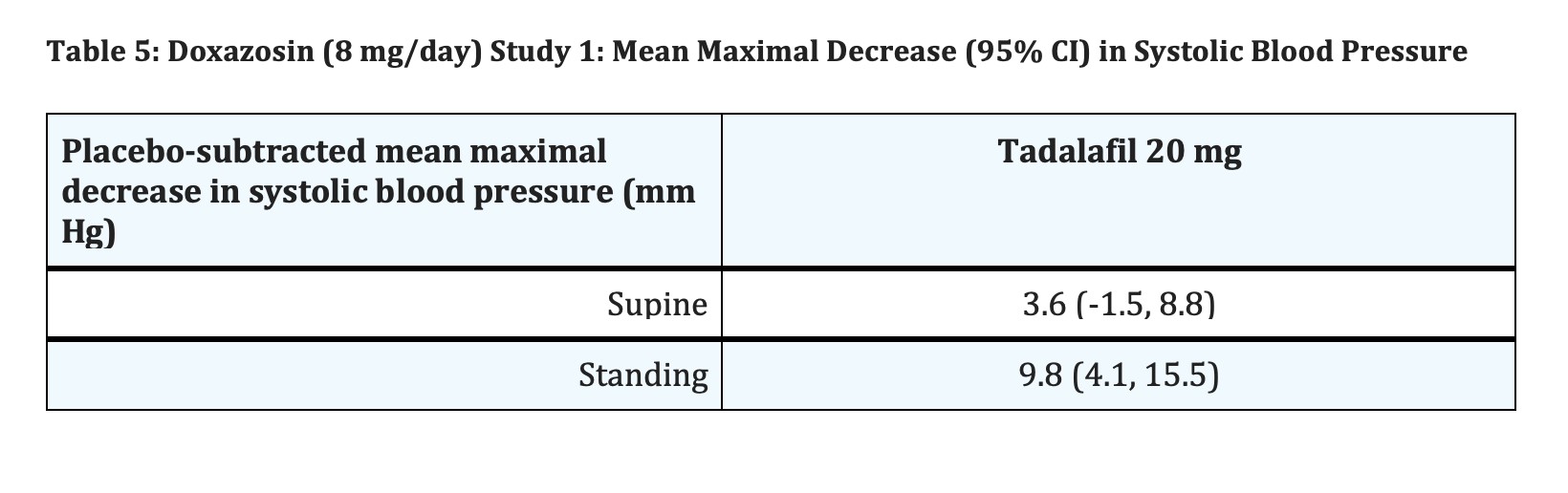
Table 5 (Table 5)

Table 5 (Table 5)
This is a table showing the results of a study on the effects of Doxazosin (8 mg/day) on systolic blood pressure. The table displays the mean maximal decrease in systolic blood pressure (in mm Hg) for two postures, supine and standing. The values are compared to a placebo-subtracted mean maximal decrease in systolic blood pressure for Tadalafil 20 mg.*
FDA Label Image

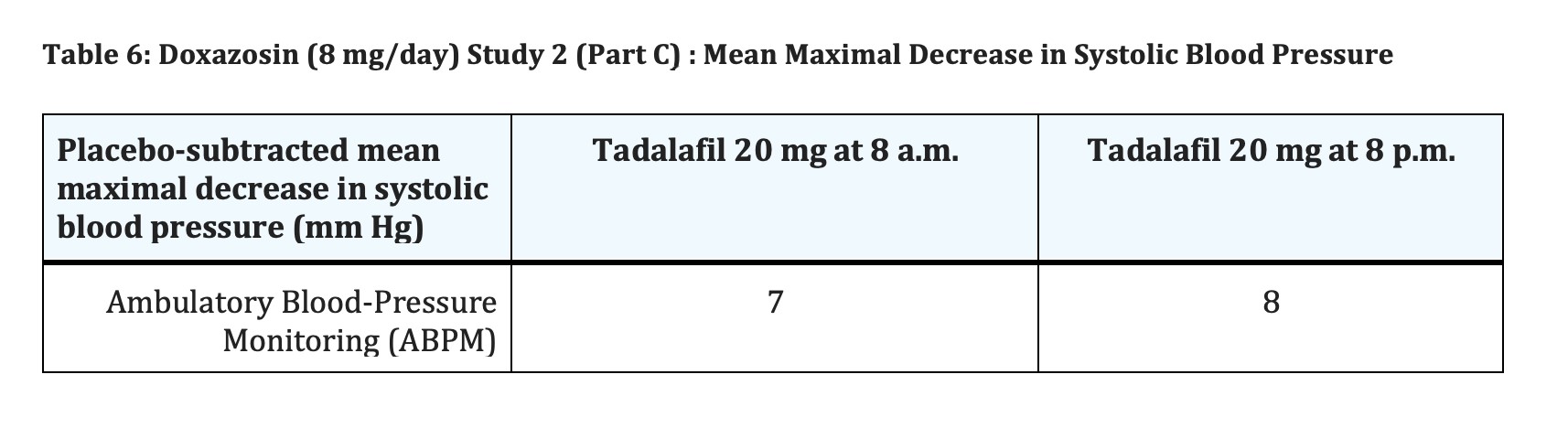
Table 6 (Table 6)

FDA Label Image

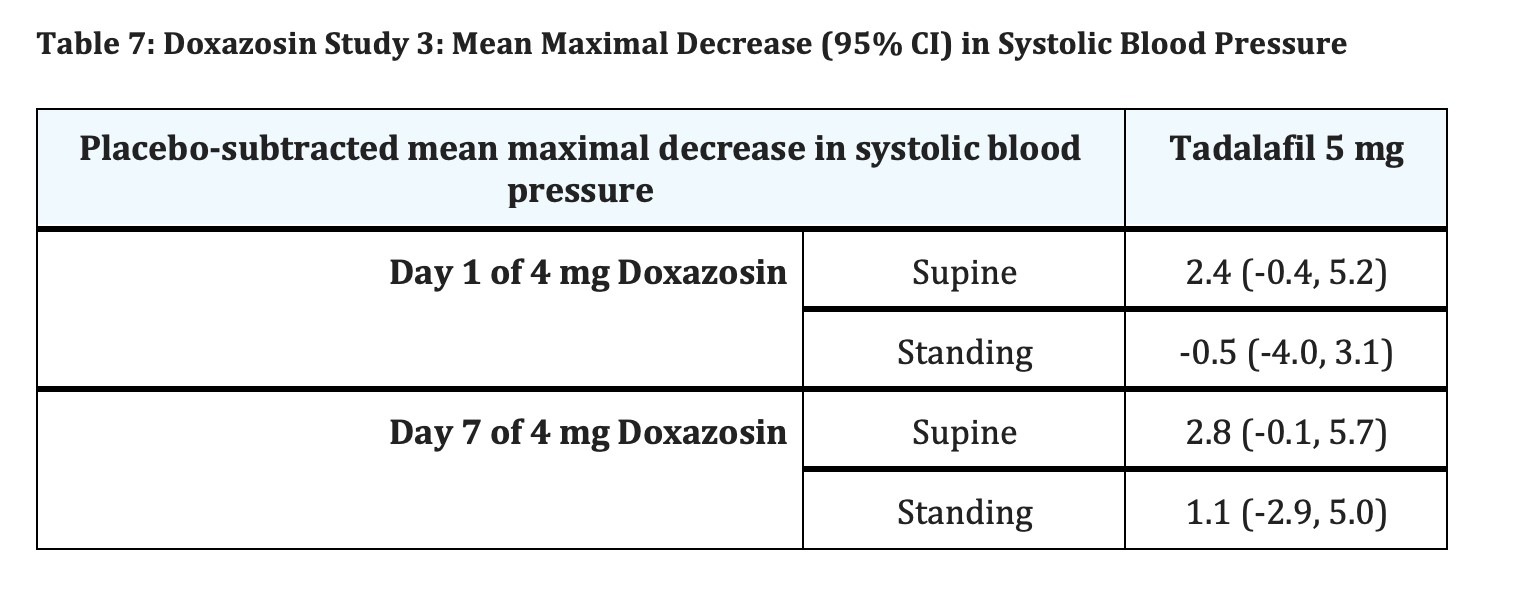
Table 7 (Table 7)

FDA Label Image

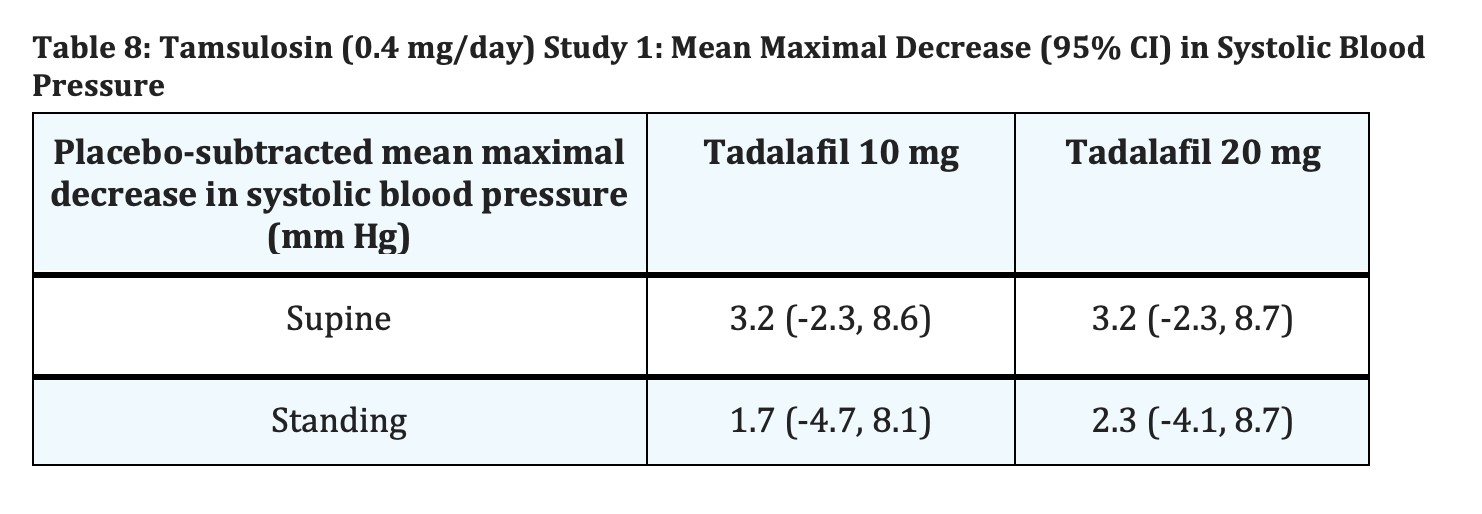
Table 8 (Table 8)

Table 8 (Table 8)
This is a table showing the results of a study on the effects of Tamsulosin (0.4 mg/day) on blood pressure. The table presents the mean maximal decrease in systolic blood pressure, in millimeters of mercury (mm Hg), for participants taking Tadalafil 10 mg, Tadalafil 20 mg, or a placebo. The results are provided for blood pressure measurements in supine and standing positions, along with the corresponding 95% confidence intervals (CI) for each treatment condition.*
FDA Label Image

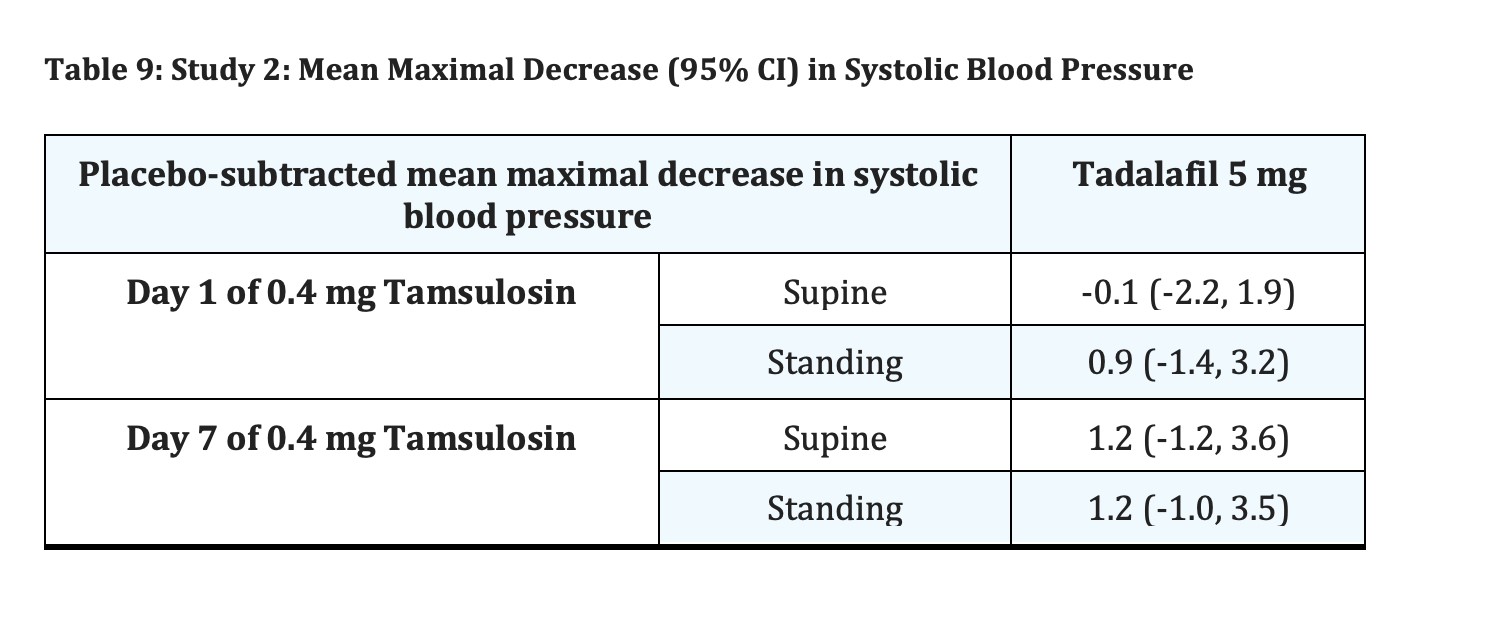
Table 9 (Table 9)

Table 9 (Table 9)
This is a table presenting data from Study 2 that shows the mean maximal decrease, along with 95% confidence intervals, in systolic blood pressure after taking Tadalafil 5mg, relative to a placebo. The table also shows the results based on whether the subject was in a supine or standing position, and whether it was on Day 1 or Day 7 of taking 0.4mg Tamsulosin.*
FDA Label Image

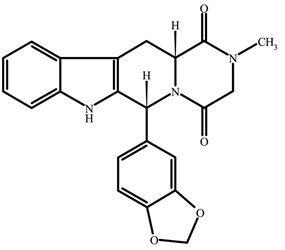
Chemical Structure (Tadalafil Structural Formula)

FDA Label Image

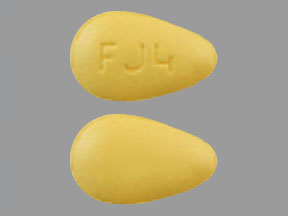
Dbd6b03b 1a8b 0fb7 E053 2a95a90ad0e0

* These product label images have been analyzed using experimental machine learning. Please verify findings with the primary label text.