Jardiance Tablet, Film Coated
Product Images NDC 71610-177

10 FDA label images from Aphena Pharma Solutions - Tennessee, Llc · Packaging, Regulatory Labels, and Product Appearance

Product Visual Gallery

This gallery contains 10 technical images submitted to the FDA as part of the official labeling for Jardiance (NDC 71610-177). Unlike standard consumer photos, these assets often include clinical data figures, molecular chemical structures, and official manufacturer packaging layouts.

As provided by Aphena Pharma Solutions - Tennessee, Llc, these visuals offer a comprehensive scientific overview of the product's physical and chemical identity, aiding pharmacists and researchers in product verification and study.

FDA Label Image

Bottle Label 25 mg (71610 0177 09)
Bottle Label 25 mg (71610 0177 09)
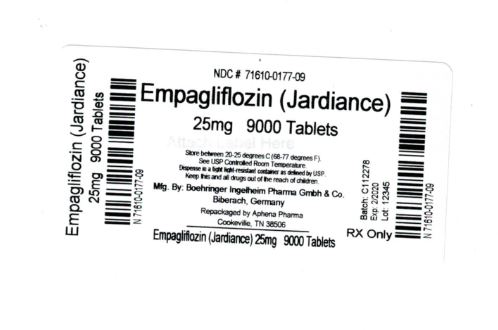
Label for Jardiance (Empagliflozin) 25 mg film-coated tablets, containing 9000 tablets. Manufactured by Boehringer Ingelheim Pharma GmbH & Co., Germany, and repackaged by Aphena Pharma Solutions - Tennessee, LLC in Knoxville, TN. The label includes storage instructions, lot number, expiration date, and states Rx only for oral use.*

FDA Label Image

Aphena Pharma Solutions (TN)

FDA Label Image

Empagliflozin Structure (Empagliflozin Structure)

Empagliflozin Structure (Empagliflozin Structure)
Chemical structure diagram of Empagliflozin, the active ingredient in Jardiance 25 mg oral film-coated tablets. The structure shows its molecular arrangement with labeled atoms and bonds.*
FDA Label Image

Figure-1 (Figure 1)

Figure-1 (Figure 1)
A chart showing geometric mean ratios with 90% confidence intervals for various antidiabetic and other drugs compared to empagliflozin alone. The horizontal axis represents change relative to empagliflozin alone, with data points plotted for AUC and Cmax for each drug listed, including metformin, glimepiride, pioglitazone, sitagliptin, linagliptin, and others.*
FDA Label Image

Figure-2 (Figure 2)

Figure-2 (Figure 2)
A forest plot showing geometric mean ratios with 90% confidence intervals for the effects of various drugs on the pharmacokinetics of a product, including antidiabetic drugs, oral contraceptives, and others. The plot compares AUC and Cmax values for drugs like Metformin, Glimepiride, Pioglitazone, and others, with a reference line at 100%.*
FDA Label Image

Figure 3 (Figure 3)

Figure 3 (Figure 3)
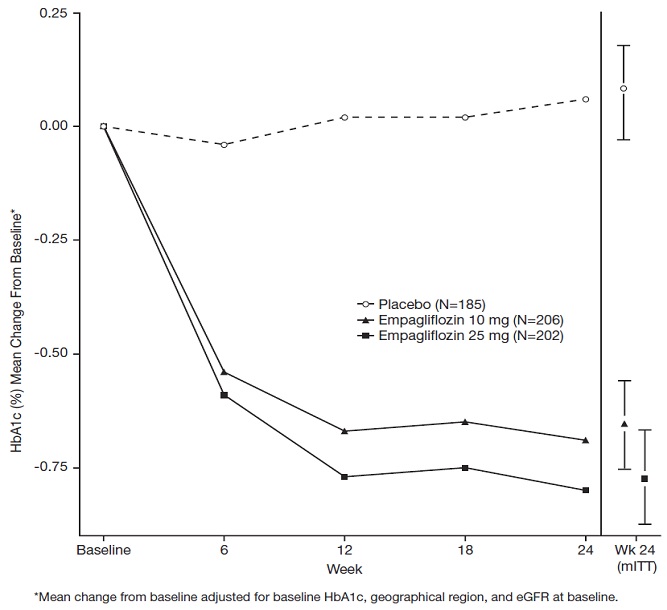
A line graph depicting mean percentage change from baseline HbA1c over 24 weeks, comparing Placebo (N=185), Empagliflozin 10 mg (N=206), and Empagliflozin 25 mg (N=202). The y-axis shows HbA1c (%) mean change, and the x-axis represents time in weeks. Empagliflozin groups show greater HbA1c reduction than placebo, with consistent trends over the study period.*
FDA Label Image

Figure 4 (Figure 4)

Figure 4 (Figure 4)
A line graph comparing mean change from baseline in HbA1c (%) over 52 weeks between two treatment groups: Glimepiride + Metformin (N=700) and Empagliflozin 25 mg + Metformin (N=693). The x-axis shows time in weeks, and the y-axis shows percent change from baseline HbA1c. Empagliflozin shows a steady reduction followed by a plateau, while Glimepiride shows a sharper initial drop then an increase after week 28, with error bars at week 52.*
FDA Label Image

Figure 5 (Jardiance Figure 5)

Figure 5 (Jardiance Figure 5)
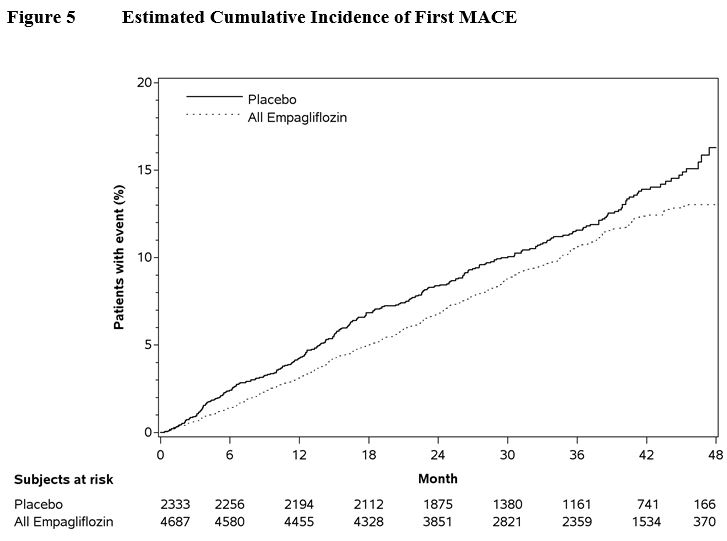
A line graph titled 'Estimated Cumulative Incidence of First MACE' comparing placebo and empagliflozin groups over 48 months. The y-axis shows percentage of patients with event ranging from 0 to 20%. Two lines represent placebo (solid) and empagliflozin (dotted) groups. Below the x-axis, a table lists numbers of subjects at risk for each group at several time points (0 to 48 months).*
FDA Label Image

Figure 6 (Jardiance Figure 6)

Figure 6 (Jardiance Figure 6)
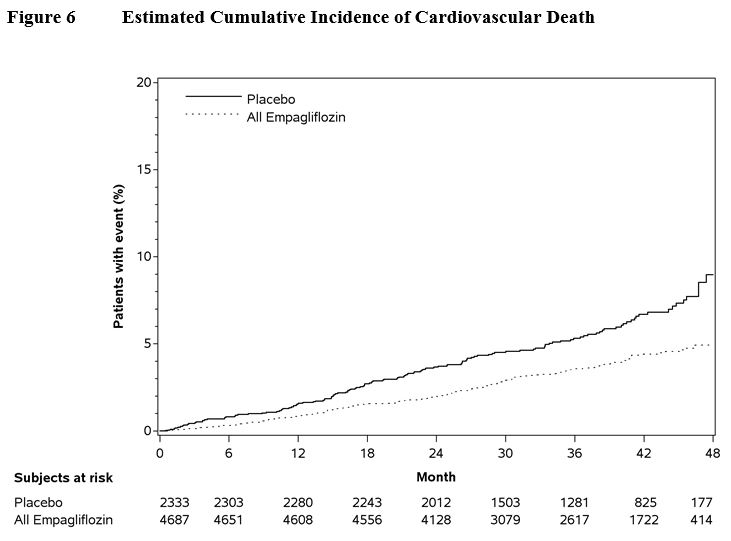
A line graph titled 'Estimated Cumulative Incidence of Cardiovascular Death' comparing placebo and empagliflozin treatment over 48 months. The y-axis shows the percentage of patients with the event, and the x-axis shows time in months. Two lines represent placebo (solid) and empagliflozin (dotted), with placebo showing a higher cumulative incidence. Below the graph, a table lists subjects at risk for each group over time.*
FDA Label Image

Qr-code (Qr Code)

* About these descriptions: Image descriptions on this page are generated by automated AI analysis of the product label images from the manufacturer's FDA label submission (SPL). They are provided for reference only and may contain errors or omissions. Always rely on the printed label itself and the official FDA labeling, and consult a pharmacist or healthcare professional with any questions about this product.