Losartan Potassium Tablet, Film Coated
Product Images NDC 71610-224

7 FDA label images from Aphena Pharma Solutions - Tennessee, Llc · Packaging, Regulatory Labels, and Product Appearance

Product Visual Gallery

This gallery contains 7 technical images submitted to the FDA as part of the official labeling for Losartan Potassium (NDC 71610-224). Unlike standard consumer photos, these assets often include clinical data figures, molecular chemical structures, and official manufacturer packaging layouts.

As provided by Aphena Pharma Solutions - Tennessee, Llc, these visuals offer a comprehensive scientific overview of the product's physical and chemical identity, aiding pharmacists and researchers in product verification and study.

FDA Label Image

Bottle Label 25 mg (71610 0224 30)

Bottle Label 25 mg (71610 0224 30)
Losartan Potassium 25 mg film-coated tablets packaging label from Aphena Pharma Solutions - Tennessee, LLC. The label indicates the product contains 30 tablets, requires storage between 20-25°C, and is to be dispensed in a tight, light-resistant container. Manufactured by Zhejiang Huahai Pharmaceuticals Co., Ltd., China, and packaged by Aphena Pharma Solutions in Cookeville, TN. The label includes the NDC 71610-0224-30, lot number, and expiration date information.*

FDA Label Image

Aphena Pharma Solutions (TN)

FDA Label Image

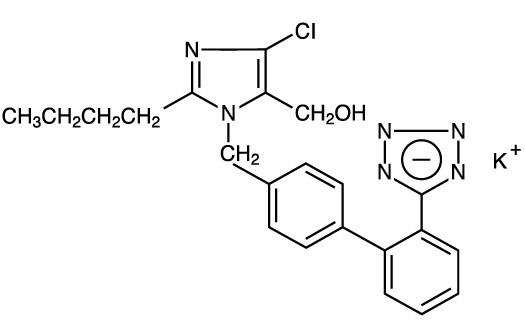
Chemical Structure (Spl Image1 Structure1)

Chemical Structure (Spl Image1 Structure1)
Chemical structure of Losartan Potassium, showing the arrangement of its atoms including rings with nitrogen, chlorine, and potassium ion components, consistent with its pharmacological identity.*
FDA Label Image

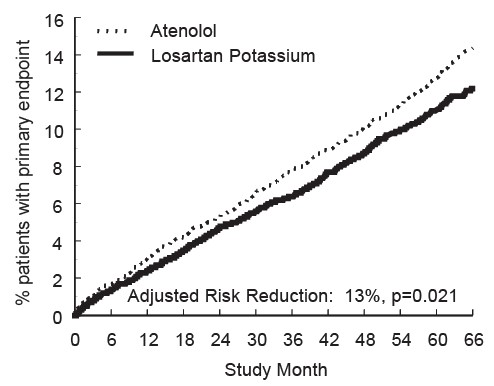
Figure 1 (Spl Image2 Figure1)

Figure 1 (Spl Image2 Figure1)
A line graph comparing the percentage of patients with primary endpoints over a study period of 66 months for Losartan Potassium versus Atenolol. The graph shows a lower percentage of patients reaching the primary endpoint with Losartan Potassium compared to Atenolol, indicating a 13% adjusted risk reduction (p=0.021). The x-axis represents study months, and the y-axis represents the percentage of patients with the primary endpoint.*
FDA Label Image

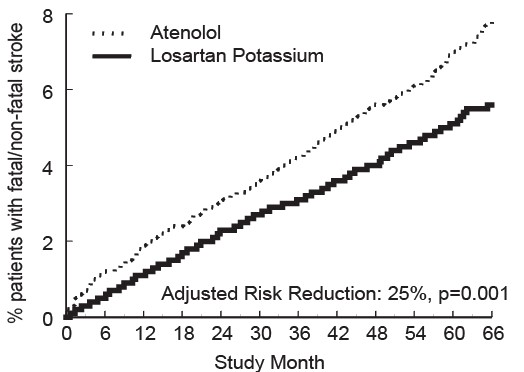
Figure 2 (Spl Image3 Figure2)

Figure 2 (Spl Image3 Figure2)
A line graph comparing the percentage of patients with fatal or non-fatal stroke over study months for Atenolol (dotted line) and Losartan Potassium (solid line). The x-axis represents study months up to 66, and the y-axis represents the percentage of patients with stroke up to 8%. The graph indicates an adjusted risk reduction of 25% with Losartan Potassium, p=0.001.*
FDA Label Image

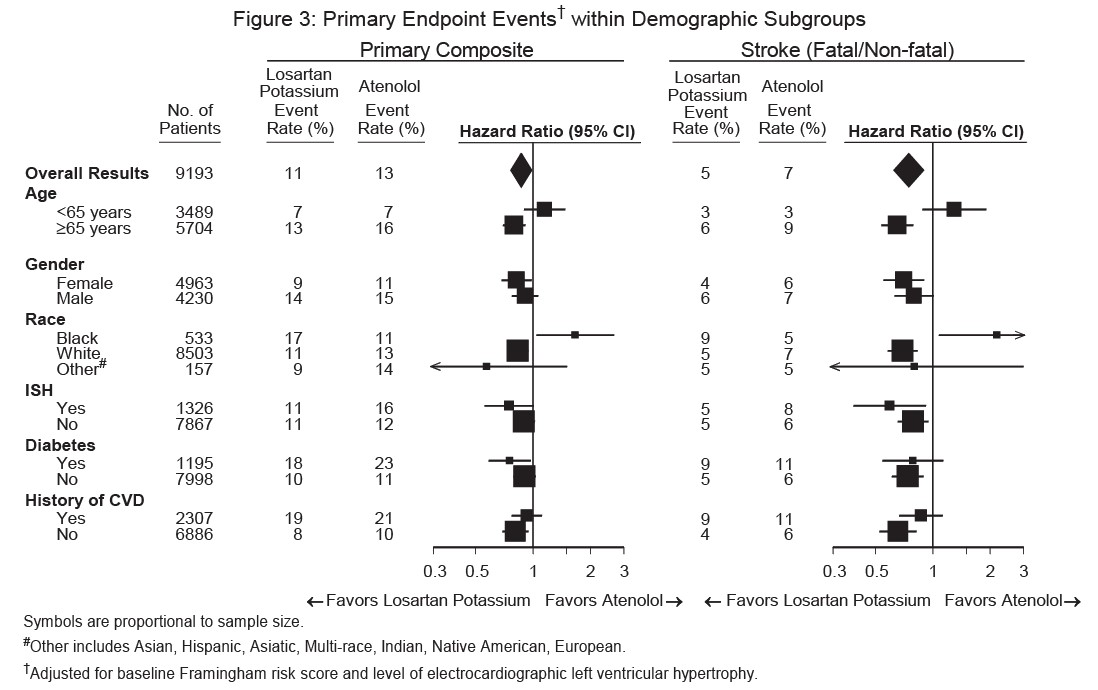
Figure 3 (Spl Image4 Figure3)

Figure 3 (Spl Image4 Figure3)
A forest plot figure titled 'Primary Endpoint Events within Demographic Subgroups' comparing event rates and hazard ratios between Losartan Potassium and Atenolol in different patient subgroups for primary composite endpoints and stroke (fatal/non-fatal). The plot shows event rates (%) across categories such as age, gender, race, ISH, diabetes, and history of CVD, with hazard ratios and 95% confidence intervals depicted by symbols proportional to sample size.*
FDA Label Image

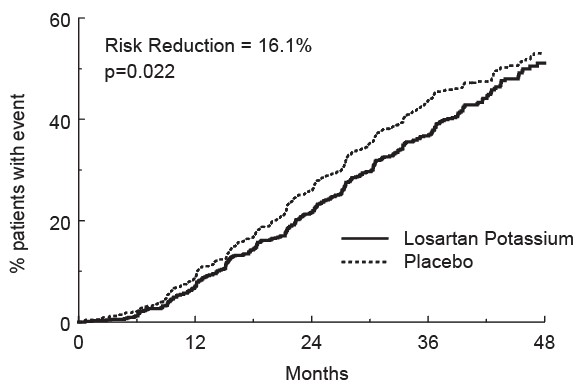
Figure 4 (Spl Image5 Figure4)

Figure 4 (Spl Image5 Figure4)
A line graph comparing the percentage of patients with events over 48 months between Losartan Potassium and Placebo groups. The x-axis represents months, the y-axis shows the percentage of patients with events. Losartan Potassium is shown with a solid line, and Placebo with a dotted line, indicating a risk reduction of 16.1% with Losartan Potassium, with a p-value of 0.022.*

* About these descriptions: Image descriptions on this page are generated by automated AI analysis of the product label images from the manufacturer's FDA label submission (SPL). They are provided for reference only and may contain errors or omissions. Always rely on the printed label itself and the official FDA labeling, and consult a pharmacist or healthcare professional with any questions about this product.