Eliquis Tablet, Film Coated
Product Images NDC 71610-662

View Photos of Packaging, Regulatory Labels, and Product Appearance

Product Visual Gallery

This gallery contains 8 technical images submitted to the FDA as part of the official labeling for Eliquis (NDC 71610-662). Unlike standard consumer photos, these assets often include clinical data figures, molecular chemical structures, and official manufacturer packaging layouts.

As provided by Aphena Pharma Solutions - Tennessee, Llc, these visuals offer a comprehensive scientific overview of the product's physical and chemical identity, aiding pharmacists and researchers in product verification and study.

FDA Label Image

Bottle Label 5 mg (71610 0662 09)

Bottle Label 5 mg (71610 0662 09)
Label for ELIQUIS (apixaban) 5 mg film-coated tablets, containing 9000 tablets. The label includes the NDC 71610-0662-09 and storage instructions for 20-25 degrees Celsius in a tight, light-resistant container. The product is labeled by Aphena Pharma Solutions - Tennessee, LLC, Fremont, Nebraska, and is for prescription use only.*
FDA Label Image

Aphena Pharma Solutions (TN)

FDA Label Image

Apixaban Chemical Structure (Apixaban Struct)

Apixaban Chemical Structure (Apixaban Struct)
Chemical structure diagram of apixaban, the active ingredient in ELIQUIS 5 mg film-coated tablets. The structure depicts the molecular composition with specific rings and bonds characteristic of apixaban.*
FDA Label Image

Aristotle Forest Plot (Eliquis Clin Forest Fig5)

Aristotle Forest Plot (Eliquis Clin Forest Fig5)
A forest plot chart comparing the hazard ratios of apixaban versus warfarin across various patient subgroups, including age, sex, weight, prior stroke, diabetes, CHADS2 score, creatinine clearance, geographic region, and aspirin use. The chart displays event counts, patient numbers, and percentage per year for each drug and subgroup, with hazard ratio points and confidence intervals to assess relative effectiveness.*
FDA Label Image

Aristotle Major Bleeding Forest Plot (Eliquis Forest Fig1)

Aristotle Major Bleeding Forest Plot (Eliquis Forest Fig1)
A forest plot comparing hazard ratios with 95% confidence intervals for apixaban versus warfarin across various patient subgroups. It includes data on events and patients per year, subgroup categories such as prior warfarin status, age, sex, weight, stroke history, diabetes, CHADS2 score, creatinine clearance, geographic region, and aspirin use. The plot visually indicates apixaban's relative safety or efficacy compared to warfarin, with markers centered mostly left of the line for equivalence, favoring apixaban.*
FDA Label Image

Aristotle Kaplan-meier Curve (Eliquis Km Fig4)

Aristotle Kaplan-meier Curve (Eliquis Km Fig4)
A line graph comparing the proportion of subjects experiencing stroke or systemic embolism over a 36-month period for ELIQUIS (apixaban) versus Warfarin. The graph includes the number of subjects at risk at various time points and shows a p-value of 0.0114 with a hazard ratio of 0.79 (95% CI, 0.66 to 0.95).*
FDA Label Image

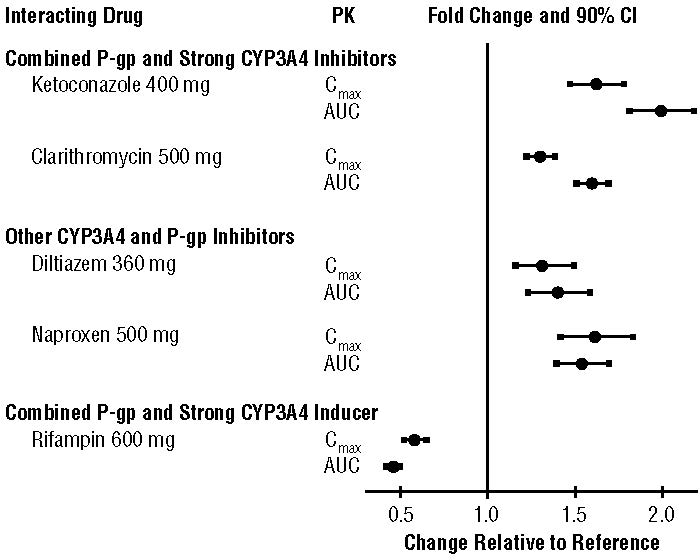
Effect Of Coadministered Drugs On Pharmacokinetics Of Apixaban (Eliquis Pkplot Drugs Fig2)

Effect Of Coadministered Drugs On Pharmacokinetics Of Apixaban (Eliquis Pkplot Drugs Fig2)
A pharmacokinetic fold-change chart showing the effect of various interacting drugs on ELIQUIS (apixaban). It compares Cmax and AUC values, plotting fold change relative to reference for combined P-gp and strong CYP3A4 inhibitors (ketoconazole, clarithromycin), other CYP3A4 and P-gp inhibitors (diltiazem, naproxen), and combined P-gp and strong CYP3A4 inducer (rifampin). Error bars represent 90% confidence intervals.*
FDA Label Image

O:\e-submissions\pbo\products\eliquis 202155\08. Pas Esrd Dosing\01. Orig Submission\source\eliquis-pkplot-pop-fig3.jpg (Eliquis Pkplot Pop Fig3)

O:\e-submissions\pbo\products\eliquis 202155\08. Pas Esrd Dosing\01. Orig Submission\source\eliquis-pkplot-pop-fig3.jpg (Eliquis Pkplot Pop Fig3)
A pharmacokinetic chart showing fold change and 90% confidence intervals for apixaban (ELIQUIS) in various populations relative to reference. It compares Cmax and AUC in groups with different renal impairments, age ranges, body weights, and hepatic impairment. Recommendations for dose adjustment are noted, mostly indicating no dose adjustment needed except for moderate hepatic impairment where dosing recommendation is not provided.*

* About these descriptions: Image descriptions on this page are generated by automated AI analysis of the product label images from the manufacturer's FDA label submission (SPL). They are provided for reference only and may contain errors or omissions. Always rely on the printed label itself and the official FDA labeling, and consult a pharmacist or healthcare professional with any questions about this product.